Showing posts with label COHA. Show all posts

September 26, 2016

Political Report # 1186 Death of Democracy: Brazilian President Impeached by Majority of Senate Votes


Political Report # 1186


Death of Democracy: Brazilian President Impeached by Majority of Senate Votes


By Hector Perla Jr., Senior Research Fellow at the Council on Hemispheric Affairs and Laura Sholtz & Liliana Muscarella, Research Associates at the Council on Hemispheric Affairs


In a historic vote on August 31, Brazil’s democratically elected President Dilma Rousseff was formally ousted by the Brazilian Senate, surpassing the required two-thirds majority with 61 votes in favor and 20 votes against.[i] The controversial impeachment formalizes the provisional government of former Vice President Michel Temer and his Partido do Movimento Democrático Brasileiro (Brazilian Democratic Movement Party, PMDB), bringing an end to 13 years of governance by Rousseff’s own Partido dos Trabalhadores (Worker’s Party, PT). This decision not only signifies a drastic change in Brazil’s government, but it also has major implications for the country’s near-term future. Allegations of corruption continue to hang over Temer’s interim administration, including leaked audio recordings that suggest that Rousseff’s ouster was politically manipulated to halt the charges against congressmen from Temer’s cabinet and party.[ii] Rousseff’s impeachment is a devastating blow to Brazil’s democracy, constituting a “soft coup”-an undemocratic process of regime change tainted by political malfeasance, selective justice, and a non-electoral transfer of power cloaked in the guise of the rule of law.
What Now?
Interim President Temer and former speaker of the House of Representatives Eduardo Cunha are recognized as the primary instigators of Rousseff’s suspension in May of this year.[iii] While the two have been accused of various acts of fiscal and electoral corruption, the spotlight has been focused primarily on Rousseff’s alleged fiscal mismanagement. Following Rousseff’s impeachment, Temer was sworn in as Brazil’s president and, barring a Supreme Court intervention, receives immunity from further investigation of any crimes that took place before he assumed the presidency.[iv]
Temer will likely remain in office until the end of 2018. The next presidential elections are scheduled for October 2018 and a new president would take office January 1, 2019. However, with growing discontent from actors along the entire political spectrum, including senators and constituents from Temer’s own PMDB, there has been a good deal of speculation that his presidency may not endure.[v] Another impeachment, while a remote possibility, is not unthinkable, especially given the lack of support within Temer’s own party and the potential that new allegations of corruption may be brought against him. At that point, the Supreme Court could choose to suspend Temer’s presidential immunity and allow for the initiation of impeachment proceedings against him.[vi]
If Temer were to suffer impeachment before the end of 2016, the Brazilian Constitution requires that new national elections be called within 90 days. Otherwise, if he were to be removed after January 1, 2017, indirect elections within the Brazilian Congress would decide which current senator would assume the position.[vii] Considering recent strategies by the PMDB, such technicalities could easily be exploited by the Temer administration, further highlighting the murky nature of recent events and calling into question the legitimacy of Brazilian democracy.
Implications for Democracy in Brazil
Rousseff’s ouster sets a negative precedent for the country in two ways. On the one hand, it institutionalizes the political abuse of power by politicians seeking to avoid corruption charges. On the other, it shamefully obscures the underlying motive for removing the PT from office: a desire to return to conservative rule and neoliberalism. Both of these strategies subvert the democracy that Brazil has worked hard to uphold.
First, the installation of a new administration with weak democratic standards does not bode well for Brazil, especially given the corruption that has traditionally pervaded its government. The PMDB saw an opportunity to evade charges against its leaders while simultaneously gaining the presidency-an accomplishment that has eluded them at the voting booth for more than 20 years. All they had to do was turn on Rousseff, their electoral coalition partner. Thus, PMDB’s leaders led the impeachment of the president, even though an independent federal prosecutor found that she had not violated any fiscal laws.[viii] This practice, known as pedaladas fiscais, or “accounting tricks,” has been recently employed by more than a dozen state governors without legal repercussions.[ix] Meanwhile, Temer has been convicted of electoral fraud and accused of other acts of corruption, but by assuming the presidency he evades existing investigations, such as Operação Lava Jato, that would have proven his guilt or his innocence.  Such hypocrisy and double standards seriously impugn the legitimacy of the impeachment process and the entire democratic institution.
Temer’s interim government almost immediately implemented a far more conservative agenda than the Rousseff Administration with neoliberal ideals that seemed to have been waiting in the wings for an opportunity to be reinstated. Among his first actions was the naming of an all-white, male cabinet, several of whom were under investigation for corruption at the time of their appointment. Additionally, as a cost-cutting measure, Temer eliminated the ministries of culture, agrarian development, science and technology, women, racial equality, and human rights (although some were since reinstated due to popular pressure).[x] Furthermore, the interim administration wasted no time in rolling back the hallmark of the PT’s government: social programs and policies that Rousseff had fought hard to continue.[xi] Temer immediately slashed funding for programs that benefit the rural and urban poor, women, afro-descendants, the LGBTQ community, and indigenous people.[xii] These changes augur how Temer will govern now that he has been sworn into office. His radical departure from the policies of the platform under which he was elected as Rousseff’s vice president lends further credence to the claim that her ouster is the result of a political witch-hunt rather than a legitimate impeachment process for a criminal offense as required by the Constitution.
It is undoubtable that the non-electoral and undemocratic ouster of Brazil’s first female president constitutes a perilous democratic regression for South America’s largest nation. In fact, the process constitutes a “soft coup” against the Rousseff presidency and a political attack against the PT.[xiii] Conservative parties came together to secure what they had been unable to achieve through popular elections: a presidential victory over the PT. By circumventing the electoral process, the impeachment strikes a huge blow to the country’s democracy, especially given the advances it has made since the impunity typical of the military government (1964-1985).[xiv]
The Future of Brazil and Beyond
The PT is not going to accept Dilma’s ouster without a fight. On its Twitter page Wednesday afternoon, it posted a letter from the Frente Brasil Popular (People’s Brazilian Front), which is a coalition of trade unions, progressive and social movement organizations, and political parties. In the letter, the Front promised that, “Our struggle against the coup government and its program of rolling back our achievements will be relentless.”[xv] Protests against the proceedings, which have been ongoing since the impeachment process began, have been increasing and are also likely to intensify in the coming days.[xvi]
The ramifications of Rousseff’s impeachment are not limited to Brazil. The reverberations throughout the Western Hemisphere, where progressive governments are on the defensive against similar right-wing attacks, began immediately when Bolivia, Ecuador, and Venezuela recalled their ambassadors from Brasília. Progressive governments of the region see Brazil as the latest example of the epidemic of “soft coups” that have brought down Pink Tide governments that came to power through democratic elections. Increasingly, right-wing forces opposed to progressive governments and discontent with their social and economic programs-but unable to defeat them in popular elections-have turned to judicial and institutional processes to roll back the left’s hold on executive office.[xvii]
Despite the rhetorical anti-corruption façade that characterized the impeachment proceedings, President Rousseff’s ouster was actually a careful orchestration designed to exploit recent public discontent with her administration’s handling of the economy. Temer is nearly as unpopular as was Rousseff, yet he and the PMDB were able to channel common grievances and direct them against President Rousseff in order to capitalize on them politically. Moving forward, Brazil is in the hands of a Trojan Horse government-one that has presented itself as one of the few hopes for democracy while subverting the very institutions that the term represents. The Council on Hemispheric Affairs (COHA) stands with Rousseff and echoes the statement she made while on trial: “Today, I only fear the death of democracy.”[xviii]


Original article and sources can be found at:
http://www.coha.org/death-of-democracy-brazilian-president-impeached-by-majority-of-senate-votes/

September 16, 2016

Political Report # 1183 Guilty by Association: How Washington is Complicit in Human Rights Abuses in Honduras


Crowd. Taken from Flickr.


Political Report # 1183


Guilty by Association: How Washington is Complicit in Human Rights Abuses in Honduras


By Jessica Farber, Research Associate at the COHA


In an opinion piece that appeared in the New York Times on August 11, titled "How the Most Dangerous Place on Earth got Safer," Sonia Nazario paints a misguided picture of Honduras as a country that was once ravaged with violence, but has since been bravely rescued and is now stable thanks to aid from the United States.[i] On the one hand, the author highlights an important point: some violence-prevention programs funded by the United States in Honduras are indeed working, and their focus on human capital and social justice is a welcome departure from the "iron-fisted" security measures that have characterized U.S. aid in the past. What the author neglects to mention, however, is that an enormous portion of the same aid package is also funneled to a government that, in conjunction with a corrupt military and police force, is carrying out massive human rights violations against its citizens. Given the increasing number of activists killed with impunity under the rightwing government, whose power the United States helped to consolidate following the 2009 coup against democratically elected President Manuel Zelaya, continued funding to Honduras deserves additional scrutiny.
A Contradictory Approach
As Nazario rightfully acknowledges, the withdrawal of all funding to Honduras could be harmful because it would interrupt successful violence-prevention initiatives at the local level. The pilot programs she describes, in which the U.S. Agency for International Development (U.S.A.I.D.) partners with community leaders to implement programs that engage and counsel gang members and other vulnerable youth, are both novel and exemplary. With such programs, the United States finally seems to acknowledge that simply intensifying security measures to kill off gang members does nothing but fuel the fire. Nazario admirably emphasizes the need to address the long-term structural factors behind gang violence and advocates for the implementation of more of these types of programs throughout Central America. Furthermore, in "a striking rebuke against the rising isolationists in American politics," Nazario highlights the positive impact that U.S. spending can have for both Americans -in terms of stemming the flow of migrants- as well as for marginalized populations in the developing world.[ii] The Council on Hemispheric Affairs (COHA), a longtime proponent of grassroots and social justice programs, applauds Nazario for her intentions in this respect.[iii]
While Nazario is not wrong to shed light on the specific U.S. initiatives that are succeeding in violence prevention, it is far too soon to claim that the United States has single-handedly created a dramatically safer Honduras. On the contrary, such a position ignores the complex roots of the violence in Honduras, and leads one to question whether the author is not trying to obfuscate U.S. complicity in the violence. As Nazario mentions in her article, crime and violence are major issues plaguing Honduran society, but she erroneously attributes most of this violence to gangs, narco-trafficking and other forms of organized crime that the Honduran government needs help in dealing with. To genuinely contribute to the overall sustainable development of Honduras, it is essential for the United States to acknowledge that much of the gang and drug-related violence, as well as the scores of uninvestigated murders of activists, are politically motivated and are carried out at the urging of elements of the military and the police. The article effectively distracts readers from the government's abysmal human rights record and its own role in perpetuating violence in a country where 98 percent of crimes go unsolved.[iv] Amnesty International's Marselha Gonçalves Margerin recently told National Public Radio that "the U.S. government has been treating these [Central American] governments as victims of organized crimes and not really making them responsible for how they are treating, and failing to protect, their citizens."[v]
Berta Cáceres: A Symbol of Impunity
This year, the collusion between private actors, the military and the government in Honduras, was placed in the international spotlight. The assassination of indigenous activist Berta Cáceres six months ago is just the tip of the iceberg in terms of human rights violations in Honduras over the past seven years. Her death, however, is the "smoking gun" that makes it impossible for the United States to turn a blind eye to the Honduran government's complicity in human rights violations against opposition activists.
Just before midnight on March 2 of this year, 44-year-old Berta Cáceres, founder of the Civic Council of Popular and Indigenous Hondurans (COPINH), was gunned down in her home. In the months leading up to her death, Berta had been carrying out a peaceful yet vocal campaign to prevent the construction of the Agua Zarca dam on a sacred river belonging to the indigenous Lenca population. While the government was entirely aware of the threats to Berta's life, and was repeatedly urged by the Inter-American Commission on Human Rights (IACHR) to offer her protection, any protection given was clearly inadequate. Given Berta's stature as the winner of the international 2015 Goldman Environmental Prize, and an inspiring leader of a global movement to preserve indigenous rights, her death triggered fear among activists all over Honduras.
The response of the Honduran government to Cáceres' death was wholly inadequate and emblematic of the way it deals with human rights violations against opposition leaders. Instead of immediately interviewing individuals from any of the 33 construction companies against whom she had lodged complaints of death threats, the government selectively interrogated individuals within Berta's own COPINH organization. It was not until May 2, exactly two months after Berta's assassination, that the government finally launched a so-called "comprehensive" investigation to find the culprits.[vi]
This state-led "Jaguar Operation," initiated in large part due to growing international scrutiny over the government's inaction, finally resulted in the arrests of five individuals. Unsurprisingly, two of the charged individuals were linked to the construction company behind the dam, Desarollos Energéticos S.A. (DESA), two others were active members of the military and one was a retired military officer. Yet evidence increasingly indicates that the assassins were not alone in plotting the attack, and that they received their orders from the state.[vii] In a previous article, COHA referred to the Jaguar Operation as a "sham investigation" that "was designed not to serve justice," but was rather a "strategy to protect the masterminds behind Berta Cáceres' murder."[viii]
What the inherently biased investigation did reveal, however, is "the blatant collusion between private interests linked to DESA, active members of the Honduran army, and a corrupt administration," according to COHA Research Associate, Emma Tyrou.[ix] A June report in The Guardian exposed further proof of the state's ties to the murder. The article disclosed testimony from a former Honduran military sergeant Rodrigo Cruz, suggesting that Berta's name had appeared on a military "hit-list." "I'm 100% certain that Berta Cáceres was killed by the army," he told the newspaper.[x] The government's reluctance to interview the sole eyewitness to the murder-Mexican activist Gustavo Soto who was also a victim of the attack-as well as its initial attribution of the crime to little more than a failed attempt at burglary, further suggests the government's likely role in scuttling the investigation.[xi]
In the six months since Berta's death, the administration of President Juan Orlando Hernandez has continuously neglected the pleas of her family and the international community to allow an independent investigation to take place. Since the IAHCR derives its mandate from the Organization of the American States, and is therefore a competent authority in Honduras, it is the only body that can create a commission of independent experts to carry out an impartial investigation.[xii] "The Honduran state is too closely linked to the murder of my mother to carry out an independent investigation," Berta's youngest daughter, Laura Cáceres, 23, told the Guardian in May. [xiii] "It is the government who awarded the dam commission and the government who sent military and police to work with DESA's private security guards, who threatened my mother."[xiv] To date, the Honduran state has refused to allow experts from the IACHR into the country, further suggesting it has something to hide.[xv]
As the closest ally of the right-wing Honduran government and the country's largest bilateral donor, the United States is uniquely positioned to pressure President Hernandez to do something about the appalling state of human rights in Honduras. At the very least, such pressure could seek to persuade him to allow an independent investigation of the Cáceres murder to take place.
The Honduran government's murky role in the case of Berta Cáceres illustrates the controversial nature of U.S. aid to the country. Berta's assassination is not an isolated incident and the United States cannot view it as such-she remains a symbol of the hundreds of Honduran activists targeted and killed by government, military, and police forces. Just days after Berta's death, environmental activist, Nelson García was killed, and in July Lesbia Yaneth Garcia, another COPINH employee, was found dead with a machete wound in her skull. At least one member of the military and one man working on the hydroelectric project she was protesting have been implicated in Yaneth García's death.[xvi] Global Witness recently reported that Honduras is the second most deadly country in which to be an environmental activist, and the Spanish newspaper, El País, described the nation as "a field of death for environmentalists."[xvii] So while the overall number of homicides in the country may have decreased over the past few years, as Nazario notes in her article, the number of activists killed has markedly increased. Since 2010, 114 environmentalists have been murdered in Honduras.[xviii] And environmental defenders are not alone; anyone who publicly voices opposition to the state faces similar danger. According to the National Human Rights Commissioner of Honduras (CONADEH), 43 journalists were murdered between 2010 and 2014, and only twelve of the alleged murders had been brought to trial by the end of that year.[xix] The IACHR received reports of the murders of 86 legal practitioners and 22 human rights defenders in the same period.[xx] The Human Rights Watch World Report 2016 also found that peasants' rights activists as well as LGBTQ activists have been victims of hundreds of uninvestigated attacks.[xxi] Essentially, it is no longer possible to express dissatisfaction with the government without becoming a target of the state.
 Towards a "More Safe" Honduras
The uptick in activist murders can be traced back to the period directly following the 2009 coup d'état against President Manuel Zelaya. Zelaya had supported rural peasant and environmental movements, such as Berta's, in their fight against land dispossession and mining. However, after 2009, the new administration led by President Porfirio Lobo cut subsidies for social programs, rolled back progressive land reforms, and sought to open infrastructure construction to foreign investors, declaring in 2011 that Honduras was "open for business." [xxii] Encouraged by the United States, the successive rightwing governments have proceeded to grant mining concessions and dam-building contracts to foreign companies, displacing many indigenous communities in the process.[xxiii] This has made peasants' rights groups and indigenous activists -who argue that the affected communities were not properly consulted by the foreign firms-political opponents of the government.[xxiv] As Greg Grandin reported in The Nation, "since Zelaya's ouster, there's been an all-out assault on these decent people-torture, murder, militarization of the countryside, repressive laws, such as the absolute banning of the morning-after pill, the rise of paramilitary security forces, and the wholesale deliverance of the country's land and resources to transnational pillagers."[xxv]
While the existing evidence is not sufficient to prove the United States' involvement in plotting the coup, it is now clear that the State Department under Hillary Clinton was a key player in legitimizing the post-coup government and effectively prevented Zelaya from running for re-election. Though the Obama administration initially criticized the military coup that put Roberto Michelletti in the presidency and other leaders of the coup in his cabinet, the United States was the first to recognize the new Porfirio Lobo government that was put in place by elections months later.[xxvi] This recognition was granted despite the fact that all opposition candidates had boycotted the elections and all international observers (besides the U.S. Republican party) withdrew, refusing to recognize the elections' legitimacy.[xxvii] While the U.N. General Assembly called for the "immediate and unconditional return of Zelaya," and the Union of South American Nations (UNASUR) refused to recognize the outcome of the elections, the U.S. State Department blocked the Organization of American States' (OAS) resolution to not recognize elections held under the de facto government.[xxviii] Instead the United States praised Lobo for "restoring democracy" and promoting "national reconciliation."[xxix]
Perhaps unsurprisingly, Washington continues to stand idly by as the rule of law in Honduras deteriorates. While former Secretary of State and current presidential candidate Hillary Clinton continues to deflect criticism of her involvement in the 2009 coup and her running mate, Tim Kaine, touts his time in Honduras as the most formative eight months of his life, the U.S. government maintains its commitment to propping up the very agents who are perpetuating injustice. Since 2009, the U.S. has sent $200 million USD in aid directly to the military and police force in the name of fighting crime and drug trafficking.[xxx] Instead, this money has allowed the state and the military to maintain the status quo, which is the violent repression of its citizens. Only a shallow analysis could describe such aid as a heroic contribution towards a safer Honduras. By solely focusing on the role of non-military spending in Honduras, Nazario's article upholds the narrative that an infusion of U.S. taxpayer dollars will help to pull Honduras from the depths of poverty and violence. Last year, Congress approved a $750 million USD budget for the Alliance for Prosperity Plan (APP) to be administered by the U.S., Guatemalan, Honduran, and Salvadoran governments. The plan aims to address the "push factors" of violence in the so-called Northern Triangle. As analyzed in previous COHA articles, the APP could, in theory, be beneficial, but an alarming 60 percent of the funds to Honduras go to military financing and training.[xxxi] It remains to be seen how the vague conditions on this aid play out in practice.[xxxii]
With so much money invested in the training of the Honduran security forces, the United States cannot remain oblivious to the mounting evidence that the military is behind the recent murders. Fusina, one of the units of the military that allegedly received the "hit-list" with Berta Cacéres' name on it, receives direct military training from the U.S. Marine Corps and the F.B.I.[xxxiii]
The Honduran police force teems with corruption as well. Marvin Ponce, Vice President of the Honduran Congress estimates that over 40 percent of the police force is involved in organized crime. [xxxiv] Additionally, Human Rights Watch reports that "the use of lethal force by the national police is a chronic problem... Investigations into police abuses are marred by inefficiency and corruption ... and impunity is the rule."[xxxv] Perhaps even more concerning, the assassinations of two Honduran investigators (in 2009 and 2011) looking at the complicity between drug traffickers, police leaders, and organized crime, were found to be linked to top Honduran police officials, according to leaked documents.[xxxvi] Of course, the Honduran government has fiercely refuted claims that either the state or the military are involved in human rights violations.[xxxvii] Following President Hernandez' lead, U.S. State Department spokesperson John Kirby claimed at a June 22 press briefing that "there's no specific credible allegations of gross violations of human rights" in Honduras.[xxxviii]
So why is it that the United States so steadfastly supports the Honduran state, despite all the evidence that it is allowing its citizens to be murdered with impunity? The answer stems from the strategic economic and military importance of Honduras. Honduras holds the United States' only air base between South America and the United States, and since the contra war in Nicaragua in the 1980s, Honduras has served as the regional hub for U.S. military operations in Central America. American corporations also have extensive mining and hydroelectric investments in Honduras, as well as banana companies like Dole and Chiquita, and apparel, auto industry and other manufacturing plants. Out of all the Central American governments, the Honduran government is also the most ideologically aligned with the United States.
Public Pressure Mounts in the United States
Aside from Berta Cáceres' three daughters who have traveled the world in recent months to call for international pressure on the Honduran government, international organizations, civil society groups, and U.S. policymakers alike have urged the Obama administration to leverage its financial support of the Honduran state to call for justice. Ever since 2009, in the face of mounting evidence that the United States is funding a criminal regime whose collusion with private interests is now well-documented, pressure on the U.S. government has grown. In 2010, thirty congressmen sent a letter to then Secretary of State Hillary Clinton, urging the Obama administration to stop funding the Honduran state, especially the police and military, until the culture of impunity is addressed. [xxxix]
After years of similar pressure on the State Department, including another congressional letter to Secretary John Kerry last year with lackluster results, opposition to the funding reached a crescendo this summer after Berta's death. In June and July, a vocal campaign to "Stop Aid to Honduras" gained traction in the United States, using the U.S. Leahy law as the crux of its argument. Under this law, the State Department and Department of Defense are prohibited from contributing funds to any foreign military unit where there is "credible evidence of human rights abuses."[xl] The United States is also prohibited from providing funds to a government instituted through a military coup.[xli] Despite a Wikileaks-exposed email from the U.S. ambassador to Honduras stating that the overthrow of Zelaya undoubtedly "constituted an illegal and unconstitutional coup," the Obama administration has avoided calling it a military coup so that aid can continue unabated.[xlii]
On June 14, Henry C. Johnson (D-GA) proposed the Berta Cáceres Human Rights Act, which offers the opportunity for the United States to hold the Honduran government accountable for its actions. The bill would halt all aid to Honduras for military operations, training, and arms until the government carries out exhaustive and transparent investigations into the deaths of activists that have been linked to the Honduran police and military.[xliii] This is the bill to which Nazario refers in her article, classifying the legislation as "an attack from the left." Though she acknowledges that the human rights concerns that the bill represents are legitimate, she claims that its passage "would be a mistake," due to the beneficial violence prevention programs carried out by the police.
Conclusion
Because of the United States' tightly bound relationship with Honduras-most importantly, the Honduran government's dependency on U.S. aid-Washington has a responsibility to the Honduran people to make a serious commitment to ending the ongoing human rights crisis. Simply providing the government funds to "reform itself" will no longer suffice. It is time for the United States to recognize its complicity in funding a criminal regime, and halt all aid to the Honduran military and police until that government can prove its own commitment to justice. Once this happens, the United States can continue to fund beneficial social justice programs such as the ones Nazario mentions in her article. Until that happens, however, human and environmental rights defenders will face extreme peril at the hands of a government that does nothing to protect them and is in collusion with the very actors who use violence to maintain control over marginalized groups. In Berta Cáceres' own words in her acceptance speech of the 2015 Goldman Prize, "Despertemos, despertemos humanidad, ya no hay tiempo"-wake up humanity, we're out of time.
By Jessica Farber, Research Associate at the Council on Hemispheric Affairs


Original article and sources can be found at:
http://www.coha.org/guilty-by-association-how-the-united-states-is-permitting-human-rights-abuses-in-honduras/

July 22, 2016

Political Report # 1163 Controversial Alternative for a Trapped Labor Force: Mexico’s Formal Employment and Illicit Drug Production


By Briseida Valencia Soto, Research Associate at COHA


Mexico's disenfranchised often see the illicit drug economy as an escape route from poverty. Mexican drug cartels post annual gains between approximately $18 and $39 billion USD.[1] For Mexico's poorest, the promise of quick and exorbitant profits is often too enticing to pass up. To put the allure of the drug trade into context, take for example the juxtaposition between Mexico's drug and crude oil economies: In 2014, crude petroleum, Mexico's primary export, was worth $37 billion, an estimated $3 billion less than the illicit drug economy's worth at its highest value.[2] The oil industry, which until recently was controlled by PEMEX, the national oil company, employed 151,000 workers in 2013.[3] In the early 1990s, the Sinaloa Federation, the largest and most powerful cartel conglomerate at the time, employed an estimated 100,000 individuals.[4] While PEMEX's 2014 workforce is somewhat larger, it is important to consider that the Sinaloa Federation was only one of dozens of Mexican drug trafficking organizations (DTOs) in the 1990s. As such, it is logical to conclude that the illicit drug economy in the '90s offered employment to a massive workforce. Since the '90s, Mexico's drug industry has only grown in scale. To make matters worse, the narcotics industry, while far riskier than the formal economy, offers Mexico's poor viable work opportunities. Recently, the spike in heroin use in the United States (a 90 percent increase between 2002 and 2013)[5] has contributed to a boom in production and illicit employment opportunities. Moreover, because of the state's failure to suppress the drug economy, the drug business has taken on a veneer of folkloric invincibility that contributes to its attractiveness.

June 29, 2016

Political Report # 1156 Canadian Mining: Still Controversial in Central America The Case of Honduras


By Mercedes Garcia, Research Fellow at COHA


Canadian companies account for 50 to 70 percent of the mining in Central America, and their presence in the region has been widely reported as highly detrimental because they fail to protect the environment and the indigenous people.[1] This article focuses on Honduras and the inadequate response of the government, where neoliberal policies benefit foreign corporations at the expense of the Honduran people. It also highlights the reluctance of the Canadian government to effectively regulate its mining corporations in Honduras, and suggests policies that will help address these issues.[2]
Due to the weakness of institutions and the absence of the rule of law in many parts of the region, as well as the prioritizing of economic over environmental and human rights concerns, local governments have ignored health problems resulting from chemical and mineral exposure, as well as environmental devastation, massive displacement, and the targeted assassination and persecution of activists who oppose on mining activities.[3] Canadian companies and their subsidiaries operating in Mexico, Guatemala, Honduras and other countries, are cited for engaging in controversial practices. Despite this, they face limited or no legal consequences.[4]

March 23, 2016

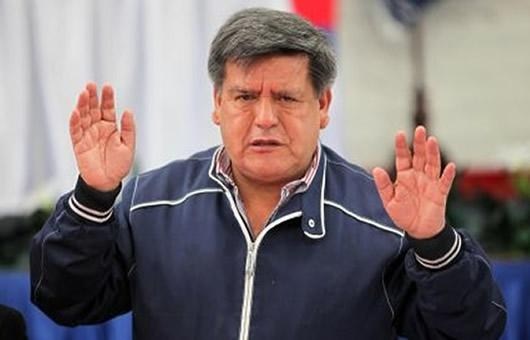
Political Report # 1130 Peru 2016 Presidential Elections: César Acuña and Julio Guzmán Disqualified By Stephan Horler and Ruby Cazarez, Research Associates at the Council on Hemispheric Affairs


Featured Photo: Cesar Acuna 2015. Taken from Wikimedia.


By Stephan Horler and Ruby Cazarez, Research Associates at the Council on Hemispheric Affairs


The United States is not the only country facing political tension around 2016 presidential elections. Two candidates whom opinion polls had running second and fourth in Peru's presidential election have been disqualified from preliminary elections to take place on April 10, while the frontrunner, Keiko Fujimori was rumored to be at risk of being similarly disqualified.
On March 4, an investigative subcommittee declared candidates Julio Guzmán and César Acuña ineligible to run in the presidential election.[1] Opinion polls had shown Guzmán, an economist, in second place behind Keiko Fujimori, daughter of imprisoned former President Alberto Fujimori, with Acuña, a successful businessman, in fourth place.[2] Guzmán, with support fluctuating between 16 and 18 percent (to Fujimori's ratings just above 30 percent), was seen as her main rival for the presidency; Acuña was polling at between 4 and 8 percent.[3]
By a vote of 3 to 2, the Special Electoral Jury (Jurados Electorales Especiales or JEE) declared Guzmán's candidacy void on technical grounds, finding that his party, All For Peru (Todos Por El Perú, or TPP), incorrectly completed its inscription process by not handing in a complete set of paperwork.[4] The JEE unanimously found that Acuña's political party, Alliance For Progress (Alianza Por El Progreso, or APP) illegally purchased support, a violation of the election process rules.[5]

December 11, 2015

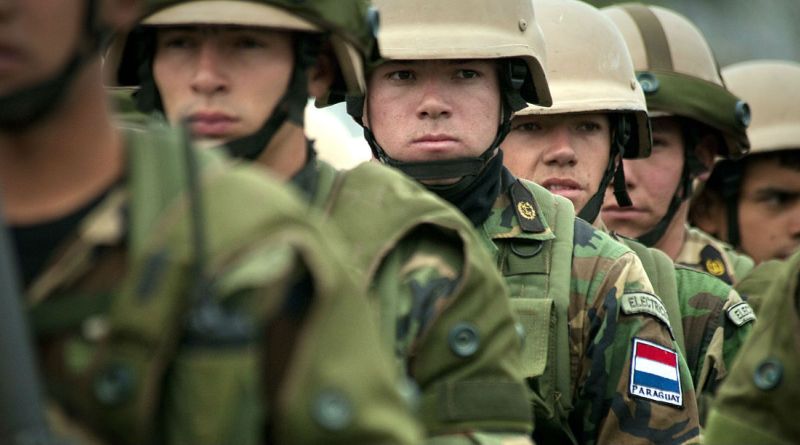
Political Report #1098, Structural Problems Perpetuate Widespread Corruption in Paraguay By Miguel Salazar and Edwin Nieves, COHA


                             Featured Photo: “Paraguayan marines at Ancon Marine Base” (Brien Aho)
Since the end of the Stroessner dictatorship in 1989, Paraguay has struggled in its efforts to reform its weak institutional structures. Systemic corruption, growing poverty, and media censorship have all contributed to the perpetuation of the country’s stagnation over the years. Paraguay’s consistent failure to institute comprehensive land reform has even contributed to the rise of a local guerrilla movement that has not been neutralized by a corrupt military. While President Horacio Cartes has acknowledged the existence of corruption within the national police and military, many of Paraguay’s structural problems remain mercilessly neglected.

November 16, 2015

Political Report # 1090 Nazca-Desventuradas: Chile's New Marine Reserve by Sara Jones, Research Associate at COHA


                              Featured photo: Bunaken Marine Park in Indonesia (Sakurai Midori)


                                 By Sara Jones, Research Associate at COHA

At the 2015 Our Ocean Conference, Chilean president Michelle Bachelet announced the creation of a new marine park off the coast of Chile, which, if created, would be the largest fully protected marine reserve in the world. This action taken by Bachelet spurred questions across the international community over whether Chile might become the world's next leader in ocean conservation. The project has been met with both skepticism and enthusiastic support by the Chilean nation and by the international community.
The Nazca-Desventuradas National Marine Park was unveiled in October and will encompass a surface area of 297,518 square kilometers (114,872 square miles), the equivalent of 8 percent of the world's oceans that have been declared as no fishing areas or have no-take protections.[1] It would include the waters off the coast of Rapa Nui (Easter Island) and the waters surrounding San Ambrosio and San Félix Islands.[2] These two islands are called the 'Islas Desventuradas' (Unfortunate Islands) and are the namesake of the marine park. The purpose of creating this national park is to reduce the amount of fishing in the area in order to protect the ecosystems within its borders. The waters surrounding the islands have been the site of "a modest amount of fishing, mainly for swordfish" but the creation of the park designates this area as a marine protected area (MPA).[3] According to the International Union for Conservation of Nature (IUCN), the definition of a protected area is "A clearly defined geographical space, recognized [sic], dedicated and managed, through legal or other effective means, to achieve the long-term conservation of nature with associated ecosystem services and cultural values."[4] The IUCN stresses the importance of having a long-term plan to actually have an impact on conservation and ocean recovery.[5] The creation of a marine reserve gives the Chilean government legal means to enforce the limits that could be imposed on fishing, especially by using its navy as a deterrent.[6] Local fisherman can still fish in an area 50 miles from the coast, but industrial fishing will ideally be eliminated.[7]

November 11, 2015

Political Report # 1088 Making Peronism Work: Prospects for Argentina's Run-Off Election By Robie Mitchell, Research Associate at COHA


Featured Photo: Daniel Scioli and Sergio Massa. From Jorge Gonzalez


Argentina's run-off elections on November 22 will not only be a test for outgoing President Cristina Fernandez de Kirchner and her mission to see if she can successfully coronate Daniel Scioli of the Partido Justicialista (PJ) as her heir, but the elections also represent a test for the Peronist movement. Since the fall of the military junta in 1983, Peronism has dominated the political arena. Political newcomers such as the center-right Propuesta Republicana (PRO) party have begun to challenge Peronists' historic dominance. Notably, there is a fundamental split between left-wing Peronism of the PJ and the right-wing Peronism of the Frente Renovador (FR). Regional and class divisions have long existed within the Peronist movement, but President Kirchner's attempt to raise export tariffs in 2008 on agricultural products set the powder keg alight and made leaving the PJ a compelling move for rural Argentinians.1 The Dissident Peronist party FR was created in the still-relevant aftermath of this aborted tax hike. Preventing the Argentinian Peso from further decreasing in value, keeping foreign reserves from falling, dealing with high inflation, and making debt payments on time will keep whoever wins the presidential election well-occupied, be it Daniel Scioli of the PJ or Mauricio Macri of the PRO2 Past leaders of an ideology as inconsistent and all-encompassing as Peronism, including Juan Peron himself, have had enough trouble governing Argentina without having to worry about these heightened internal and external political threats.
Accordingly, Argentina's need for a strong leader with a clear vision and a stable party would not have boded well for any Peronist winner, whether it had been Scioli or the farther right Sergio Massa of the FR, as the broad ideological struggles over the depth and type of proper government intervention in the market undermines their movement and serves as a distraction to actual governance. The difference of opinion between fellow Peronists is far less than that of any given Peronist and non-Peronist politicians like Macri; compromise between the PJ and FR should come naturally. However, history complicates this seemingly simple picture of an ideology that is fracturing itself.


October 21, 2015

Political Report # 1082 Peace in Sight: Historic Agreement between Colombia and the FARC By Miguel Salazar, Research Associate at the COHA

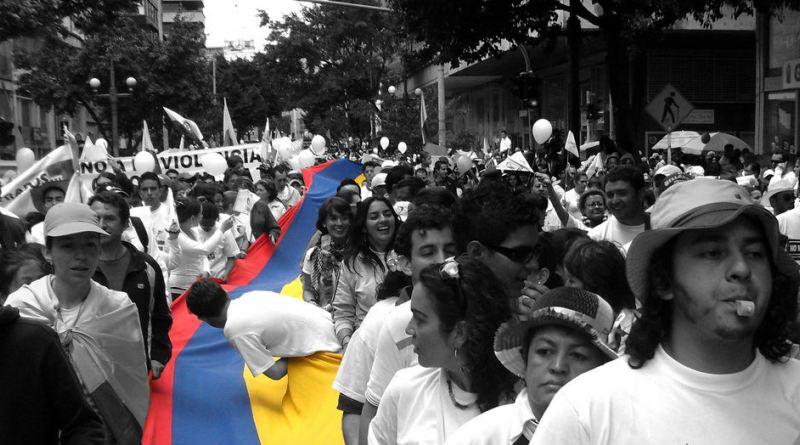
Featured Photo: Colombians protest for peace (2008). From: Marco Suárez


On Wednesday, September 23, 2015, Colombian President Juan Manuel Santos and FARC leader Rodrigo Londoño pledged to end the country's internal conflict by March 26, 2016.
Following La Violencia-Colombia's infamous civil war lasting from 1948 to 1958-the polarization of the country's political parties and ideological factions has led to a continuation of violence throughout Colombia. The left-wing Revolutionary Armed Forces of Colombia (Fuerzas Armadas Revolucionarias de Colombia, FARC) were initially formed as an armed peasant movement in 1964 that demanded comprehensive land and social reforms. Since then, the government and right-wing paramilitaries have waged a violent conflict against the FARC in rural Colombia that has resulted in a total of 220,000 deaths and over 5.7 million displacements.[1]

August 31, 2015

Political Report # 1072 Guatemalan Supreme Court Approves Motion to Impeach President by Sofia Rada, COHA


                                       Featured Photo: Otto Perez Molina. From: World Economic Forum


By Sofia Rada, Research Associate at the Council on Hemispheric Affairs

Amid a growing political crisis in Guatemala, the country's Supreme Court issued a unanimous decision on August 25 to approve a motion by the attorney general to impeach the president.[1] The attorney general identified President Otto Pérez Molina as the head of a corruption scheme that led to the resignation of the country's vice president and a number of other senior officials. The growing crisis has mired the president's administration for much of this year, but until now the opposition has been unable to get enough votes in congress to lift the immunity granted to Pérez Molina by Guatemalan law.

As opposition to his continuance in office mounted, Guatemalan President Pérez Molina announced on August 23 through a televised address that he would not resign.[2] He categorically denied all claims that he has ties to the corruption scandal, which led to the May resignation of the country's former vice president, Roxana Baldetti, who was arrested on August 21 and taken to court. The scandal concerns the funneling of taxes into private accounts and offering discounted custom rates for under-the-table payments.[3] Despite growing protests and increasing pressure from those who oppose his continued rule, however, the president continues to reject any responsibility and does not show signs of succumbing to demands for his resignation.[4]


August 20, 2015

Political Report # 1068 MUD's Murky Future in Venezuelan Politics By: Emma Scully and Daniel A. Tovar, Research Associates at COHA


Featured Photo: Capriles sobre verjas. From: Julio César Mesa


By: Emma Scully and Daniel A. Tovar, Research Associates at the Council on Hemispheric Affairs
 
Henrique Capriles Radonski, opposition politician and governor of Venezuela's Miranda state, disclosed a pressing reality of Venezuelan politics in an interview with the Spanish newspaper El País on June 13. When asked if the Venezuelan opposition is unified, Capriles, two-time presidential candidate who came close to defeating Nicolás Maduro in the 2013 elections, expressed confidence that the opposition is "going to be unified," thus confirming the existence of intra-opposition divisions that have gradually chipped away at the fabric of the Mesa de la Unidad Democrática (Democratic Unity Roundtable; MUD), the electoral coalition of Venezuelan opposition parties.[1] The purpose of this article is to trace and outline the sources of the divisions within MUD that have transformed it into a splintered opposition coalition plagued by party factionalism. Failure to resurface as a cohesive coalition may help the current government to retain a majority in the national assembly in this year's parliamentary elections on December 6.

August 14, 2015

Political Report # 1067 Capital Over People? Puerto Rican Debt Crisis Explained By Chandler Foust, COHA


                Featured Photo: Aeriel view of Old San Juan.
            From: U.S. National Park Service.


By Chandler Foust, Research Associate at the Council on Hemispheric Affairs
 
UPDATE (August 4, 2015, 2:28 p.m.): On Monday August 4, Puerto Rico's Public Finance Corporation failed to pay the $58 million USD it owed creditors, making only a $628,000 USD payment. In addition, the island owes $5 billion USD over the next twelve months. Monday marked the first day in the island's history where it failed to make a payment.
The current debt crisis in Puerto Rico not only illustrates a need for a complete restructuring of the island's economy, but a closer look taken toward its further political union with the United States. In addition, the current crisis shows the flawed way that politicians respond to debt crises, and how the people who end up getting hurt are usually not the ones who started the crisis. Lastly, the current political debate between debtors and creditors, harsh austerity measures, and further concessions to capital has shown that these lessons have yet to sink in for many.