Showing posts with label Dilma Rousseff. Show all posts

April 20, 2020

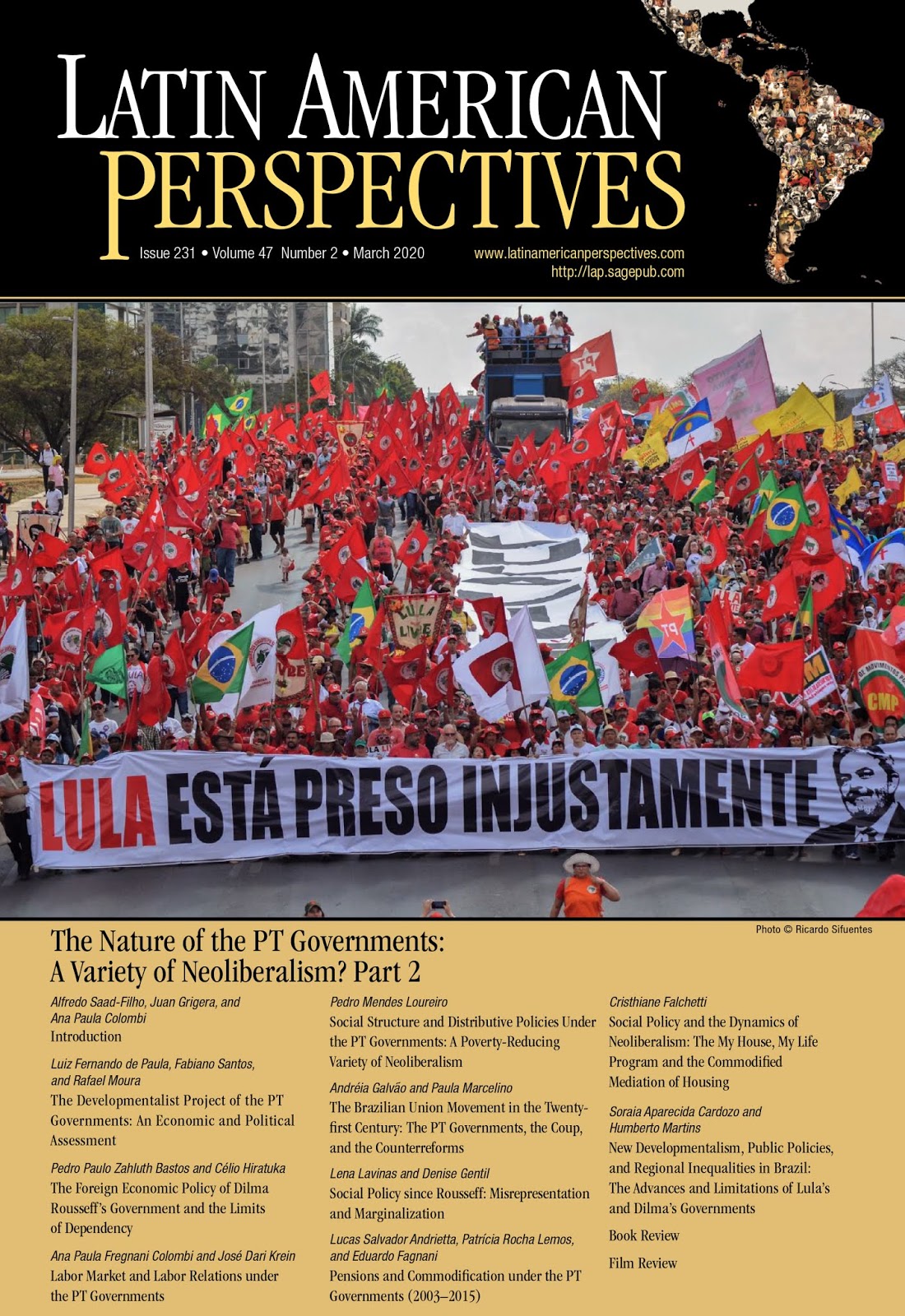
Abstract - The Foreign Economic Policy of Dilma Rousseff’s Government and the Limits of Dependency

:::::: Abstract ::::::


The Foreign Economic Policy of Dilma Rousseff’s Government and the Limits of Dependency

by Pedro Paulo Zahluth Bastos, Célio Hiratuka


There is some consensus on the foreign policy of Dilma Rousseff’s government that Brazil lost prestige and international influence because of her lesser personal dedication. Against this consensus, the paper presents two alternative hypotheses for explaining its unsatisfactory outcomes: that there was no change in policy objectives but an adaptation to a more hostile context and that its limitations were structurally related to dependency on global corporations and to the increasing rejection of South-South politics by domestic business. If this analysis is correct, the structural limitations described require that the struggle to achieve an independent foreign policy involve deeper political and ideological battles and a more radical questioning of neoliberal capitalism.


February 24, 2020

Abstract: The Political Economy of Lulism and Its Aftermath

:::::: Abstract ::::::


The Political Economy of Lulism and Its Aftermath

by Ruy Braga and Fabio Luis Barbosa Dos Santos


President Dilma Rousseff’s impeachment should be framed as part of the crisis of the Lulist mode of regulation of social conflict. The Partido dos Trabalhadores (Workers’ Party—PT) presidencies lost their functionality from the standpoint of the interests of the traditional ruling classes of the country, led by the financial sector. The breakdown of Lulism was the exhaustion of the mediation between the predatory aspirations of the Brazilian bourgeoisie and the rights and aspirations of workers. This exhaustion was first evident in June 2013 and became acute in the subsequent years as the government was confronted with economic crises and corruption scandals. The Temer administration’s open confrontation of the working class pointed to a return of workers’ living conditions to the nineteenth century, but these measures reflected not a turning point but simply an acceleration of the pace of the prevailing politics. The collaboration of the ruling PT in confusing, calming, and alienating the popular classes helps explain the negligible popular reaction to the impeachment, the antipopular assault led by Temer, and Lula’s arrest.


February 17, 2020

Abstract: The Failure of Dilma Rousseff's Developmentalist Experiment

:::::: Abstract ::::::


The Failure of Dilma Rousseff's Developmentalist Experiment


by André Singer


There are various reasons for the dissolution of the productivist coalition and the formation of an antidevelopmentalist bourgeois united front during Dilma Rousseff’s first term. With the intention of accelerating the pace of Lulism, Rousseff actively opposed neoliberalism, but state intervention alienated the industrialists even though, paradoxically, it aimed to favor them. On a small scale, Rousseff’s developmentalist experiment may have followed in the footsteps that led to the 1964 military coup.


January 20, 2020

Abstract: Growth, Distribution, and Crisis: The Worker's Party Administrations

:::::: Abstract ::::::


Growth, Distribution, and Crisis: The Worker's Party Administrations


by Pedro Cezar Dutra Friedmann and Claudio A. Castelo Branco Puty


The economic policies of the governments of Lula da Silva (2003–2010) and Dilma Rousseff (2011–2016) combined orthodox measures with distinctive pro-growth measures that, although they deviated from neoliberalism, cannot be called “developmentalist” either. They lacked a long-term strategy for reversing the deindustrialization of the country or advancing to a new technological paradigm. They did, however, have a historical commitment to income redistribution that was largely implemented. The broad social pact proposed by Lula acknowledged the hegemony of financial capital, and its contradiction was that it protected the hegemonic group by means of monetary and fiscal policies that required growth in the gross domestic product, a favorable balance of payments, and a gap between wages and productivity. When these conditions no longer held, Rousseff responded to the crisis with a “new macroeconomic matrix” that amounted to the abandonment of Lula’s class-coalition pact.


January 14, 2020

Abstract, Sailing Against the Wind: The Rise and Crisis of a Low-Conflict Progressivism

:::::: Abstract ::::::


Sailing Against the Wind: The Rise and Crisis of a Low-Conflict Progressivism

by Gustavo Codas Friedmann, Claudio A. Castelo Branco Puty


The governments of the Partido dos Trabalhadores (Workers’ Party—PT) in Brazil (2003– 2016) were part of a cycle of progressive governments in Latin America whose differences are more specific to the conditions of political struggle in each country—the conditions of arrival in government, the structure of the political system—than fundamentally programmatic. They can be characterized as a low-conflict progressivism in that, although there was no promotion of a neoliberal agenda on the model of European social liberalism, there was accommodation within the framework of the established order that was ultimately fundamental to the success of the 2016 parliamentary-judicial coup.


January 7, 2020

Abstract, Varieties of Neoliberalism in Brazil

:::::: Abstract ::::::


Varieties of Neoliberalism in Brazil (2003-2019)

by Alfredo Saad-Filho


The main feature of capital accumulation in Brazil during the administrations led by Luís Inácio Lula da Silva and Dilma Rousseff of the Partido dos Trabalhadores (Workers’ Party—PT) was the continuity of neoliberalism of two varieties: inclusive (2003–2006) and developmental (2006–2013). The PT’s attachment to neoliberalism was mitigated by the party’s (shifting) commitment to (mild) developmental outcomes, redistribution of income (at the margin), social inclusion (within narrow limits), and democratization of the state (bounded by the 1988 Constitution). Achievements in these areas were further constrained by the inability or unwillingness of the PT to confront the institutionalization of neoliberalism in the fields of economics, politics, ideology, the media, and class relations. The political crisis unfolding in Brazil since 2013 and the imposition of authoritarian neoliberalism after Rousseff’s impeachment can be examined from the perspective of the contradictions in the dominant varieties of neoliberalism under the PT and the limitations of the party’s political ambitions.


August 5, 2019

Abstract, Lula, Dilma, and Temer: The Rise and Fall of Brazilian Foreign Policy

:::::: Abstract ::::::


Lula, Dilma, and Temer: The Rise and Fall of Brazilian Foreign Policy
by André Luiz Reis da Silva and José O. Pérez


The rapid rise and fall of Brazilian foreign policy initiatives and capacities across the Lula (2003–2010), Dilma (2011–2016), and Temer (2016–2018) governments cannot be attributed solely to any of these presidential administrations but was also affected by domestic variables, international events, and economic factors. Furthermore, identity, corporations, the media, corruption scandals, and other variables influenced each president’s ability to conduct foreign policy. Process tracing of these three governments reveals the way policies and programs such as the BRICS and IBSA can be understood in this context. In short, analyses of Brazilian foreign policy must be balanced between agent and structure.


January 15, 2019

Abstract, Pink-Tide Governments: Pragmatic and Populist Responses to Challenges from the Right

:::::: Abstract ::::::


Pink-Tide Governments: Pragmatic and Populist Responses to Challenges from the Right
by Steve Ellner


The downturn in international commodity prices after 2008 heavily impacted leftist and center-leftist Latin American governments, leading to economic contraction and political confrontation and culminating in a series of setbacks beginning in 2015. Adversaries to the right ascribed the problems to the flaws inherent in the model that those governments had adopted. As could have been expected, some government critics pointed to the model of leftist-style populism as the root cause. Ironically, the Mexican scholar Jorge Castañeda, who had viewed Brazil’s Workers’ Party as the quintessence of the “good left” in contrast to the “populist left” personified by Hugo Chávez, by 2015 classified the nation’s president Dilma Rousseff as a populist and pointed to her allegedly populist policies as responsible for her downfall (Castañeda, 2015; Castañeda and Morales, 2008: 9–11). Other analysts on the right attributed the political and economic woes faced by progressive governments to economic interventionism, a model they considered to be tantamount to socialism (Ellner, 2015; 2016).


CONTINUE READING THE FULL ARTICLE HERE

SaveSave
SaveSave
SaveSave
SaveSave
SaveSave


SaveSave
SaveSave
SaveSave
SaveSave
SaveSave
SaveSave

January 10, 2019

Abstract, Chronicle of a Defeat Foretold: The PT Administrations from Compromise to the Coup

:::::: Abstract ::::::


Chronicle of a Defeat Foretold: The PT Administrations from Compromise to the Coup
by Ricardo Antunes, Marco Aurelio Santana, and Luci Praun


The period in which the Workers’ Party (Partido dos Trabalhadores—PT) was in power in Brazil was characterized by limits and contradictions with regard to policies on employment, unions, and the fight against poverty. An analysis of the factors that contributed to the end of the 14-year cycle of consecutive presidential terms highlights the combined impacts of the international economic crisis, a deepening political crisis with charges of corruption, the destabilization of the party’s political alliances, and mass discontent intensified by fiscal adjustment measures that further penalized the already stressed working class. The PT once in power did not motivate resistance, advances in social and union struggles, or social movements, and when it finally attempted to reach out to other social movements it was too late. With the coup represented by the impeachment of Dilma Rousseff in 2016, Brazil entered once again into what Florestan Fernandes has called “preventive counterrevolution.”


CONTINUE READING THE FULL ARTICLE HERE

SaveSave
SaveSave
SaveSave
SaveSave
SaveSave


SaveSave
SaveSave
SaveSave
SaveSave
SaveSave
SaveSave

August 31, 2018

Political Report # 1367 Brazil austerity policies devastating to rural communities: analysis

CAMPOS LINDOS, Brazil - Seu Raimundo Miranda, age 61, is a small-scale farmer and honey producer who lives with his wife and three children in a small home he built himself on the outskirts of Campos Lindos city in Tocantins state. Until 2016, his wife received vital economic support from Brazil’s Bolsa Familia program. Then the benefit was suddenly cut, with no reason given for the loss.
His wife called the local aid bureau dozens of times, explaining how important the money was to the family, and pleading for the benefit to be reinstated. Each time, she was refused aid without explanation.
Raimundo, his wife and children used to live in the rural countryside where they grew crops and raised cattle, but were forced to move to the city after several family members became severely ill due to pesticide poisoning. The small land plot where Raimundo now grows food isn’t very productive, and people from the city regularly steal the crops he does grow.
“All of this is so painful for us,” he says. On many days the parents struggle to bring enough food to the table to feed their teenage children, one of whom has now taken a low paying job as a laborer, clearing land for a soy farmer. “I don’t like that he does that kind of work, and I know they don’t treat him well, but we need the money,” Raimundo explains.
The family is just one of many thousands in Brazil suffering deepening privation as, over recent years, the national government has used the nation’s extreme economic crisis as justification for the implementation of what critics call severe austerity measures.
Especially impactful have been sweeping funding cuts to institutions and programs hugely important to the health and wellbeing of poor rural communities in the Amazon and Cerrado regions, according to NGOs, academics and commentators who have drawn a compelling link between these drastic reductions and decreased quality of life in these areas.

January 8, 2018

Political Report # 1306 The State of the Brazilian Left: Analysis from an American in Brazil


By Brian Mier
COHA


During the lead-up and in the aftermath of last year’s overthrow of democratically elected Brazilian president Dilma Rousseff, several writings appeared in progressive English language publications analyzing the state of the Brazilian left. Most of them were written by members of the white middle class, based on little or no contact with the Brazilian organized left which, as a recent article in NACLA mentioned, is a long-standing problem with Northern American analysis on Latin America.[i] In an attempt to go beyond more of the same, my next four contributions to COHA’s Brazil Unit were interviews with key figures of the Brazilian organized left: a national urban social movement leader, a union federation leader, a renowned radical-left intellectual and a national leader of the Movimento dos Trabalhadores Rurais Sem Terra (Landless Workers’ Movement, MST). [ii] [iii] [iv] [v] This article represents a systematization of the interviews and original analysis from the standpoint of an American who has lived in Brazil for 22 years and who has worked with the MST and the four largest Brazilian social movements. For clarity’s sake I will add that the I am not affiliated with any political party and that I supported Partido dos Trabalhadores (Workers’ Party, PT) candidate Lula in 2002, Partido Socialismo e Liberdade (Socialist Liberty Party, PSOL) candidate Heloisa Helena in 2006, PSOL candidate Plinio Arruda in 2010, and PT candidate Dilma Rousseff in 2014. The interviews were based on questions about changes in the political economy, last year’s soft coup, and what the left is doing to alter the current state of affairs.

November 30, 2016

Political Report # 1203 ¡Canallas! ¡Canallas! ¡Canallas!


Por Eric Nepomuceno


El jueves dos de abril de 1964 se consumaba otro golpe de Estado, un golpe cívico-militar, liquidando un gobierno elegido por el voto popular y soberano. En aquella ocasión, las mismas fuerzas que hoy triunfaron recurrieron a los cuarteles. Ahora, las tropas no fueron necesarias.
Hace 52 años, presidiendo una sesión extraordinaria del Congreso que reunía a diputados y senadores, el conspirador derechista Auro de Moura Andrade decretó vacante la presidencia, afirmando que el presidente constitucional, João Goulart, había abandonado el país.
Era mentira. Goulart estaba en Porto Alegre, capital de Rio Grande do Sul, intentando reunir fuerza suficiente para resistir. Moura Andrade lo sabía. Todos sabían.

September 26, 2016

Political Report # 1186 Death of Democracy: Brazilian President Impeached by Majority of Senate Votes


Political Report # 1186


Death of Democracy: Brazilian President Impeached by Majority of Senate Votes


By Hector Perla Jr., Senior Research Fellow at the Council on Hemispheric Affairs and Laura Sholtz & Liliana Muscarella, Research Associates at the Council on Hemispheric Affairs


In a historic vote on August 31, Brazil’s democratically elected President Dilma Rousseff was formally ousted by the Brazilian Senate, surpassing the required two-thirds majority with 61 votes in favor and 20 votes against.[i] The controversial impeachment formalizes the provisional government of former Vice President Michel Temer and his Partido do Movimento Democrático Brasileiro (Brazilian Democratic Movement Party, PMDB), bringing an end to 13 years of governance by Rousseff’s own Partido dos Trabalhadores (Worker’s Party, PT). This decision not only signifies a drastic change in Brazil’s government, but it also has major implications for the country’s near-term future. Allegations of corruption continue to hang over Temer’s interim administration, including leaked audio recordings that suggest that Rousseff’s ouster was politically manipulated to halt the charges against congressmen from Temer’s cabinet and party.[ii] Rousseff’s impeachment is a devastating blow to Brazil’s democracy, constituting a “soft coup”-an undemocratic process of regime change tainted by political malfeasance, selective justice, and a non-electoral transfer of power cloaked in the guise of the rule of law.
What Now?
Interim President Temer and former speaker of the House of Representatives Eduardo Cunha are recognized as the primary instigators of Rousseff’s suspension in May of this year.[iii] While the two have been accused of various acts of fiscal and electoral corruption, the spotlight has been focused primarily on Rousseff’s alleged fiscal mismanagement. Following Rousseff’s impeachment, Temer was sworn in as Brazil’s president and, barring a Supreme Court intervention, receives immunity from further investigation of any crimes that took place before he assumed the presidency.[iv]
Temer will likely remain in office until the end of 2018. The next presidential elections are scheduled for October 2018 and a new president would take office January 1, 2019. However, with growing discontent from actors along the entire political spectrum, including senators and constituents from Temer’s own PMDB, there has been a good deal of speculation that his presidency may not endure.[v] Another impeachment, while a remote possibility, is not unthinkable, especially given the lack of support within Temer’s own party and the potential that new allegations of corruption may be brought against him. At that point, the Supreme Court could choose to suspend Temer’s presidential immunity and allow for the initiation of impeachment proceedings against him.[vi]
If Temer were to suffer impeachment before the end of 2016, the Brazilian Constitution requires that new national elections be called within 90 days. Otherwise, if he were to be removed after January 1, 2017, indirect elections within the Brazilian Congress would decide which current senator would assume the position.[vii] Considering recent strategies by the PMDB, such technicalities could easily be exploited by the Temer administration, further highlighting the murky nature of recent events and calling into question the legitimacy of Brazilian democracy.
Implications for Democracy in Brazil
Rousseff’s ouster sets a negative precedent for the country in two ways. On the one hand, it institutionalizes the political abuse of power by politicians seeking to avoid corruption charges. On the other, it shamefully obscures the underlying motive for removing the PT from office: a desire to return to conservative rule and neoliberalism. Both of these strategies subvert the democracy that Brazil has worked hard to uphold.
First, the installation of a new administration with weak democratic standards does not bode well for Brazil, especially given the corruption that has traditionally pervaded its government. The PMDB saw an opportunity to evade charges against its leaders while simultaneously gaining the presidency-an accomplishment that has eluded them at the voting booth for more than 20 years. All they had to do was turn on Rousseff, their electoral coalition partner. Thus, PMDB’s leaders led the impeachment of the president, even though an independent federal prosecutor found that she had not violated any fiscal laws.[viii] This practice, known as pedaladas fiscais, or “accounting tricks,” has been recently employed by more than a dozen state governors without legal repercussions.[ix] Meanwhile, Temer has been convicted of electoral fraud and accused of other acts of corruption, but by assuming the presidency he evades existing investigations, such as Operação Lava Jato, that would have proven his guilt or his innocence.  Such hypocrisy and double standards seriously impugn the legitimacy of the impeachment process and the entire democratic institution.
Temer’s interim government almost immediately implemented a far more conservative agenda than the Rousseff Administration with neoliberal ideals that seemed to have been waiting in the wings for an opportunity to be reinstated. Among his first actions was the naming of an all-white, male cabinet, several of whom were under investigation for corruption at the time of their appointment. Additionally, as a cost-cutting measure, Temer eliminated the ministries of culture, agrarian development, science and technology, women, racial equality, and human rights (although some were since reinstated due to popular pressure).[x] Furthermore, the interim administration wasted no time in rolling back the hallmark of the PT’s government: social programs and policies that Rousseff had fought hard to continue.[xi] Temer immediately slashed funding for programs that benefit the rural and urban poor, women, afro-descendants, the LGBTQ community, and indigenous people.[xii] These changes augur how Temer will govern now that he has been sworn into office. His radical departure from the policies of the platform under which he was elected as Rousseff’s vice president lends further credence to the claim that her ouster is the result of a political witch-hunt rather than a legitimate impeachment process for a criminal offense as required by the Constitution.
It is undoubtable that the non-electoral and undemocratic ouster of Brazil’s first female president constitutes a perilous democratic regression for South America’s largest nation. In fact, the process constitutes a “soft coup” against the Rousseff presidency and a political attack against the PT.[xiii] Conservative parties came together to secure what they had been unable to achieve through popular elections: a presidential victory over the PT. By circumventing the electoral process, the impeachment strikes a huge blow to the country’s democracy, especially given the advances it has made since the impunity typical of the military government (1964-1985).[xiv]
The Future of Brazil and Beyond
The PT is not going to accept Dilma’s ouster without a fight. On its Twitter page Wednesday afternoon, it posted a letter from the Frente Brasil Popular (People’s Brazilian Front), which is a coalition of trade unions, progressive and social movement organizations, and political parties. In the letter, the Front promised that, “Our struggle against the coup government and its program of rolling back our achievements will be relentless.”[xv] Protests against the proceedings, which have been ongoing since the impeachment process began, have been increasing and are also likely to intensify in the coming days.[xvi]
The ramifications of Rousseff’s impeachment are not limited to Brazil. The reverberations throughout the Western Hemisphere, where progressive governments are on the defensive against similar right-wing attacks, began immediately when Bolivia, Ecuador, and Venezuela recalled their ambassadors from Brasília. Progressive governments of the region see Brazil as the latest example of the epidemic of “soft coups” that have brought down Pink Tide governments that came to power through democratic elections. Increasingly, right-wing forces opposed to progressive governments and discontent with their social and economic programs-but unable to defeat them in popular elections-have turned to judicial and institutional processes to roll back the left’s hold on executive office.[xvii]
Despite the rhetorical anti-corruption façade that characterized the impeachment proceedings, President Rousseff’s ouster was actually a careful orchestration designed to exploit recent public discontent with her administration’s handling of the economy. Temer is nearly as unpopular as was Rousseff, yet he and the PMDB were able to channel common grievances and direct them against President Rousseff in order to capitalize on them politically. Moving forward, Brazil is in the hands of a Trojan Horse government-one that has presented itself as one of the few hopes for democracy while subverting the very institutions that the term represents. The Council on Hemispheric Affairs (COHA) stands with Rousseff and echoes the statement she made while on trial: “Today, I only fear the death of democracy.”[xviii]


Original article and sources can be found at:
http://www.coha.org/death-of-democracy-brazilian-president-impeached-by-majority-of-senate-votes/