Showing posts with label Workers. Show all posts

June 5, 2019

Political Report # 1397 México: las izquierdas negadas por la «cuarta transformación»


Political Report # 1397

México: las izquierdas negadas por la «cuarta transformación»

By Nueva Sociedad


En el contexto de la proclamada «cuarta transformación» de México, el discurso de Andrés Manuel López Obrador tiende a negar la existencia de la izquierda, ya sea como posición político-ideológica en abstracto o como encarnación en grupos y movimientos que ostenten cierto grado de autonomía y radicalidad. La disputa respecto del significado y el lugar de la izquierda está atravesada por la tensión entre distintas acepciones y contenidos, pero también entre lógicas políticas tendencialmente divergentes como son las de la hegemonía y la autonomía.
Transformadores versus conservadores
La ex-presidenta argentina Cristina Kirchner solía decir que a su izquierda solo estaba la pared. De forma análoga, Andrés Manuel López Obrador (AMLO), desde el primer semestre de su mandato de gobierno, etiquetó como «conservadores» tanto a los sectores acomodados que llama burlonamente «fifís» como a los «radicales» de izquierda, refiriéndose, en particular, a un sector disidente del magisterio y a grupos opositores a megaproyectos. Es indudable que, a su derecha, existen y actúan políticamente clases y grupos históricamente dominantes que no aceptaron la invitación a sumarse a la llamada «cuarta transformación», así como sectores medios y altos que no comulgan con el obradorismo y que rechazan más su estilo plebeyo que su programa moderadamente reformista. Definirlos como «conservadores» es una manera de colocarse del lado de la Reforma y la Revolución, en mayúsculas, como referencias históricas (la segunda y la tercera transformaciones, según el conteo de AMLO), y de delimitar una práctica política que quiere modular, en función de las circunstancias y los interlocutores, el grado de profundidad del cambio. De cara a los conservadores de derecha, se perfila una definición del obradorismo por izquierda, una delimitación geométrica que se sustenta a partir de dos clivajes fundamentales de clásica raigambre antioligárquica: el nacionalismo y el justicialismo. Ambos posicionamientos, revitalizados por las luchas antineoliberales desde la década de 1990, se resuelven a partir del fortalecimiento del Estado como portador del interés general, capaz de intervenir en clave nacionalizadora y redistributiva. En esta definición histórica e ideológica por defecto, el no conservadurismo de AMLO se coloca entre el liberalismo reformista decimonónico y el nacionalismo revolucionario, rehuyendo sistemáticamente una ubicación a partir de la etiqueta de izquierda, así como otros sucedáneos como socialdemocracia, posneoliberalismo y, más aún, socialismo y anticapitalismo. Esta colocación aparentemente aséptica podría asimilarlo a la tradición del centrismo priísta, si no fuera porque se retroalimenta de un rasgo típicamente progresista latinoamericano al reivindicar explícitamente un perfil antineoliberal, aunque se limite a pregonar algo similar a lo que Néstor Kirchner llamaba un «capitalismo en serio», invitando a los empresarios honestos a sumarse al concierto nacional y popular, gesto que recuerda toda una tradición del México de la revolución institucionalizada.

January 10, 2019

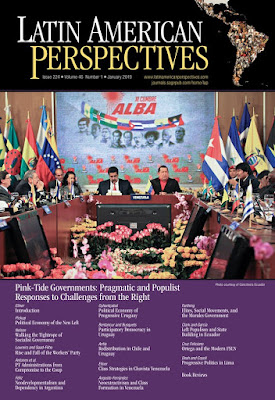
Abstract, Chronicle of a Defeat Foretold: The PT Administrations from Compromise to the Coup

:::::: Abstract ::::::


Chronicle of a Defeat Foretold: The PT Administrations from Compromise to the Coup
by Ricardo Antunes, Marco Aurelio Santana, and Luci Praun


The period in which the Workers’ Party (Partido dos Trabalhadores—PT) was in power in Brazil was characterized by limits and contradictions with regard to policies on employment, unions, and the fight against poverty. An analysis of the factors that contributed to the end of the 14-year cycle of consecutive presidential terms highlights the combined impacts of the international economic crisis, a deepening political crisis with charges of corruption, the destabilization of the party’s political alliances, and mass discontent intensified by fiscal adjustment measures that further penalized the already stressed working class. The PT once in power did not motivate resistance, advances in social and union struggles, or social movements, and when it finally attempted to reach out to other social movements it was too late. With the coup represented by the impeachment of Dilma Rousseff in 2016, Brazil entered once again into what Florestan Fernandes has called “preventive counterrevolution.”


CONTINUE READING THE FULL ARTICLE HERE

SaveSave
SaveSave
SaveSave
SaveSave
SaveSave


SaveSave
SaveSave
SaveSave
SaveSave
SaveSave
SaveSave

November 23, 2018

Abstract, Understanding Outsourcing and Subcontracting: An Approach from the Theory of Surplus Value

:::::: Abstract ::::::


Understanding Outsourcing and Subcontracting: An Approach from the Theory of Surplus Value
by Martín Rodríguez Miglio


A critical analysis of outsourcing studies dating from the mid-1980s to the present lays the groundwork for a new understanding of its rationale. Relying on the idea of production in contemporary capitalism as involving both labor and valorization processes, this approach explains outsourcing as arising from the requirements of capitalist accumulation.


CONTINUE READING THE FULL ARTICLE HERE

SaveSave
SaveSave
SaveSave
SaveSave
SaveSave


SaveSave
SaveSave
SaveSave
SaveSave
SaveSave
SaveSave

November 21, 2018

Abstract, Radical Political Unionism as a Strategy for Revitalization in Argentina

:::::: Abstract ::::::


Radical Political Unionism as a Strategy for Revitalization in Argentina
by Lucila D’Urso and Julieta Longo


 The grassroots union experiment undertaken at the Lear automotive parts factory in Argentina can be seen as a paradigmatic struggle for an understanding of the relationship between unionism and politics. The Lear case reveals that the distinctiveness of radical political unionism lies in the democratic elements of its decision making and its appeal to direct action, its construction of alliances with other social organizations, its linkage of economic demands with broader political objectives, its identification of the management, the state, and the union bureaucracy as adversaries, and its transmission of a leftist political culture. 


CONTINUE READING THE FULL ARTICLE HERE

SaveSave
SaveSave
SaveSave
SaveSave
SaveSave


SaveSave
SaveSave
SaveSave
SaveSave
SaveSave
SaveSave

November 19, 2018

Abstract, Neoliberal Workfare and the Battle for Grassroots Control in Argentina

:::::: Abstract ::::::


Neoliberal Workfare and the Battle for Grassroots Control in Argentina
by Steven Araujo


While the vast majority of the academic literature on the popular classes and social programs in Argentina revolves around the concept of clientelism, it has largely ignored organizations that administer these programs without participating in clientelist networks and thus giving up their political autonomy. The struggle for grassroots control of an Argentine unemployed workers’ movement known as the Frente de Organizaciones en Lucha depends on the use of neoliberal workfare programs. Its ability to take resources from the state and administer them according to its own principles and priorities challenges the inference that receiving social programs necessarily leads to co-optation.

CONTINUE READING THE FULL ARTICLE HERE

SaveSave
SaveSave
SaveSave
SaveSave
SaveSave


SaveSave
SaveSave
SaveSave
SaveSave
SaveSave
SaveSave

October 30, 2018

Latest LAP Issue!

Immigrants, Indigenous People, and Workers Pursuing Justice

Issue 223 | Volume 45 | Number 6 | November 2018

This issue of Latin American Perspectives includes several key clusters of current topics that are very much in the forefront of political discussion.  These are: immigration, indigenous rights, labor, and politics.  Within each cluster there are articles that look at a case study or an overall aspect of public policy and even political and economic theory.  This issue features contributions to discussions of displaced peoples, resistance to displacement and the struggles of workers in Argentina. 


English

February 22, 2018

Political Report # 1313 One in 10 senior politicians in Brazil funded by companies 'linked to slavery'


By Anna Sophie Gross

The Guardian


More than one in 10 of Brazil’s high-ranking politicians, among them President Michel Temer, received campaign donations from companies linked to modern-day slavery, an investigation has found.
Party leaders, state secretaries and five of ex-president Dilma Rousseff’s governors are among the elected parliamentarians who received R$3.5m (£760,000) during the last general election, according to the NGO Repórter Brasil.
Temer’s election committee was found to have received R$700,000 (£150,000) from OAS, a Brazilian construction company found guilty of keeping 111 workers in slave-like conditions during the expansion of São Paulo airport, in 2013.
“This is just one of an ocean of shocking practices that Temer’s administration has exposed,” said Xavier Plassat, head of the Pastoral Land Commission (CPT).
President Temer is being investigated for corruption as part of the nationwide Lava Jato (“Car Wash”) enquiry following accusations that he received bribes from JBS, the meat-packing company. JBS was at the heart of a series of Brazilian corruption and meat-industry scandals last year, including investigations of reported slavery in its supply chain.
Though receiving donations is neither a crime nor forbidden by Brazil’s electoral commission, the report provides an insight into how closely connected lawmakers can be with companies and individuals linked to illegal practices.
Twenty-one of the 51 MPs who received donations from companies identified by the authorities as using slave labour are part of the extremely influential rural caucus in congress. This lobby has continually attempted to limit efforts to combat slavery in Brazil and, late last year, supported Temer’s attempt to restrict the legal definition of modern-day slavery.


February 5, 2018

Abstract, Paid Domestic Work: Gender and the Informal Economy in Mexico

:::::: Abstract ::::::


Paid Domestic Work: Gender and the Informal Economy in Mexico
by Georgina Rojas-García, Mónica Patricia Toledo González


A consideration of paid domestic work as an aspect of the informal economy in Mexico identifies some distinctive features: a paternalistic view rather than a labor relation based on a contract, a reluctance on the part of the state to regulate this employment area, and a devaluation of this work as something largely performed by women who are poor and of rural or indigenous origin. The lack of social security is almost universal among paid domestic workers, and coverage is one of the principal demands of organizations formed in defense of their rights.

January 31, 2018

Abstract, Solid Waste Management and Social Inclusion of Wastepickers: Opportunities and Challenges

:::::: Abstract ::::::


Solid Waste Management and Social Inclusion of Wastepickers: Opportunities and Challenges
by Marta Marello and Ann Helwege


As informal workers, wastepickers gather recyclable material without adequate social benefits and occupational protection. In response to wastepicker demands for legalization and access to the waste stream, cities have created inclusion programs to improve livelihoods and promote recycling. While inclusion yields benefits for many participants, it brings challenges at each step of development. In the poorest countries, workers lack the skills, capital, and managerial experience to operate profitably, while projects in wealthier cities employ few wastepickers and face stiff competition from the formal sector. The most sophisticated municipal systems mechanize waste processing and threaten wastepickers’ livelihoods because capital-intensive methods yield few jobs. To realize genuine inclusion, policies to support wastepickers must enable workers to compete throughout the broader economy.

January 26, 2018

Abstract, Living on the Construction Site: Paraguayan Construction Workers in Buenos Aires

:::::: Abstract ::::::


Living on the Construction Site: Paraguayan Construction Workers in Buenos Aires
by Álvaro del Águila


Argentine enterprises subsume Paraguayan migrant workers into the construction industry in the Buenos Aires metropolitan area, subordinating them to the demands of production by temporarily housing them on the construction sites themselves. Ethnographic fieldwork carried out on various construction sites between 2006 and 2015 shows how this practice overlaps with wider processes of global transformation in labor relations. The lodging of workers on construction sites is an increasingly widespread strategy for capitalist entrepreneurs to exploit the migrant workforce even further.

January 12, 2018

Introduction, The Urban Informal Economy Revisited

:::::: Introduction ::::::


The Urban Informal Economy Revisited
by Ray Bromley and Tamar Diana Wilson                                     


One of the most cited definitions of the informal economy is “a process of income generation characterized by one central feature: it is unregulated by the institutions of society, in a legal and social environment in which similar activities are regulated” (Castells and Portes, 1989: 12). Among those the International Labour Organization (ILO) (2013: 3) identifies as being part of the informal economy are those who work in the informal sector as employers and employees in informal enterprises and as self-employed workers. Also included are those who labor outside the informal sector and are informally employed in formal firms or as domestic workers, not covered by labor law protections. The employees in the informal economy also include unpaid family workers, whether employed in informal enterprises or in formal firms or in domestic service.

For decades there have been debates over whether the informal economy is procyclical, expanding as the capitalist economy expands, or countercyclical, contracting as that economy expands. Both things may be happening, depending on which part of the informal economy is under scrutiny: the informally self-employed or informalized wage workers in either informal or formal enterprises (FORLAC, 2015: 2). For example, informal microenterprises that market their products directly to customers or retail outlets may show countercyclical tendencies, whereas informal microenterprises that are subcontracted by large businesses, whether national or multinational, may show procyclical tendencies. More domestic workers may be employed when the economy expands, whereas self-employment in artisanal work and vending may expand when waged employment dries up.

December 29, 2017

Abstract, Paid Domestic Work: Gender and the Informal Economy in Mexico

:::::: Abstract ::::::


Paid Domestic Work: Gender and the Informal Economy in Mexico
by Georgina Rojas-García, Mónica Patricia Toledo González


A consideration of paid domestic work as an aspect of the informal economy in Mexico identifies some distinctive features: a paternalistic view rather than a labor relation based on a contract, a reluctance on the part of the state to regulate this employment area, and a devaluation of this work as something largely performed by women who are poor and of rural or indigenous origin. The lack of social security is almost universal among paid domestic workers, and coverage is one of the principal demands of organizations formed in defense of their rights.

December 25, 2017

Abstract, Solid Waste Management and Social Inclusion of Wastepickers: Opportunities and Challenges

:::::: Abstract ::::::


Solid Waste Management and Social Inclusion of Wastepickers: Opportunities and Challenges
by Marta Marello and Ann Helwege


As informal workers, wastepickers gather recyclable material without adequate social benefits and occupational protection. In response to wastepicker demands for legalization and access to the waste stream, cities have created inclusion programs to improve livelihoods and promote recycling. While inclusion yields benefits for many participants, it brings challenges at each step of development. In the poorest countries, workers lack the skills, capital, and managerial experience to operate profitably, while projects in wealthier cities employ few wastepickers and face stiff competition from the formal sector. The most sophisticated municipal systems mechanize waste processing and threaten wastepickers’ livelihoods because capital-intensive methods yield few jobs. To realize genuine inclusion, policies to support wastepickers must enable workers to compete throughout the broader economy.

December 20, 2017

Abstract, Living on the Construction Site: Paraguayan Construction Workers in Buenos Aires

:::::: Abstract ::::::


Living on the Construction Site: Paraguayan Construction Workers in Buenos Aires
by Álvaro del Águila


Argentine enterprises subsume Paraguayan migrant workers into the construction industry in the Buenos Aires metropolitan area, subordinating them to the demands of production by temporarily housing them on the construction sites themselves. Ethnographic fieldwork carried out on various construction sites between 2006 and 2015 shows how this practice overlaps with wider processes of global transformation in labor relations. The lodging of workers on construction sites is an increasingly widespread strategy for capitalist entrepreneurs to exploit the migrant workforce even further.

December 18, 2017

Abstract, Living on the Construction Site: Paraguayan Construction Workers in Buenos Aires

:::::: Abstract ::::::


Living on the Construction Site: Paraguayan Construction Workers in Buenos Aires
by Álvaro del Águila


Argentine enterprises subsume Paraguayan migrant workers into the construction industry in the Buenos Aires metropolitan area, subordinating them to the demands of production by temporarily housing them on the construction sites themselves. Ethnographic fieldwork carried out on various construction sites between 2006 and 2015 shows how this practice overlaps with wider processes of global transformation in labor relations. The lodging of workers on construction sites is an increasingly widespread strategy for capitalist entrepreneurs to exploit the migrant workforce even further.

December 8, 2017

Introduction, The Urban Informal Economy Revisited

:::::: Introduction ::::::


The Urban Informal Economy Revisited
by Ray Bromley and Tamar Diana Wilson                                     


One of the most cited definitions of the informal economy is “a process of income generation characterized by one central feature: it is unregulated by the institutions of society, in a legal and social environment in which similar activities are regulated” (Castells and Portes, 1989: 12). Among those the International Labour Organization (ILO) (2013: 3) identifies as being part of the informal economy are those who work in the informal sector as employers and employees in informal enterprises and as self-employed workers. Also included are those who labor outside the informal sector and are informally employed in formal firms or as domestic workers, not covered by labor law protections. The employees in the informal economy also include unpaid family workers, whether employed in informal enterprises or in formal firms or in domestic service.

For decades there have been debates over whether the informal economy is procyclical, expanding as the capitalist economy expands, or countercyclical, contracting as that economy expands. Both things may be happening, depending on which part of the informal economy is under scrutiny: the informally self-employed or informalized wage workers in either informal or formal enterprises (FORLAC, 2015: 2). For example, informal microenterprises that market their products directly to customers or retail outlets may show countercyclical tendencies, whereas informal microenterprises that are subcontracted by large businesses, whether national or multinational, may show procyclical tendencies. More domestic workers may be employed when the economy expands, whereas self-employment in artisanal work and vending may expand when waged employment dries up.