Showing posts with label Debt. Show all posts

June 15, 2020

Abstract, The Debt/Energy Nexus behind Puerto Rico’s Long Blackout: From Fossil Colonialism to New Energy Poverty

:::::: Abstract ::::::


The Debt/Energy Nexus behind Puerto Rico’s Long Blackout: From Fossil Colonialism to New Energy Poverty

by Sandy Smith-Nonini


After Hurricane Maria wiped out Puerto Rico’s electrical grid in 2017, its citizens endured the longest blackout in U.S. history, some not regaining power until nearly a year later. An analysis of the profound social impacts and health costs and the delays in power restoration with a focus on the relationship between the U.S. territory’s debt crisis and its “fossil colonial” past offers insights into patterns of manipulation by politicians, bankers, and fossil-fuel companies that led to excess borrowing by the Puerto Rican public electrical utility, contributing to a neglect of infrastructure and high rates for citizens during a time period when tax incentives for corporate manufacturing were being phased out just as oil prices rose to record levels.


June 12, 2020

Abstract, Exceptionality and Colonial-State–Corporate Crimes in the Puerto Rican Fiscal and Economic Crisis

:::::: Abstract ::::::


Exceptionality and Colonial-State–Corporate Crimes in the Puerto Rican Fiscal and Economic Crisis

by José Atiles Osoria


A sociolegal analysis of the sources of Puerto Rico’s fiscal and economic crisis points to the use of the colonial state of exception as an economic development policy facilitating the creation of a tax-haven-like economy and normalizing a series of a colonial-state–corporate crimes. The Puerto Rican people need to hold those who generated the crisis accountable both politically and legally. They must continue mobilizing and promoting the repoliticization of recovery efforts by not paying the public debt, taking legal action against financial predators and corrupt politicians, clawing back fees and refusing to pay any additional fees, giving more importance to the human rights of Puerto Ricans than to the rights of bondholders and vulture funds, and initiating a process of decolonization that will allow them to make decisions about their future.


August 6, 2019

Political Report # 1404 Celebrating the Young Lords-Amid Revolution in Puerto Rico


The Nation


Last Friday evening, less than 48 hours after Puerto Rico Governor Ricardo Rosselló resigned in the wake of a series of unprecedented mass protests in the streets of San Juan, several hundred people jammed Harlem’s Schomburg Center for Research in Black Culture to celebrate Puerto Rican activism from another era.
The occasion was the 50th anniversary of the founding of the New York Young Lords, and the timing could not have been more apt. After all, young people made up the bulk of the protesters in Puerto Rico the past two weeks-including the July 22 march of more than half a million-and the audience at the Schomburg instantly understood the connection.
Back in 1969, a few dozen young Puerto Ricans, all children of post-World War II working-class migrants from the island, gathered in Tompkins Square Park on the Lower East Side, sporting purple berets and green field jackets, and we announced to the world that the Young Lords were here to start a revolution.
Over the next few years, the Lords became a household name in more than a dozen Northeastern and Midwestern cities, with our militant and often theatrical protests against inadequate city services, our free breakfast and free clothing programs, and our occupations of churches and hospitals that were aimed at spurring reforms by local officials.
Along the way, we taught ourselves Puerto Rican history and politics, sparked a cultural renaissance among a generation of Latinos, changed our ways of relating to each other-including launching one of the earliest lesbian and gay caucuses among people of color-and controlled our own narrative through our newspaper, Palante, and our own local radio show. And we somehow managed to receive more favorable news coverage in the mainstream media than virtually any other radical group of that era.

June 21, 2017

Political Report # 1255 Puerto Rico Is Emblematic of the Excesses of Financial Systems


You can find the audio for this interview here

Janine Jackson interviewed Ed Morales about Puerto Rico's recent filing for bankruptcy amidst its debt crisis for the May 12, 2017 episode of CounterSpin. This is a lightly edited transcript.
Janine Jackson: A CNN story headlined "Five Facts About Puerto Rico's Utter Economic Misery" invited readers to marvel at the $74 billion in debt and $50 billion in pension obligations that led to the largest municipal bankruptcy ever filed. Puerto Rico owes $8 million to Microsoft alone, readers are told, but now they may be shielded by the court as they try to negotiate that settlement. "There's no established rulebook to shape what comes next" in Puerto Rico, said a recent Bloomberg report, which described fights around the debt as "about to plunge into the unknown."
There is much that is unclear about the way forward in Puerto Rico, but some things about how we got here are just not being much talked about. We're joined now to discuss the situation by Ed Morales, author and journalist and lecturer at the Center for the Study of Ethnicity and Race at Columbia University. Welcome back to CounterSpin, Ed Morales.
Ed Morales: Hi. Thanks for having me.
JJ: When we had you on the last time in 2015, in July, talking about Puerto Rico's debt crisis, you said that the moderate position is that Puerto Rico should be allowed to declare bankruptcy, but even if that happened, "there is still going to be a price paid by Puerto Rico." And you also noted at the time that the Puerto Rican government had its own committee looking at restructuring the debt, but that there was "noise from more right-wing Republicans, who want a US oversight committee that would take away a lot of the autonomy of Puerto Rico to determine its economic future." Well, that sounds a lot like where we're at about now. I can't imagine that you're surprised by the current situation.

June 1, 2017

Book, The Process of Economic Development

:::::: Book ::::::


The Process of Economic Development 
by James M. Cypher


The fourth edition of The Process of Economic Development offers a thorough and up-to-date treatment of development economics. This landmark text will continue to be an invaluable resource for students, teachers and researchers in the fields of development economics and development studies.

The new edition has been revised and updated throughout, reflecting the most recent developments in research and incorporating the latest empirical data, as well as key theoretical advances. The period since the publication of the third edition of The Process of Economic Development has been a time of immense change in the developing world. The period has seen huge economic growth in China, economic restructuring in India and the continuing impact of environmental issues such as climate change. The fourth edition reflects these developments, as well as including numerous case studies and new material on the following:


  • transnational corporations and labor in export processing zones
  • industrial policy and structural change
  • gender inequality, income distribution and development
  • progress towards the Millennium Development Goals
  • technology and national innovation systems
  • aid and the least developed nations
  • the post debt crisis era and debt relief for Africa.


Cypher’s comprehensive account remains the development economics text par excellence, as it takes a much more practical, hands-on view of the issues facing developing countries than other, overly mathematical texts. This book is unique in its scope and in the detailed attention it gives to the historical contexts that have influenced progress toward development. It is accessibly written both for students of economics and for those with an interest in the many aspects of development studies.

May 26, 2017

Political Report # 1249 Puerto Rico's Political and Economic Crisis Deepens


Last week, events in Puerto Rico continued to reach new levels of tension and emotion as the island's bankruptcy proceedings began, the university's month-long strike was threatened by court maneuverings, and the long-held political prisoner Oscar López Rivera emerged from house arrest to assertively spread an anti-colonial message to a people long denied sovereignty.

December 12, 2016

Political Report # 1207 Goldman Sachs steals $1.25 BILLION from Puerto Rico...and uses two "governors" to cover it up


By WarAgainstAllPuertoRicans.com


Puerto Rico has become the Wild West of Wall Street fraud, with the island's politicians guiding the robbers. The latest scam - netting more than one billion dollars - was engineered by Goldman Sachs and executed by two governors from BOTH political parties: Alejandro Garcia Padilla (PPD) and Luis Fortuño (PNP).
They used the island's most profitable highway, PR-22, in order to steal $1.25 billion dollars. Here is how...
PR-22, aka José de Diego Expressay, is 51 miles long. It runs from Santurce to Hatillo, passes through San Juan, and is the island's busiest highway. Every day, more vehicles pass through PR-22, than any other road in Puerto Rico.

November 22, 2016

Book, The Process of Economic Development

:::::: Book ::::::


The Process of Economic Development 
by James M. Cypher


The fourth edition of The Process of Economic Development offers a thorough and up-to-date treatment of development economics. This landmark text will continue to be an invaluable resource for students, teachers and researchers in the fields of development economics and development studies.

The new edition has been revised and updated throughout, reflecting the most recent developments in research and incorporating the latest empirical data, as well as key theoretical advances. The period since the publication of the third edition of The Process of Economic Development has been a time of immense change in the developing world. The period has seen huge economic growth in China, economic restructuring in India and the continuing impact of environmental issues such as climate change. The fourth edition reflects these developments, as well as including numerous case studies and new material on the following:


  • transnational corporations and labor in export processing zones
  • industrial policy and structural change
  • gender inequality, income distribution and development
  • progress towards the Millennium Development Goals
  • technology and national innovation systems
  • aid and the least developed nations
  • the post debt crisis era and debt relief for Africa.


Cypher’s comprehensive account remains the development economics text par excellence, as it takes a much more practical, hands-on view of the issues facing developing countries than other, overly mathematical texts. This book is unique in its scope and in the detailed attention it gives to the historical contexts that have influenced progress toward development. It is accessibly written both for students of economics and for those with an interest in the many aspects of development studies.

October 14, 2016

Political Report # 1189 Obama Appoints Social Security Critic to Fix Puerto Rico’s Budget


By David Dayen, The Intercept


Andrew Biggs, an American Enterprise Institute resident scholar and architect of conservative efforts to cut and privatize Social Security, has been named by President Obama to a seven-member fiscal oversight board for the debt-ridden U.S. territory of Puerto Rico. That board, which will work out restructuring for over $70 billion in debt, has widespread authority to institute additional austerity on the island’s citizens, including potential reductions in public pensions. And Biggs appears to be the only member of the board that has significant experience with social insurance.
Under the Puerto Rico Oversight, Management, and Economic Stability Act signed into law in June, the fiscal oversight board will be effectively in charge of the island’s finances, usurping its democratically elected government. The oversight board is tasked with balancing Puerto Rico’s budget and pursuing all avenues to pay off its massive debt, including cuts to the island’s education, police, and health care systems. It can sell off Puerto Rican assets, lower the island’s minimum wage, order layoffs, and enforce a ban on public employee strikes. Only as a last resort can the island obtain court approval for a debt restructuring agreement, and negotiate with creditors, which include several “vulture funds” that scooped up Puerto Rican debt at a discount in the hopes of a big payday.

July 27, 2016

Political Report # 1164 ree Puerto Rico


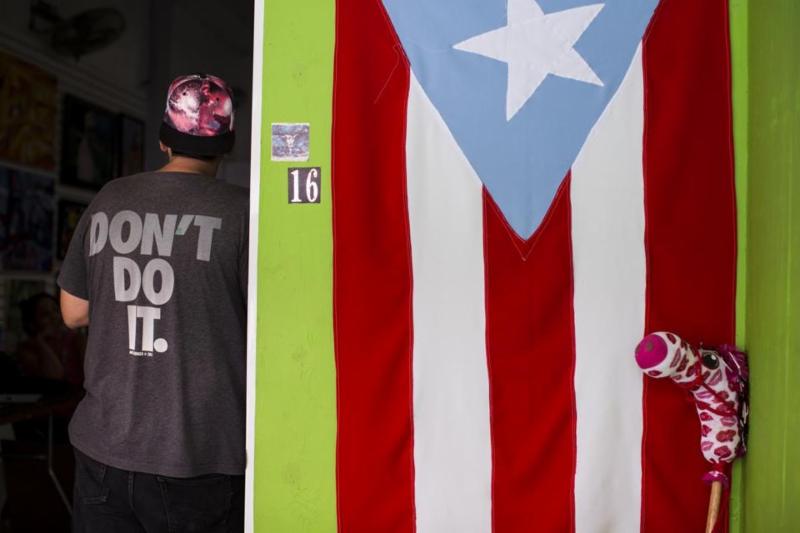
A Puerto Rican flag was draped outside a community gallery in Caguas, Ruerto Rico, on June 7. Puerto Ricans have been sharply divided over White House-backed legislation designed to reboot their economy.


By Stephen Kinzer, The Boston Globe


‘DO NOT MAKE peace until we get Porto Rico,” Theodore Roosevelt wrote in 1898 to Senator Henry Cabot Lodge, his closest friend and political partner. Lodge’s answer was reassuring: “Porto Rico is not forgotten and we mean to have it.”
A few weeks after that exchange, American troops landed in Puerto Rico, seized it, and proclaimed it part of the United States. The colonial experiment has not gone well. By most standards - health, education, per capita income, rates of violent crime - Puerto Rico compares poorly to even the most backward US states. Now it is broke.
Puerto Rico’s governor has restricted withdrawals from the government development bank and placed the highway authority in a “state of emergency” so creditors cannot seize its assets. Hundreds of businesses have closed. Schools lack electricity. Hospitals have reduced their services. The Zika virus is spreading and, according to the Centers for Disease Control and Prevention, may afflict one-fourth of the population by the end of this year. Planeloads of Puerto Ricans are emigrating each week, including many teachers and other professionals. The remaining population is older, poorer, and more in need of services the government cannot provide.

June 6, 2016

Political Report # 1148 Puerto Rico: a Junta By Any Other Name


By Miguel A. Cruz Díaz


Empire is once again fashionable. The financial crisis that is presently gutting the island of Puerto Rico plays out like the world's worst case of botched assisted suicide. The sell of its municipal funds and its constitutionally guaranteed promise of repayment to investors has plunged the island into a very precarious situation for its millions of citizens and the opportunity of a lifetime for hedge fund vultures. While it is laudable that the current economic meltdown on the island has made some headlines, including a mostly well-thought out piece by comedian John Oliver, the same cannot be said for the congressional knee-jerk legislative reaction to it. The bill, H.R. 4900, was designed to impose an oversight board meant to administer the fiscal responsibilities of the Puerto Rican people and has unleashed a firestorm of opposition that was glossed over by Oliver's otherwise on-point observations. The controversy surrounding this bill has served as a catalyst underscoring the deep disregard bordering on contempt that frames the question of self-determination and complete lack of sovereignty afforded to islanders.

May 27, 2016

Political Report # 1145 Puerto Rico: The Crisis Is About Colonialism, Not Debt


By Linda Backiel, Monthly Review


Tourists are fascinated by the heavy blue cobblestones that pave the streets of Old San Juan. Why they are there is as good an explanation as any for Puerto Rico's current crisis. In the days of Spanish colonialism, they were ballast to keep the ships crossing the Atlantic from tossing about and blowing over. The ships came empty, and left for Spain full of gold, silver, and other riches stolen from the indigenous Taínos. The ballast left behind was used to pave the streets.
Puerto Rico has been sacked by colonial powers for half a millennium. Is it any wonder it is in dire straits? Today, it is $73 billion in debt. As a point of comparison: Greece recently asked for about $82 billion from the European Union. The German finance minister thought it was funny when he proposed to U.S. Treasury Secretary Jack Lew that the Eurozone exchange Greece for Puerto Rico. This is not funny; it is not even a good analogy. Neither the Germans nor the Eurozone have the power to "trade Greece" to anyone; its citizens can tell their prime minister what they think about EU debt proposals. Of course, they have to weigh their choice against the threat of being kicked out of the Eurozone.1

April 20, 2016

Political Report # 1134 No More Colonialism Disguised as Financial Assistance: The US Must Relinquish Puerto Rico By Nelson A. Denis, Truthout


Puerto Rican Congressional Delegate Pedro Pierluisi speaks during a National Day of Action for Puerto Rico during a news conference on Capitol Hill in Washington, December 2, 2015. The impoverished island turned to hedge funds to stave off collapse; now someone has to pay. (Photo: Zach Gibson / The New York Times)


By Nelson A. Denis, Truthout 


This year, 2016, marks a new era in Caribbean colonialism.
The US Congress is preparing a "Financial Control Authority," which will supervise the finances of the entire government of Puerto Rico -- its legislature and courts, public authorities, pension system and all leases, union contracts and collective bargaining agreements. The authority will also restructure the entire public workforce (including teachers and police), freeze public pensions and ensure "the payment of debt obligations." Then it will issue its own debt, spend the funds as it sees fit and leave Puerto Rico to pay the bill.
Congress can veto any law passed in Puerto Rico.
The authority will also have prosecutorial powers. It will be empowered to "conduct necessary investigations" into the government of Puerto Rico, or in other words, be empowered to hold hearings, secure government records, demand evidence, take testimony, subpoena witnesses and administer oaths -- under penalty of perjury -- to all witnesses.
Any witness who fails to appear or to supply information will be subject to criminal prosecution and removal from office. This includes any elected official on the island: even the governor and attorney general.
All of these powers are enumerated in the 157-page Senate Bill 2381, also known as the "Puerto Rico Assistance Act of 2015," which is currently under review in the US Senate.
The bill is supported by banking lobbyists in Washington, DC, since it will ensure the repayment of $72 billion in public debt and exclude any bankruptcy protections.
It is opposed by many of the island's journalists, union leaders and independence advocates, who view the looming "authority" as nothing more than a hedge fund collection agency. They also fear the imposition of a de facto dictatorship in the Caribbean: created in Washington, operated from Wall Street, all disguised as a "management assistance authority."
But the problem in Puerto Rico is not its debt, the vulture funds or even the Financial Control Authority. The problem is that Puerto Rico, a tiny island in the Caribbean, is staring into the rifle barrel of the entire US capitalist system.
Sooner or later, there will be an explosion.

January 25, 2016

Political Report # 1107 How Hedge Funds Are Pillaging Puerto Rico By David Dayen, The American Prospect


Clementina Murcia González, from Honduras, holds up the pictures of her two missing sons, Jorge Orlando Funes Murcia and Mauro Orlando Funes. (photo: Federico Barahona)


By David Dayen, The American Prospect 


Vulture investors have descended on the commonwealth, taking advantage of a debt crisis that has impoverished citizens and created massive unemployment.
his is a distress call from a ship of 3.5 million American citizens that have been lost at sea," Puerto Rico Governor Alejandro García Padilla said on December 1, begging the Senate Judiciary Committee to help protect his homeland from an unspooling disaster. After issuing bonds for over a decade on everything not nailed down, Puerto Rico now carries $73 billion in debt, a sum that García Padilla had termed "not payable" in June. Successive governments have enacted punishing austerity measures to service the debt, despite a stubbornly depressed economy and poverty rates near 50 percent. Now, after defaulting on smaller loans, it's likely that much of the $957 million due January 1 will go unpaid, bringing more chaos and suffering at the hands of Puerto Rico's creditors.
In many ways, the Puerto Rico situation is sui generis, resulting from a patchwork of laws and obligations on an entity that is not really a country and not really a U.S. state. But looked at another way, Puerto Rico is just the latest battlefield for a phalanx of hedge funds called "vultures," which pick at the withered sinews of troubled governments. In Greece, Argentina, Detroit, and now Puerto Rico, vultures have bought distressed debt on the cheap, and then used coercion, threats, and legal action to secure a massive windfall, compounding the effects on millions of citizens.


December 4, 2015

Political Report # 1095 Debt and the Punishing of Mexico’s Working Classes By Enrique C. Ochoa, El BeiSMan


Alejandrina Castillo, 12, picks chile peppers near Teacapan, Sinaloa. An estimated 100,000 children toil in Mexican fields for pay. Some work for farms that export produce to the U.S. Photo: Los Angeles Times/ Don Bartletti
By Enrique C. Ochoa, El BeiSMan
In her 2007 book, The Shock Doctrine: The Rise of Disaster Capitalism, journalist Naomi Klein demonstrated how from Buenos Aires to New Orleans political leaders in alliance with national and global capital fabricated and manipulated crises to plunder the gains won by working class movements. These crises varied widely from guerrilla insurgencies and popular protests to economic meltdowns and natural disasters. In almost all instances, the method was the same: segments of the elite hyped the crisis while masking its origins in order to grab greater economic and political power. The results varied, but in nearly all cases free-market reforms were imposed and state companies privatized enriching a few. Meanwhile social programs were slashed, unions smashed, and social movements repressed.

August 14, 2015

Political Report # 1067 Capital Over People? Puerto Rican Debt Crisis Explained By Chandler Foust, COHA


                Featured Photo: Aeriel view of Old San Juan.
            From: U.S. National Park Service.


By Chandler Foust, Research Associate at the Council on Hemispheric Affairs
 
UPDATE (August 4, 2015, 2:28 p.m.): On Monday August 4, Puerto Rico's Public Finance Corporation failed to pay the $58 million USD it owed creditors, making only a $628,000 USD payment. In addition, the island owes $5 billion USD over the next twelve months. Monday marked the first day in the island's history where it failed to make a payment.
The current debt crisis in Puerto Rico not only illustrates a need for a complete restructuring of the island's economy, but a closer look taken toward its further political union with the United States. In addition, the current crisis shows the flawed way that politicians respond to debt crises, and how the people who end up getting hurt are usually not the ones who started the crisis. Lastly, the current political debate between debtors and creditors, harsh austerity measures, and further concessions to capital has shown that these lessons have yet to sink in for many.


August 5, 2015

Political Report # 1065 The Roots of Puerto Rico's Debt Crisis-and Why Austerity Will Not Solve It


                            By Ed Morales, The Nation
 
Riding through the hills of Canóvanas last weekend with Prima, a vacationing 65-year-old Brooklynite who was born and raised in the Puerto Rican countryside, I got a brief lesson on the island's history and political economy. "This land was all cañaverales," she said, meaning rough acres of sugarcane, which has now been replaced by mile after mile of suburban tract housing. "When that ended, some people worked in factories and construction. Now, I don't know what's going to happen. I think the empire is collapsing."

Today that history has caught up with the island. Puerto Rico-an unincorporated territory of the United States with 3.5 million US citizen residents who do not have the right to vote for president or representation in Congress-is making headlines these days because of its inability to pay a $72 billion debt owed to holders of its devalued bonds, often issued through such entities as the infamous PREPA, the electrical power authority. The threat of default was signaled by Governor Alejandro García Padilla's admission last week to The New York Times that the debt was "not payable."

July 14, 2015

Political Report # 1057 Puerto Rico's Economic and Fiscal Crisis: Made in the U.S.A. by Victor M. Rodriguez, CounterPunch


                                              By Victor M. Rodriguez, CounterPunch
 
On Tuesday June 23, the Special Decolonization Committee of the United Nations heard 30 petitioners who came to denounce from various perspectives the colonial situation of Puerto Rico. For the 34th time the UN committee approved a resolution requesting that the United States allow Puerto Rico to exercise its right to self-determination and independence. In 1953, the U.S. and colonial administrators lied to the U.N. in order to get Puerto Rico off the list of territories which still had not achieved self-determination. They told the UN that Puerto Rico in 1952 had drafted a constitution and now was exercising self-determination. This despite the fact, as Jose Trias Monge who was the Attorney General of Puerto Rico from 1953 and 1957 and a central actor in the colonial government, revealed in his book Puerto Rico the Trials of the Oldest Colony in the World (1997) that the government of the United States, through the state department and the department of the interior said "Puerto Rico should still be considered a territory."  Through political pressure in a smaller United Nations, the US petition to remove Puerto Rico from the list was approved with 26-16 and eighteen abstentions.

July 6, 2015

Political Report # 1053 Puerto Rico - like Greece - will default on its debts, as the U.S. has ignored the island’s financial problems for decades By Juan Gonzalez, NY Daily News


                                    RICARDO ARDUENGO/AP

                           A local walks by closed San Juan bank, where posters say, 'Let rich pay for crisis.'


                           By Juan Gonzalez, NY Daily News
 
Obama to Puerto Rico: Drop Dead.

That was the message from the White House this week to 3.5 million U.S. citizens of Puerto Rico - our own version of Greece.