Showing posts with label Neoliberalism. Show all posts

April 22, 2021

Blog Exclusive - On the threshold of a Latin American and Caribbean tie-breaker?

written by Félix Pablo Friggeri y Angélica Remache López

    The description of the regional situation and its integration process has gone through a series of conceptualizations with diverse political intentions. We propose a characterization based on the concept of “catastrophic tie,” seeking to highlight elements that may be studied prospectively, considering recent events. These include aspects of the electoral processes and popular demonstrations that have taken place in recent times. We raise the question of whether we are moving towards the possibility of a resumption of the predominance of popular governments and regional integration processes.

Regional catastrophic tie

    We understand that there are two mistakes in the interpretation of the Latin American-Caribbean regional reality, it is, therefore, important to overcome those in order to understand the current situation and generate an analysis that serves as the source of the political debate oriented to respond the popular needs and popular struggles of our region. 

    In the face of the relative predominance of popular governments in at least part of the first two decades of this century, the idea that we had entered a “post-neoliberal era” resonated throughout the continent. Some studies used this term, which had accurate elements of the analysis of reality, but its reading in the sense that the neoliberal conformation had been fundamentally overcome was not in line with what was predominating in the economic world and, in a good part, of the social imaginary of our countries.  Latin America and the Caribbean was the only region on the planet that, as such, formed a regional bloc to contestation to neoliberal hegemony. The neoliberal hegemony, however, continued to define the fundamentals of the economic dynamics and social imaginary, especially those related to socio-economic mobility. The predominance of popular governments represented a strong and relatively sustained challenge to the hegemony of global capital, but never its definitive defeat. Neoliberalism continued to define the fundamentals of labor relations, capital accumulation processes, the people-nature relationship and the rural and urban property system. This explains why popular governments achieved significant advances in income distribution but did not achieve a considerable modification in the distribution of wealth, which is what modifies the correlation of social forces (Schuldt 2013). The core of the explanation of the regional crisis in the face of emerging progressive governments with popular characteristics suffers, therefore, opens a way to a relative predominance of the forces of the neoliberal right.

    The second mistake was to understand the advance of the forces of wild capitalism as the “end of the populist cycle.” An interpretation clearly organized by the right, but which was accompanied by some versions of the intellectual left, generally conditioned by the economic view. The right-wing achieved a relative hegemony based on several coups d’état (Honduras 2009; Paraguay 2013; Brazil 2016; Bolivia 2019), on the pressure and encirclement of governments and peoples (Cuba and Venezuela), on some electoral processes that represented defeats for popular forces, but, above all and fundamentally, by multiple forms of u.s. interventionism. At the internal level, they played in favor of what Álvaro García Linera (2016) called “declassification” processes. Because of this process, part of the same population that benefited by the so-called “inclusion policies” of the popular governments ended up voting against them. This phenomenon has happened in several countries of the region and should be analyzed rigorously: people who were poor and who began to have access to some goods they had never had and who were identified -with more or less reason- as people who came out of poverty and began to be part of what was identified as “middle class,” adopted the discourse and political options of the bosses, stopped voting “as poor” and voted as “middle class” and adopted criteria against the working majorities to which they still belonged. This was a partial phenomenon, perhaps conjunctural, but it influenced the advance of the right wing in the popular spheres. This is what we would call the “mercantilization of social mobility.” Another mercantilizing process that collaborated in this “right-wing” of a part of the popular sectors was that of spirituality, driven, above all, by the so-called “Theology of Prosperity” that orients a good part of what is called the Neo-Pentecostal movement.

    We understand that the situation that has been developed in the region for several years may be described as a “catastrophic tie.” The political concept of “tie” arises from the work of Antonio Gramsci, but was developed, especially, by two Latin American authors to describe the conjunctural realities of their countries. One was the Argentine Juan Carlos Portantiero (2003) in the 1970s. He described the reality of his country as a “hegemonic tie” because the groups fighting for power were not strong enough to lead the country, but they did have the strength to veto opposing projects. The other approach, with which Álvaro García Linera (2008) described the reality of Bolivia, opted for the expression “catastrophic tie,” highlighting the existence of two political projects with the capacity to attract and mobilize social forces with an extended scope, but whose confrontation resulted in a “paralysis of the state command.” For him, the way out of this situation was the election of Evo Morales. This theoretical approach, which the authors use to describe the reality of their countries, can also be used to analyze the current regional situation.


On a regional tie-breaker?

    The victories of Andrés López Obrador in Mexico in 2018 and Alfredo Fernández in Argentina in 2019 were key to the advance of a change in the regional landscape. Both countries have a population and economic weight, behind Brazil, among the most important in the region. Their articulation, given in the Community of Latin American and Caribbean States (CELAC), in the Puebla Group and in joint actions among which the action to save the lives of Evo Morales, García Linera and other Bolivian officials at the time of the coup d'etat in that country, highlights the possibility of an “Argentina / Mexico Axis” that can promote policies different from the purely neoliberal ones and a resumption of the process of regional articulation.

November 26, 2020

Abstract: Environmental Violence and the Socio-environmental (de)Evolution of a Landscape in the San Quintín Valley


:::::: Abstract ::::::


Environmental Violence and the Socio-environmental (de)Evolution of a Landscape in the San Quintín Valley
 

by  Nemer E. Narchi, Sula E. Vanderplank, Jesús Medina-Rodríguez, Enrique Alfaro-Mercado

"The social and environmental effects of industrial agriculture in the San Quintín Valley of Baja California are closely related. An environmental history of the valley from European contact to the present demonstrates that modern schemes of globalized agricultural production erode biological diversity while fostering labor exploitation. A critical model drawing on the concept of environmental violence— historically structured asymmetrical power relations that are reproduced and maintained to foster capital accumulation—describes how neoliberalism shapes and exploits agro-industrial landscapes and livelihoods in San Quintín to produce a crisis of underproduction.


CONTINUE READING FULL ARTICLE HERE


SaveSave
SaveSave
SaveSave
SaveSave
SaveSave

November 10, 2020


:::::: Abstract ::::::


Climate Change, Neoliberalism, and Migration: Mexican Sons of Peasants on the Beach
 

by  Tamar Diana Wilson

Climate change and neoliberal policies in Mexico have been fomenting migration by campesinos and their sons. This migration is primarily internal, to cities and tourist centers, where migrants engage in informal and semi-informal income-generating activities. Interviews with 32 beach vendors, sons of campesinos, in Cabo San Lucas reflect these two drivers of migration: while most reported that they would like to farm, they identified drought and lack of government aid as major difficulties for farmers in their hometowns.


July 3, 2020

Abstract, Neoliberal Urbanization and Synergistic Violence in Postearthquake Concepción

:::::: Abstract ::::::


Neoliberal Urbanization and Synergistic Violence in Postearthquake Concepción 

by Christian Paulo Matus Madrid, Rodrigo Ganter, Juan Antonio Carrasco, and Camila Barraza Huaiquimilla

The Chilean neoliberal state’s institutional strategy for displacing a historical population from Aurora de Chile, a centrally located area with real estate value in the city of Concepción, combined three types of violence: shock urbanization, which used the 2010 earthquake as an opportunity to impose the construction of major infrastructure, the construction of public opinion aimed at naturalizing displacement, and the strategic use of participation as a disciplinary socio-technical device to legitimize a solution to the conflict that guaranteed the building of the Bicentennial Bridge. The deployment of this synergistic, multifaceted violence was a sophisticated management technique associated with a neoliberal urban rationality that contributed to the process of urban renewal.


June 12, 2020

Abstract, Exceptionality and Colonial-State–Corporate Crimes in the Puerto Rican Fiscal and Economic Crisis

:::::: Abstract ::::::


Exceptionality and Colonial-State–Corporate Crimes in the Puerto Rican Fiscal and Economic Crisis

by José Atiles Osoria


A sociolegal analysis of the sources of Puerto Rico’s fiscal and economic crisis points to the use of the colonial state of exception as an economic development policy facilitating the creation of a tax-haven-like economy and normalizing a series of a colonial-state–corporate crimes. The Puerto Rican people need to hold those who generated the crisis accountable both politically and legally. They must continue mobilizing and promoting the repoliticization of recovery efforts by not paying the public debt, taking legal action against financial predators and corrupt politicians, clawing back fees and refusing to pay any additional fees, giving more importance to the human rights of Puerto Ricans than to the rights of bondholders and vulture funds, and initiating a process of decolonization that will allow them to make decisions about their future.


April 24, 2020

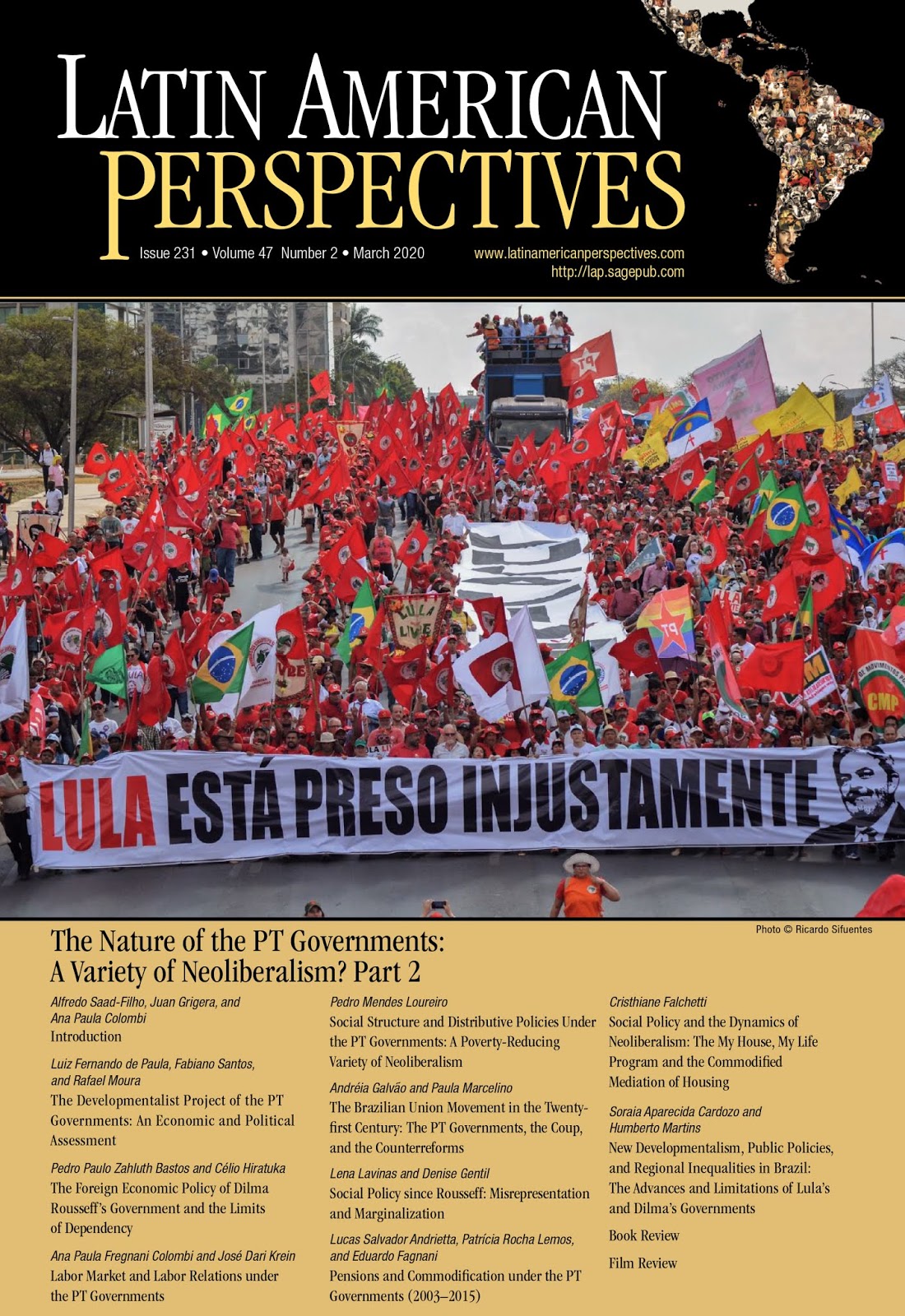
Abstract - Social Structure and Distributive Policies under the PT Governments: A Poverty-Reducing Variety of Neoliberalism

:::::: Abstract ::::::


Social Structure and Distributive Policies under the PT Governments: A Poverty-Reducing Variety of Neoliberalism

by Pedro Mendes Loureiro

Brazil’s social structure and associated distributive policies during the PT governments did not depart from neoliberalism but rather implemented a poverty-reducing variant of it. Through minimum-wage hikes, conditional cash transfers, legislation driving financial innovation, and the subsidizing of privately provided for-profit services, state power was used to include individuals in ever-expanding formal circuits of commodity production and consumption. Deprivation in multiple dimensions was indeed reduced through these policies, but in the process social mobility came to mean exiting poverty, getting a formal low-skilled job, and accessing credit at lower interest rates to pay for state-subsidized private health and education.


April 16, 2020

Political Report # 1440 Ecuador: An October that lights up March


Political Report # 1440

Ecuador: An October that lights up March


Luisa Lozano is the director of women’s organizing of the National Confederation of Indigenous Nationalities in Ecuador (CONAIE), which incorporates 18 communities from 14 Indigenous nations from the coast, the Amazon and the Andean region. She was one of the key women who participated in organizing and sustaining the Indigenous and popular uprising that took place in Ecuador in October of 2019, against Decree 883. 

In August of 2015, Lozano was imprisoned while protesting against neoliberal measures that threaten the lifeways of communities and against the organizational forms of rural smallholders. She was charged with paralyzing public services and instigation, and sentenced for four years in jail. Together with her lawyers she fought against incarceration. She was in prison for 16 days and spent more than three years under house arrest, after which she was absolved. 

Today, Lozano is participating together with a team of lawyers in the legal case against the state of Ecuador. They are seeking to establish the causes of the nine assassinations and many other injuries, including serious injuries to those who were shot with buckshot, that took place during the Indigenous uprising. The goal is to ensure that these crimes do not remain in impunity.

In our conversation, Lozano analyzes the effects and the responses of the police and army attack against communities who participated in the uprising in Ecuador in October. She discusses how women led the call to end violence, while at the same time looking after feeding a massive mobilization of over 50,000 people who were in the streets of Quito with their children in protest against the economic measures and structural adjustment contained in Decree 883. She also talks about what happened when President Lenin Moreno abandoned the Carondelet (the seat of government) in Quito and moved to Guayaquil, among other things. What follows is a transcript of our interview, edited for length and clarity.

Gladys Tzul Tzul: I’m calling this interview “An October that lights up March” because as Indigenous women, we are entering the month of March this year with the very important precedent of the Indigenous and popular uprising in Ecuador. Women were the backbone of the October strike, in terms of care, discourse and leadership. How did you experience those days in October?

Luisa Lozano: During the uprising, as women we were the ones making an appeal to stop the violence. We put ourselves in front of the police to say to them: “Don’t kill us. Our children are waiting for us at home. Why are you killing us, we are just protesting.” It was women who managed to calm the violence. 

The state didn’t take into account the consequences, or the impacts that would take place in the communities. The state declared a curfew. They sent busses, horses, motorcycles, bullets, bombs, police and soldiers to repress us. The state never respected the peace zones, of which the CONAIE created four: the Universities, El Arbolito Park, and the agora of the Casa de Cultura. They entered those areas and repressed women, boys and girls. Regardless, the women stayed. We united with women from the countryside and led a march of more than 15,000 women. 

When the state saw our strength, and saw that everyone was rising up, it abandoned the Carondelet and left for Guayaquil. The congresspeople left. We were never armed, our hands were empty, but we were intensely repressed. The police went against their word.

GTT: Explain a little more what you mean when you say the police went against their word.

LL: In Indigenous communities there is great value placed on our word. If you give your word, you must follow through. That’s how it is in Indigenous communities. The value of our word is fundamental. If you make a promise, you must follow through. We spoke with the police commander, we spoke with the head of the army, we also spoke with a woman police officer who was in charge during some of those shifts. 

We told them we were unarmed, that we were peacefully protesting for the annulment of Decree 883, and demanded the congresspeople return. We told them to stop the violence before there was a bloodbath. They agreed that they would not repress us, but it didn’t end up that way. Women from the communities and from the city held a march to demand the cancellation of 883.

When we women took over the National Assembly, we demanded that they return to do their work. We were singing, dancing, eating, and calling for an end to violence. And that’s when they repressed us. There were more than 15,000 women. And the repression was intense, really harsh against the women. Our hands were empty, they attacked us with buckshot, with gas canisters. It was made very clear to us that violence against women comes from the state as well. We suffered violent attacks and also political attacks, because there was fake news created that said we had sold out.

GTT: How did you interpret those attacks, and how did you react? 

LL: The best strategy, so that the Indigenous movement didn’t end up getting crushed, was to hold an open public dialogue. We made our dialogues public, so that people could see on TV and hear on the radio who was negotiating and who refused to change their position. Unfortunately, that public dialogue required a huge amount of energy. We organized the dialogue, but there, the dead and wounded passed under our noses.

As leaders, we ended up exhausted, because our base was asking us to look after our interests and the government was attacking us. After 11 days we were tired, hungry, under-slept, we hadn’t bathed, we were even looking after the wounded. And at the same time as we were avoiding direct persecution by infiltrators, secret agents and police who were following us. We even went into hiding in order to care for ourselves.

With all of our strength combined we managed to take down the Decree. The goal is to establish decrees that don’t hurt the communities. We were accused of being terrorists, saboteurs, criminals. But we even planned and carried out a day to clean up the streets in the city of Quito.

GTT: What do you think about the next step after the strike? How are the struggles of the women from the communities?

LL: There are nine people who were killed, one person in a coma, our records show that 1,300 people were injured and 1,160 more were criminalized. The CONAIE has taken on the important goal of seeking justice. The health of the wounded is not being guaranteed. As a woman leader, we’re working so that neither state violence nor femicide (the killing of women because of their gender) remain in impunity. The army and the police shot directly at us, all we had were gas masks.

The period after the strike brought criminalization to the communities and to families. But it is clear to everyone in Ecuador that Decree 883 and the state apparatus function without consulting. Their actions impact not just communities, but everyone. In addition, we’ve been attacked, because they say we don’t allow development. [In the last week of February] there were three femicides in Ecuador. We have to keep working on prevention strategies from below, at the community and family level. 

But it is also the responsibility of men to look after life. Men have that responsibility. It is the responsibility of the whole community. Just as we work in chacra (communal work), that’s how we have to work against violence against women. During the march in October, it was the communities that came out, women and men, to topple a Decree. We’ll struggle in the same way against violence. 

Finally, we salute the [feminist/women’s] struggles in March, these are women who have given up their lives to fight for better working conditions. In the case of Indigenous women, we celebrate on September 5 (the International Day of Indigenous Women, which is commemorated on the anniversary of the assassination of Bartolina Sisa, an Aymara women who fought shoulder to shoulder with Tupac Katari). That is also a day of struggle. 

Translated and slightly edited by Toward Freedom with permission and input from the author. Read the original here.

Original article can be found (here).
URL:      https://towardfreedom.org/story/ecuador-an-october-that-lights-up-march/

February 3, 2020

Abstract: Profitability and Distribution: The Origin of the Brazilian Economic and Political Crisis

:::::: Abstract ::::::


Profitability and Distribution: The Origin of the Brazilian Economic and Political Crisis


by Adalmir Antonio Marquetti, Cecilia Hoff, and Alessandro Miebach


The PT governments combined elements of developmentalism and neoliberalism in a contradictory construction, organizing a large political coalition of workers and capitalists that allowed expanding the real wage and reducing poverty and inequality while maintaining the gains of productive and financing capitals. The decline of profitability after the 2008 crisis broke the class coalition constructed during Lula’s administration. The Dilma Rousseff government adopted a series of fiscal stimuli for private capital accumulation with meager economic growth. After her reelection, the government implemented an austerity program that resulted in negative growth rates. With the deepening economic crisis and without political support, Rousseff was removed from power.


January 20, 2020

Abstract: Growth, Distribution, and Crisis: The Worker's Party Administrations

:::::: Abstract ::::::


Growth, Distribution, and Crisis: The Worker's Party Administrations


by Pedro Cezar Dutra Friedmann and Claudio A. Castelo Branco Puty


The economic policies of the governments of Lula da Silva (2003–2010) and Dilma Rousseff (2011–2016) combined orthodox measures with distinctive pro-growth measures that, although they deviated from neoliberalism, cannot be called “developmentalist” either. They lacked a long-term strategy for reversing the deindustrialization of the country or advancing to a new technological paradigm. They did, however, have a historical commitment to income redistribution that was largely implemented. The broad social pact proposed by Lula acknowledged the hegemony of financial capital, and its contradiction was that it protected the hegemonic group by means of monetary and fiscal policies that required growth in the gross domestic product, a favorable balance of payments, and a gap between wages and productivity. When these conditions no longer held, Rousseff responded to the crisis with a “new macroeconomic matrix” that amounted to the abandonment of Lula’s class-coalition pact.


January 14, 2020

Abstract, Sailing Against the Wind: The Rise and Crisis of a Low-Conflict Progressivism

:::::: Abstract ::::::


Sailing Against the Wind: The Rise and Crisis of a Low-Conflict Progressivism

by Gustavo Codas Friedmann, Claudio A. Castelo Branco Puty


The governments of the Partido dos Trabalhadores (Workers’ Party—PT) in Brazil (2003– 2016) were part of a cycle of progressive governments in Latin America whose differences are more specific to the conditions of political struggle in each country—the conditions of arrival in government, the structure of the political system—than fundamentally programmatic. They can be characterized as a low-conflict progressivism in that, although there was no promotion of a neoliberal agenda on the model of European social liberalism, there was accommodation within the framework of the established order that was ultimately fundamental to the success of the 2016 parliamentary-judicial coup.


January 9, 2020

Abstract, The Government of the Workers' Party: Capitalist Development Pattern and Macroeconomic Policy Regimes

:::::: Abstract ::::::


The Government of the Workers' Party: Capitalist Development Pattern and Macroeconomic Policy Regimes

by Luis Filgueiras


From the point of view of their capitalist development pattern, the governments of Fernando Collor de Mello, Fernando Henrique Cardoso, and Michel Temer, on the one hand, and Lula da Silva and Dilma Rousseff, on the other, were similar: the former were actively promoting that pattern and the latter accepting it as irreversible, the limit of the possible, and adapting to it. They differed, however, in the macroeconomic policy regimes they adopted. The development pattern of the Workers’ Party governments may be described as the peripheral-liberal pattern, the form assumed by neoliberalism in Brazil.