Showing posts with label Partido dos Trabalhadores (PT). Show all posts

April 24, 2020

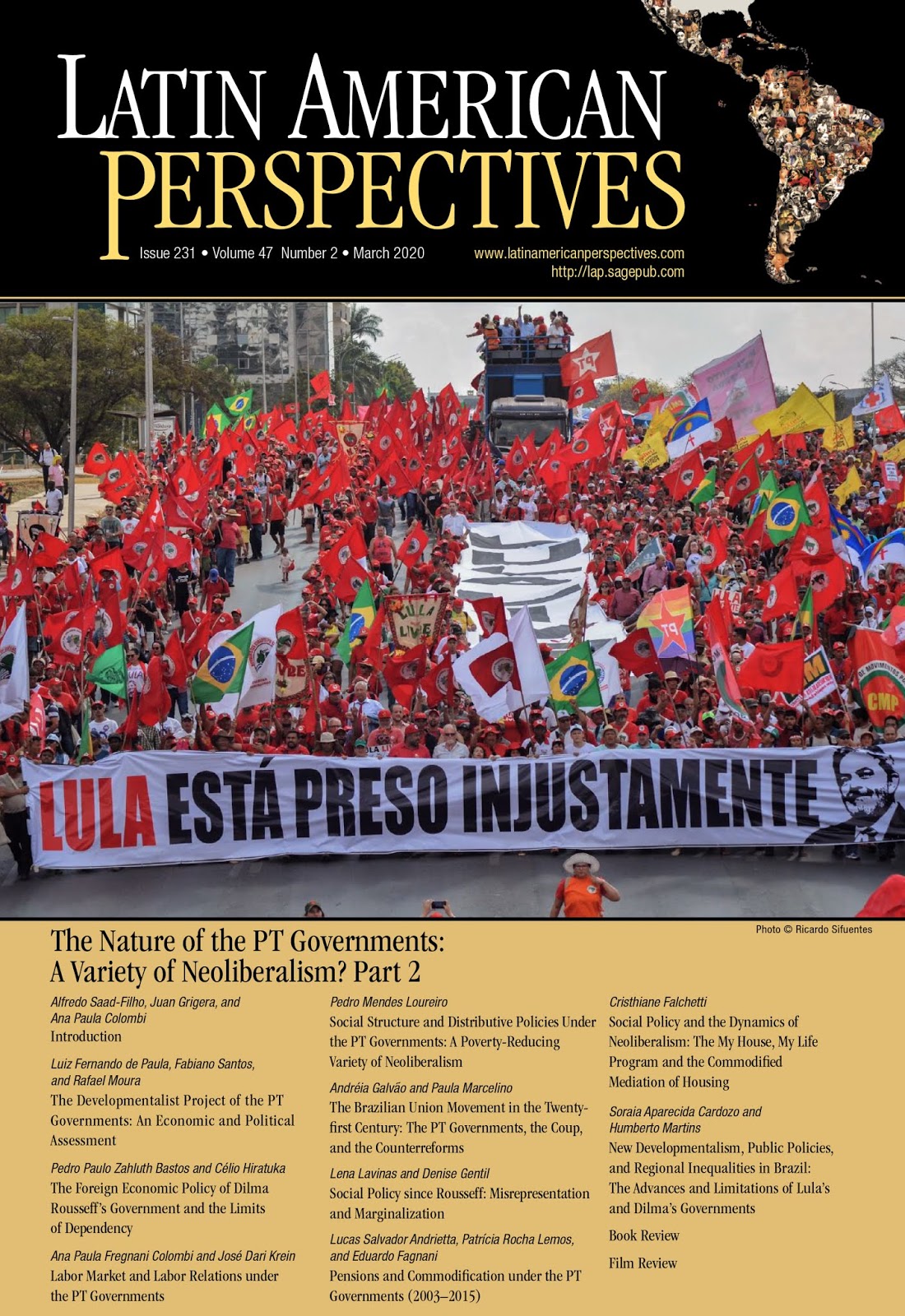
Abstract - Social Structure and Distributive Policies under the PT Governments: A Poverty-Reducing Variety of Neoliberalism

:::::: Abstract ::::::


Social Structure and Distributive Policies under the PT Governments: A Poverty-Reducing Variety of Neoliberalism

by Pedro Mendes Loureiro

Brazil’s social structure and associated distributive policies during the PT governments did not depart from neoliberalism but rather implemented a poverty-reducing variant of it. Through minimum-wage hikes, conditional cash transfers, legislation driving financial innovation, and the subsidizing of privately provided for-profit services, state power was used to include individuals in ever-expanding formal circuits of commodity production and consumption. Deprivation in multiple dimensions was indeed reduced through these policies, but in the process social mobility came to mean exiting poverty, getting a formal low-skilled job, and accessing credit at lower interest rates to pay for state-subsidized private health and education.


April 19, 2020

Abstract: The Developmentalist Project of the PT Governments: An Economic and Political Assessment

:::::: Abstract ::::::


The Developmentalist Project of the PT Governments: An Economic and Political Assessment

by Luiz Fernando de Paula, Fabiano Santos, Rafael Moura


An analysis of the endogenous and exogenous political and economic factors that conditioned the Partido dos Trabalhadores’s (PT) social-developmentalist project in 2003–2016 in the light of financialization and the “confidence game” conditioned by the volatility of external liquidity and commodities prices concludes that the first Lula administration faced the problem of a crisis of confidence and adopted orthodox policies but was able, with the improvement of international conditions, to launch policies of a more interventionist and distributive trend. Dilma Rousseff, facing a downright unfavorable international context, explicitly broke with the confidence game by applying the policy set of the new macroeconomic matrix. In her second term she radically reversed the policy orientation, moving toward a strong fiscal adjustment and monetary orthodoxy, and this eventually undermined her few sources of political support. The economic crisis from the second half of 2014 on undoubtedly contributed to the political crisis, which in turn made infeasible any attempt to implement policies to reverse the situation of economic crisis. Dilma’s impeachment finally interrupted the PT’s developmentalist project, allowing the emergence of new political actors.


February 24, 2020

Abstract: The Political Economy of Lulism and Its Aftermath

:::::: Abstract ::::::


The Political Economy of Lulism and Its Aftermath

by Ruy Braga and Fabio Luis Barbosa Dos Santos


President Dilma Rousseff’s impeachment should be framed as part of the crisis of the Lulist mode of regulation of social conflict. The Partido dos Trabalhadores (Workers’ Party—PT) presidencies lost their functionality from the standpoint of the interests of the traditional ruling classes of the country, led by the financial sector. The breakdown of Lulism was the exhaustion of the mediation between the predatory aspirations of the Brazilian bourgeoisie and the rights and aspirations of workers. This exhaustion was first evident in June 2013 and became acute in the subsequent years as the government was confronted with economic crises and corruption scandals. The Temer administration’s open confrontation of the working class pointed to a return of workers’ living conditions to the nineteenth century, but these measures reflected not a turning point but simply an acceleration of the pace of the prevailing politics. The collaboration of the ruling PT in confusing, calming, and alienating the popular classes helps explain the negligible popular reaction to the impeachment, the antipopular assault led by Temer, and Lula’s arrest.


October 19, 2018

Political Report # 1377 Bolsonaro’s Most Dangerous Supporters

The first round of Brazil’s elections saw the neo-fascist candidate Jair Bolsonaro come within four points of victory. Between Bolsonaro and victory however stands The Workers Party’s (PT) candidate Fernando Haddad. He has less than two weeks to stop Bolsonaro, after coming second with only 29 percent of the vote. Moreover Bolsonaro’s Social Liberal Party (PSL) went from political irrelevance to become the second-largest party in Brazil overnight. It is no exaggeration to say that Brazilian democracy itself is at stake.
Even if Haddad manages to pull off a last-minute victory, in the polarized climate of Brazilian politics there could still be a hard military coup to follow the soft congressional coup that removed Dilma Rousseff in 2016. Bolsonaro has the backing of significant sectors within the military hostile to the PT.
These sectors, along with many on the Brazilian right, claim the PT is trying to enact “a “silent revolution” with the goal of turning Brazil into a communist dictatorship. In order to understand both Bolsonaro’s rise and the danger to democracy he poses, it is vital to examine the anti-PT faction in the military.

October 12, 2018

Political Report # 1375 The Workers’ Party electoral struggle in Brazil


            To be anti-PT in Brazil these days, makes one a member of the country’s largest political “party.” The PT is Brazil’s famous Workers’ Party, which was formed by leftists, neighborhood activists and labor union militants in order to renovate democratic politics and escape the stale pull of Brazil’s communist parties as the country’s 21-year-long military dictatorship (1964-1985) came to a tortured end. After many attempts, the PT’s founding light, Luís Ignacio Lula da Silva, served twice as Brazil’s president (2003-2010). His protégé, Dilma Rousseff, was also elected twice for president, becoming Brazil’s first female executive, but her second term ended abruptly in a parliamentary coup d’etat in 2016.

            On Sunday, October 7, the size of the anti-PT vote became apparent when more than 49 million citizens marked their ballots for Jair Bolsonaro, a retired army captain and current Rio de Janeiro congressional representative, who is campaigning to be Brazil’s president on the ticket of the Social Liberal Party (PSL). Critics call Bolsonaro a “fascist” due to his expressions of authoritarianism, ultra-nationalism, machismo, and racism. His aggressive rhetoric and meteoric growth in popularity certainly mark him as Brazil’s contribution to the rightward tilt of politics internationally, something of a Brazilian Donald Trump. In this first round of elections, the voters’ top two choices were Bolsonaro, with 46 percent of the vote, and Fernando Haddad, the PT’s candidate, with 29 percent of the vote. The remaining electorate cast their votes for one or another of the remaining 11 candidates. In essence, 70 percent of 107 million electors voted against the PT.

            Due to polling, the overall results surprised few. Nevertheless, nearly all earlier polls had shown a rejection rate for Bolsonaro of over 60 percent. Now, a short time before the final election round on October 28, reliable polls show Bolsonaro winning with 58 percent of the vote. Many worry that a country that struggled so hard to overcome military rule is about to vote for military rule. In fact, Bolsonaro rose to rank during the later stages of the dictatorship. His vice presidential running mate is a retired Army general and another general is coordinating the work of some 30 study-groups developing policies for governing the country. Many additional military officials man each of these groups. Military men are capable of respecting the law, but leading officials in Bolsonaro’s camp express their disdain for laws and regulations, like those controlling deforestation and protecting minorities. Just about four years ago, the country passed through a period of reckoning, involving truth commissions at every level - from local institutions to the federal government - analyzing the dictatorship and its crimes on the 50th anniversary of the 1964 coup d’etat. The current resurgence of the military in politics seems in part to be a reaction, as they have stridently rejected any wrong-doing and oppose reparations for violating the human rights of their victims.

October 11, 2018

Political Report # 1374 To understand the 2018 elections


On the surface, the Brazilian presidential election seems complex. Despite the coup and Lula´s arrest, the PT seems to be the favorite in the week before the election, facing a fearsome creature of the dictatorship - Bolsonaro. What is in dispute in this election? Who is the candidate for large capital? What is the strategy of the bourgeoisie? And the answer from the left? I will now address these issues.
1.
For the Brazilian bourgeoisie, the economy is not in dispute in the elections: whoever wins will confront the problems of neoliberalism with more neoliberalism. Whether through the utopian way of an "inclusive neoliberalism" preached by the PT, or by the ultraneoliberalism of the Toucans (PSDB) or Bolsonaro.
What the bourgeoisie contests is the political form to manage Brazilian crises. What will be the face of the institutional, legal and cultural arrangement that will replace the New Republic[2], definitively condemned.
On the immediate plane, there are two paths.
In his own words, Lula offers credibility and stability. The credibility of which he speaks is not with those from above, but with those from below: what Lula says, society will accept. In other words, Lulaism offers its capacity for persuasion and popular neutralization, as a path for order. If Dilma Rousseff was the shadow of Lula, Fernando Haddad is projected as the avatar of this policy.[3]
At the opposite, complementary pole, is Bolsonaro. How to understand him? Bolsonaro is the frightening response of a frightened society. Those who are out of work are afraid of hunger, and those who work are afraid of unemployment. Everyone is afraid of violence, and also afraid of the police.


April 18, 2018

Political Report # 1331 "Millions and Millions of Lulas": A Post from Brazil


By Clifford Welch for
Social Justice Journal
(also LAP Editor)


Thirty-eight years ago, in April, 1980 Luiz Inácio Lula da Silva went to jail for the first time. On April 7, 2018, the former president of Brazil, one of the most beloved politicians in the world, went to jail for the second time. Both times the metalworkers union in the industrial suburbs of São Paulo played a significant role. In 1980, Lula was president of the union. In 2018, he chose the union’s impressive headquarters as the stage for what may prove to be his final act of civil disobedience. In 1980, Brazil’s secret police jailed Lula for violating national security laws by criticizing authorities as corrupt while encouraging a strike of more than 100,000 metalworkers in factories. In 2018, Brazil’s federal police-akin to US Marshals-jailed Lula for “crimes of corruption and money laundering.” In his final public address before being jailed, delivered to thousands of supporters gathered around the union hall and broadcast live on hundreds of platforms, Lula reaffirmed his innocence and compared his current imprisonment to his former jailing. In both cases, he argued, his real crime was to have dared to fight for poor people and the oppressed.
Many one-time supporters of Luiz Inácio Lula da Silva’s Workers Party (PT) have doubted the ex-president’s claims of innocence. The charges for which he was jailed are only some among several others that the judiciary plans to level against him. Federal prosecutors and judges, including some appointed by Lula, meticulously constructed the so-called JetWash anti-corruption operation that determined Lula to be the “conductor of a grand orchestra formed to pilfer the public coffers.” In a judicial system centered on professional judges rather than juries, one such judge ruled Lula guilty of accepting an expensive beachfront condominium, its costly remodeling and additional storage space-alleged to be worth about US$1 million-in exchange for helping a construction company get lucrative contracts from Brazil’s state petroleum transnational, Petrobras. Lula consistently denied the accusations and even prosecutors had to admit the absence of written evidence documenting Lula’s ownership of the apartment.

November 18, 2015

Political Report # 1091 Policy Switching in Brazil: How PT is Betraying the Very Ideals That Elected Them By Victoria Tellechea-Rotta, Research Associate at COHA


                  Featured Photo: Protests in front of Brazil's National Congress. From: Senado Federal


           By Victoria Tellechea-Rotta, Research Associate at COHA

Policy switching is an ever-looming cloud in Latin America that tends to arise whenever leaders are facing tough political or economic crises within their nation. With the current grave economic hardships that Brazil is now facing under the second mandate of President Dilma Rousseff and the most recent credit rating downgrade by Standard & Poor's earlier this week,[1] Rousseff's administration has been hurried into having to manage a devalued currency, a significant budget deficit, and consequently, an abysmal approval rating of just 7.7 percent.[2]
Rousseff and her economic advisors now must brutally slash away at any and all expenses in an attempt to re-stabilize a once-booming economy. These cuts and shrinkages, however, may come at a significant political cost that could prove to be irreparable. Rousseff's political party, the Partido dos Trabalhadores (PT), initially lifted itself within the Brazilian political arena with a battle cry sounded against social injustice and poverty. When Luiz Inácio Lula da Silva (Lula) became president in 2002, he created a series of significant social programs that were able to lift 36 million people from poverty within ten years,[3] reflecting a remarkable feat. These programs ranged from welfare redistribution such as Bolsa Família and nationwide government-financed access to housing. Lula was then able to place social issues and economic disparity at the forefront of his political targets.

October 23, 2015

Political Report # 1083 Policy Switching in Brazil: How PT is Betraying the Very Ideals That Elected Them By Victoria Tellechea-Rotta, Research Associate at COHA


                   Featured Photo: Protests in front of Brazil’s National Congress. From: Senado Federal


Policy switching is an ever-looming cloud in Latin America that tends to arise whenever leaders are facing tough political or economic crises within their nation. With the current grave economic hardships that Brazil is now facing under the second mandate of President Dilma Rousseff and the most recent credit rating downgrade by Standard & Poor’s earlier this week,[1] Rousseff’s administration has been hurried into having to manage a devalued currency, a significant budget deficit, and consequently, an abysmal approval rating of just 7.7 percent.[2]
Rousseff and her economic advisors now must brutally slash away at any and all expenses in an attempt to re-stabilize a once-booming economy. These cuts and shrinkages, however, may come at a significant political cost that could prove to be irreparable. Rousseff’s political party, the Partido dos Trabalhadores (PT), initially lifted itself within the Brazilian political arena with a battle cry sounded against social injustice and poverty. When Luiz Inácio Lula da Silva (Lula) became president in 2002, he created a series of significant social programs that were able to lift 36 million people from poverty within ten years,[3] reflecting a remarkable feat. These programs ranged from welfare redistribution such as Bolsa Família and nationwide government-financed access to housing. Lula was then able to place social issues and economic disparity at the forefront of his political targets.