Showing posts with label Poverty. Show all posts

April 24, 2020

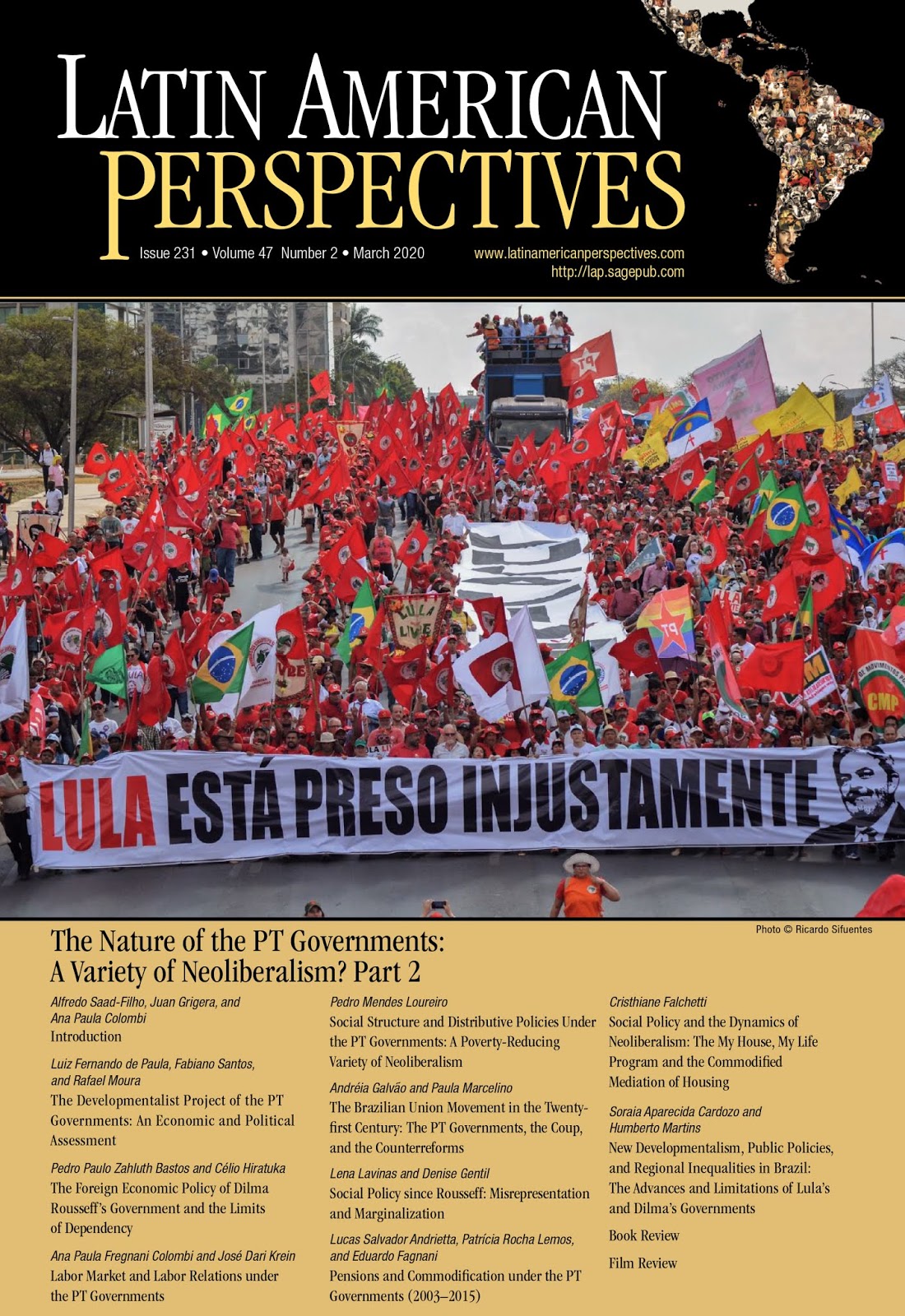
Abstract - Social Structure and Distributive Policies under the PT Governments: A Poverty-Reducing Variety of Neoliberalism

:::::: Abstract ::::::


Social Structure and Distributive Policies under the PT Governments: A Poverty-Reducing Variety of Neoliberalism

by Pedro Mendes Loureiro

Brazil’s social structure and associated distributive policies during the PT governments did not depart from neoliberalism but rather implemented a poverty-reducing variant of it. Through minimum-wage hikes, conditional cash transfers, legislation driving financial innovation, and the subsidizing of privately provided for-profit services, state power was used to include individuals in ever-expanding formal circuits of commodity production and consumption. Deprivation in multiple dimensions was indeed reduced through these policies, but in the process social mobility came to mean exiting poverty, getting a formal low-skilled job, and accessing credit at lower interest rates to pay for state-subsidized private health and education.


December 5, 2018

Political Report # 1384 George H.W. Bush, Icon of the WASP Establishment-and of Brutal US Repression in the Third World


By Greg Grandin
The Nation
Obituaries have transformed the terror that Bush inflicted, depicting it as heroism.
George Herbert Walker Bush represented a ruling class in decay. His WASP awkwardness, his famous syntactical struggles-described in obituaries as an ah-shucks genuineness, a goofy, “irreducible niceness”-was symptomatic of an Establishment in crisis. Franklin Foer, writing in The Atlantic, notes the nostalgia of the encomiums. The public apparently yearns for a time when politics were less coarse, when the country’s clubby elites were well-bred, well-voweled (compare the pleasantly rolling i’s and o’s found in the Harrimans and Roosevelts with the guttural u of today’s ruling clan), and well-mannered, their grasping and groping kept out of the press, for the most part.
What Foer doesn’t mention, and what is perhaps the single most important through-line in Bush’s life, is the way the extension of the national-security state, and easy recourse to political violence in the world’s poorer, darker precincts, allowed Anglo-Saxon men like Bush to stem the decomposition and to sharpen their class and status consciousness.
Raised in the shadow of legends, of a father (Prescott Bush) and two grandfathers (Samuel Bush and George H. Walker) who helped steer the expansive, epic era of Episcopalian capitalism-when American industry and politics had become interlocked with militarism-George H.W. Bush came into his own during the glory days of covert action in the Third World. This period ran from, say, the 1953 overthrow of Mohammad Mosaddegh in Iran through the Guatemala coup in 1954 and the Cuban Revolution in 1959 to the assassination of Congolese leader Patrice Lumumba and the Bay of Pigs in 1961, until the eve of escalation in Vietnam.
Bush would serve for a year as the director of the Central Intelligence Agency in the mid-1970s, but, as Joseph McBride reported in The Nation in 1988, his involvement with the agency had started much earlier. In November 1963, shortly after the assassination of John F. Kennedy, FBI director J. Edgar Hoover wrote a memo to the State Department describing the briefing of “Mr. George Bush of the Central Intelligence Agency” on the reaction to the assassination by anti-Castro Cuban exiles in Miami (it was feared by some that the exiles might take advantage of the chaotic situation by initiating an unauthorized raid against Cuba). McBride also cited a source with close connection to the intelligence community who confirmed that, as McBride put it, “Bush started working for the agency in 1960 or 1961, using his oil business as a cover for clandestine activities.”

November 30, 2018

Political Report # 1383 "It Is Not a Natural Disaster": Dana Frank on How U.S.-Backed Coup in Honduras Fueled Migrant Crisis


By Dana Frank is interviewed by Democracy Now! hosts Amy Goodman and Juan Gonzalez
As the United States continues to face criticism for tear gassing asylum seekers on the U.S.-Mexico border, we look at the crisis in Honduras and why so many Hondurans are fleeing their homeland. Honduras has become one of the most violent countries in the world because of the devastating drug war and a political crisis that stems in part from a U.S.-backed 2009 coup. We speak with Dana Frank, professor emerita at the University of California, Santa Cruz. Her new book is titled, “The Long Honduran Night: Resistance, Terror, and the United States in the Aftermath of the Coup.”
Transcript
JUAN GONZÁLEZ: Dana Frank, your book comes at a particularly important time as clearly the whole nation has been seeing what has been going on at the U.S.-Mexico border with the caravan of migrants from Central America, most of them from Honduras. But there is very little discussion of what is fueling, what is forcing them to leave. If you could talk about what has been the night of terror that has descended on Honduras, especially following the 2009 coup against President Zelaya.
DANA FRANK: When you read the interviews or the mainstream news reports about why the migrants in the caravan are fleeing, they will say, “Well, they are fleeing gangs and violence and poverty.” And that’s true, but what’s missing from that narrative is where the gangs and violence and poverty come from. It’s not a natural disaster. It’s actually the result of the deliberate policies of this government that came to the successive post-what we call the post-regime governments that came to power in the aftermath of the coup, most recently the illegal government of Juan Orlando Hernández.
So if you look at those causes, where does all the violence and the gang terror come from? It comes from this almost complete destruction of the rule of law. The coup itself was a criminal act. But it’s also that it opened the doors for every kind of conceivable criminal activity. In that context, the gangs proliferated, drug trafficking proliferated. They’re infiltrated throughout the police and military. So you have this situation in which the government itself is implicated in these gangs and in this military that people are fleeing.
So it is not just random violence. It is a U.S.-backed regime that is in cahoots with this. For example, a lot of people are fleeing gangs, or small business people are-their businesses are being destroyed by gang taxes. The police are very much cooperating with the gangs in extracting those kinds of so-called war taxes that the gang members charge. So it is this lawlessness that then opens the door for this kind of terror that people are fleeing, and the government is very much part of that terror.
The second factor here is poverty, because people are very much fleeing poverty, but that poverty again is not a natural disaster. It is the direct result of the post-coup policies. Because first of all, the state itself has been destroyed both by neoliberal policies of multilateral development banks like the International Monetary Fund. State services have been destroyed because the elites that run the government are just robbing it blind. For example, the president and his party stole as many as $90 million from the health service in 2013 to pay for their campaigns, and so then there’s no national health service that functions.

November 29, 2018

Political Report # 1382 Chile-Brazil: A New Laboratory For The Far-Right


By Joana Salém Vasconcelos (LAP editor) and 
 Rejane Carolina Hoeveler
Brazil Wire
Still shocked by the electoral results in Brazil, many Brazilians are asking how an avalanche of votes for Jair Bolsonaro and General Hamilton Mourão took place and what exactly will happen when a right wing extremist government takes over. We are still a long way off from answering this, but the connections between Bolsonaro’s main economic guru, Paulo Guedes, and the Augusto Pinochet dictatorship in Chile (1973-1990), give us important leads about the underlying plans.
Until recently, Paulo Roberto Nunes Guedes (69) was relatively unknown to the Brazilian public. Although he was a columnist for Epoca magazine and O Globo newspaper and founder of the Millenium Institute, the economist spent decades isolated from the mainstream, rejecting all of Brazil’s economic plans for the last 35 years, from those of President José Sarney to Dilma Rousseff. Reading some of his articles it becomes clear why. Guedes shows an aversion to the social contract guaranteed in the 1988 Constitution, which he interprets as an obstacle to his political project. For him, Brazil suffered from an “interventionist curse” which has blocked the “irreversible evolutionary process (...) towards a great open society.”
On May Day, 2017, Guedes wrote, “the right wing hegemony governed for two decades and the left wing hegemony governed for three, both with a disastrous, interventionist economic model.” In his mind, the 30 years of democratic Brazil, from Fernando Collor to Itamar Franco, Fernando Henrique Cardoso, Lula and Dlima all comprised part of the same hegemonic left. Looking at this tabula rasa, it’s not hard to understand his political preferences. The social rights system guaranteed in the 1988 Constitution may have has survived to the present day, at least on paper, but Guedes is part of the group that wants to exterminate it by capitalizing on the authoritarian wave of Jair Bolsonaro. This implies a radicalization and destruction of the democratic contract. But how will he try to do it?
From Chicago to Chile
Guedes got his PhD in Economics from University of Chicago, a center of Austrian-American neoliberalism dominated by figures like Milton Friedman, in 1978. As Friedman says in his book Freedom of Choice, it was a time in which his “apostles” were “wandering in the desert”. Forged in Chicago, Guedes economically-extremist vision has not caught on in Brazil until now. But the contrary happened in Chile. The first laboratory of the Shock Doctrine, as Naomi Klein designated the process, resulted from the Freidman-Pinochet alliance. It was there that the brothers in faith from Chicago found perfect partners for their economic plans after September 11, 1973: Chilean militarism and fascism promised, at the same time, repression and “innovation”.

June 7, 2017

Abstract, Deepening Demobilization: The State’s Transformation of Civil Society in the Poblaciones of Santiago, Chile

:::::: Abstract ::::::


Deepening Demobilization: The State’s Transformation of Civil Society in the Poblaciones of Santiago, Chile
by Carter M. Koppelman                                                    


Since Chile’s transition to an electoral regime in 1990, the demobilization of local organizations in Santiago’s poor and working-class neighborhoods, known as poblaciones, presents a puzzle, given the continuation of the neoliberal socioeconomic program that urban popular sectors mobilized against under the dictatorship. Ethnographic and interview data from two districts in southern Santiago reveal that the posttransition period has been characterized by increased state domination of local organizations in Santiago’s poor communities. By virtue of their dependence on material resources, local organizations have become extensions of the local state, engaged in service provision rather than contentious claims making. At the same time, the extension of state control has been masked through reinforcement in official discourse of the symbolic boundaries between state and society. This shifting and blurring of the state–civil-society boundary contributes to the deepening of the political demobilization of popular organizations.

May 24, 2017

Book Review, Scars and Resistances in Latin American Cities

:::::: Abstract ::::::


Scars and Resistances in Latin American Cities

by María Mercedes Di Virgilio                     


The production logics of Latin American cities have not followed the same canons as those of American or European ones. Although in many cities we can recognize neighborhoods or areas that appear to conform to the “North Atlantic urban ideal,” these areas or neighborhoods—as expressions of the so-called formal city—clearly adjoin and interact with what has come to be known as the informal city. The two volumes reviewed here contribute to the vast literature on Latin American cities and to discussions regarding poverty and the scars that informality has stamped on these cities since their foundation (for an overview, see McTarnaghan et al., 2016).

Cities from Scratch: Poverty and Informality in Urban Latin America, edited by Brodwyn Fischer, Bryan McCann, and Javier Auyero, is another in the long list of works on urban informality, but it attempts to move beyond the truisms and paradoxes found in this type of analysis (1):


May 3, 2017

Abstract, Deepening Demobilization: The State’s Transformation of Civil Society in the Poblaciones of Santiago, Chile

:::::: Abstract ::::::


Deepening Demobilization: The State’s Transformation of Civil Society in the Poblaciones of Santiago, Chile
by Carter M. Koppelman                                                    


Since Chile’s transition to an electoral regime in 1990, the demobilization of local organizations in Santiago’s poor and working-class neighborhoods, known as poblaciones, presents a puzzle, given the continuation of the neoliberal socioeconomic program that urban popular sectors mobilized against under the dictatorship. Ethnographic and interview data from two districts in southern Santiago reveal that the posttransition period has been characterized by increased state domination of local organizations in Santiago’s poor communities. By virtue of their dependence on material resources, local organizations have become extensions of the local state, engaged in service provision rather than contentious claims making. At the same time, the extension of state control has been masked through reinforcement in official discourse of the symbolic boundaries between state and society. This shifting and blurring of the state–civil-society boundary contributes to the deepening of the political demobilization of popular organizations.

April 26, 2017

Introduction, Planning Latin American Cities: Housing and Citizenship

:::::: Introduction ::::::


Planning Latin American Cities: Housing and Citizenship
edited by Clara Irazabal and Tom Angotti                                                                


After the 1973 coup in Chile, the Pinochet dictatorship, aided by advisers from the United States, became a proving ground for neoliberal reforms in Latin America. Its efforts to minimize the public role and maximize private initiative have strongly influenced social housing programs in other countries in the region. In effect, Chile’s housing reforms were recognized as best practices. The massive social housing program it launched in the early 1990s has been emulated throughout the Americas, most notably in Brazil’s Minha Casa, Minha Vida program. Following its developer-driven and neoliberal approach to housing, Chile produced a significant volume of new housing units. However, from the larger vantage point of community development and citizenship rights, the new housing has been deficient. It has generated new urban ghettos and peripheral neighborhoods and contributed to suburban expansion, auto dependency, unevenness in the provision of services, and a new form of poverty.

April 17, 2017

Political Report # 1245 Amazon rainforest's final frontier under threat from oil and soya

Celso Carlos has made a modest living for 10 years growing manioc and coconuts and rearing poultry on a few hectares of lowland in Brazil's northern Amazon.
But three years ago, out of the blue, Carlos was told by an Amapá state judge that he had to move because his land had been bought by a businessman living more than 1,500 miles away in São Paulo. Within months, fences had been put up, and Carlos and other assentados, or settlers, had been forced off their land.
Carlos's land - along with hundreds of thousands more hectares across Amapá state - is the new frontier of global agribusiness. It lies unused for now but will almost certainly be sold on and used for soya production. The ubiquitous crop, which is part of most western diets and feeds billions of animals, will most likely be shipped as animal feed to the UK from a new Amapá port.
Having swept through Brazil and much of Latin America, causing ecological and social devastation by displacing people, ripping up the savannah and driving forest destruction, soya is now poised to do the same in Amapá, Brazil's least developed and most forgotten state, says Sisto Hagro, a Catholic priest.
Hagro, who works with the Brazilian Pastoral Land Commission (CPT) to defend peasant farmers' rights, blames government corruption and greed for what he calls a massive land grab. The state, he says, is illegally redistributing land bestowed on it by the federal government and moving existing smallholders to promote large-scale agribusiness. It is then legitimising its actions by changing its laws, he claims.

August 8, 2016

Political Report # 1169 Free Trade is Killing Colombian Labor Activists


Police during International workers day on May 1, 2016, in Bogotá, Colombia. (Daniel Garzón Herazo / Pacific Press, Sipa via AP Images)


By  Michelle Chen, The Nation


Though Hillary Clinton and Donald Trump have both said they oppose the Trans-Pacific partnership-at least in its current form-they've hedged on trade issues overall, while the Obama administration continues to slide the treaty through Congress. Meanwhile, the Democratic Party remains ideologically tied to neoliberal policies for opening more "free markets," despite potential impacts on labor and economic standards around the Pacific Rim.
But if past is prologue, it's time to revisit another trade pact that candidate Barack Obama rebuffed in 2008-back then he cited human-rights abuses against labor activists. The US-Colombia Trade Promotion Agreement ultimately did get enacted, however, and eight years on, despite lowering trade barriers and fueling an export market worth about $17 billion, it has left a labor movement in tatters, replicating a pattern of neoliberal trade ravaging the hemisphere.
American workers are increasingly wary of NAFTA-like free-trade policies that are historically associated with the hemorrhaging of many blue-collar jobs. But the losses for our "trade partners" in the Global South are often paid in blood. According to a complaint recently filed by AFL-CIO with the Department of Labor, Colombia's political climate is just as, if not more, hostile toward trade unionists as it was before the trade treaty was enacted.