Showing posts with label Social Movements. Show all posts

November 24, 2020

Abstract: Forced Disappearance as a Collective Cultural Trauma in the Ayotzinapa Movement


:::::: Abstract ::::::


Forced Disappearance as a Collective Cultural Trauma in the Ayotzinapa Movement
 

by  Tommaso Gravante


The disappearance of 43 students of the teachers’ training college at Ayotzinapa in 2014 has inspired a broad social movement. Ethnographic work and interviews conducted at several of the demonstrations to show solidarity with the parents of the students reveal that their forced disappearance has been framed by participants as a collective cultural trauma. The politicization of this trauma has led to a change in the relationship between citizens and public    institutions and produced a new social narrative.


CONTINUE READING FULL ARTICLE HERE


SaveSave
SaveSave
SaveSave
SaveSave
SaveSave

June 24, 2020

Abstract, Social Movements, Crises, and Mobilizations: A Look at Summer 2019

:::::: Abstract ::::::


Social Movements, Crises, and Mobilizations: A Look at Summer 2019 

by Liliana Cotto Morales 

Beginning in the 1990s and in the first five years of the twenty-first century, we saw a strengthening of social movements that had achieved political space for combating U.S. neoliberal strategies and halting the dangerous influence of big business and capitalist governments. These movements became the protagonists influencing state policies in several Latin American countries and other regions. A systematic study of the knowledge produced by this resistance and insurgency may suggest alternatives that could be transformed into solutions.


SaveSave
SaveSave
SaveSave
SaveSave
SaveSave
SaveSave

June 22, 2020

Abstract, The Boricua Summer: Keys from a Human Rights Perspective

:::::: Abstract ::::::


The Boricua Summer: Keys from a Human Rights Perspective 

by José Javier Colón Morera
The Boricua summer1 of 2019 (as the series of popular demonstrations against the administration of the then-governor of Puerto Rico, Ricardo Rosselló Nevares, has been termed) was a complex social event with significant potential. Some of its features are specific to the social context of one of the world’s last colonies, a body politic that is still fighting for full decolonization and the expansion of its democracy in the face of an austerity agenda that has intensely affected the vulnerable sectors of the population (Colón Morera, 2016; Negrón-Muntaner, 2019; Rivera Ramos, 2019). In another sense, however, reflect a new anti-neoliberal activism that is common to very diverse contexts and significantly transnational (Bandy and Smith, 2004; Cotto Morales, in this issue; Díaz Lotero, 2019). The Boricua summer became part of an extensive process of citizen empowerment linked to the country’s struggle to escape the colonial entrapment of its current territorial Commonwealth’ arrangement (Colón Ríos, 2016; Fonseca, 2019; Negrón-Muntaner, 2019).2 For this reason, it demands further analysis and presents the enormous challenges of capturing a process in full motion.3


SaveSave
SaveSave
SaveSave
SaveSave
SaveSave
SaveSave

June 19, 2020

Abstract, Puerto Rico’s Summer 2019 Uprising and the Crisis of Colonialism

:::::: Abstract ::::::


Puerto Rico’s Summer 2019 Uprising and the Crisis of Colonialism

by Pedro Cabán

July 22, 2019, was a watershed moment in Puerto Rico’s history. On that day Puerto Ricans by the hundreds of thousands marched and demanded the resignation of Ricardo Rosselló Nevares, the colony’s inept and ethically bankrupt governor. On August 2 the pro-statehood governor became the first elected governor of Puerto Rico to resign his office.


June 8, 2020

Abstract, The Political Economy of Puerto Rico: Surplus Use and Class Structure

:::::: Photo Essay ::::::


The Political Economy of Puerto Rico: Surplus Use and Class Structure

by Ricardo R. Fuentes-Ramírez


Assuming that the first claim on a society’s output is to meet the essential consumption needs of its citizens, the remainder of its output, or surplus, can be conceptualized as discretionary income that it may use in various ways. An analysis of the use of the surplus in Puerto Rico suggests that most of the economic surplus remains within the island, unproductively utilized by domestic capitalists. By redirecting this surplus to productive investment, Puerto Rico could initiate a process of recovery. The task is developing the political will to transfer this wealth from high-income Puerto Ricans and unproductive sectors to a radical industrial policy initiative. Emphasizing that there are in fact alternatives to austerity may facilitate social movements’ coalescing around this policy and thus contribute to the development of the political conditions necessary for restoring growth and development.


June 3, 2020

Introduction, Calles de la Resistencia: Pathways to Empowerment in Puerto Rico

:::::: Introduction ::::::


Calles de la Resistencia: Pathways to Empowerment in Puerto Rico

by Jean Hostetler-Díaz 


The Boricua (Puerto Rican) heritage is one of resistance and valiant defense of freedom. From the initial, violent Spanish conquest of Borinquen (the island’s original name), the realities of domination and oppression by hostile invading armies confronted an organic consciousness of liberation within the indigenous culture. From the initial, violent Spanish conquest, the realities of domination and oppression by hostile invading armies confronted an organic consciousness of liberation within the indigenous culture. Puerto Ricans have always resisted, organized, and taken action against their oppressors and against their colonization in all its forms. It has been a centuries-long, life-and-death struggle, with brutally repressive policies and other methods of suppression and control constantly attempting to defeat the forces of resistance. At various times, conditions have reached critical mass, and a clear confrontation of forces has occurred. Last summer that point was reached when the forces of resistance became abundantly visible and their power obvious. Ultimately, this sustained collective uprising, now known as El Verano Boricua (The Puerto Rican Summer), directly and triumphantly challenged state authority.


SaveSave
SaveSave
SaveSave
SaveSave
SaveSave
SaveSave

September 23, 2019

Abstract, Continually Redefining Protagonismo: The Peruvian Movement of Working Children and Political Change, 1976–2015

:::::: Abstract ::::::


Continually Redefining Protagonismo: The Peruvian Movement of Working Children and Political Change, 1976–2015


by Jessica K. Taft


Activists in the Peruvian working children’s movement have been theorizing about “children’s protagonismo” for nearly 40 years. Changing political contexts and the infusion of discourses from other social movements have produced three major sets of meanings for this concept, each reflecting different dynamics in Peruvian social movement history. First, the concept, infused with ideas from liberation theology and Latin American engagements with Marxism, was primarily understood in terms of class struggle and collective organization. Second, because of opportunities and threats in the 1980s and 1990s, it became more closely associated with children’s rights frameworks. Third, since the early 2000s, the movement’s approach to protagonismo has drawn on indigenous theories of interdependence and relationality to challenge the individualism of neoliberal capitalism and governmentality. In holding these diverse ideological commitments together, the concept has allowed the movement of working children to communicate across multiple discursive communities.


August 22, 2019

Political Report # 1408 The Student Movement Standing up to the Honduran Regime


Jacobin


Ten years have passed since the democratically elected center-right president of Honduras, Manuel Zelaya, was removed in a military coup. On the same day of a referendum to create a National Constituent Assembly that sought to rewrite the military dictatorship's 1982 Constitution, Zelaya was whisked away to Costa Rica still in his pajamas. Observers across Latin America, watching nervously to see how President Obama would respond to his first real foreign policy test in the region, quickly had their hopes for a shift in US policy crushed. Obama and Secretary of State Hillary Clinton were quick to legitimize the coup and call for new elections that in Clinton's words would "render the question of Zelaya moot."
Clinton has defended the US role in the coup by arguing that to declare it a "coup" would have forced the United States to cut off all aid to the country, ultimately hurting the Honduran people. Yet since then, Washington has found no shortage of alternative ways to hurt the Honduran people, who have watched their country turn into one of the most violent and dangerous in the world.
The current status quo in Honduras is reminiscent of the days of US-backed death squads during the 1970s and '80s Central American civil wars. Since the coup, a right-wing dictatorship - maintained through an alliance between the military, landowning elites, and the media - has increased ties with the United States while drastically militarizing the country. In July 2013, the regime created the Intelligence Troop and Special Security Group. The next month in August, with a quick amendment to the Constitution to avoid the prohibition on military participation in policing, the Military Police was created. Even the DEA has entered the scene, through its Foreign-deployed Advisory Support Team (FAST) which is now conducting operations in the country.

July 4, 2019

Abstract, Brazil’s June Days of 2013: Mass Protest, Class, and the Left

:::::: Abstract ::::::


Brazil’s June Days of 2013: Mass Protest, Class, and the Left


by Sean Purdy


On June 17, 2013, Brazilians took to the streets in militant rallies and marches against transit fare hikes, poor-quality education and health care services, and the immense public investment in “mega-events” such as the 2014 World Cup and the 2016 Olympics. These massive demonstrations capped off a two-week series of demonstrations initially provoked by a 20-cent increase in bus, train, and subway fares in São Paulo. In the face of brutal police repression, the harsh opposition of politicians and the major political parties, and the clear bias of the mass media, the largely young and working-class protesters soon forced municipal governments in over 100 cities to revoke proposed fare increases. Explanations for the June Days and the ensuing political crisis, which have been the subject of fierce debates in activist and scholarly circles in Brazil, ignore the role of particular forms of capitalism, the adoption of neoliberalism by Workers’ Party governments, and the changing forms and conditions of class struggle.


May 3, 2019

Introduction, Israel, Palestine, and Latin America: Conflictual Relationships

:::::: Introduction ::::::


Israel, Palestine, and Latin America: Conflictual Relationships


by Ronaldo Munck and Pablo Pozzi


Latin American studies were not immune to the “Palestinian question” in the past, but there has been renewed interest since the launch, in response to a call from Palestinian civil society in 2005, of the Boycott, Divestment, and Sanctions (BDS) movement, which has attracted exponentially growing support among Latin American academic and intellectual institutions and associations. Popular organizations and civil society organizations have also begun to support it. Another strand of boycotts, popular among Jewish communities, has emerged that is not associated with the official BDS campaign but supports selective actions such as those targeting the Israeli blockade of Palestine or settlements on land lying outside of the June 1967 Israeli borders.


CONTINUE READING THE FULL ARTICLE HERE

SaveSave
SaveSave
SaveSave
SaveSave
SaveSave


SaveSave
SaveSave
SaveSave
SaveSave
SaveSave
SaveSave
February 7, 2019

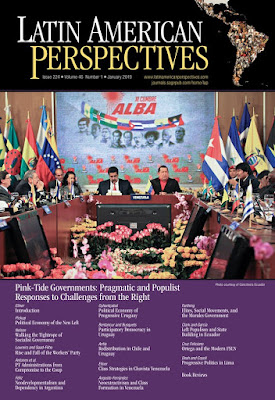
Abstract, An Opportunity Squandered? Elites, Social Movements, and the Government of Evo Morales

:::::: Abstract ::::::


An Opportunity Squandered? Elites, Social Movements, and the Government of Evo Morales

by Linda Farthing

Over its 12 years in power, Bolivia’s MAS government has made significant advances in expanding inclusion and reducing poverty. In the process, it has steadily been transformed into a hegemonic force that is increasingly dependent on expedient and pragmatically based compromises with economic elites. Concurrently, social movement influence and participation in the government have steadily declined. After 2009, when an uprising by Eastern elites had been quashed and MAS gained a congressional majority, the MAS missed an opening to advance its original project of structural change, opting instead for a more expedient strategy that has kept it in power at the cost of accommodating elites and debilitating social movements.


CONTINUE READING THE FULL ARTICLE HERE

SaveSave
SaveSave
SaveSave
SaveSave
SaveSave


SaveSave
SaveSave
SaveSave
SaveSave
SaveSave
SaveSave