Showing posts with label Migration. Show all posts

December 5, 2019

Abstract: Citizenship in the Global South: Policing Irregular Migrants and Eroding Citizenship Rights in Mexico by Heidy Sarabia

:::::: Abstract ::::::


Citizenship in the Global South: Policing Irregular Migrants and Eroding Citizenship Rights in Mexico

by Heidy Sarabia


A study of the implications of the coproduction-of-security policy implemented by Chile’s postdictatorship governments shows that the appeal for citizen participation in security provision has resulted in individual practices of home defense and protection rather than the development of the associative programs promoted by the state. This has come about in a context of extreme fear of crime and mistrust of the institutions in charge of security. The fact that the discourse of security coproduction is interwoven with the individuation and privatization that characterize Chilean society calls for a review of the agenda of citizen participation in security issues.

October 31, 2019

Political Report # 1422 U.S. announces asylum deal with Honduras, could send migrants to one of world's most violent nations


Political Report # 1422


U.S. announces asylum deal with Honduras, could send migrants to one of world's most violent nations


The Trump administration announced a migration deal Wednesday that will give U.S. immigration authorities the ability to send asylum seekers from the border to Honduras, one of the most violent and unstable nations in the world.

Department of Homeland Security officials reached the accord with the government of President Juan Orlando Hernández, who is embroiled in allegations of government corruption and charges that he and others have been operating the nation as a criminal enterprise — Hernández has been named as a co-conspirator in a major U.S. drug trafficking case.

The deal paves the way for the United States to take asylum seekers from the U.S. border and ship them to a nation with one of the highest murder rates in the world, a country with gang wars that have fueled waves of mass migration and multiple “caravans” to the United States that became a major irritant to President Trump.

More than 250,000 Hondurans have crossed the U.S. border during the past 11 months alone, many filing protection claims that have added to the soaring number of asylum cases clogging U.S. courts.

That DHS would enter into such an accord with the Honduran government a month after its president was named by U.S. prosecutors as a co-conspirator in a drug case is a sign of the Trump administration’s eagerness to armor the U.S. immigration system against a new surge of Central Americans.

Last week, DHS Acting Secretary Kevin McAleenan signed a similar deal with El Salvador, after reaching an accord with the government of Guatemala in July. None of those pacts have been implemented, but once in place, U.S. officials say they will have the ability to redirect asylum applicants from the U.S. border to the same three countries that accounted for the vast majority of unlawful migration.

McAleenan and other U.S. officials said asylum seekers should try to find refuge “as close to home” as possible, rather than embarking on the long and often dangerous trip to the United States.

A senior DHS official who described the Honduras agreement to reporters Wednesday said that the accord would allow the United States to redirect asylum seekers to the countries through which they transit while on the way to the United States — if they failed to seek protection in those countries first.

An asylum seeker from Nicaragua or Venezuela, for example, would be asked to choose among Guatemala, Honduras or El Salvador as places to seek protection, under the scenario the senior DHS official described.

Immigration attorneys and rights advocates have denounced the DHS agreements as a flagrant abrogation of long-standing U.S. legal protections extended to those fleeing persecution. Trump administration officials have acknowledged that their goal is to deter migrants from using U.S. humanitarian programs as a way to avoid detention and deportation at the border.

“If you don’t have integrity in the system, if you can’t effectuate immigration results as people arrive at the border, and they’re invited to come up with a promise they’ll be released into the next country, they’re going to keep coming,” McAleenan said Wednesday on Fox News.

McAleenan has made several trips to Honduras in recent months seeking a deal, and he met with Hernandez and other senior officials on Aug. 27 in Washington. DHS officials say the agreement will be key to unlocking U.S. investment and a renewed commitment to job creation and growth in the region.

The acting DHS secretary also hosted Honduras’ first lady, Ana García Carías, during a border tour in June, making a personal appeal to her government and others in the region for help stemming a record influx of Central American families at the border.

DHS officials say the accord signed with Honduras also will expand information-sharing and improve cooperation targeting transnational criminal organizations. Hernández, the Honduran president, was accused by U.S. prosecutors in New York last month of conspiring with other top officials to protect cocaine traffickers, including a crime ring allegedly led by the president’s younger brother, Juan Antonio “Tony” Hernández.

U.S. prosecutors described the president’s brother as a “a violent, multi-ton drug trafficker” after taking him into custody in Miami last year. He has pleaded not guilty to weapons and drug charges.

The charges include claims that about $1.5 million in drug money was used to finance Hernández’s 2013 presidential campaign, paying for bribes and gifts to politicians who provided their support.

President Hernández has denied the charges.

Asked whether the Trump administration took the pending charges into account while hashing out the migration accord with Hernández, the senior DHS official declined to answer.


Original article can be found (here).
URL:      Click here for article

August 26, 2019

Political Report # 1410 The Government Relies on False "Evidence" Against Migrants


ProPublica


Laura Peña could see that her 36-year-old client was wasting away. Gaunt and haggard after nearly two months in jail, he ran his fingers through his hair and opened his hands to show her the clumps that were falling out. He was so distraught that his two young children had been taken from him at the border, he could barely speak without weeping.
After Carlos requested political asylum, border and immigration agents had accused him of being a member of the notorious MS-13 gang in El Salvador - a criminal not fit to enter the United States. But as Peña looked at him, she saw none of the typical hallmarks of gang membership: the garish MS-13 tattoos or a criminal record back home. He was the sole caregiver for his 7-year-old son and 11-year-old daughter. He'd even brought an official letter from El Salvador's Justice Ministry certifying that he'd never been in jail. Something else about his case bothered her, too: She'd been peppering the government's lawyers with phone calls and emails for weeks and they'd yet to reveal any evidence to back up their accusation.
Unlike most attorneys working pro bono to reunite families, Peña was familiar with MS-13, because she'd pursued the deportation of gang members as a trial attorney for Immigration and Customs Enforcement. She understood how the system worked, because she'd been a part of it. Her long tumble of curly hair, which makes her look younger than her 37 years, is paired with a forthright-bordering-on-blunt manner of speaking forged from her years as a prosecutor on the front line of the immigration debate. She was empathetic toward the plight of clients like Carlos, whose last name is not being used for his protection. But she was also unwilling to give any of them false hope. If Carlos was a gang member, his chance for asylum was zero.

August 12, 2019

Political Report # 1405 Mexico’s Crackdown Is Making the Migrant Crisis Worse


The Nation


Amid all the urgent and much-deserved coverage of the family separation policy, the migrant detention centers, and predatory Immigration and Customs Enforcement raids, it has been easy to miss the fact that Mexican security forces aren’t treating migrants much better. Partly armed and trained by the United States, Mexico’s police and immigration authorities are carrying out a campaign of fear and violence against migrants-with impunity.
Just last week, Mexican police shot and killed a Honduran migrant in front of his 8-year-old daughter in the northern Mexican state of Coahuila. The details are still unclear, but the man was shot near a migrant shelter where he was staying with his daughter. And in June a 19-year-old woman was shot and killed after the truck she was in ran through a Mexican police checkpoint.
Both shootings came on the heels of the Trump administration’s pressuring Mexico to crack down on northward US-bound migration. Given the track record of Mexican security forces-the disappearance of 43 students in Ayotzinapa in 2014, the execution-style killing of 22 other people the same year, the recent arrest of migrant rights activists, the thousands of migrants who have gone missing during their transit through Mexico in recent years-it’s hard not to expect anything but more violence. And it’s not just rogue cops or the unfortunate and inevitable outcome of policing migration. It’s worse than that. The border has long been a site of violence, but its cruelty extends well beyond the borderlands. Border violence reaches south into Mexico and other countries, and it seeps into the interior of the United States; we witnessed the logic of bordering play out in the mass shooting in El Paso last weekend.

August 1, 2019

Abstract, Brazilians in London: Ideology, Social Class, and Motivations for Migration, Settlement, and Return

:::::: Abstract ::::::


Brazilians in London: Ideology, Social Class, and Motivations for Migration, Settlement, and Return
by Daniel Robins


The United Kingdom now boasts the largest Brazilian population in Europe, but so far the processes behind this relatively new migration stream remain undertheorized. An examination of Brazilian migration to London suggests that, although increased access to economic capital certainly plays a role in it, what migrants do with this capital may vary significantly and, further, that these differences are related to social class and ideology. The likelihood that they will settle or return is also linked to the degree to which they identify with the dominant ideology of the destination society.


June 20, 2019

Political Report # 1400 Honduran Labor Fight Reveals Exploitation Behind the Migrant Crisis


By Michael Galant, 
 Truthout


Thousands of migrants sit in cages along the U.S.-Mexico border.
U.S. policy makers and media debate their proper treatment as if they have appeared out of nowhere - fleeing hardships that are, to us, unknowable and unavoidable.
Two thousand miles away, one labor struggle reveals how false this narrative is.
In a microcosm of the conditions that have forced millions around the world to leave their homes in search of a better life in the global North, farmworkers in Honduras are fighting for their rights against the violent exploitation of a powerful multinational corporation and a global economic system designed to marginalize them.
Fyffes plc is the fourth-largest banana distributor in the world and the top importer of winter-season melons to the United States. Despite an annual $1 billion in revenue, the Japanese-owned and Irish-headquartered corporation remains a virtual unknown compared to its competitors: Dole, Chiquita and Del Monte. But in Honduras, Fyffes is infamous.
Fyffes employs up to 8,000 seasonal workers in its Honduran melon fields, the majority women. These workers have faced unendurable and often illegal exploitation. Fyffes pays sub-poverty wages, fails to provide legally mandated benefits, and leaves workers without savings for retirement. According to The Guardian, workers report that Fyffes regularly refuses to supply adequate drinking water, toilets or safety gear, and the company has been known to illegally fire pregnant workers.
When these dangerous conditions reach their inevitable conclusion - when, for example, 17 women are hospitalized from exposure to dangerous agrochemicals - Fyffes fails to deliver adequate medical care or compensation.

June 18, 2019

Political Report # 1399 Migrants Will Pay the Price of Mexico’s Tariff Deal With Trump


By Luis Gómez Romero, 
 The Conversation


Mexican President Andrés Manuel López Obrador is celebrating an agreement avoiding U.S. tariffs as a major political and diplomatic triumph for his government.
“We didn’t win everything, but we were able to claim a victory with there being no tariffs,” said chief negotiator Marcelo Ebrard, Mexico’s foreign affairs secretary, on June 9.
The two neighbors have been at odds since United States President Donald Trump on May 30 threatened to hit all Mexican imports with steadily rising tariffs unless Mexico successfully halted the northward flow of Central American migrants fleeing extreme poverty and violence through Mexico toward the United States.
Approximately 80% of Mexican exports are destined for the United States. Tariffs would have devastated Mexico’s economy.
To keep its goods untaxed, Mexico had to convince President Trump that it was serious about stopping migration. After a week of frantic negotiations, Mexico said it would deploy up to 6,000 National Guard troops to its southern border with Guatemala to stop migrants from entering Mexico.
As part of the agreement, a Trump administration program known as “Remain in Mexico,” which forces some migrants to wait in Mexico while their asylum claims are processed in the U.S., will also be expanded.

May 3, 2019

Introduction, Israel, Palestine, and Latin America: Conflictual Relationships

:::::: Introduction ::::::


Israel, Palestine, and Latin America: Conflictual Relationships


by Ronaldo Munck and Pablo Pozzi


Latin American studies were not immune to the “Palestinian question” in the past, but there has been renewed interest since the launch, in response to a call from Palestinian civil society in 2005, of the Boycott, Divestment, and Sanctions (BDS) movement, which has attracted exponentially growing support among Latin American academic and intellectual institutions and associations. Popular organizations and civil society organizations have also begun to support it. Another strand of boycotts, popular among Jewish communities, has emerged that is not associated with the official BDS campaign but supports selective actions such as those targeting the Israeli blockade of Palestine or settlements on land lying outside of the June 1967 Israeli borders.


CONTINUE READING THE FULL ARTICLE HERE

SaveSave
SaveSave
SaveSave
SaveSave
SaveSave


SaveSave
SaveSave
SaveSave
SaveSave
SaveSave
SaveSave

May 2, 2019

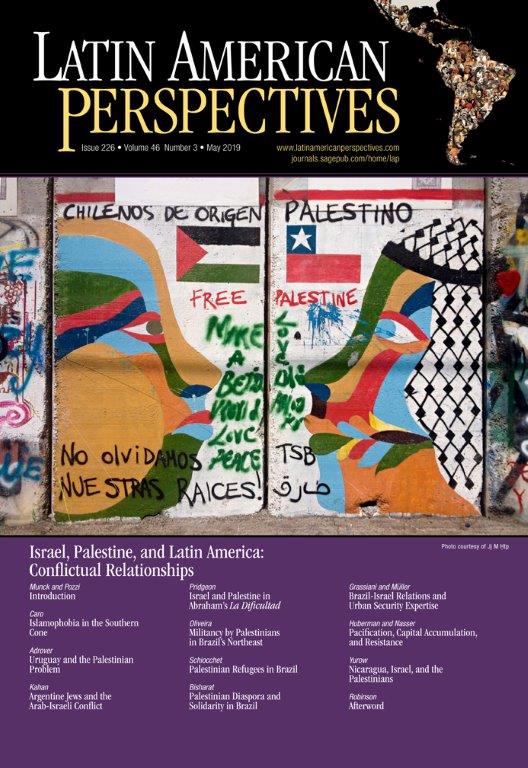
May 2019 LAP issue - Israel, Palestine, and Latin America: Conflictual Relationships


Israel, Palestine, and Latin America: Conflictual Relationships

Edited by Pablo Pozzi and Ronaldo Munck

Issue 226 | Volume 46 | Number 3 | May 2019
Table of Contents


This issue of Latin American Perspectives represents a step toward a better understanding of the Israeli-Palestinian conflict in a Latin American context. The articles cover a range of historical and current topics and show that Arab and Jewish histories are an integral part of Latin American history, that Latin America has been an important actor in the conflict over Palestine, and that the issue is being played out today in ever-changing circumstances.  Historical topics address how specific Latin American countries dealt with the creation of Israel and the Six-Day War while other articles consider more recent topics including the role and treatment of the Palestinian diaspora and Israeli marketing of urban security expertise. 


Microphone

Alexander Scott, Outreach Coordinator for Latin American Perspectives, interviews co-issue editor Pablo Pozzi on the subject of this issue.

CLICK HERE to listen to the podcast!


You can also listen to past podcasts by


April 19, 2019

Political Report # 1392 The Epidemic of Debt Plaguing Central American Migrants


By Jonathan Blitzer, 
 The New Yorker


When Elias López decided to leave his home in the western highlands of Guatemala for the United States, in 2014, the going rate to hire a smuggler was ninety thousand quetzales, or about twelve thousand dollars. López, who was eighteen, worked two jobs at the time, one in construction and the other as a day laborer harvesting vegetables, and the combined pay was barely enough to cover his living expenses. A lending coöperative, essentially a small local bank, offered loans at a low interest rate, but with one condition: López would need to offer collateral. In exchange for a loan of fifty-five thousand quetzales, he opted to mortgage the plot of land where his family grew their food. "I would pay off the loan once I made it to the United States," he recalls thinking.
In recent years, the rise of criminal cartels in Mexico and the newly aggressive posture of state authorities have made it much more difficult to reach the U.S. Beginning in 2014, at the urging of the Obama Administration, Mexican authorities increased their apprehension rate of Central Americans by eighty-five per cent. Even before Donald Trump took office, the U.S. government developed a new battery of measures-termed the "Consequence Delivery System," which included prolonged detention, criminal charges, and deliberate deportation of migrants to remote locations in their home countries-to make crossing the border so gruelling that people would decide to abandon the trip altogether. Nevertheless, the number of Central Americans coming to the U.S. has continued to rise, as has the pace of apprehensions: of the more than three hundred Guatemalans who leave for the U.S. each day, two-thirds are arrested and deported by Mexican and American immigration agents. One outgrowth of increased enforcement at the border is that the price many migrants are forced to pay smugglers has surged.

April 12, 2019

Political Report # 1391 Migrant Farm Workers are the Main Victims of Slave Labour in Mexico


By Emelio Godoy, Toward Freedom


(IPS) - “They mislead the workers, tell them that they will be paid well and pay them much less. The recruiters and the employers deceive them,” complained Marilyn Gómez, a migrant farm worker in Mexico.
Gómez, a member of the Mixteco Yosonuvico of Sonora Cerró Nublado cooperative and the mother of two girls, told IPS that the migrant workers are forced to buy whatever they need in their employers’ stores - “where everything is super expensive” - because they aren’t allowed to leave the farm.
“There’s no social security, no contracts, we work very long hours. They take advantage of the fact that people need work,” said Gómez, who began to work in the fields with her family at the age of 13, picking grapes and vegetables in the northern state of Sonora.
The 27-year-old migrant worker and activist, who has worked sick and has frequently worked for more than 12 hours a day for just a few dollars, has harvested fruit and vegetables near the town of Miguel Aleman, part of the municipality of Hermosillo, about 1,600 kilometers north of Mexico City.
Her account illustrates the working conditions of migrant farm workers, who provide substantial returns to their employers and who put vegetables and fruit on the tables of Mexican and U.S. consumers.
They are generally peasant farmers who migrate temporarily or permanently from the southern states to harvest export crops in central and northern Mexico.
They routinely suffer violations of labor rights, and of their rights to housing, education, health and a healthy diet.
And they lack work contracts, adequate working conditions, social security and overtime pay, according to the report “Violations of the rights of agricultural day laborers in Mexico“, launched on Mar. 21 in Mexico City by the National Network of Agricultural Day Labourers, to which Gómez belongs.
In Mexico, migrant farm workers or day laborers are the main victims of slave or forced labor, according to this and other local and international studies. The National Network, made up of workers’, indigenous and academic organisations, has identified cases of labor exploitation, human trafficking and forced labor and/or services.
The latest National Survey of Occupation and Employment, from 2017, placed the number of migrant farm workers at 2.9 million, while the governmental Program of Care for Agricultural Day Laborers put the figure at 1.54 million, plus 4.41 million family members who follow them as they move about.

November 7, 2018

Abstract, Marking “Preemptive Suspects”: Migration, Bodies, and Exclusion

:::::: Abstract ::::::


Marking “Preemptive Suspects”: Migration, Bodies, and Exclusion
by Seth M. Holmes 


The dynamics of inclusion and exclusion are central to public perceptions and policy responses to transnational immigrants, including those arriving from Latin America in the United States. Scholars have shown in various contexts that even official inclusion by a nation-state involves important gradations of exclusion on social, economic, political, and symbolic levels (e.g., Blommaert and Verschueren, 1998; Castañeda, 2012). Social scientists have analyzed the metaphors through which different variations of exclusion are promoted and enacted, including the dichotomy of the undeserving voluntary economic migrant versus the (relatively) deserving forced political refugee (e.g., Holmes, 2013; Holmes and Castañeda, 2016; Yarris and Castañeda, 2015). Lynn Stephen analyzes the “preemptive suspect” as a metaphor of exclusion in the treatment of unaccompanied Central American minors arriving in the United States in 2014. She builds on her previous work on indigenous Mexican families (2007), resistance (2002; 2005; 2013), and transborder life (2007), synthesizing and organizing substantial scholarship and placing it in historical context. At the same time, her diverse experiences as ethnographer, activist, expert witness, and comadre add local color and thick description to her rigorous analysis. She develops her analysis explicitly in honor of Michael Kearney, who examined theoretical understandings of immigration and conducted ethnographic work focused on indigenous Mexican migrants in the United States and especially on their health (e.g., Kearney, 1986; Kearney and Nagengast, 1989). His focus on health, health care, and bodies seems especially important here. After all, for many transnational migrants the gradations of exclusion encountered in the process of displacement can easily become a matter of life and death. 

July 11, 2018

Political Report # 1355 Keeping the Salt in the Earth

In April, as border patrol agents began to separate migrant families who risked their lives to reach the United States at the border, a group of men from the Tohono O'odham Nation trekked 300 miles in the opposite direction-from Arizona Upland to the salt fields at Mexico's Sea of Cortez. This was the eighth year they'd undertaken the Tohono O'odham Men's Salt Pilgrimage, which has gained new significance for an Indigenous people cleaved in two by the U.S.-Mexico border, and threatened by Trump's plan to build an "impenetrable" wall across 75 miles of their reservation.
For thousands of years, the Tohono O'odham, which in the O'odham language means "desert people," developed patterns of seasonal migration that enabled them to survive in one of the most arid swaths of North America, stretching roughly from Phoenix, Arizona to Hermosillo, Sonora, Mexico, and from the Gulf of California in the west to Tucson in the east. Today, this extensive homeland has been reduced to the Tohono O'odham Indian Reservation, whose 10,000 residents live on nearly 4,500 square miles of southern Arizona-the third largest reservation in the United States. On the other side of the steel beams and barbed-wire fences, an estimated 2,000 O'odham in Sonora live without access to the reservation's medical and educational services, and without recognition of their land rights by the Mexican government, which still calls them "Pápagos"-a misnomer imposed by Spanish colonizers.
Since Trump's election, O'odham on both sides of the border are leading an increasingly outspoken struggle to defend their land and way of life against threats of its destruction-both from a fortified wall that would further divide them, and from the environmental consequences that appear to be deepening during the presidencies of Trump and his Mexican counterpart, Enrique Peña Nieto.
Today, the pilgrimage bisects biometric checkpoints and narco-trafficking routes that have dismembered traditional O'odham territory, culminating in the salt flats where companies are profiting from their sacred minerals.One of the O'odham's most emblematic struggles is for the continuation of their transnational salt pilgrimage. For the O'odham salt is sacred, and for their ancestors the salt pilgrimage was both an initiation ceremony for young men and a way to gather the vital mineral used for healing, food preservation, and trade with other peoples. Today, the pilgrimage bisects biometric checkpoints and narco-trafficking routes that have dismembered traditional O'odham territory, culminating in the salt flats where companies are profiting from their sacred minerals.

May 16, 2018

Political Report # 1337 Mexico in the Time of the Caravan


By Danica Jorden, ZCommunications
Puebla, Mexico, 8 April 2018: An annual Easter march to shine a light on the plight of Central Americans living in a region with the highest murder rate in the world drew the attention of international aid groups, the United Nations ... and the President of the United States. While the U.N. admonished the government of Mexico to provide safe conduct to the approximately 1,200 persons who crossed the southern border of their country, Donald Trump reacted with incommensurate fear, threatening to deploy National Guard troops to his own border, 1,200 miles (2,000 km) away.

The march, or caravan, is also known as the Via Crucis del Migrante (Migrant Stations of the Cross). A more-or-less yearly event, the caravan has been organized by Pueblo Sin Fronteras (People Without Borders), an NGO with a presence in Arizona, for over a decade. The original Via Crucis recalls the path Jesus Christ took to his execution according to the Christian religion: a fourteen-step journey that recounts the burdens, humiliations, consolations, torture and death he suffered, before being resurrected and ascending to heaven on what was to become Easter Sunday. In historically Catholic Central America, marking the Stations is a significant event.

Usually numbering less than a hundred, Via Crucis del Migrante 2018 grew unexpectedly, according to organizer Irineo Mújica, though not unpredictably in retrospect. This year's caravan has a high number of Hondurans, reflecting that country's extreme levels of violence and deepening political crisis following a contested presidential election in November that resulted in widespread protests and "excessive use of force" in response.

The caravan is also mostly made up of women, children, unaccompanied minors and LGBTI persons, compelled to leave their homes but seeking the protection afforded by the organized march. According to Médecins Sans Frontières (Doctors Without Borders), even hospitals in Honduras are dangerous for victims of gender-based violence because they cannot be guaranteed safety within. And the road through Mexico is fraught with danger for even the most able-bodied.

Violence is the main factor pushing Central American emigration. A Canadian professor attending a conference on comparative education in Mexico City's historic centre says she no longer goes to El Salvador: "It's too dangerous." Discovery of trucks packed with Central Americans suffering and perishing from heat and thirst has become routine nowadays in Mexico, even occurring simultaneously with the march.

January 26, 2018

Abstract, Living on the Construction Site: Paraguayan Construction Workers in Buenos Aires

:::::: Abstract ::::::


Living on the Construction Site: Paraguayan Construction Workers in Buenos Aires
by Álvaro del Águila


Argentine enterprises subsume Paraguayan migrant workers into the construction industry in the Buenos Aires metropolitan area, subordinating them to the demands of production by temporarily housing them on the construction sites themselves. Ethnographic fieldwork carried out on various construction sites between 2006 and 2015 shows how this practice overlaps with wider processes of global transformation in labor relations. The lodging of workers on construction sites is an increasingly widespread strategy for capitalist entrepreneurs to exploit the migrant workforce even further.

December 20, 2017

Abstract, Living on the Construction Site: Paraguayan Construction Workers in Buenos Aires

:::::: Abstract ::::::


Living on the Construction Site: Paraguayan Construction Workers in Buenos Aires
by Álvaro del Águila


Argentine enterprises subsume Paraguayan migrant workers into the construction industry in the Buenos Aires metropolitan area, subordinating them to the demands of production by temporarily housing them on the construction sites themselves. Ethnographic fieldwork carried out on various construction sites between 2006 and 2015 shows how this practice overlaps with wider processes of global transformation in labor relations. The lodging of workers on construction sites is an increasingly widespread strategy for capitalist entrepreneurs to exploit the migrant workforce even further.

December 18, 2017

Abstract, Living on the Construction Site: Paraguayan Construction Workers in Buenos Aires

:::::: Abstract ::::::


Living on the Construction Site: Paraguayan Construction Workers in Buenos Aires
by Álvaro del Águila


Argentine enterprises subsume Paraguayan migrant workers into the construction industry in the Buenos Aires metropolitan area, subordinating them to the demands of production by temporarily housing them on the construction sites themselves. Ethnographic fieldwork carried out on various construction sites between 2006 and 2015 shows how this practice overlaps with wider processes of global transformation in labor relations. The lodging of workers on construction sites is an increasingly widespread strategy for capitalist entrepreneurs to exploit the migrant workforce even further.

November 22, 2017

Abstract, Migration and Trafficking of Persons for Labor Exploitation in the Textile Workshops of Buenos Aires under Neoliberalism

:::::: Abstract ::::::


Migration and Trafficking of Persons for Labor Exploitation in the Textile Workshops of Buenos Aires under Neoliberalism
by Debora Betrisey


The practices and political representations of the Argentine state with regard to trafficking in persons for purposes of labor exploitation, currently dominated by legal logic, treat immigrant workers as vulnerable victims. This robs them of any autonomy and ignores other aspects of their subjectivity, hindering the establishment of connections and solidarity with other social sectors in the national context that would allow them to contest the exploitation and domination to which they are subject.

November 17, 2017

Abstract, Prostitution and Migrant Smuggling Networks Operating between Central America, Mexico, and the United States

:::::: Abstract ::::::


Prostitution and Migrant Smuggling Networks Operating between Central America, Mexico, and the United States
by Simón Pedro Izcara Palacios


During the past five years, a process of specialization has taken place in migrant smuggling networks that has led to the strengthening of those focused on transporting women. The reasons are that migrant women have been less affected than men by the violence in Mexico and that the adult entertainment industry pays the highest prices for irregular migrants. In-depth interviews with procurers, smugglers, and women from Central America describe the operation of the networks for the smuggling of women for prostitution operating between Central America, Mexico, and the United States and indicate that the recruitment of women is usually not coercive and that the employment of minors is more frequent in the United States than in Mexico.

November 15, 2017

Abstract, Migrant Smuggling on Mexico’s Gulf Route: The Actors Involved

:::::: Abstract ::::::


Migrant Smuggling on Mexico’s Gulf Route: The Actors Involved
by Simón Pedro Izcara Palacios


Migrant flows crossing Mexican territory into the United States along the Gulf route are mainly driven by a demand for cheap labor. The decrease in the number of migrants wishing to cross the border to escape the violence in Mexico has turned undocumented migrants into a rare and valuable commodity. The increasing costs of migrant smuggling as a result of organized crime and the activities of the immigration authorities have prompted employers to finance this activity to ensure that they receive enough workers. In-depth interviews with 70 migrant smugglers shed light on the function and participation of the different actors involved in migrant smuggling.