Showing posts with label Energy. Show all posts

June 15, 2020

Abstract, The Debt/Energy Nexus behind Puerto Rico’s Long Blackout: From Fossil Colonialism to New Energy Poverty

:::::: Abstract ::::::


The Debt/Energy Nexus behind Puerto Rico’s Long Blackout: From Fossil Colonialism to New Energy Poverty

by Sandy Smith-Nonini


After Hurricane Maria wiped out Puerto Rico’s electrical grid in 2017, its citizens endured the longest blackout in U.S. history, some not regaining power until nearly a year later. An analysis of the profound social impacts and health costs and the delays in power restoration with a focus on the relationship between the U.S. territory’s debt crisis and its “fossil colonial” past offers insights into patterns of manipulation by politicians, bankers, and fossil-fuel companies that led to excess borrowing by the Puerto Rican public electrical utility, contributing to a neglect of infrastructure and high rates for citizens during a time period when tax incentives for corporate manufacturing were being phased out just as oil prices rose to record levels.


August 19, 2019

Political Report # 1407 Using Renewable Energy and the Circular Economy to Fight Poverty in Argentina


Toward Freedom


(IPS) - On the outer edges of Buenos Aires proper, where the paved streets end and the narrow alleyways of one of Argentina’s largest shantytowns begin, visitors can find the En Haccore soup kitchen.
The community endeavor is using renewable energy and the circular economy in an effort to improve quality of life for local residents.
“We were overrun by trash, because the garbage trucks don’t always come. Thanks to a biodigester we are now converting that waste into biogas, which enables us to spend less on energy for cooking. It’s a dream come true,” Bilma Acuña, the founder and head of the soup kitchen, told IPS.
She explained that she started the soup kitchen in 1993, after losing her job at a meatpacking plant, at a time that many others in the neighborhood also became unemployed during the government of neoliberal president Carlos Menem (1989-1999), when the unemployment rate climbed to almost 20 percent.
She named it En Haccore (En-hakkore), the Aramaic name of a spring in the biblical story of Samson and Delilah. The soup kitchen is on the southern edge of the Argentine capital, a 15-minute drive from downtown, at the entrance to the overcrowded shantytown of 25,000 people known as Ciudad Oculta (Hidden City).

June 1, 2018

Political Report # 1344 Top Republican Plans to Use Fossil Fuels to Make Puerto Rico “the Energy Hub of the Entire Caribbean


By Kate Aronoff, The Intercept
Puerto Rico could become “the energy hub of the entire Caribbean area” under a vision laid out by Rob Bishop, the chairman of the House Natural Resources Committee, who visited the island.
Bishop is not thinking of wind or solar.
In a press conference held in San Juan on Friday, with Puerto Rican Resident Commissioner Jenniffer González-Colón - a nonvoting representative to the U.S. House - Bishop, R-Utah, said he had been consulting with oil and gas companies in Washington about how to bring more natural gas to the island.
“Puerto Rico could be a headquarters for the entire Caribbean area,” Bishop said in response to a question from The Intercept. “That could be a source of energy not just for Puerto Rico, but it could be a source of export for that kind of energy to other places as well. As I look at the future, I envision Puerto Rico as being kind of like the energy hub of the entire Caribbean area. ... To do that, you would have to get a lot of people involved, and the private sector has a role in trying to push that forward.”
Asked if he will be meeting with oil and gas companies during his time on the island this week, he said he would not, but that he has been talking to them in Washington. When asked which companies in particular he had been meeting with, Bishop said, “This is like ... if I start thanking the volunteers on my campaign, I’ll insult somebody by forgetting them. So, let’s just keep it blanket and say I love all of them.”
Bishop laid out some specific changes he would like to see to the energy landscape in Puerto Rico. “I would love to see more natural gas ports. They could be either stationary or terminals that float, as we have in other areas of the world,” he said, noting that there “has to be some infrastructure built before that. You just can’t put the ports in there. ... There has to be infrastructure to integrate that within the bill.” He did not elaborate on whether he was referring to a specific piece of legislation.

May 18, 2018

Political Report # 1338 Controversial Contractor Was Behind Island-Wide Blackout, as Puerto Rico Debates Full Privatization


By
Kate Aronoff
The Intercept
The bulldozer that accidentally triggered an island-wide blackout in Puerto Rico last week was operated by D. Grimm Inc., a company that reports up to the Oklahoma-based firm Mammoth Energy Services. The same subcontractor was blamed for another blackout two weeks ago that affected 870,000 homes.

Attempting to repair a downed wire on Wednesday, a bulldozer got too close to a live, high-voltage line, triggering a chain reaction that left most of the island’s 3.4 million residents without power. D. Grimm is a subcontractor hired by Cobra Acquisitions LLC, itself a subsidiary of Mammoth.

First signed in October, Cobra’s contract is reminiscent of the one negotiated between the Puerto Rico Electric Power Authority, or PREPA, and novice Montana-based firm Whitefish Energy Holdings LLC, a $300 million agreement that generated international controversy. The utility’s contract with Cobra - a recently formed amalgamation of a handful of small mainland utility services companies - was less outrageous on its face than the Whitefish deal, and faced less scrutiny.

Unlike the Whitefish contract, it was arrived at with the blessing of the Federal Emergency Management Agency, which Mammoth claims was in the negotiating room “every step of the way” and will ultimately reimburse PREPA for payments it makes to Cobra. Over the last several months, Cobra’s initial 90-day, $200 million contract ballooned to $445 million in late January and more than doubled again to $945 million about a month later, reportedly allowing it to source construction materials itself, rather than work through third-party contractors.

While such generous contracts are an obvious boon for companies like Cobra, Freddyson Martínez, vice president of UTIER, the PREPA utility workers union, doesn’t see them as one for island residents. Wednesday’s blackout took place in the context of a concerted push from both the Puerto Rican government and the Washington-appointed Financial Oversight Management Board, or FOMB, to privatize PREPA, bringing its transmission and distribution capacity under private management and selling pieces of its generation capacity off to different bidders. With these contracts and more federal funding potentially up for grabs via privatization, Martínez predicted “there will be more Whitefishes and more Cobras - more animals of those species - lurking around trying to bite again.”

September 18, 2017

Political Report # 1277 In Wake of Hurricane Irma, Vultures Eye Puerto Rico’s Electric Grid for Privatization

By Kate Aronoff, Angel Manuel Soto, and Averie Timm, 


The Intercept 


Vultures circling the wreckage of Puerto Rico in the wake of Hurricane Irma are closing in on a long-sought prize: the privatizing of the island’s electric utility.
Puerto Rico avoided the very worst of the storm, which darted just north of the U.S. territory. But it didn’t escape unscathed. Following a request from Gov. Ricardo A. Rosselló, the White House declared a state of emergency. Three people were killed and more than 1 million were left without electricity in the storm’s wake.
The fragile body responsible for that power is the Puerto Rico Electric Power Authority, whose executive leadership warned ahead of the storm that parts of the island could be left without electricity for up to six months. Thanks to the change in the storm’s path and a crew of dedicated line workers, Prepa, the island’s sole electricity provider, now expects most towns to have their lights back on within two weeks and full power within a month. As of Monday, more than 70 percent of homes had already gotten electricity back.
But once the lights are turned on, Puerto Rican households will face a new threat.
“[The investors] have the best sales pitch now,” Carlos Gallisá, a former consumer representative on Prepa’s board of directors, told The Intercept by phone from San Juan. “They have already started, saying that only privatization will serve the people.”

September 14, 2016

Political Report # 1181 The Alliance for Prosperity: Solution to the Central American Migrant Crisis or Déjà Vu?


Migrants crouch out of sight on the side of the road, waiting for a smuggler's signal that it is safe to cross, near Los Corazones, Mexico, November 8, 2015. The US Senate passed the Alliance for Prosperity Plan as a means to curtail the reasons for migration from the northern triangle of Central America. However, many fear the social component of the plan will be lost to the question of security, contributing to the militarization of the region. 
 (Photo: Daniel Berehulak / The New York Times)


By Jeff Abbott, Thruthout


This year Guatemala inaugurated a new president: Jimmy Morales, a former comedian known for a racist television show in which he regularly performed in blackface and mocked Guatemala's indigenous populations. Morales, who took office on January 14, had positioned himself as a political outsider who was able to ride the wave of popular discontent to the office. But before his inauguration, Morales was paid a special visit by US Vice President Joseph Biden, whose late arrival disrupted the events planned for the day. Biden privately met with the new president in an upscale hotel in Guatemala's wealthy Zone 10. Guatemala's daily newspaper reports that the two discussed the importance of Washington's latest plan to curb northern migration, the Alliance for Prosperity.
A month prior, the US Senate passed the controversial Alliance for Prosperity Plan as part of the 2016 budget on December 18, 2015, in a vote of 66 to 33. The plan includes $750 million to improve governance, strengthen security and promote the economic integration of the northern triangle countries of Honduras, El Salvador and Guatemala. In late 2015, Mexico and Nicaragua were both added to the plan, with each country receiving nearly $120 million of the funds made available to secure their borders.
In a New York Times op-ed, Biden called for the plan following the migration crisis of 2015, and proposed the plan as a means to curtail the reasons for migration from the northern triangle of Central America. "The economies of El Salvador, Guatemala and Honduras remain bogged down as the rest of the Americas surge forward," Biden wrote, emphasizing the reasons for this plan. "Inadequate education, institutional corruption, rampant crime and a lack of investment are holding these countries back."

December 23, 2015

Political Report #1101, Fracking Expands in Latin America, Threatening to Contaminate World's Third-Largest Aquifer By Santiago Navarro F. and Renata Bessi, Truthout


Schlumberger employees work during an oil fracking process in Vaca Muerta in the Patagonian province of Neuquen, Argentina, September 20, 2013. 
 (Photo: Anibal Adrian Greco / The New York Times)


By Santiago Navarro F. and Renata Bessi, Truthout 
Hydraulic fracturing, or fracking - a method whereby hydrocarbons trapped within rocks are extracted - is expanding rapidly in Latin America. Fracking emits benzene, toluene, ethylbenzene and xylene, which are considered by the World Health Organization to be carcinogenic and responsible for blood disorders and other immunological effects. Despite these adverse health effects, however, reserves have already been mapped out in Bolivia, Colombia, Venezuela, Paraguay, Uruguay, Chile, Argentina, Brazil and Mexico.
Fracking produces large volumes of toxic and radioactive waste and dangerous air pollutants.

September 9, 2015

Political Report #1075 Corporate Developers Seize Indigenous Lands in Brazil and Hire Hit Men to Murder Residents By Renata Bessi and Santiago Navarro F., Truthout


A Xucuru dancer in front of the National Congress in April 2015. The indigenous Xucuru people from the state of Pernambuco are from one of the best-organized groups in Brazil. (Photo: Santiago Navarro F.)


By Renata Bessi and Santiago Navarro F., Truthout

In an effort to make way for new investment projects, the Brazilian government and transnational corporations have been taking over ancestral indigenous lands, triggering a rise in murders of indigenous people in Brazil.
According to the report, "Violence Against Indigenous People in Brazil," recently published by the Indigenous Missionary Council (CIMI by its Portuguese initials), the number of indigenous people killed in the country grew 42 percent from 2013 to 2014; 138 cases were officially registered. The majority of the murders were carried out by hit men hired by those with economic interests in the territories.
The states of Mato Grosso del Sur, Amazonas and Bahía figure heavily in the statistics. An emblematic case was the brutal killing of the indigenous woman Marinalva Kaiowá, in November of 2014. She lived in recovered territories, land that for over 40 years has been claimed by the Guaraní people as the land of their ancestors. Marinalva was assassinated - stabbed 35 times - two weeks after attending a protest with other indigenous leaders at the Federal Supreme Court in the Federal District of Brasilia. The group was protesting a court ruling that annulled the demarcation process in the indigenous territory of the Guyraroká.


July 16, 2015

Political Report # 1058 Fracking Expands Under the Radar on Mexican Lands By Emilio Godoy, Inter Press Service


Mexico City - "People don't know what 'fracking' is and there is little concern about the issue because it's not visible yet," said Gabino Vicente, a delegate of one of the municipalities in southern Mexico where exploration for unconventional gas is forging ahead.

Vicente is a local representative of the community of Santa Úrsula in the municipality of San Juan Bautista Tuxtepec, some 450 km south of Mexico City in the state of Oaxaca, where - he told IPS - "fracking is sort of a hidden issue; there's a great lack of information about it."

Tuxtepec, population 155,000, and another Oaxaca municipality, Loma Bonita, form part of the project Papaloapan B with seven municipalities in the neighbouring state of Veracruz. The shale gas and oil exploration project was launched by Mexico's state oil company, Pemex, in 2011.

Papaloapan B, backed by the governmental National Hydrocarbons Commission (CNH), covers 12,805 square kilometres and is seeking to tap into shale gas reserves estimated at between 166 and 379 billion barrels of oil equivalent.

The project will involve 24 geological studies and the exploratory drilling of 120 wells, for a total investment of 680 million dollars.

June 25, 2015

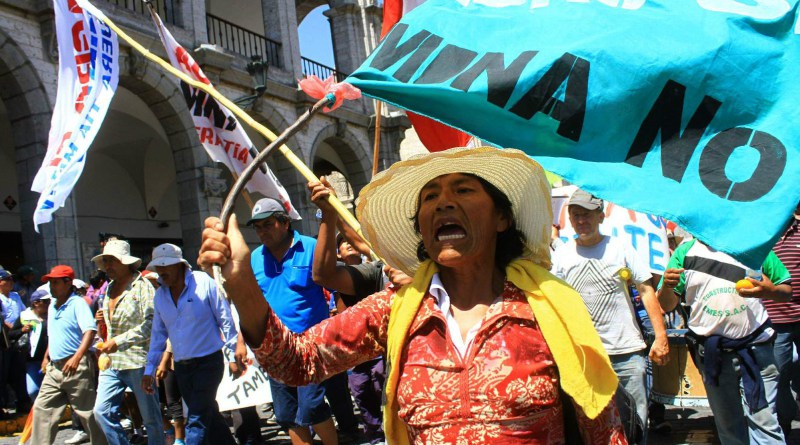
Political Report #1048 Transnational Perceptions and Corporate Greed: Behind the Tía María Mine Protests

By Rachel Quartararo, Research Associate at the Council on Hemispheric Affairs 


The citizens of Peru are taking a stand against the development of Tía María, an open pit copper mine in the Valle de Tambo in Islay, a province in the country's southern Arequipa Region.[1] The Mexican-owned mining company, Southern Copper, plans to invest over $1.4 billion USD in the project, which would make Tía María the second largest copper mine in the world. Peru's Deputy Minister of Mines Romulo Mucho estimated that the mine would generate approximately $150 million USD in royalty revenue annually and produce $700 million USD in exports from the production of 120,000 metric tons of copper cathodes each year.[2] The project received final approval by the state government in 2014, but since 2009 it has been continuously delayed due to ongoing resistance from the rural communities in the region. Local residents have been up in arms since mid-March, fearing that the mine will cause irreversible damage to their environment, water systems, and livelihoods.

 
A History of Exploitation

Peru's struggle with Tía María and with resource extraction as a whole is highly contextual. It is deeply intertwined in the nation's political and economic history, which has, in turn, shaped the various facets of Peruvian identity. In the past two decades, the Peruvian Andes have seen a dramatic increase in mineral extraction and exploitation owing in large part to groundwork that was laid by former President Alberto Fujimori during his rise to power in 1990. Fujimori's presidency was highly controversial due to his conviction of widespread corruption, human rights violations, and adherence to the neoliberal agenda. Economic growth was achieved through economic policies including the privatization of state-run industries, which reintegrated Peru into the global economic system. As a result, Peru's mining and energy extraction industry began to attract foreign investment from transnational mining corporations.[3] The liberalization of Peru's market economy and the implementation of attractive legal and tax regimes have transformed the country into a leading exporter of base and precious metals. Currently, Peru ranks third in the world as a producer of copper and zinc. Copper production is expected to double within the next year, and Peru's expansive and untapped copper deposits are considered "golden opportunities" for international investors.[4]


>>>To continue reading this article, please click here.