Showing posts with label Ronaldo Munck. Show all posts

May 3, 2019

Introduction, Israel, Palestine, and Latin America: Conflictual Relationships

:::::: Introduction ::::::


Israel, Palestine, and Latin America: Conflictual Relationships


by Ronaldo Munck and Pablo Pozzi


Latin American studies were not immune to the “Palestinian question” in the past, but there has been renewed interest since the launch, in response to a call from Palestinian civil society in 2005, of the Boycott, Divestment, and Sanctions (BDS) movement, which has attracted exponentially growing support among Latin American academic and intellectual institutions and associations. Popular organizations and civil society organizations have also begun to support it. Another strand of boycotts, popular among Jewish communities, has emerged that is not associated with the official BDS campaign but supports selective actions such as those targeting the Israeli blockade of Palestine or settlements on land lying outside of the June 1967 Israeli borders.


CONTINUE READING THE FULL ARTICLE HERE

SaveSave
SaveSave
SaveSave
SaveSave
SaveSave


SaveSave
SaveSave
SaveSave
SaveSave
SaveSave
SaveSave

May 2, 2019

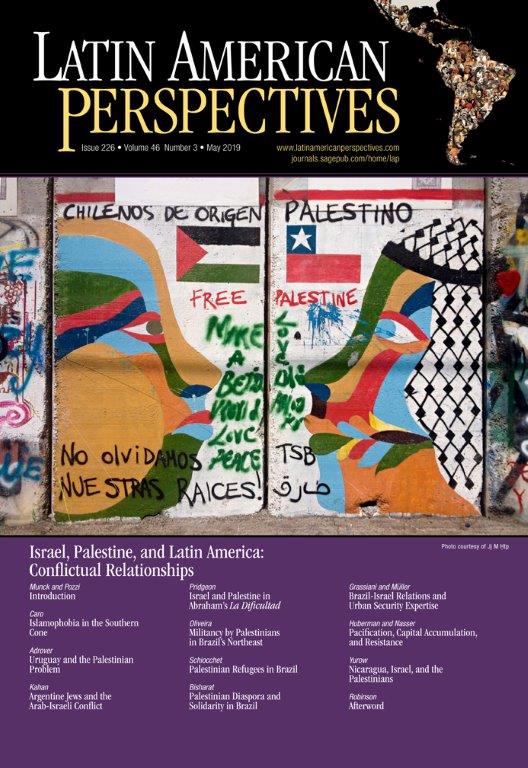
May 2019 LAP issue - Israel, Palestine, and Latin America: Conflictual Relationships


Israel, Palestine, and Latin America: Conflictual Relationships

Edited by Pablo Pozzi and Ronaldo Munck

Issue 226 | Volume 46 | Number 3 | May 2019
Table of Contents


This issue of Latin American Perspectives represents a step toward a better understanding of the Israeli-Palestinian conflict in a Latin American context. The articles cover a range of historical and current topics and show that Arab and Jewish histories are an integral part of Latin American history, that Latin America has been an important actor in the conflict over Palestine, and that the issue is being played out today in ever-changing circumstances.  Historical topics address how specific Latin American countries dealt with the creation of Israel and the Six-Day War while other articles consider more recent topics including the role and treatment of the Palestinian diaspora and Israeli marketing of urban security expertise. 


Microphone

Alexander Scott, Outreach Coordinator for Latin American Perspectives, interviews co-issue editor Pablo Pozzi on the subject of this issue.

CLICK HERE to listen to the podcast!


You can also listen to past podcasts by


January 19, 2017

Book, Rethinking Latin America

:::::: Book ::::::


Rethinking Latin America
Development, Hegemony, and Social Transformation
by Ronaldo P. Munck


In a subtle but powerful reading of the shifting relationships between development, hegemony, and social transformation in post-independence Latin America, Ronaldo Munck argues that Latin American subaltern knowledge makes a genuine contribution to the current search for a social order which is sustainable and equitable.


August 15, 2016

Abstract, Latin American Studies: Publishing and Politics by Ronaldo Munck

:::::: Abstract ::::::

Latin American Studies: Publishing and Politics 
by Ronaldo Munck

This is an opportune moment, I believe, to debate the future of Latin American studies journals, given their variety and well-established nature. My own standpoint derives from a long-term membership of the Latin American Perspectives advisory panel and a brief stint as chief editor of the Bulletin of Latin American Research (UK) as well as membership of around a dozen editorial boards of journals dedicated to labor and globalization studies. And, of course, as has any other active researcher I have faced the demands made by the powers that be on where we should publish and what we should publish.

August 28, 2015

Abstract, Rethinking Latin America: Back to the Future? by Ronaldo Munck

:::::: Abstract ::::::

by Ronaldo Munck

It could be argued that Latin America is currently at a crossroads every bit as fundamental as that of the 1930s. While according to some the region has escaped the worst impacts of the Great Recession, for others the model of extractive capitalism is simply not sustainable. Clearly there is a new left hegemony emerging, but for many analysts the left’s efforts have been insufficient and have simply continued the neoliberal economic model. A rethinking of Latin America from the perspective of three somewhat disparate thinkers who were shaped by the crisis of 1929—José Carlos Mariátegui, Antonio Gramsci, and Karl Polanyi—can help us reimagine a progressive way forward.

August 17, 2015

Abstract: Commentary by Ronaldo Munck, Whither Latin America?

:::::: Abstract ::::::

Commentary
by Ronaldo Munck

The time is ripe to (re)consider Latin America from a holistic perspective. Not all would agree with the assumption by Katz, in his broad review of current events and tendencies, that Latin America can be treated a whole, but I think it is at least a good starting point. Katz poses two alternative overarching perspectives against which he advances his own positions. One is the post-neoliberal approach, for which the Washington Consensus is well and truly in the past and a more equitable development perspective beckons. The other, which is shared to some extent by Katz but from which he distances himself in the end, is the commodities consensus view, according to which Latin America is being re-primarized under a new global order that condemns the region to extractivism rather than production. Katz recognizes that in the present global crisis Latin America is not going the way of the 1930s. Much has changed, and, for example, as he argues, Brazil has more in common with Spain than with Ecuador. The “Empire” still rules, however, and Katz mentions the various U.S. bases and involvement in the misnamed “war on drugs.” Coercion is still seen as a major means for maintaining the subjection and dependency of Latin America.