A social leader is killed every four days in Colombia, according to a report from the Foundation for Peace and Reconciliation (PARES).
The organization that monitors armed conflict in the South American country recorded 55 assassinations of community leaders and human rights activists this year alone.
"Every four days a homicide is committed against a social leader in Colombia and every two days, there is one threatened," said the report.
"The vulnerability of leaders and human rights defenders in Colombia remains critical. The acts of violence against this population show high degrees of systematic behavior."
The report states that the motivations for these actions are to limit the participation of social leaders in politics, impede processes of truth-building, land restitution and environmental protection, reported Caracol Radio.
It highlights that since Colombia's government signed a historic peace deal with the Marxist-inspired FARC guerrillas last November, a total of 181 acts victimizing social leaders and human rights defenders have been recorded up to July 11, 2017.
|

Showing posts with label FARC. Show all posts
Showing posts with label FARC. Show all posts
August 21, 2017
Political Report # 1272 'A social leader is killed every 4 days in Colombia': Report

March 16, 2017
A Partial Peace in Colombia
A Partial Peace in Colombia
|

In November 2016 the Colombian Congress approved a peace deal between the government and the Revolutionary Armed Forces of Colombia (FARC) guerrillas, potentially ending a 50-year armed conflict that has killed at least 220,000 people--82 percent civilians--and displaced almost seven million. The accord includes mechanisms for disarmament and reintegration of guerrilla fighters, lenient sentencing for those who confess to committing acts of violence, and an allotment of ten congressional seats for FARC politicians for eight years. Separate peace talks with the smaller National Liberation Army (ELN) guerrilla force are now underway. |
February 15, 2017
Political Report #1226 Unease in Colombia, as Old Enemies Become New Neighbors
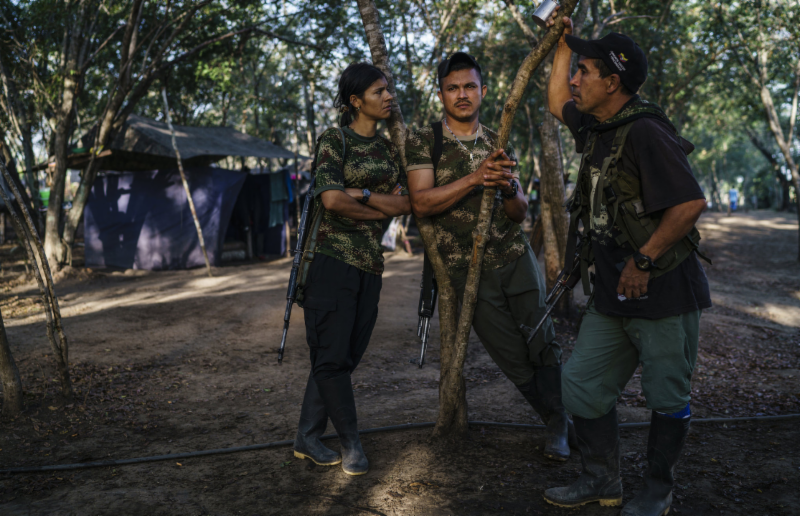
Tierra Grata, a settlement in La Paz, Colombia, where former rebels have moved. This year, 7,000 across the country are to surrender their guns. (Photo: Federico Rios Escobar for The New York Times)
Political Report # 1226
By Nicholas Casey, NY Times
|
LA PAZ, Colombia - The town’s name is Spanish for “peace.” The days to come will test how accurate that is.
After a half-century of war, Colombia’s rebels are disarming, preparing to enter civilian life under the peace accord signed last year. In this mountain town, a new settlement of former fighters, 80 strong and growing, is taking shape, one of many scattered across the country.
Gone are most of the uniforms, replaced with the kind of clothes worn by the townspeople who live nearby and watch warily. The tents and their wooden poles will be swept aside too, replaced with a small library, a community center, a store - a town in miniature, a steppingstone out of the jungle.
“We’ve spent 52 years in hammocks,” said the fighters’ commander, who still uses his nom de guerre, Aldemar Altamiranda. “It’s time we moved into tiny houses.”
|
October 28, 2016
Political Report # 1192 EThere's Still Time for Peace in Colombia

Colombians celebrate as they watch on a giant screen broadcasting the signing of a peace agreement between the Colombian Government and the FARC. (photo: Guillermo Legaria/Getty Images)
By Kieran Duffy, Jacobin
|
Colombia's president is no champion of peace. But the chance to finally end the country's civil war cannot be allowed to slip away.
The past couple weeks have been full of ups and downs for Colombian president Juan Manuel Santos.
On October 2, he suffered a surprise defeat when Colombian voters narrowly rejected his peace deal with the Revolutionary Armed Forces of Colombia (FARC). After four years of negotiations with the rebels, it seemed his plan to end the fifty-two-year conflict - the plan he had hoped would define his presidency - had come to nothing. As he negotiated with the deal's opponents in a desperate bid to find a compromise, many Colombians feared that the country would be plunged back into war and that a unique chance for peace had been lost.
Less than a week later, Santos was no doubt in a cheerier mood. The Nobel Committee had just announced it would award him its peace prize, making him only the second Colombian Nobel laureate. The august body praised Santos "for his resolute efforts to bring the country's more than 50-year-long civil war to an end, a war that has cost the lives of at least 220,000 Colombians and displaced close to six million people."
|
October 18, 2016
Political Report # 1190 There's Still Time for Peace in Colombia

Colombian president Juan Manuel Santos in September 2010.
Sara Rojas / Flickr
By Kieran Duffy, Jacobin
|
The past couple weeks have been full of ups and downs for Colombian president Juan Manuel Santos.
On October 2, he suffered a surprise defeat when Colombian voters narrowly rejected his peace deal with the Revolutionary Armed Forces of Colombia (FARC). After four years of negotiations with the rebels, it seemed his plan to end the fifty-two-year conflict - the plan he had hoped would define his presidency - had come to nothing. As he negotiated with the deal’s opponents in a desperate bid to find a compromise, many Colombians feared that the country would be plunged back into war and that a unique chance for peace had been lost.
Less than a week later, Santos was no doubt in a cheerier mood. The Nobel Committee had just announced it would award him its peace prize, making him only the second Colombian Nobel laureate. The august body praised Santos “for his resolute efforts to bring the country’s more than 50-year-long civil war to an end, a war that has cost the lives of at least 220,000 Colombians and displaced close to six million people.”
|
March 10, 2016
Abstract, State, Illegality, and Territorial Control: Colombian Armed Groups in Ecuador under the Correa Government by Jorge Enrique Forero
:::::: Abstract ::::::

State, Illegality, and Territorial Control: Colombian Armed Groups in Ecuador under the Correa Government
by Jorge Enrique Forero
The inevitable incursion of Colombian armed groups into Ecuador remained at low levels for decades, but in the late 1990s the United States increased its level of engagement in the conflict and the Colombian government permitted the expansion of paramilitaries into the South of the country. While Rafael Correa’s Plan Ecuador privileged economic development in the border region as a way of promoting peace there, the massacre by the Colombian military in Angostura (Sucumbíos) in March 2008 led to an increase in military spending and increasing violations of the human rights of the region’s people. Socioeconomic conditions remain favorable to the expansion of the paramilitary organizations, linked to drug trafficking, gasoline smuggling, and other illegal activities. Without the resurrection of Plan Ecuador, their presence will continue to threaten the sovereignty of the state and the consolidation of its progressive national project.
by Jorge Enrique Forero
The inevitable incursion of Colombian armed groups into Ecuador remained at low levels for decades, but in the late 1990s the United States increased its level of engagement in the conflict and the Colombian government permitted the expansion of paramilitaries into the South of the country. While Rafael Correa’s Plan Ecuador privileged economic development in the border region as a way of promoting peace there, the massacre by the Colombian military in Angostura (Sucumbíos) in March 2008 led to an increase in military spending and increasing violations of the human rights of the region’s people. Socioeconomic conditions remain favorable to the expansion of the paramilitary organizations, linked to drug trafficking, gasoline smuggling, and other illegal activities. Without the resurrection of Plan Ecuador, their presence will continue to threaten the sovereignty of the state and the consolidation of its progressive national project.
February 8, 2016
Abstract, State, Illegality, and Territorial Control: Colombian Armed Groups in Ecuador under the Correa Government by Jorge Enrique Forero
:::::: Abstract ::::::
State, Illegality, and Territorial Control: Colombian Armed Groups in Ecuador under the Correa Government
by Jorge Enrique Forero
The inevitable incursion of Colombian armed groups into Ecuador remained at low levels for decades, but in the late 1990s the United States increased its level of engagement in the conflict and the Colombian government permitted the expansion of paramilitaries into the South of the country. While Rafael Correa’s Plan Ecuador privileged economic development in the border region as a way of promoting peace there, the massacre by the Colombian military in Angostura (Sucumbíos) in March 2008 led to an increase in military spending and increasing violations of the human rights of the region’s people. Socioeconomic conditions remain favorable to the expansion of the paramilitary organizations, linked to drug trafficking, gasoline smuggling, and other illegal activities. Without the resurrection of Plan Ecuador, their presence will continue to threaten the sovereignty of the state and the consolidation of its progressive national project.
by Jorge Enrique Forero
The inevitable incursion of Colombian armed groups into Ecuador remained at low levels for decades, but in the late 1990s the United States increased its level of engagement in the conflict and the Colombian government permitted the expansion of paramilitaries into the South of the country. While Rafael Correa’s Plan Ecuador privileged economic development in the border region as a way of promoting peace there, the massacre by the Colombian military in Angostura (Sucumbíos) in March 2008 led to an increase in military spending and increasing violations of the human rights of the region’s people. Socioeconomic conditions remain favorable to the expansion of the paramilitary organizations, linked to drug trafficking, gasoline smuggling, and other illegal activities. Without the resurrection of Plan Ecuador, their presence will continue to threaten the sovereignty of the state and the consolidation of its progressive national project.
October 21, 2015
Political Report # 1082 Peace in Sight: Historic Agreement between Colombia and the FARC By Miguel Salazar, Research Associate at the COHA
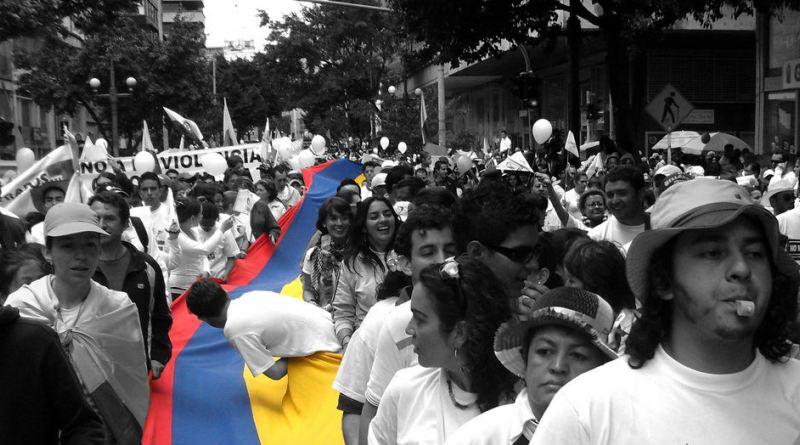 |
On Wednesday, September 23, 2015, Colombian President Juan Manuel Santos and FARC leader Rodrigo Londoño pledged to end the country's internal conflict by March 26, 2016.
Following La Violencia-Colombia's infamous civil war lasting from 1948 to 1958-the polarization of the country's political parties and ideological factions has led to a continuation of violence throughout Colombia. The left-wing Revolutionary Armed Forces of Colombia (Fuerzas Armadas Revolucionarias de Colombia, FARC) were initially formed as an armed peasant movement in 1964 that demanded comprehensive land and social reforms. Since then, the government and right-wing paramilitaries have waged a violent conflict against the FARC in rural Colombia that has resulted in a total of 220,000 deaths and over 5.7 million displacements.[1] |
June 18, 2015
Political Report #1046 AELN Commander Manrique Dies: What Is Next?
By Eliza Davis and Michael Paczkowski, Research Associates at the Council on Hemispheric Affairs
|

On Sunday, June 14, 2015, the Colombian military announced the death of prominent ELN commander José Amín Hernández Manrique in the northern department of Antioquia. The Ejército de Liberación Nacional (National Liberation Army; ELN) is a left-wing guerilla movement, operating under a Marxist platform with the aim of liberating Colombia. The death of Manrique, also known as "Marquitos," illustrates the rising tensions between the Colombian government and its left-wing guerilla adversaries, the Fuerzas Armadas Revolucionarias de Colombia (Revoluationary Armed Forces of Colombia; FARC) and the ELN. Colombia has been plagued by widespread violence for more than 50 years, which has produced some 220,000 deaths and another 5 million refugees.
The Colombian government and the FARC, the largest and oldest guerilla group in Colombia today, renewed peace negotiation talks-the fourth such attempted in the past 30 years-in December 2012 in Havana, Cuba. So far, the parties have agreed upon three terms of agreement: land reform, political integration, and drug trafficking. Consequentially, Bogotá and the FARC have yet to agree upon the reparations for the conflict's victims, the disarmament of the rebel forces, and the methods of implementation once a finalized agreement has been signed. While the ELN has had only a minimal presence in the Havana negotiations, the FARC has repeatedly encouraged a greater ELN participation in the discussion, facilitated by Bogotá's recent lift of the 182 arrest warrants against FARC Commander-in-Chief Rodrigo Londono Echeverri.[1]
>>>To continue reading this article, please
|
June 16, 2015
Political Report # 1045 A Journey Toward Colombian Unity by Michael Paczkowski

Featured photo: © European Union 2014 - European Parliament.
Political Report # 1045
A Journey Toward Colombian Unity
By: Michael Paczkowski, Research Associate at the Council on Hemispheric Affairs
|
Since December 2012, representatives from the Colombian left-wing guerrilla movement, the Fuerzas Armadas Revolucionarias de Colombia (Revolutionary Armed Forces of Colombia, or FARC), have been in peace negotiations with the Colombian Government in Havana, Cuba. This is the fourth attempt in the past 30 years to find a solution to the continuing violence in Latin America's most war torn nation. The negotiations in Havana have been slogging forward, but have found some successes on the issues of land reform, drug trafficking, and future FARC member political participation.
The nation has now suffered through five decades of conflict, and the results have been brutal: some 220,000 dead and another five million people are refugees. There are many warring parties. The FARC, the largest and oldest group, claims to be fighting for agrarian reform and anti-imperialism, with the ultimate goal of the violent removal of the Colombian government. A second left-wing guerrilla movement, the Ejército de Liberación Nacional (the National Liberation Army, or ELN), claims that it is battling for a Marxist revolution and the liberation of Colombia. The most murderous group involved in the fighting has been the Autodefensas Unidas de Colombia (United Self-Defense Forces of Colombia, or AUC), a collection of right-wing paramilitary death squads responsible for the preponderance of the savage human rights crimes that have plagued this nation.[1] |
Subscribe to:
Posts (Atom)