By Anastasia Moloney, Thomson Reuters Foundation
|

Showing posts with label Peace Negotiations. Show all posts
Showing posts with label Peace Negotiations. Show all posts
January 30, 2017
Political Report # 1222 Killings of Colombia rights activists casts shadow over peace deal

October 21, 2015
Political Report # 1082 Peace in Sight: Historic Agreement between Colombia and the FARC By Miguel Salazar, Research Associate at the COHA
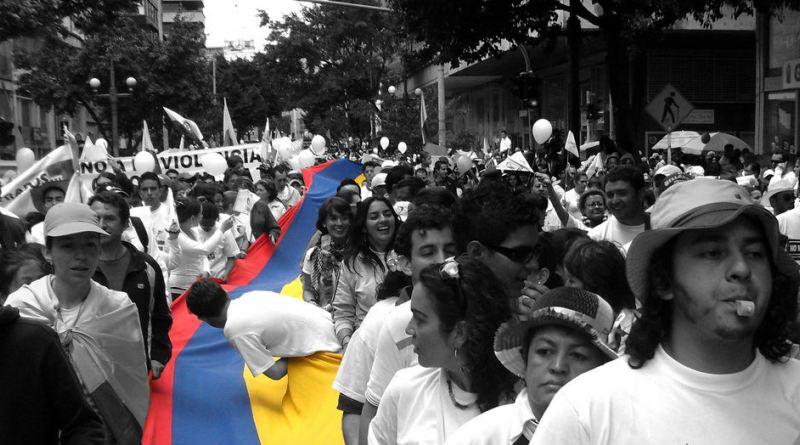 |
On Wednesday, September 23, 2015, Colombian President Juan Manuel Santos and FARC leader Rodrigo Londoño pledged to end the country's internal conflict by March 26, 2016.
Following La Violencia-Colombia's infamous civil war lasting from 1948 to 1958-the polarization of the country's political parties and ideological factions has led to a continuation of violence throughout Colombia. The left-wing Revolutionary Armed Forces of Colombia (Fuerzas Armadas Revolucionarias de Colombia, FARC) were initially formed as an armed peasant movement in 1964 that demanded comprehensive land and social reforms. Since then, the government and right-wing paramilitaries have waged a violent conflict against the FARC in rural Colombia that has resulted in a total of 220,000 deaths and over 5.7 million displacements.[1] |
June 16, 2015
Political Report # 1045 A Journey Toward Colombian Unity by Michael Paczkowski

Featured photo: © European Union 2014 - European Parliament.
Political Report # 1045
A Journey Toward Colombian Unity
By: Michael Paczkowski, Research Associate at the Council on Hemispheric Affairs
|
Since December 2012, representatives from the Colombian left-wing guerrilla movement, the Fuerzas Armadas Revolucionarias de Colombia (Revolutionary Armed Forces of Colombia, or FARC), have been in peace negotiations with the Colombian Government in Havana, Cuba. This is the fourth attempt in the past 30 years to find a solution to the continuing violence in Latin America's most war torn nation. The negotiations in Havana have been slogging forward, but have found some successes on the issues of land reform, drug trafficking, and future FARC member political participation.
The nation has now suffered through five decades of conflict, and the results have been brutal: some 220,000 dead and another five million people are refugees. There are many warring parties. The FARC, the largest and oldest group, claims to be fighting for agrarian reform and anti-imperialism, with the ultimate goal of the violent removal of the Colombian government. A second left-wing guerrilla movement, the Ejército de Liberación Nacional (the National Liberation Army, or ELN), claims that it is battling for a Marxist revolution and the liberation of Colombia. The most murderous group involved in the fighting has been the Autodefensas Unidas de Colombia (United Self-Defense Forces of Colombia, or AUC), a collection of right-wing paramilitary death squads responsible for the preponderance of the savage human rights crimes that have plagued this nation.[1] |
Subscribe to:
Posts (Atom)