Showing posts with label Environment. Show all posts

November 26, 2020

Abstract: Environmental Violence and the Socio-environmental (de)Evolution of a Landscape in the San Quintín Valley


:::::: Abstract ::::::


Environmental Violence and the Socio-environmental (de)Evolution of a Landscape in the San Quintín Valley
 

by  Nemer E. Narchi, Sula E. Vanderplank, Jesús Medina-Rodríguez, Enrique Alfaro-Mercado

"The social and environmental effects of industrial agriculture in the San Quintín Valley of Baja California are closely related. An environmental history of the valley from European contact to the present demonstrates that modern schemes of globalized agricultural production erode biological diversity while fostering labor exploitation. A critical model drawing on the concept of environmental violence— historically structured asymmetrical power relations that are reproduced and maintained to foster capital accumulation—describes how neoliberalism shapes and exploits agro-industrial landscapes and livelihoods in San Quintín to produce a crisis of underproduction.


CONTINUE READING FULL ARTICLE HERE


SaveSave
SaveSave
SaveSave
SaveSave
SaveSave

September 26, 2019

Abstract, The Truth and Reconciliation Commission and the Law of Prior Consultation: Obstacles and Opportunities for Democratization and Political Participation in Peru

:::::: Abstract ::::::


The Truth and Reconciliation Commission and the Law of Prior Consultation: Obstacles and Opportunities for Democratization and Political Participation in Peru


by Juan Pablo Sarmiento Barletti and Lexi Seedhouse


A study informed by long-term fieldwork with Amazonian and Andean indigenous peoples examines their experiences of Peru’s Truth and Reconciliation Commission and Law of Prior Consultation. It engages with these efforts, which sought to address injustice by creating a new pact between the state and its indigenous citizens, their various failures, and the unintended opportunities that they have created for the political participation of indigenous peoples and their representatives.


July 31, 2019

Political Report # 1403 The Global Beef Trade Is Destroying the Amazon


By Andrew Wasley, Alexandra Heal, Dom Phillips, Daniel Camargois, Mie Lainio, André Campos & Diego Junqueira

 The Bureau of Investigative Journalism


The cows grazed under a hot sun near a wooden bridge spanning a river in the Amazon. The quiet was occasionally broken by a motorbike growling along a dirt road that cut through the sprawling cattle ranch.
But the idyllic pasture was on land that the Lagoa do Triunfo ranch has been forbidden to use for cattle since 2010, when it was embargoed by Brazil’s environment agency Ibama as a punishment for deforestation. Nearby there were more signs of fresh pasture: short grass, feeding troughs, and fresh salt used to feed cattle - all in apparent contravention of rules designed to protect vital rainforest.
This vast 145,000 hectare ranch is one of several owned by AgroSB Agropecuária SA - a company known in the region as Santa Barbara. Located in an environmentally protected area, Lagoa do Triunfo is more than 600km from the capital of the Amazon state of Pará, on the western fringes of Brazil’s “agricultural frontier” - where farming eats into the rainforest.
An investigation by the Bureau, the Guardian and Repórter Brasil has found that cattle produced by Santa Barbara are being sold to JBS, the world’s biggest meat-packing company. JBS is the single biggest supplier of beef, chicken and leather globally, and exports fresh beef to Europe and about half of the corned beef eaten in the UK. In 2017, JBS said it had stopped buying Santa Barbara cattle, after it was fined $7.7 million for buying cows raised on illegally deforested land - but our investigation shows that is no longer the case.

April 4, 2019

Abstract, How Does Development Mean? Attitudes toward Mining and the Social Meaning of Development in Guatemala

:::::: Abstract ::::::


How Does Development Mean? Attitudes toward Mining and the Social Meaning of Development in Guatemala


by Michael L. Dougherty

The ways that the concept of development comes to mean refract individual value sets and map onto Guatemalan host-community residents’ attitudes toward mining. Economically oriented residents tend to support mining while those who prioritize public health and environmental advocacy tend to oppose it. Individuals who trust institutions of the state tend to support mining, while individuals who perceive these issues through the lens of their religious faith tend to oppose it. Concerns around public health are especially salient. Focusing on individual-level decision making rather than community-level action distinguishes between rationale and decision, thus highlighting the variegated social meanings underlying superficially similar attitudes. Mining attitudes and their rationales are heterogeneous and vary in intensity.


CONTINUE READING THE FULL ARTICLE HERE

SaveSave
SaveSave
SaveSave
SaveSave
SaveSave


SaveSave
SaveSave
SaveSave
SaveSave
SaveSave
SaveSave

October 8, 2018

Abstract, Environmentalism and the Globalization of the Oil Industry in Rio de Janeiro, Brazil

:::::: Abstract ::::::


Environmentalism and the Globalization of the Oil Industry in Rio de Janeiro, Brazil
by Maria Guadalupe Moog Rodrigues


The state of Rio de Janeiro has become a hub for oil and gas production and infrastructure since Brazil entered the global oil market in the 2000s. Observers have anticipated increasing tensions between environmental activists and oil companies. These predictions have not been fulfilled, despite increasing evidence of environmental degradation caused by oil production. What could be hindering environmental mobilization in defense of the environment and affected populations and against the unrestrained expansion of oil infrastructure in the state? A longitudinal case study of environmental activism in defense of the Guanabara Bay ecosystem suggests that answers must consider the combined effects of democratization, political and regulatory decentralization, and neoliberal reforms on socioenvironmental activism—specifically, its weakening as civil society organizations confront increasing burdens of participation in policy making, deeply fragmented institutional and regulatory frameworks for environmental governance, and the expansion of opportunities to engage in collaborative arrangements with corporations.


June 29, 2018

Political Report # 1352 Powerful New Yorkers Are Criminalizing Ecuadorians Seeking Relief From Chevron

Two powerful New Yorkers have been indispensable in protecting Chevron from having to pay $9.5 billion to clean up its massive oil contamination in the Amazon rainforest after an Ecuadorian court decision. The contamination was an intentional injustice that killed and injured thousands of Ecuadorians - many Indigenous people and many children.
The Ecuadorian lawsuit, first filed 25 years ago, continues to languish because Chevron refuses to pay damages while 200,000 pages of lawful evidence of contamination by Chevron and Texaco have been ignored in a New York court.
Chevron’s intent in this case always has been to turn the focus from its own wrong-doing to the criminalization and de-legitimization of the Ecuadorians and their legal system.
The brain behind this travesty of justice is Chevron, but the muscle is Judge Lewis A. Kaplan and Chevron’s attorney Randy Mastro. Together, the two New Yorkers have demonized, criticized and belittled the 30,000-plus Ecuadorians who have tried for decades to clean up their polluted rainforest.
Judge Kaplan was appointed by former President Bill Clinton and now serves as the senior judge of the United States District Court for the Southern District of New York. As for Mastro, Chevron hired him and his firm, Gibson Dunn, to rescue the oil giant from the Ecuadorian lawsuit. Mastro once worked at New York’s City Hall as a deputy mayor for his longtime pal Rudy Giuliani, who is now Trump’s personal lawyer.
Around the time an Ecuadorian court ruled against Chevron in 2011, the California-based company retaliated in Judge Kaplan’s courtroom by accusing the 47 Ecuadorian plaintiffs of fraud and bribery. Judge Kaplan heard the case and ruled in Chevron’s favor in 2014, even though no credible evidence of fraud and bribery has surfaced.

June 22, 2018

Political Report # 1349 Plastic Tsunamis Threaten Coast in Latin America


Political Report # 1349

Plastic Tsunamis Threaten Coast in Latin America


By Fabiana Frayssinet, Inter Press Service News Agency

This article is part of special IPS coverage for World Environment Day, on June 5, whose theme this year is “Beat Plastic Pollution.”

Rio de Janeiro - Although Latin America produces just five percent of the world’s plastic, it imports billions of tons annually for the use of all kinds of products, some of which end up in the sea as garbage.
It thus contributes to this kind of artificial tsunami that threatens the biodiversity of the oceans, where 13 million tons of waste, mostly disposable plastics, are dumped each year at a global level, according to UN Environment - enough to wrap around the Earth four times.
The impact is such that it also affects human health, as this resistant waste enters the food chain, and has led the United Nations to declare “Beat Plastic Pollution” as the theme for this year’s World Environment Day, on Jun. 5.
Favoured by a 3,000-km coastline on the Pacific Ocean, with one of the world’s most nutrient-rich waters, Peru was one of the first Latin American countries to join the Clean Seas campaign, launched a year ago by UN Environment.
The global campaign aims to eliminate by 2022 the main sources of marine debris, which can remain in ecosystems for 500 years. There are five identified ‘islands’ of plastic rubbish in the Pacific, Atlantic and Indian Oceans, one of them between Chile and Peru.
“We have witnessed firsthand the serious impacts of different types of waste, including plastic in our seas,” said Ursula Carrascal, project coordinator for the Institute for the Protection of the Environment Vida in Peru.
For 20 years, the organisation has been leading a campaign to clean up beaches and coastlines in this Andean country, involving all sectors of society.
According to Carrascal, the problem is exacerbated when the country suffers additional damage caused by natural disasters, such as the “La Niña” phenomenon that in 2017 caused flooding and the shifting of tons of waste accumulated on river banks.
“Marquez Beach in Callao was literally covered in garbage for three km. Many beaches are now gone, fishing boats and artisanal fishermen are affected by the damage to their nets or engines caused by plastic,” she told IPS from Lima.
The country, according to the Environment Ministry, generates 6.8 million tons of solid waste. Lima and the neighbouring port city of Callao alone generate an estimated three million tons per year. Of that total, 53 percent is organic waste, and in second place comes plastic, accounting for 11 percent, a percentage in line with the world average.
In fact, half of the 6,000 tons of marine debris collected by Vida since 1998, with the support of 200,000 volunteers, is plastic.
“There is a strong concern about the risk in the field of food safety due to the plastic accidentally ingested by fish,” Carrascal said.
The governmental Marine Institute of Peru has been studying the impact of microplastic (less than five mm long) on Peruvian beaches and in the digestive tract of fish for years. A 2017 report found 473 plastic fragments per square metre on a beach in Callao.
The British Ellen MacArthur Foundation, dedicated to promoting the circular economy - based on the reduction of both new materials and waste, to create loops of recycling - warns that by 2050 there will be more plastic than fish in the oceans and reminds us that all marine life eats this waste.
One of the consequences, say scientists at Ghent University in Belgium, is that when you eat fish and seafood, you ingest up to 11,000 tiny pieces of plastic, a material most commonly derived from petrochemicals, every year.
In Brazil, a country with more than 9,000 km of coastline on the Atlantic Ocean, a marine aquarium was inaugurated in October 2016 in Rio de Janeiro. AquaRío, which promotes environmental education and scientific research for biodiversity conservation, is the institution with which the Clean Seas campaign was launched.
“Plastic discarded improperly on beaches, rivers and the sewers ends up in the sea and causes the death of thousands of marine animals every year. Drinking straws, cigarette butts, caps, plastic bags, improperly discarded, represent the highest percentage of environmentally hazardous materials for marine wildlife,” director Marcelo Szpilman told IPS.
“The remains of nets, fishing lines, ropes and plastic bags abandoned in the sea remain in the environment for many years due to their low biodegradability and end up injuring or killing countless animals that end up entangled and die by asphyxiation or starvation,” added the marine biologist.
To raise awareness among children about this silent killing at sea, the aquarium uses the image of mermaids dying from the ingestion of plastic.
This happens in reality in the oceans to fish, birds, seals, turtles and dolphins that confuse floating plastic waste with octopuses, squid, jellyfish and other species that they eat.
“Dolphins have been found with their stomachs full of city trash. Cigarette butts, the most widely collected item in all beach clean-up campaigns, have caused the death of animals that swallow them mistaking them for fish eggs,” Szpilman said.
In addition, he noted, “a plastic bag drifting at sea is easily mistaken for a jellyfish, which is a food for several species of sea turtles, which as a result can die from asphyxiation.
According to experts, in Brazil and other Latin American countries, the problem is combated with isolated initiatives, such as the banning of plastic bags in supermarkets, when what is needed is a broader change in the model of plastic production and consumption.
But some things have started to be done.
In Peru, for example, Vida has coordinated actions with the waste management industry to promote the circular economy model through recycling chains with the waste collected in coastal cleanups throughout the country.
This work has been carried out not only with large industry but also with small and medium-sized enterprises and the National Movement of Recyclers of Peru.
“Greater efforts and investment in recycling technology are needed to solve the plastic problem. In Peru, much of the plastic waste collected, although it could be 100 percent recycled, is not recycled because there are no recycling plants, due to lack of knowledge or lack of adequate technology,” Carrascal said.
In his opinion, “great progress is being made in the separation of waste from primary sources, but this cycle ends when the waste ends again in a landfill.”
The Peruvian model of waste management in the marine ecosystem has been used as a reference point in other countries of the Southeast Pacific, including Chile, Ecuador, Colombia and Panama.
Visit IPS news for fresh perspectives on development and globalization.
Fabiana Frayssinet
Fabiana Frayssinet has been a correspondent since 1989 in Central America, and since 1996 in Brazil, where she served as a contributor for various international media outlets in radio, print and television, including CNN en Español, Inter Press Service, UNIVISION, Telefé de Argentina, Radio Suecia and Radio Nederland.


Original article can be found here:
http://www.ipsnews.net/2018/06/plastic-tsunamis-threaten-coast-latin-america/

March 30, 2018

Political Report # 1326 Latin America poised to agree world's first legal pact for nature defenders


By Arthur Neslen  
The Guardian


Latin American countries are poised to agree the world's first legally binding convention to protect environmental defenders at a conference in Costa Rica.
Land activists and indigenous people were killed in record numbers on the continent last year, with more than two nature protectors murdered every week.
Now, after two years of negotiations, UN and diplomatic sources say it is very likely that an environmental democracy treaty offering them legal protection will be agreed at the summit which ends on 4 March.
Constance Nalegach, Chile's lead negotiator at the UN's Economic commission for Latin America and the Caribbean (Eclac) meeting, said that a legal pact was now "the most probable result and [also] a political gain".

November 10, 2017

Political Report # 1289 In El Salvador, Vidalina Morales Is Uprooting Patriarchy While Defending the Environment


By Lorena Gaibor,
Upside Down World
Vidalina Morales is an eco-feminist and leader of The National Roundtable Against Metallic Mining in El Salvador (MESA) who has fought against the damaging effects of metal mining in that country for the last decade. These effects include the contamination of water sources, higher rates of cancer in affected communities, damage to agriculture and fishing areas, forced evictions, and the breakdown of Indigenous and rural communities. In March of this year, MESA’s work helped push the country’s Congress to pass a historic nationwide ban against metallic mining, making El Salvador the first country in the world to do so.
On Nov. 4, the Denver Justice and Peace Committee (DJPC), a longstanding human rights organization in the Rocky Mountain region, chose to honor MESA with the Global Justice & Peace Award 2017. Vidalina Morales’ leadership in that organization has been instrumental in the effort to protect the environment and envision a more just world for all.
I was able to sit down with Vidalina the morning after she received the award. Although small in stature, you quickly sense her strength and resolve as she begins to speak. Her voice is steady and her expression remains calm as she describes the moving struggle of the environmental protection movement in El Salvador.
LG: For you personally and as an organizer, what have the greatest challenges been?
VM: One of the most challenging struggles in MESA has been an internal one in which women were not taken seriously and even disrespected by some who held traditional patriarchal notions of women as not belonging in leadership positions and instead belonging in the home. To be a female leader was a lot to overcome. When the MESA asked me to start speaking out as a leader, this was usually a position reserved for men and although the progressive MESA leadership wanted to push more women forward, at first this was very hard. I felt discrimination as a person in three major ways: First, for being a campesina; second, for not having a formal educational degree; and third, for being a woman. The discrimination was the result of not seeing the capacity that campesina women have. Thankfully, with the support of other strong female leaders in the movement, women began promoting women as leaders.

July 27, 2017

Entrevista con el Dr. Nemer Narchi (Español)


El Dr. Nemer Narchi, un Coordinating Editor de LAP, discute el daño de la extracción y la violencia ambiental en las comunidades de América Latina y cómo podemos comenzar a reimaginar nuestra relación con el medio ambiente.


"Environmental Violence in Mexico"
Latin American Perspectives 
Issue 204 Vol. 42 #5 September 2015
Available here.


June 14, 2017

Political Report # 1253 Brazil Assaults Indigenous Rights, Environment, Social Movements


"The first five months of 2017 have been the most violent this century," Cândido Neto da Cunha, a specialist in agrarian affairs at the National Institute of Colonization and Agrarian Reform (INCRA) in Santarém, Brazil, told Mongabay. According to the Catholic Church's Pastoral Land Commission (CPT), which has been compiling statistics on rural violence since 1985, 36 people have already been assassinated in rural conflicts this year.
The latest violence came on 24 May when nine men and a woman were killed in what seems to have been a deliberate massacre on the Santa Lúcia estate in the rural district of Pau D'Arco located 860 kilometers (535 miles) south of Belém, the capital of the state of Pará.
For many years, landless families had lobbied for the creation of a land reform settlement on this estate, saying that the man claiming to own the land, now deceased, was a land thief. His widow agreed to hand over the property, but had second thoughts when INCRA officials, who cannot pay above the market price, refused to pay her what she asked.
In the meantime, landless families had occupied the area and a security guard, working for the ranch, was killed on 30 April. A posse of military and civil police went in to evict the families and to investigate the death. The families say the police arrived shooting. This version is disputed by the police, who claim that the peasant families shot at them first. However, no police officer was killed or wounded.

March 22, 2017

Political Report #1235 Argentina's Never-ending Environmental Disaster


Political Report # 1235
Argentina's Never-ending Environmental Disaster
By Daniel Gutman, IPS

A view of Buenos Aires from the point where the Riachuelo flows into the Rio de la Plata. To the left can be seen the famous Boca Juniors stadium. Chronicles from 200 years ago were already talking about the pollution in the river. (Credit: Courtesy of FARN)
Is it possible to spend 5.2 billion dollars to clean up a river which is just 64-km-long and get practically no results? Argentina is showing that it is.

As the government admitted to the Supreme Court of Justice in late 2016, that is the amount of public funds earmarked since July 2008 for the clean-up of the 64-km Matanzas-Riachuelo river, which has been identified as one of the worst cases of industrial pollution in the world.

August 19, 2016

Political Report # 1173 In Latin America, environmentalists are an endangered species


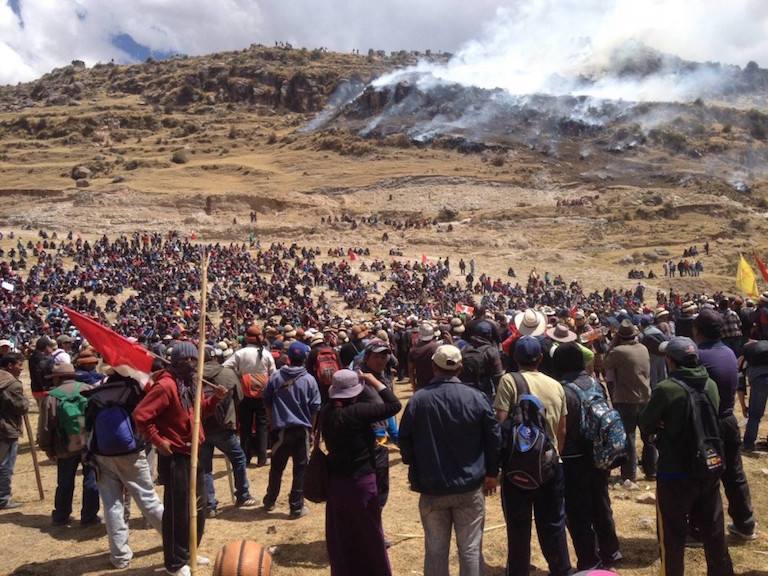
In September, 2015, four protestors were killed during demonstrations at Las Bambas mine in Apurimac, Peru. Photo from the Mining Conflict Observatory.


By  Lindsay Fendt, Mongabay


On a Tuesday in March, indigenous activist Nelson García was shot in the face in northwest Honduras. The next day, in Guatemala, unknown attackers found environmentalist Walter Méndez outside his home and filled his chest with bullets. Two weeks earlier gunmen killed Berta Cáceres, an internationally renowned environmental campaigner, in her Honduran home. And in the months before, similar killings were reported in Brazil, Mexico, and Peru.
Since 2010, murders over land disputes have been on the rise worldwide, but the problem is especially severe in Latin America, according to U.K.-based NGO Global Witness. The group documented more than 900 environmentalists killed in the region between 2002 and 2015. Last year was the deadliest year on record, with 185 murders worldwide, nearly two-thirds of them in Latin America, according to a report the group released in June.
"There is an increase in pressure to exploit resources that have not been exploited yet," John Knox, a Special Rapporteur on human rights and the environment for the United Nations, told Mongabay. "You have very powerful economic interests on one hand and marginalized communities on the other and that seems to be leading to these conflicts [worldwide]."
Though in Latin America the reasons for the killings vary, many are related to a surge in development in remote parts of the region. Seeking out foreign investment, governments have been granting concessions to foreign-funded hydroelectric dams, mines, and other projects, often without consulting the communities already occupying the land. Meanwhile, landless ranchers, poachers, and illegal loggers are also pushing into remote areas in search of untapped resources.
Most of the encroached-upon areas have been inhabited by indigenous groups or subsistence farmers for generations, but many communities lack titles or deeds for their land. With little government assistance, some members of these communities are opposing environmental destruction on their own and paying the ultimate price.
"It is one of the most serious injustices in the world," said Bill Kovarik, a professor at Radford University in Virginia who tracks murders of green activists. "For every one of these very serious deaths there are dozens of others that face violence."
International interests
One day in February, Maxima Acuña de Chaupe says she returned to her home in Cajamarca, Peru, to find her house ransacked and her dog bleeding from its neck. It was another in a string of attacks against Acuña and her family, who claim to have been targeted for their refusal to sell their 60-acre potato farm to make way for a gold mine. According to Acuña, her children have been attacked and threatened by police and in April her home was shot at.
"In Cajamarca, we know what mines can do. In no time it would have poisoned the trout and the livestock. If we don't have water we don't have a life or a future," Acuña told The Guardian after she was awarded the prestigious Goldman Environmental Prize for her work in April.
The $4.8 billion Conga mine that Acuña has opposed would have become the largest gold mine in South America. The Peruvian government granted the concession to a venture between U.S.-owned Newmont Mining Corporation and Peruvian company Buenaventura with no public consultation. The concession spurred protests in Cajamarca; in 2012 five people were killed during protests.
The controversy forced Newmont to suspend the Conga project in 2015, but the Peruvian government remains steadfast in its effort to attract mining businesses to the country. In 2014, Peru's legislature passed a law loosening environmental requirements for new development projects and the government is now reportedly relying on copper mining to bring in $62 billion of investment before 2017. Conflicts related to mining have driven approximately 80 percent of Peru's 69 environmental murders since 2002, according to Global Witness figures.
Other countries in the region have pursued similar paths to rapid development. In Honduras, the right-wing government granted 47 hydropower dam concessions in 2010 under a law that granted the government the right to sell off the country's water resources to the highest bidder. Until recently, Colombia had development laws on the books that were drafted by lawyers on the payroll of mining companies.
In many cases, the funds for these developments come from outside of Latin America.
"There is definitely a role played by the global north," Billy Kyte, an author of the Global Witness report, told Mongabay. "Many of the companies and investments come from the global north and entities like the World Bank."
Between 2009 and 2013 the World Bank lent $50 billion worldwide to projects ranked as having a high risk for causing "irreversible or unprecedented" impacts to communities or the environment, according to an investigation by the International Consortium of Investigative Journalists. Within Latin America, the International Financing Corporation, the World Bank's independent lending arm, has been linked to controversial projects in Peru, Honduras, and Guatemala.
While the World Bank has environmental and social safeguards intended to prevent directly funding projects with severe social or environmental consequences, the IFC often operates through financial intermediaries rather than making direct contributions to a project. According to Paul Cadario, a distinguished fellow at the University of Toronto's Munk School of Global Affairs and a former senior manager at the World Bank, the IFC does not always vet the projects that their investments will eventually fund.
"The IFC is arguing that they just lend to the development bank and don't worry about their clients, what they do with the money, and how they do it," Cadario told Mongabay. "There are many, including me, that believe for a development institution that is unacceptable."
The IFC has updated its risk assessment protocols, but only for projects it funds directly. It made many of these changes following its lending to the Honduran food company Corporación Dinant in 2009 and 2011. The money went to the corporation's Paso Aguán palm oil plantation, the development of which has been linked to the deaths of 89 people in the local farming community, as well as 19 who were either security guards, members of the police or military, or landowners.
According to Mark Constantine, a current IFC official who works in environmental and social risk assessment, following the well-publicized disaster with Corporación Dinant the IFC stepped up its efforts to make sure that the companies it lends to have the capacity to adhere to the World Bank's performance standards. Constantine also said the group began doing a better job of examining the historical context of land-rights issues in the countries where it operates and in studying the entire supply chain to spot areas with less obvious potential for human rights abuses.
Though the IFC will still take on risky projects, the group's commitment to working in developing nations sometimes makes some risk unavoidable, Constantine said.
"We are trying to foster economic and social development and alleviate poverty. For us to walk away completely solves nothing," he said. "If there is a problem, we feel that our involvement can yield a better outcome or solution on the ground."
Private projects by international companies also have contributed to the violence. Canadian extractive companies, in particular, have a strong presence in Latin America and a poor human rights record. According to a 2014 report by a group of NGOs known as the Working Group on Mining and Human Rights in Latin America, 70 percent of mining activity in Latin America in 2012 had Canadian involvement. The same report highlighted 22 large-scale Canadian projects that entailed environmental and human rights abuses.
Another report, commissioned by the Prospectors and Developers Association of Canada (PDAC) in 2010, found that extractive companies from Canada were responsible for 33 percent of incidents involving community conflict, human rights abuses, unlawful or unethical practices, or environmental degradation in a developing country in the previous ten years - four times the number of any other country. Nearly a third of these incidents took place in Latin America.
Despite commissioning the report, the PDAC did not make it public, and a spokesperson declined to comment for this story.
It isn't only foreign funding that fuels risky projects. In recent years there has also been an increase in illegal domestic activities like poaching and logging. In Brazil, the country with the highest total number of environmentalist murders (50 in 2015 alone, per Global Witness's report), the states with the highest deforestation rates also have the highest rates of violence against activists. In Brazil and many other Latin American countries, rural communities often do not have land titles, which allows logging and agricultural interests to push into previously uncut forest areas without fear of legal repercussions. Loggers, farmers, and ranchers often have significant influence over what little government may be present in the area, leaving the land's previous occupants to defend their territory alone.
"The ones who stand up are quickly cut down," said Kovarik.
The Activists 
In March 2013, the people of Río Blanco in western Honduras awoke to a group of armed security guards blocking their access to the nearby Gualcarque River. For generations, the indigenous Lenca people have lived in Río Blanco, fishing and bathing in and drinking from the Gualcarque. The security forces belonged to Desarrollos Energeticos SA, a Honduran energy company that had received a concession to build a dam on the river.
Berta Cáceres, a Lenca woman, and the Civic Council of Popular and Indigenous Organizations of Honduras (COPINH is its Spanish acronym), soon started a blockade on the road to the construction site, demanding to be consulted about the project per Honduran law. They maintained the blockade for more than a year, holding their ground despite death threats and even after one of their members, Tomás García, was shot during a peaceful protest in July 2013.
Though some of the protestors, like Cáceres, worked as professional campaigners, most were pulled into the conflict when their way of life was threatened. The same is true of many of the green activists killed in Latin America. Indigenous groups are particularly at risk due to both the value of the land they occupy and the lack of clarity surrounding their land rights in many countries throughout the region. According to Global Witness, indigenous people made up almost 40 percent of the environmental land defenders killed in 2015. Professionals like environmental lawyers and journalists also number among the dead.
 "Often times, people just find themselves caught up in these conflicts," said Knox of the UN. "These are marginalized communities that rely heavily on what they get from the land. They feel like they don't have a choice so they are willing to stand up to this."
In many cases, protest and resistance is the only option for land defenders. Many Latin American countries have laws requiring companies to consult local communities before projects can move ahead. But in an effort to make deals more attractive to investors, advocates say that Latin American governments will often circumvent these laws, allowing companies to buy, or simply take, land from its previous occupants. Global Witness uncovered hundreds of cases throughout the region in which police or private security forces were dispatched to evict communities without their prior consent.
"The government needs to consult communities if they want to allow industry onto their territory," Sergio Beltetón, a Guatemalan lawyer who works on land rights cases with the Campesino Unity Committee, told Mongabay. "They aren't going to be able to stop these conflicts until they start respecting the consultation laws."
Despite their high mortality rate and the other obstacles land defenders face, their protests are sometimes effective. The Lenca blockade led by Cáceres convinced the powerful Chinese hydro engineering firm Sinohydro to pull out of the Río Blanco project. In recent months, the international outrage spurred by Cáceres's murder forced more companies to cease their involvement with the dam, including the project's largest European investors. In other cases, including Acuña's standoff with the Conga Mine in Peru, activists who refused to leave their land effectively stopped projects from moving forward.
"The world lives in a glass house now and we can see what is going on and action can be taken," said Kovarik. "Projects can be stopped and people can be embarrassed."
Criminalization and impunity
For each environmental defender who is killed, many others are threatened or otherwise repressed, including through the legal system. The Geneva-based Observatory for the Protection of Human Rights Defenders documented legal cases against 123 land activists globally from 2011 to 2014, but noted that the true number is likely much higher. According to this report and Global Witness's findings, this criminalization of land defenders is extremely common in Latin America, especially Central America. Large companies and government entities often wrongfully arrest or prosecute anyone who stands in the way of their development interests, jailing activists or embroiling them in costly legal battles.
"The companies will not tolerate criticism from anyone. They consider anyone who speaks out an enemy, and they go after them," Beltetón said. "They find the best way to get rid of them, whether that is through criminal proceedings or killing them."
Green activists have been charged with libel or slander for speaking against development projects, framed for robbery, or charged with impeding justice while blocking a highway during a protest. According to Global Witness, in recent years, human rights groups have also seen a worldwide surge in governments labeling activists as terrorists. Both Guatemala and Chile have labeled activists "internal enemies" and charged them under anti-terrorism laws for peacefully protesting.
Even when the legal system is not actively punishing environmentalists, it does little to protect them. Global Witness has found that authorities rarely investigate threats made against activists and that the murders almost never result in prosecutions convictions. Though precise numbers are not available, Global Witness only found 10 cases worldwide between 2002 and 2013 in which the murderers of environmentalists were tried and convicted. This problem is especially severe in Latin America, where impunity rates tend to be high.
In Honduras 90 percent of the crimes committed against human-rights defenders go unsolved, according to the Honduran Public Ministry and only one of the 75 crimes against environmentalists recorded in Costa Rica since 2002 was punished. In May, Honduran authorities arrested four men in connection with Berta Cáceres's murder. But authorities have failed to identify or bring to justice those responsible for the violence against García, Mendez, and Acuña.
There is also a pattern in Latin American of legal systems distancing crimes from the victim's environmental work.
"There is a tendency on the part of the government to say this isn't part of a broader pattern," Knox said. "There often is a broader problem related to environmental work. It's not just a tragic coincidence."
This tendency was on full display in 2013, when turtle-egg poachers murdered Costa Rican turtle conservationist Jairo Mora was killed while patrolling the beach one night, and though he had received death threats from poachers in the past for his work protecting turtle nests, police and government officials repeatedly declared that the motive for the slaying was robbery. After heavy media coverage, protests, and a botched trial where the suspects were acquitted on all charges, the government changed its stance.
Prosecutors secured an appeal to try the same seven men that were acquitted in the first trial. The second time around, the prosecution emphasized Mora's work with sea turtles and his ongoing conflict with a poaching gang. The new strategy, along with evidence excluded from the previous trial, resulted in convictions for four of the men in March.
As with Mora, other cases in which environmentalist murders were successfully prosecuted have usually been well publicized and drew pressure from the international community.
In 2007, two men were convicted of the murder of Dorothy Stang, an American nun who campaigned against illegal logging near her home in the Brazilian Amazon, and another man was eventually convicted of orchestrating the hit. Though violence against environmentalists is rarely prosecuted in Brazil, lawyers in the case say Stang's status as an American nun helped gain media attention and traction in court.
"I went into the court and told them that if they didn't do this right I was going to rake them over the coals in the international press," Brent Rushforth, a U.S. environmental lawyer who worked with Brazilian prosecutors on the case told Mongabay.
Though protests and media attention can sometimes pressure governments into investigating a case, few believe that these isolated successes signal a change in the tide.
"It is a Herculean task and there has to be sufficient backbone from the top down in the government to hold the billionaires and their cohorts responsible," Rushforth said. "I thought Dorothy's murder and prosecution would have more influence than it has, but this remains a huge problem."
Slow change?
Though the outlook for environmentalists in Latin America remains bleak, increased visibility and new legal strategies could eventually make a difference.
Last year, a group of indigenous Mayan Q'eqchi' people from El Estor, Guatemala, presented three civil cases in Canada alleging human rights abuses involving the Canadian-owned Fenix Nickel mine. While similar cases tried in Guatemala have seen little success, the Canadian negligence suits have made some headway. In 2013, an Ontario Superior Court judge ruled that the mine's former owner, HudBay Minerals Inc., could potentially be held legally responsible for the actions of the mine's security personnel, who allegedly shot and killed a protestor and paralyzed a bystander during a peaceful protest and also allegedly raped ten women during a forced eviction. In total, the victims are claiming $55 million in damages, but more significant is the legal precedent of bringing the case to the company's home country and the visibility that the case has brought to the issue of murdered environmentalists.
"What is positive is that the issue is slowly getting more and more recognized," Kyte said. "The very small silver lining when someone more well-known is murdered is the international outrage."
Cáceres's recent murder, in particular, has drawn heavy media attention, spurring protests both in Honduras and abroad. International human rights organizations and activists in Honduras are now pressuring the government to allow an independent investigation into the murder.
While pressure from abroad may help secure a comprehensive international investigation in Cáceres's case, human rights advocates say Latin American governments' own laws and actions will need to transform to secure lasting change.
"Up to now the government sees these people as opposing development," Kyte said. "What really needs to happen is that these people need to be treated as heroes."


Original article and sources can be found at:
https://news.mongabay.com/2016/08/in-latin-america-environmentalists-are-an-endangered-species/

July 26, 2016

Book, "Oil in the Soil. The Politics of Paying to Preserve the Amazon" by Pamela L. Martin


Oil in the Soil

The Politics of Paying to Preserve the Amazon

PAMELA L. MARTIN


Rowman & Littlefield Publishers
Pages: 168 • Size: 6 x 9
978-1-4422-1128-5 • Hardback • July 2011 • $81.00 • (£54.95)
978-1-4422-1130-8 • eBook • August 2011 • $79.99 • (£52.95)

ABOUT THE BOOK


February 15, 2016

Political Report # 1115 Costa Rica's Green Energy Feat Shows Hope For The Planet By Lynne Peeples, The Huffington Post


                       ESTEBAN BERMUDEZ FORN


By Lynne Peeples, The Huffington Post


Green energy beacons continue to pop up around the world -- from a small Scandinavian island to a Japanese resort town to other first-world enclaves such as Burlington, Vermont. But one source of lessons and inspiration in the transition to renewable energy may come as a bit of a surprise: a developing Central American country.
As nearly 200 nations pledged to wean themselves off climate-disrupting fossil fuels earlier this month in Paris, Costa Rica was already well on its way -- proving, according to some experts, that major moves to stave off catastrophic climate change were indeed possible and practical.
Nearly all of the energy produced in Costa Rica during 2015 came from renewable sources -- 99 percent as of Dec. 17 -- including 285 days during which the small Central American country completely eschewed fossil fuels in its energy generation, according to official data. (The nation's roads, like much of the world, are still filled with fossil-fuel-guzzling vehicles.)
Back in March, the nation broke a world record for the longest streak of relying solely on renewable energy for electricity: 75 days. Among the effects were lower electricity prices for Costa Rican residents.
"The newly adopted Paris climate agreement has sent a powerful signal: the world will need to leave fossil fuels behind if we are to achieve climate security this century," Monica Araya, executive director at Nivela, a Costa Rica-based environmental group, told The Huffington Post in an email. "Costa Rica is well positioned to be a trail blazer in this clean-energy transition."
Andrea Watson, section manager for strategy and implementation at the National Renewable Energy Laboratory, part of the U.S. Department of Energy, agreed that this is "absolutely a signal" of the world's potential to head down the right path.
She also noted that Costa Rica's efforts illustrate one of the key components included in the Paris accord: "differentiated responsibilities" based on countries' unique capabilities and circumstances. It ended up a crucial point, helping bring all 195 nations at the 21st Conference of the Parties, or COP21, on board.
"The idea out of the agreement wasn't that everyone will cut their emissions by this much, or that everyone must convert to renewable energy," said Watson. "But rather, every country will take an individualized approach to ambitious renewable energy goals -- one that works best for them and their development goals."
"The idea is that there is a path," she added. "Costa Rica has demonstrated that."
Costa Rica's individualized approach began decades ago with investments in its most abundant sources of renewable power. A major river system and heavy rainfall meant hydroelectricity could provide a solid base of energy generation. Geothermal and, increasingly, wind are also now significant in their mix.
ESTEBAN BERMUDEZ FORN
Since rivers tend to continuously flow, hydropower is generally among the more predictable renewable sources. The wind doesn't always blow and the sun doesn't always shine, of course. Yet climate change itself may be compromising hydropower's reliability due to more extreme fluctuations between floods and droughts. In nearby nations, such as Chile, melting glaciers also threaten future hydroelectric power generation.
"Most countries in Central and South America are still growing their use of electricity," said Gabriel Goldschmidt, regional head of infrastructure for Latin America and Caribbean at the International Finance Corporation, part of the World Bank.
So as these nations move along the development continuum, he added, they face difficult decisions. Expanding hydroelectricity to keep up with demand and to compensate for years when water flows are low, for example, could damage the environment and impact wildlife. "Simple spots to put sizable hydros have already been filled," added Goldschmidt. "The next ones are more difficult from environmental and cost perspectives."
Incorporating other sources of renewable energy is critical. Only in the last few years have options such as wind and solar become cost-effective. But as Costa Rica and other nations, including the U.S., continue to revisit their plans to cut carbon emissions -- per the Paris climate agreement -- they will have a wider array of alternatives thanks to technology innovations including energy storage, cheaper price tags on renewables, and now the extra push from Paris.
Much like hydropower in Costa Rica, wind and solar show significant potential in the U.S. -- especially in the middle and southern states. "You could take a corner of Utah and Nevada and power the entire United States with solar power," Tesla's Elon Musk was quoted as saying during a conference last week.
"The future looks very promising," said Goldschmidt.
Of course, while achieving nearly fossil-fuel-free electricity generation, Costa Rica still uses a fair amount of dirty energy. Their cars and trucks largely run on petroleum, of course. That's the next challenge, noted Araya.
"The government has pledged to build an electric train which will be integrated with public buses. There is also a proposal to start replacing oil-powered cars with electric cars as part of a new bill in congress that aims to offer consumer incentives to lower the prices of these cars," she said. "This would have multiple benefits including better air quality."
Clean air, according to a 2014 opinion poll, is Costa Ricans' No. 1 environmental priority. The same poll revealed that a majority of Costa Ricans also support the development of renewable energy projects such as wind, geothermal and hydropower.
In fact, opposition to wind power is lower in Costa Rica compared to developed nations, perhaps because the towering turbines, suggested Araya, are "a symbol of modernization."


Original and sources article can be found:
http://www.huffingtonpost.com/entry/costa-rica-renewable-energy-climate_us_56798c79e4b014efe0d6f524