On a Tuesday in March, indigenous activist Nelson García was shot in the face in northwest Honduras. The next day, in Guatemala, unknown attackers found environmentalist Walter Méndez outside his home and filled his chest with bullets. Two weeks earlier gunmen killed Berta Cáceres, an internationally renowned environmental campaigner, in her Honduran home. And in the months before, similar killings were reported in Brazil, Mexico, and Peru.
Since 2010, murders over land disputes have been on the rise worldwide, but the problem is especially severe in Latin America, according to U.K.-based NGO Global Witness. The group documented more than 900 environmentalists killed in the region between 2002 and 2015. Last year was the deadliest year on record, with 185 murders worldwide, nearly two-thirds of them in Latin America, according to a report the group released in June.
"There is an increase in pressure to exploit resources that have not been exploited yet," John Knox, a Special Rapporteur on human rights and the environment for the United Nations, told Mongabay. "You have very powerful economic interests on one hand and marginalized communities on the other and that seems to be leading to these conflicts [worldwide]."
Though in Latin America the reasons for the killings vary, many are related to a surge in development in remote parts of the region. Seeking out foreign investment, governments have been granting concessions to foreign-funded hydroelectric dams, mines, and other projects, often without consulting the communities already occupying the land. Meanwhile, landless ranchers, poachers, and illegal loggers are also pushing into remote areas in search of untapped resources.
Most of the encroached-upon areas have been inhabited by indigenous groups or subsistence farmers for generations, but many communities lack titles or deeds for their land. With little government assistance, some members of these communities are opposing environmental destruction on their own and paying the ultimate price.
"It is one of the most serious injustices in the world," said Bill Kovarik, a professor at Radford University in Virginia who tracks murders of green activists. "For every one of these very serious deaths there are dozens of others that face violence."
International interests
One day in February, Maxima Acuña de Chaupe says she returned to her home in Cajamarca, Peru, to find her house ransacked and her dog bleeding from its neck. It was another in a string of attacks against Acuña and her family, who claim to have been targeted for their refusal to sell their 60-acre potato farm to make way for a gold mine. According to Acuña, her children have been attacked and threatened by police and in April her home was shot at.
"In Cajamarca, we know what mines can do. In no time it would have poisoned the trout and the livestock. If we don't have water we don't have a life or a future," Acuña told The Guardian after she was awarded the prestigious Goldman Environmental Prize for her work in April.
The $4.8 billion Conga mine that Acuña has opposed would have become the largest gold mine in South America. The Peruvian government granted the concession to a venture between U.S.-owned Newmont Mining Corporation and Peruvian company Buenaventura with no public consultation. The concession spurred protests in Cajamarca; in 2012 five people were killed during protests.
The controversy forced Newmont to suspend the Conga project in 2015, but the Peruvian government remains steadfast in its effort to attract mining businesses to the country. In 2014, Peru's legislature passed a law loosening environmental requirements for new development projects and the government is now reportedly relying on copper mining to bring in $62 billion of investment before 2017. Conflicts related to mining have driven approximately 80 percent of Peru's 69 environmental murders since 2002, according to Global Witness figures.
Other countries in the region have pursued similar paths to rapid development. In Honduras, the right-wing government granted 47 hydropower dam concessions in 2010 under a law that granted the government the right to sell off the country's water resources to the highest bidder. Until recently, Colombia had development laws on the books that were drafted by lawyers on the payroll of mining companies.
In many cases, the funds for these developments come from outside of Latin America.
"There is definitely a role played by the global north," Billy Kyte, an author of the Global Witness report, told Mongabay. "Many of the companies and investments come from the global north and entities like the World Bank."
Between 2009 and 2013 the World Bank lent $50 billion worldwide to projects ranked as having a high risk for causing "irreversible or unprecedented" impacts to communities or the environment, according to an investigation by the International Consortium of Investigative Journalists. Within Latin America, the International Financing Corporation, the World Bank's independent lending arm, has been linked to controversial projects in Peru, Honduras, and Guatemala.
While the World Bank has environmental and social safeguards intended to prevent directly funding projects with severe social or environmental consequences, the IFC often operates through financial intermediaries rather than making direct contributions to a project. According to Paul Cadario, a distinguished fellow at the University of Toronto's Munk School of Global Affairs and a former senior manager at the World Bank, the IFC does not always vet the projects that their investments will eventually fund.
"The IFC is arguing that they just lend to the development bank and don't worry about their clients, what they do with the money, and how they do it," Cadario told Mongabay. "There are many, including me, that believe for a development institution that is unacceptable."
The IFC has updated its risk assessment protocols, but only for projects it funds directly. It made many of these changes following its lending to the Honduran food company Corporación Dinant in 2009 and 2011. The money went to the corporation's Paso Aguán palm oil plantation, the development of which has been linked to the deaths of 89 people in the local farming community, as well as 19 who were either security guards, members of the police or military, or landowners.
According to Mark Constantine, a current IFC official who works in environmental and social risk assessment, following the well-publicized disaster with Corporación Dinant the IFC stepped up its efforts to make sure that the companies it lends to have the capacity to adhere to the World Bank's performance standards. Constantine also said the group began doing a better job of examining the historical context of land-rights issues in the countries where it operates and in studying the entire supply chain to spot areas with less obvious potential for human rights abuses.
Though the IFC will still take on risky projects, the group's commitment to working in developing nations sometimes makes some risk unavoidable, Constantine said.
"We are trying to foster economic and social development and alleviate poverty. For us to walk away completely solves nothing," he said. "If there is a problem, we feel that our involvement can yield a better outcome or solution on the ground."
Private projects by international companies also have contributed to the violence. Canadian extractive companies, in particular, have a strong presence in Latin America and a poor human rights record. According to a 2014 report by a group of NGOs known as the Working Group on Mining and Human Rights in Latin America, 70 percent of mining activity in Latin America in 2012 had Canadian involvement. The same report highlighted 22 large-scale Canadian projects that entailed environmental and human rights abuses.
Another report, commissioned by the Prospectors and Developers Association of Canada (PDAC) in 2010, found that extractive companies from Canada were responsible for 33 percent of incidents involving community conflict, human rights abuses, unlawful or unethical practices, or environmental degradation in a developing country in the previous ten years - four times the number of any other country. Nearly a third of these incidents took place in Latin America.
Despite commissioning the report, the PDAC did not make it public, and a spokesperson declined to comment for this story.
It isn't only foreign funding that fuels risky projects. In recent years there has also been an increase in illegal domestic activities like poaching and logging. In Brazil, the country with the highest total number of environmentalist murders (50 in 2015 alone, per Global Witness's report), the states with the highest deforestation rates also have the highest rates of violence against activists. In Brazil and many other Latin American countries, rural communities often do not have land titles, which allows logging and agricultural interests to push into previously uncut forest areas without fear of legal repercussions. Loggers, farmers, and ranchers often have significant influence over what little government may be present in the area, leaving the land's previous occupants to defend their territory alone.
"The ones who stand up are quickly cut down," said Kovarik.
The Activists
In March 2013, the people of Río Blanco in western Honduras awoke to a group of armed security guards blocking their access to the nearby Gualcarque River. For generations, the indigenous Lenca people have lived in Río Blanco, fishing and bathing in and drinking from the Gualcarque. The security forces belonged to Desarrollos Energeticos SA, a Honduran energy company that had received a concession to build a dam on the river.
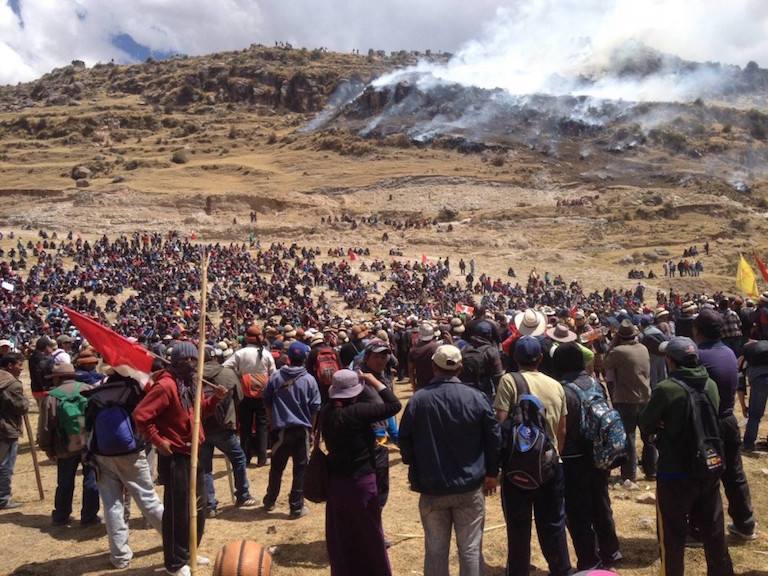
Berta Cáceres, a Lenca woman, and the Civic Council of Popular and Indigenous Organizations of Honduras (COPINH is its Spanish acronym), soon started a blockade on the road to the construction site, demanding to be consulted about the project per Honduran law. They maintained the blockade for more than a year, holding their ground despite death threats and even after one of their members, Tomás García, was shot during a peaceful protest in July 2013.
Though some of the protestors, like Cáceres, worked as professional campaigners, most were pulled into the conflict when their way of life was threatened. The same is true of many of the green activists killed in Latin America. Indigenous groups are particularly at risk due to both the value of the land they occupy and the lack of clarity surrounding their land rights in many countries throughout the region. According to Global Witness, indigenous people made up almost 40 percent of the environmental land defenders killed in 2015. Professionals like environmental lawyers and journalists also number among the dead.
"Often times, people just find themselves caught up in these conflicts," said Knox of the UN. "These are marginalized communities that rely heavily on what they get from the land. They feel like they don't have a choice so they are willing to stand up to this."
In many cases, protest and resistance is the only option for land defenders. Many Latin American countries have laws requiring companies to consult local communities before projects can move ahead. But in an effort to make deals more attractive to investors, advocates say that Latin American governments will often circumvent these laws, allowing companies to buy, or simply take, land from its previous occupants. Global Witness uncovered hundreds of cases throughout the region in which police or private security forces were dispatched to evict communities without their prior consent.
"The government needs to consult communities if they want to allow industry onto their territory," Sergio Beltetón, a Guatemalan lawyer who works on land rights cases with the Campesino Unity Committee, told Mongabay. "They aren't going to be able to stop these conflicts until they start respecting the consultation laws."
Despite their high mortality rate and the other obstacles land defenders face, their protests are sometimes effective. The Lenca blockade led by Cáceres convinced the powerful Chinese hydro engineering firm Sinohydro to pull out of the Río Blanco project. In recent months, the international outrage spurred by Cáceres's murder forced more companies to cease their involvement with the dam, including the project's largest European investors. In other cases, including Acuña's standoff with the Conga Mine in Peru, activists who refused to leave their land effectively stopped projects from moving forward.
"The world lives in a glass house now and we can see what is going on and action can be taken," said Kovarik. "Projects can be stopped and people can be embarrassed."
Criminalization and impunity
For each environmental defender who is killed, many others are threatened or otherwise repressed, including through the legal system. The Geneva-based Observatory for the Protection of Human Rights Defenders documented legal cases against 123 land activists globally from 2011 to 2014, but noted that the true number is likely much higher. According to this report and Global Witness's findings, this criminalization of land defenders is extremely common in Latin America, especially Central America. Large companies and government entities often wrongfully arrest or prosecute anyone who stands in the way of their development interests, jailing activists or embroiling them in costly legal battles.
"The companies will not tolerate criticism from anyone. They consider anyone who speaks out an enemy, and they go after them," Beltetón said. "They find the best way to get rid of them, whether that is through criminal proceedings or killing them."
Green activists have been charged with libel or slander for speaking against development projects, framed for robbery, or charged with impeding justice while blocking a highway during a protest. According to Global Witness, in recent years, human rights groups have also seen a worldwide surge in governments labeling activists as terrorists. Both Guatemala and Chile have labeled activists "internal enemies" and charged them under anti-terrorism laws for peacefully protesting.
Even when the legal system is not actively punishing environmentalists, it does little to protect them. Global Witness has found that authorities rarely investigate threats made against activists and that the murders almost never result in prosecutions convictions. Though precise numbers are not available, Global Witness only found 10 cases worldwide between 2002 and 2013 in which the murderers of environmentalists were tried and convicted. This problem is especially severe in Latin America, where impunity rates tend to be high.
In Honduras 90 percent of the crimes committed against human-rights defenders go unsolved, according to the Honduran Public Ministry and only one of the 75 crimes against environmentalists recorded in Costa Rica since 2002 was punished. In May, Honduran authorities arrested four men in connection with Berta Cáceres's murder. But authorities have failed to identify or bring to justice those responsible for the violence against García, Mendez, and Acuña.
There is also a pattern in Latin American of legal systems distancing crimes from the victim's environmental work.
"There is a tendency on the part of the government to say this isn't part of a broader pattern," Knox said. "There often is a broader problem related to environmental work. It's not just a tragic coincidence."
This tendency was on full display in 2013, when turtle-egg poachers murdered Costa Rican turtle conservationist Jairo Mora was killed while patrolling the beach one night, and though he had received death threats from poachers in the past for his work protecting turtle nests, police and government officials repeatedly declared that the motive for the slaying was robbery. After heavy media coverage, protests, and a botched trial where the suspects were acquitted on all charges, the government changed its stance.
Prosecutors secured an appeal to try the same seven men that were acquitted in the first trial. The second time around, the prosecution emphasized Mora's work with sea turtles and his ongoing conflict with a poaching gang. The new strategy, along with evidence excluded from the previous trial, resulted in convictions for four of the men in March.
As with Mora, other cases in which environmentalist murders were successfully prosecuted have usually been well publicized and drew pressure from the international community.
In 2007, two men were convicted of the murder of Dorothy Stang, an American nun who campaigned against illegal logging near her home in the Brazilian Amazon, and another man was eventually convicted of orchestrating the hit. Though violence against environmentalists is rarely prosecuted in Brazil, lawyers in the case say Stang's status as an American nun helped gain media attention and traction in court.
"I went into the court and told them that if they didn't do this right I was going to rake them over the coals in the international press," Brent Rushforth, a U.S. environmental lawyer who worked with Brazilian prosecutors on the case told Mongabay.
Though protests and media attention can sometimes pressure governments into investigating a case, few believe that these isolated successes signal a change in the tide.
"It is a Herculean task and there has to be sufficient backbone from the top down in the government to hold the billionaires and their cohorts responsible," Rushforth said. "I thought Dorothy's murder and prosecution would have more influence than it has, but this remains a huge problem."
Slow change?
Though the outlook for environmentalists in Latin America remains bleak, increased visibility and new legal strategies could eventually make a difference.
Last year, a group of indigenous Mayan Q'eqchi' people from El Estor, Guatemala, presented three civil cases in Canada alleging human rights abuses involving the Canadian-owned Fenix Nickel mine. While similar cases tried in Guatemala have seen little success, the Canadian negligence suits have made some headway. In 2013, an Ontario Superior Court judge ruled that the mine's former owner, HudBay Minerals Inc., could potentially be held legally responsible for the actions of the mine's security personnel, who allegedly shot and killed a protestor and paralyzed a bystander during a peaceful protest and also allegedly raped ten women during a forced eviction. In total, the victims are claiming $55 million in damages, but more significant is the legal precedent of bringing the case to the company's home country and the visibility that the case has brought to the issue of murdered environmentalists.
"What is positive is that the issue is slowly getting more and more recognized," Kyte said. "The very small silver lining when someone more well-known is murdered is the international outrage."
Cáceres's recent murder, in particular, has drawn heavy media attention, spurring protests both in Honduras and abroad. International human rights organizations and activists in Honduras are now pressuring the government to allow an independent investigation into the murder.
While pressure from abroad may help secure a comprehensive international investigation in Cáceres's case, human rights advocates say Latin American governments' own laws and actions will need to transform to secure lasting change.
"Up to now the government sees these people as opposing development," Kyte said. "What really needs to happen is that these people need to be treated as heroes."