Showing posts with label Labor. Show all posts

November 26, 2020

Abstract: Environmental Violence and the Socio-environmental (de)Evolution of a Landscape in the San Quintín Valley


:::::: Abstract ::::::


Environmental Violence and the Socio-environmental (de)Evolution of a Landscape in the San Quintín Valley
 

by  Nemer E. Narchi, Sula E. Vanderplank, Jesús Medina-Rodríguez, Enrique Alfaro-Mercado

"The social and environmental effects of industrial agriculture in the San Quintín Valley of Baja California are closely related. An environmental history of the valley from European contact to the present demonstrates that modern schemes of globalized agricultural production erode biological diversity while fostering labor exploitation. A critical model drawing on the concept of environmental violence— historically structured asymmetrical power relations that are reproduced and maintained to foster capital accumulation—describes how neoliberalism shapes and exploits agro-industrial landscapes and livelihoods in San Quintín to produce a crisis of underproduction.

CONTINUE READING FULL ARTICLE HERE


SaveSave
SaveSave
SaveSave
SaveSave
SaveSave

April 22, 2020

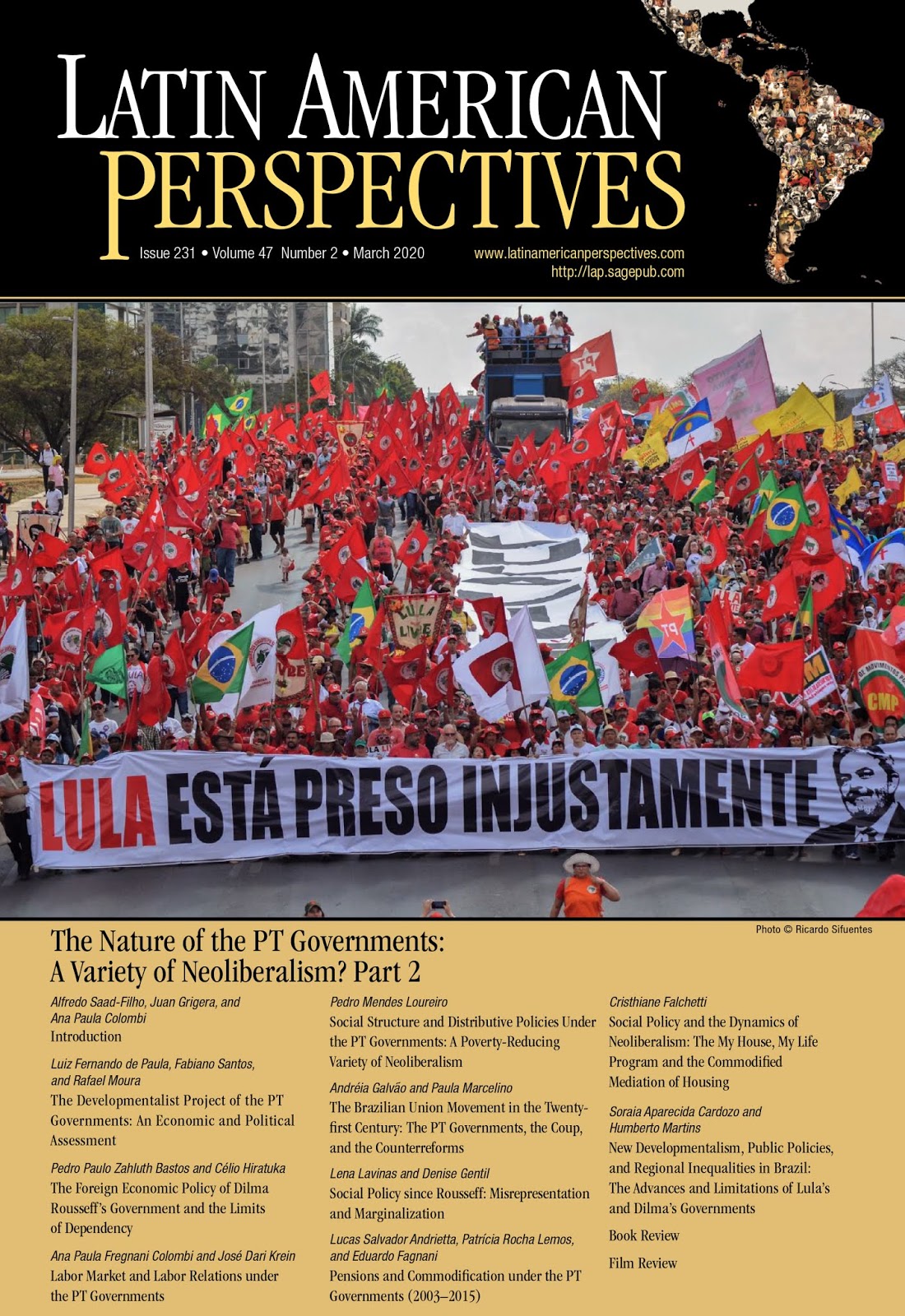
Abstract - Labor Market and Labor Relations under the PT Governments

:::::: Abstract ::::::


Labor Market and Labor Relations under the PT Governments

by Ana Paula Fregnani Colombi, José Dari Krein

There is some consensus on the foreign policy of Dilma Rousseff’s government that Brazil lost prestige and international influence because of her lesser personal dedication. Against this consensus, the paper presents two alternative hypotheses for explaining its unsatisfactory outcomes: that there was no change in policy objectives but an adaptation to a more hostile context and that its limitations were structurally related to dependency on global corporations and to the increasing rejection of South-South politics by domestic business. If this analysis is correct, the structural limitations described require that the struggle to achieve an independent foreign policy involve deeper political and ideological battles and a more radical questioning of neoliberal capitalism.


January 29, 2019

Abstract The Political Dynamic of Redistribution in Unequal Democracies: The Center-Left Governments of Chile and Uruguay in Comparative Perspective

:::::: Abstract ::::::


The Political Dynamic of Redistribution in Unequal Democracies: The Center-Left Governments of Chile and Uruguay in Comparative Perspective


by Florencia Antía

The redistributive reforms carried out by center-left governments in Chile and Uruguay in the 2000s affected the core interests of economic elites. Efforts to increase taxes on high-income sectors and reform the institutions that regulate the capital-labor relationship produced different results in the two countries. While Uruguay adopted significant reforms, reforms in Chile were marginal in 2000–2010 and moderate in 2014–2016. Their different trajectories are related to different configurations of the distribution of power resources between the elites and the social organizations that represent the interests of low-income sectors.


CONTINUE READING THE FULL ARTICLE HERE

SaveSave
SaveSave
SaveSave
SaveSave
SaveSave


SaveSave
SaveSave
SaveSave
SaveSave
SaveSave
SaveSave

January 1, 2019

Abstract, The Political Economy of the New Left

:::::: Abstract ::::::


The Political Economy of the New Left
by Megan Pickup 


New Left regimes have been underpinned by a reliance both on labor and nontraditional social groups and on capital interests related to the primary commodity sector, and the state has played an important overseer role in these relationships. These states have attempted to accommodate all these groups by pursuing incompatible populist and pragmatic policies. Study of the particular configuration of these regimes is important because they have become simultaneously more inclusive and closed off, generating heightened social fragmentation. Divisions among the left, the hardening of the right, and economic frailty render these governments unstable.

CONTINUE READING THE FULL ARTICLE HERE

SaveSave
SaveSave
SaveSave
SaveSave
SaveSave


SaveSave
SaveSave
SaveSave
SaveSave
SaveSave
SaveSave

September 24, 2018

Abstract, Part-Time Miners: Labor Segmentation and Collective Action in the Peruvian Mining Industry

:::::: Abstract ::::::


Part-Time Miners: Labor Segmentation and Collective Action in the Peruvian Mining Industry
by Omar Manky


Over the past two decades, besides the transformation of the organizational structure of the mining industry, there has been a shift in the spatial organization of production, expressed by the replacement of mining towns with mining hotels. Two case studies in Peru show that these changes have produced new forms of labor segmentation affecting workers’ capacity to mobilize by turning those who are directly employed by the company into a minority. While subcontracted miners have managed to overcome organizational segmentation by organizing across companies, the spatial segmentation of the mining hotel model has made local coordination difficult. Workers are not, however, necessarily defeated, as greater spatial mobility may offer possibilities of networking with new actors.


February 14, 2018

Book Review: Day Labor in Two U.S. Cities

:::::: Book Review ::::::


Book Review: Day Labor in Two U.S. Cities
by David Stoll

Jornalero: Being a Day Laborer in the USA
Ordoñez Juan Thomas Jornalero: Being a Day Laborer in the USA. Berkeley and Los Angeles: University of California Press, 2015.


Against the Tide: Immigrants, Day Laborers, and Community in Jupiter, Florida
de la Vega Sandra Lazo & Steigenga Timothy Against the Tide: Immigrants, Day Laborers, and Community in Jupiter, Florida. Madison: University of Wisconsin Press, 2013.


Day laborers and open-air labor markets are not new in American history, but in the twentieth century, thanks to high employment and increasing job security, they almost disappeared. Now they’re back, fed by heavy migration from Mexico and Central America, and a bone of contention in the U.S. immigration debate. For immigrant-rights activists, the increasing visibility of day laborers is irrefutable evidence of the demand for immigrant labor. Since most day laborers lack legal status, their advocates continue, they also illustrate the need for a comprehensive legalization program. For critics who wish to reduce immigration, in contrast, the resurgence of day labor is a sign that job markets are being flooded and labor laws are being ignored.

January 30, 2018

Exclusive, The Right to Protest: Women Retake the Streets in El Progreso, Yoro, Honduras

By Suyapa Portillo, Pitzer College
@SuyapaPV


Women and Jesuit Clergy, among them Father Melo of Radio Progreso, take over the road near Quebrada Seca bridge after a meaningful mass that called for an end to militarization and violence. Photo taken by: Suyapa Portillo


Women took over the road for a peaceful march in Quebrada Seca, El Progreso, Yoro, on November 25, 2018, National Day of the Honduran Woman. On this same road, just a day before, protesters experienced heavy repression.  People have been here almost daily protesting the fraudulent elections of November 26, 2017. They have been met with disproportionate force and violence from riot squads of the National Police, Military Police of Public Order and the Armed Forces, who have harmed, threatened, and shot real bullets at innocent people. One young man was taken out of his house without proper warrant and falsely accused of burning a police station and taking police gear. Unable to find the actual perpetrators of the alleged crime, police have framed him. Contrary to the fabricated story of the police, this young man’s only activity was his participation in peaceful street protests in opposition to electoral fraud. Another young woman was picked up at a protest by an unmarked civilian car. She was beaten, insulted and then thrown out of the car in the street down the road. Other protesters have been followed by National Police and Military Police agents after the demonstrations to their homes, beaten, and told they would be killed, as happened to the son and brother in law of former LIBRE congressperson Bartolo Fuentes on November 26, 2018. These intimidation tactics are infringing on local Progreseños right to peacefully protest the imposition on them of a repressive authoritarian government, which is starting to look more and more like a nascent dictatorship.
 
"Pare 1 minuto y proteste es su derecho Fuera JOH" Quebrada Seca, El Progreso, Yoro
Photo taken by: Suyapa Portillo


Since the elections of November 26, 2017, there has been no peace in Honduras.  The unrest is not that of hopeful, peaceful protesters who bring banners, flags and creative chants calling for the resignation of the fraudulent president, Juan Orlando Hernandez, but rather the violence of the Military Police and Armed forces who shoot to kill, invade homes and shoot tear gas canisters often affecting children and the elderly. Far from a true democracy, the government regime has sought to repress civilians’ right to peaceful protest, a protected value alongside freedom of speech and freedom of the press.

Quebrada Seca was heavily militarized on January 20, the first day of the Paro Nacional (National Stoppage) to oppose the illegitimate president’s swearing in ceremony, a national strike called by those who oppose the dictatorship—the Alliance Against the Dictatorship.  The exaggerated levels militarization that day dwarfed contingents of protesters and local citizens in El Progreso and the nearby Valley of Sula.  In this context, the taking of Quebrada Seca by young and elderly women on Honduran Women’s Day has special significance.

Women have had to fight for any political and labor rights they have in Honduras, including the right to vote. This is why many are unhappy their vote was stolen by Juan Orlando Hernandez. They are confident in their claims, even if ample proof of vote rigging and Nationalist Party intimidation tactics, doctoring of voting documents, and plain force and repression have not convinced the US State Department, nor the Organization of American States, to invoke the Inter-American Democratic Charter, demand due process in Honduras, call for annulment of the elections and a new electoral process, with full civil society participation as well as international observers.
 
Resident of Quebrada Seca shows International Observers real bullet casings shot at them the night before during protest. Photo by: Suyapa Portillo

November 25, 2018 marked 63 years since women in Honduras gained suffrage. Though they won the right to vote in 1955, they did not vote until the election of 1957, when President Ramon Villeda Morales was elected, the first Liberal President since the dictatorship of Carías Andino, and his hand-picked successors.  Since 1955, women in Honduras has been important social actors in every ambit of society, yet Honduras remains one of the most violent countries to be a woman.  The feminicide rate soars as does impunity, where apparently most of these cases remain in file cabinets. Now, with the current electoral coup (as many local women call the illegal re-election of Juan Orlando Hernandez), many Feminist groups consider their situation dire. Women are employed mostly in the informal economy, including maquiladoras, which are non-union and enforce no-pregnancy and negative HIV test to hire workers.
 
Military Police for Public Order, National Police and DPI Investigators stationed on both sides of street during peaceful protest. Photo by: Suyapa Portillo


Locals ascertain that they were not physically harmed on that day only because of the solidarity of international observers, a delegation of 50 North American clergy members, Jesuit priests, pastors, ministers and affinity groups accompanying local Jesuit Radio Progreso. On January 27, 2018, the inauguration of Juan Orlando Hernandez, took place with no international dignitaries present. Even more noteworthy, 5 rings of security, including National Police, Military Police and the Armed Forces, created a fortress around Juan Orlando Hernandez in the National Stadium, where he was installed as president of the people he was keeping at bay.  The event was underwhelming and overshadowed by protesters courageously taking the streets to express their discontent in the face of vicious military response against unarmed citizens.  While National TV and Radio stations were forced to play the ceremony live, over 80% of the population throughout the country protested, took over streets, and made their voice heard using creative protests tactics chants and posters that in invalidated the inauguration. Honduras’ future remains in the balance as the various social movements align in one concrete demand: #FueraJoh.

January 29, 2018

Abstract, Environmental Protection, Work, and Social Inclusion: Formalizing the Recycling of Urban Solid Waste in Buenos Aires

:::::: Abstract ::::::


Environmental Protection, Work, and Social Inclusion: Formalizing the Recycling of Urban Solid Waste in Buenos Aires
by Johanna Maldovan Bonelli


The changes in the paradigms regarding urban solid waste management that have occurred in the past few decades have led to a reformulation of Argentine social, labor, and environmental policies. In the case of the city of Buenos Aires, the presence of thousands of “informal” recyclers dedicated to the recovery of recyclable materials for their subsistence has given a particular imprint to the design of these policies, the focus of which has been the social inclusion of these workers through the creation of cooperatives. An examination of the assumptions underlying the use of the concept of informality in the development of cooperatives for recycling from 2007 to 2013 shows that they are part of a complex process in which measures for increasing rights and protections are associated with various forms of labor instability.

January 24, 2018

Abstract, Unions Opposing Labor Precarity in Chile: Union Leaders’ Perceptions and Representations of Collective Action

:::::: Abstract ::::::


Unions Opposing Labor Precarity in Chile: Union Leaders’ Perceptions and Representations of Collective Action
by Dasten Julián


The systematic deregulation of labor relations was a cornerstone of the imposition of the neoliberal model in Chile. This process had a significant impact on both the strategies and the structure of unionism. A study of the perceptions and representations of precarious work of union leaders contributes to a discussion of the relationship between precarity and repertoires of collective action in workers’ pursuit of regulation, institutionalization, social improvement, and well-being in employment relations.

January 19, 2018

Abstract, From Structuralism to Neoliberal Depredation and Beyond: Economic Transformations and Labor Policies in Latin America, 1950–2016

:::::: Abstract ::::::


From Structuralism to Neoliberal Depredation and Beyond: Economic Transformations and Labor Policies in Latin America, 1950–2016
by James Cypher 


From the 1930s until the early 1970s, national industrialization programs in Latin America were part of an effort to introduce social policies that broadened the national market, indirectly creating employment opportunities. Yet, Celso Furtado and other structuralists found the pattern of investment in Latin America predetermined by the unequal composition of aggregate demand, skewed toward the landholding-industrial-financial elite and newly emerged professional strata, leading to constricted employment. In reaction to the inclusive policies urged by the structuralists, insurgent neoliberal policies created a new climate of hostility toward unions and indifference to employment. Neoliberal doctrines deconstructed labor’s eminence, forcing flexibility and precariousness while labor laws and unions were conjured as market distortions. Social neoliberalist, neostructuralist, and neodevelopmentalist regimes arose in the early twenty-first century as a reaction to the failure of neoliberalism to create growth and employment security. These temporary regimes have focused largely on income transfer policies, deploying economic surpluses arising from reprimarization as serendipitous exogenous forces generated export income windfalls from the commodities boom. Fundamental issues such as the pervasiveness of informal work, the recent introduction of flexible employment regimes, and deunionization have not been addressed.

January 15, 2018

January 2018 Issue!

The Urban Informal Economy Revisited

Issue Editors : Ray Bromley and Tamar Diana Wilson


The distinction between “formal” and “informal” jobs and enterprises was first introduced in the 1970s and has been very widely used ever since.  The underlying assumption was that the formal economy would gradually expand and dominate, and the informal economy would gradually disappear.  The reality, however, associated with neoliberal economic development and growing socio-economic inequality, is that the informal economy has persisted and sometimes grown, and that job security and benefits in the formal economy have often diminished.  This theme issue focuses on the informal economy under neoliberalism, with case studies of some of the most significant and persistent occupations. Several of the articles focus on the process of the “formalization” of informal workers, a goal expressed by the International Labour Organization, but often fraught with difficulties.


Listen to the Podcast!