The announcement came on a Friday afternoon, late in the second half of the World Cup quarterfinal match between Belgium and Brazil, the national team adopted by most Haitian soccer fans. Minutes later, Brazil had lost the match. And soon after, thousands of Haitians were in the streets, though not because of the game’s disappointing result.
The government stated it would be eliminating fuel subsidies, sending the price of gasoline soaring by 38 percent overnight, to $4.50 a gallon. Kerosene, heavily relied upon by the country’s poorest citizens, would increase by 51 percent, to almost $4 a gallon. If the thought was that most Haitians would be distracted by soccer, the plan failed.
The government had agreed to end the subsidies months earlier as part of an agreement with the International Monetary Fund (IMF). “The people were waiting for that decision,” a law-enforcement source explained, “and everyone in each area was prepared to react.”
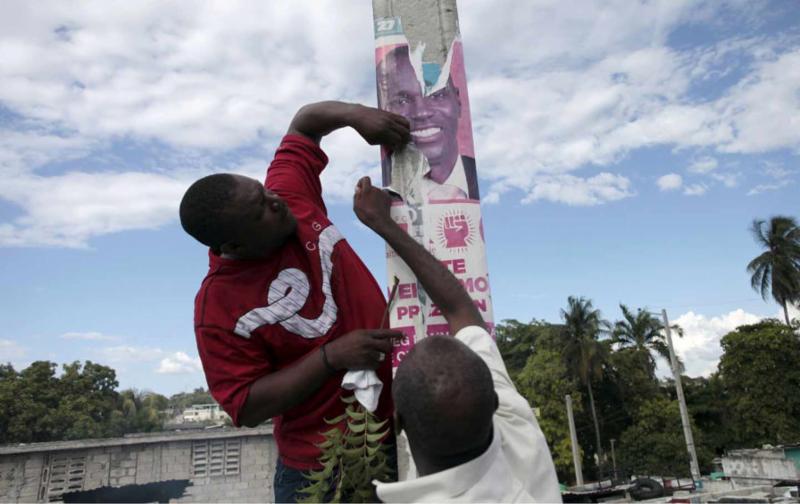
Though fuel subsidies predominantly benefit the wealthy, any increase in the cost of living can be catastrophic in a country where 60 percent of the population scrapes by on less than $2.40 a day. Protesters built roadblocks and burned tires throughout the capital, Port-au-Prince, and soon demonstrations had broken out across the country. By Saturday morning the situation had worsened. An uprising had begun.
Protesters appeared to target hotels catering to the international market and a supermarket owned by one of Haiti’s richest families. But just as the country’s economic malaise has hit the middle class, so too did the protests; overall some 80 businesses of all sizes were damaged. International airlines canceled flights to Haiti, while some of the wealthy boarded helicopters or private jets and fled the country. As many as 20 people were killed, and more than 50 arrested.
Less than 24 hours after the initial announcement, the government walked back the price increase. And a week later, on July 14, Prime Minister Jack Guy Lafontant was forced to resign rather than succumb to an embarrassing no-confidence vote in Parliament. But the aftershocks of that initial decision have continued to reverberate and have exposed fault lines that continue to threaten Haiti’s democracy.
President Jovenel Moïse, who took office in February 2017, now finds himself alone atop the government, but he faces the stiffest test of his presidency.
An agricultural entrepreneur from rural Haiti, Moïse was put forward as the candidate who could feed a hungry nation. And he came to office with lofty promises of food security, paved roads, electricity across the country, and a crackdown on corruption. After the election, Moïse likened his own victory to that of another businessman turned president: Donald Trump. “President Trump and I are entrepreneurs, and all an entrepreneur wants is results,” he said at the time.
But results have been elusive. Food scarcity remains high, and multiple years of double-digit inflation, coupled with the local currency’s losing half of its value, have eroded purchasing power in a country that is highly dependent on imports. Haiti remains one of the world’s most unequal societies, while government waste and inaction have fueled the perception that the country’s politicians are more interested in their own bottom line than that of their constituents.
The response to the elimination of subsidies appeared to come as a shock to Moïse and his administration, as if they could not see the reality surrounding them. But the fuel-price announcement was like tossing a lit match on a gasoline-soaked pile of kindling; it shouldn’t have been a surprise when it went up in flames.
Trou-du-Nord in Northeast Haiti is Moïse’s hometown and the site of the banana plantation that gave him his nickname, Neg Bannann, or Banana Man in Haitian Kreyol.
In a former colony subject to centuries of foreign interference and exploitation, the moniker would have been too clichéd for a Graham Greene novel. But it resonated across the country, and served as a selling point for the political neophyte.
In September 2015, just one day before the official launch of his presidential campaign, Moïse stood amid his fields of produce and proudly exclaimed, “Our bananas are now on their way to Europe.” It was his company’s first shipment, and, the company said, Haiti’s first export of bananas in more than 50 years.
Moïse, the ruling party’s pick to take the reins of government, officially received the most votes in the 2015 election, only to see those results tossed out because of “widespread” irregularities. His predecessor, Michel Martelly, left office at the end of his term and was replaced by an interim government, largely made up of political opponents. Then, in October 2016, Hurricane Matthew devastated Haiti’s southern peninsula, delaying the rerun elections even further.
Moïse was the best-funded among Haiti’s sprawling field of candidates, 54 in total, and with a slick international public-relations company at his back, he was able to keep up the campaign as others faded through the delays. With food stocks-including bananas and, far more common in Haiti, plantains-decimated by the hurricane, Moïse appeared to be the perfect antidote.
“Without [the plantation],” Jean-Max Bellerive, a former prime minister who also held a position with the interim government, explained to me, “there is no way he’s president.”
Still, less than 20 percent of registered voters turned out. While Moïse emerged with a parliamentary majority and the presidency, the popular mandate he claimed was never there-as has become clear with the recent unrest.
A banana tree can go from planting to harvest in nine months. In November 2017, a year after Moïse’s election and nine months since he had taken office, I traveled to the plantation that catapulted him to the presidency to see for myself if the Banana Man was beginning to bear fruit.
A fence, formed by green stalks of bamboo threaded together with barely visible strands of barbed wire, lined the road to Moïse’s 2,500-acre banana plantation, an area three times the size of New York’s Central Park. In 2013 the Haitian government declared this land part of its first-ever agricultural free-trade zone. The government granted tax-free access to the land and a $6 million loan to a new company, Agritrans, owned by Moïse, the president of the local chamber of commerce. Anonymous investors contributed at least another $10 million.
Back on the road, the bamboo fence gives way to Agritrans’s entrance. There is no real office here. Just a tall metal gate, a few empty shipping containers, a faded sign, and land-lots of land.
A handful of workers watched as a new Hyundai excavator fired up its engine and began slowly poking into the earth, now largely overgrown with grass. In the distance, a dozen or so workers appeared to be planting cuttings in a small newly tilled area. As I would come to discover, no bananas had been shipped since the Banana Man’s election.
“After the election, they cashed in,” a water technician on site explained, with a shrug. I could see an irrigation system snaking through the fields before disappearing into the distance. He pointed to a small building a few hundred yards away where I could find the man in charge.
Erlin Tijerino, a Costan Rican agronomist and banana specialist, was perched on a stalled conveyor belt in the processing area. Tijerino didn’t have an office, but this worked for him. The belt hadn’t moved in more than a year-since he was hired.
When Tijerino showed up for his first day of work, soon after Moïse won the election, all of the banana trees were already dead. “The soil was not right,” he explained, “it was difficult to grow bananas.”
It took a moment for the implication of what he said to sink in.
When I met him, Tijerino was overseeing a process to improve the soil and was just beginning to plant a new variety that he hoped would be better suited for the land. The first small harvest would come in early 2018, he expected. Less than a hundred acres had been replanted-about 5 percent of the land that lay behind the bamboo fence. It would take time to make it viable. The soil, he explained, had been better suited for small-scale production of foods such as peanuts, corn, and beans.
“We used to sell our goods at the market to buy local produce,” Nadia told me. But now, she continued, her expression hardening, “It is mostly imported rice we eat.”
We were standing next to a quarter-built cinder-block frame, wedged between Nadia’s mother’s house and the road that runs alongside it. Across that road is Agritrans’s fence, and behind that, open land. But that land is no longer open to Nadia or to the rest of the crowd that assembled beside her stunted home.
Nadia still remembered the day, more than four years earlier, when Moïse showed up with the tractors. Her family had lived and farmed this land for more than 30 years, she told me. Then, one day the fence went up-with her home inside it. Days later, the tractors came and demolished that home, and what remained of her previous life along with it.
Nadia and her husband moved across the street, to her mother’s house. Slowly, Nadia and her husband saved up and started building a house of their own on the same lot. But he passed away soon afterward. Since then she hasn’t been able to afford to keep building. And so the quarter-built house sits empty, a constant reminder of all that has been lost.
Agritrans promised that some 3,000 local farmers would find work on the plantation. But the farmers who had gathered at Nadia’s house claimed not to have worked a day on the Agritrans land. At the plantation, employees told me that only a few dozen worked there full-time. And for the few farmers lucky enough to get rotational shifts preparing fields, the daily pay is about $3.50.
Jennifer Vansteenkiste is a Canadian anthropologist who was doing field work around Trou-du-Nord when Agritrans took over the land. Her research provides a rare glimpse into the actual impact on those communities displaced by megaprojects such as Agritrans. Her before-and-after study, published in May 2017, showed a drastic change in diet, and a significant loss of income. On average, she found, each person lost about $1,400 a year. Some families received a small, one-time payment as compensation for losing their land and their livelihood. But no one I spoke with had received more than about $700.
But when I asked those gathered at Nadia’s for whom they voted, nearly every resident quickly proclaimed “Neg Bannann!” Moïse received more than 85 percent of the vote in Trou-du-Nord. He’s from here, they said. He made promises, they said.
Even after taking office, the Banana Man’s campaign never really ended. En route to the northeast, I stopped in the fertile rice fields of the Artibonite Valley. It was here where, upon taking office, Moïse launched the “Caravan for Change,” a catchall development program that he pledged would travel the country and restore agricultural production to its full potential.
I met Mesadieux Alexis, the leader of a Caravan-created farming cooperative, at a rice-milling station he operates in Ponte Sonde. As part of the program, the government has provided new tractors and processing mills on credit to such cooperatives. The smell of diesel used to run the mill was heavy in the dark building, filled close to the ceiling with bags of rice awaiting processing.
Alexis explained that the problem is not their ability to produce, but that there is no market for it. Alexis was happy with the Caravan’s support, but “we have to be prepared to confront the government,” he told me. “We cannot produce rice if they keep importing it.”
In the 1990s, under pressure from Washington and multilateral lenders including the IMF, Haiti dropped rice tariffs from 50 to 3 percent. Imported “Miami Rice” flooded the market. Haitian diets changed with the policy. Today, the average Haitian gets nearly a quarter of their daily caloric intake from rice, 80 percent of which is imported.
The collapse of peasant agriculture pushed hundreds of thousands of Haitians to leave the country, and millions more into the sprawling slums of the capital where they are ever more reliant on imports. But once there, Haitians face an extraordinarily high cost of living. The history of the IMF’s involvement, and the deleterious impact, cannot be delinked from the response to the fuel-price increase.
But despite the administration’s apparent focus on undoing this lingering harm by focusing on national production and rural livelihoods, many of the country’s peasant organizations are becoming increasingly frustrated. Some 20 organizations signed a declaration in October declaring that while “the president has talked much about farming,” he has left farmers out. “The most important attacks against agriculture among peasant families are coming from the Haitian state itself,” the statement concluded.
It hasn’t helped that, even if his plantation someday succeeds, the Banana Man’s harvest was always meant for a foreign audience. And the banana cuttings themselves are imported.
But the Caravan has also come under criticism for its lack of transparent financing. The Caravan itself is not mentioned in the official budget, and the government has paid for the program using funds from a variety of government ministries, making accountability more difficult.
Though I requested more detailed financial information from the government multiple times, none was provided. “There is no paper, no anything,” Tonny Joseph, an international consultant and good-governance campaigner, told me.
In February 2018, I reached out to the president’s staff for an interview. I wanted to know more about the Caravan and who Agritrans’s anonymous investors really were and how this plantation, which had exported next to nothing, could still be in business. After initially saying they’d quickly get me some answers, the staff abruptly stopped responding.
But two weeks later, with the heads of state of Caribbean nations in Haiti for a high-level summit, Moïse and a convoy of official vehicles arrived in Trou-du-Nord, at Agritrans. In well-produced video clips, one can see the conveyor belt that Tijerino, the agronomist, had used as his desk, now loaded up with green bananas.
The fact remains, however, that Agritrans has never made a profit. Since Moïse launched his presidential campaign with that first shipment, only one additional container has left port, and it was more than two years ago, in April 2016.
As a free-trade zone, Agritrans is legally required to export 70 percent of its production. In 2014 the company signed a long-term deal with a German company, Port International, which called for the shipment of up to 60 containers per week. Agritrans has claimed that the replanting effort was made in coordination with their international partner, but the company provided a contradictory view.
Mike Port, an official with the company, confirmed to me that there had been no recent communication with Agritrans. “We had just 2 shipments and it seems that due to unknown reasons Agritrans was not in a position to establish the relationship we wanted,” Port wrote to me via e-mail in February. “We lost contact during and after elections.”
It is unclear how the firm has any funds remaining from its initial, and anonymous, investment, or if it has paid anything back to the government on that $6 million start-up loan. Wilson Laleau, the minister of commerce at the time and a cousin of Moïse’s wife, signed the agreement granting Agritrans the state land and generous tax exemptions. Laleau is now Moïse’s chief of staff.
While the government has been under pressure to eliminate fuel subsidies, Agritrans itself has benefited from close to $600,000 in import tax exemptions alone. As Americans are also quickly learning, it can be a tricky thing having a businessman as president. Especially one with a history of allegations of financial impropriety.
In August 2016, the government’s anti-money laundering office released an investigation into the then-candidate Moïse, identifying a number of suspicious bank accounts (including in the name of Agritrans) and transactions that appeared to indicate involvement in money laundering.
Another investigation, this one from the government’s anti-corruption unit, found that Moïse had received two personal loans totaling hundreds of thousands of dollars in 2011 and 2013 from a state-run bank now on the verge of bankruptcy. The investigation alleged that the bank had not performed due diligence before making the loans to Moïse. After “delays and irregularities” on the payments, the second loan was restructured, the investigation found. The remaining balance of about $160,000 was due last month.
Both files were passed on to an investigating judge before Moïse’s inauguration, but local human-rights organizations say there has been no progress since. Moïse has categorically rejected the findings as politically motivated. Once in office, he fired the director of the anti-money laundering office.
Moïse campaigned as the candidate of rural Haitians, the man who could restore national production and feed a hungry nation. Moïse was elected president, but those displaced farmers in his hometown are left to look across the road, through Agritrans’s fence, at the largely fallow land that once sustained them. Today, Moïse is a president without a government.
The mishandling of the fuel-price adjustment has alienated allies, emboldened his enemies, and forced the president to the negotiating table. It wasn’t just the response to the elimination of subsidies that seemed to come as a shock, but also the president’s political fragility.
His first prime minister, Lafontant, had also never held political office, and the pick ensured Moïse would not be overshadowed. He is known as insular, resistant to criticism, and reliant on a small coterie of close advisers, but it has become clear that Moïse will have to adapt to lead Haiti out of its current crisis. “When will the one-man show end?” Haiti’s largest and oldest newspaper, Le Nouvelliste, asked following the demonstrations.
The former prime minister Bellerive has been involved in negotiations with the government to find a way out of the crisis. For him, it is Moïse’s business background that, more than anything else, reveals his shortcomings. “They sold him as an entrepreneur,” he told me earlier this year, “but the manipulation is bigger than Agritrans.... he has had no real success.”
His previous business résumé consists of running a rural auto-parts store and a water distribution company. Under his predecessor, Martelly, another of Moïse’s companies received a government contract to install solar lights. He has been accused in a Senate corruption investigation of failing to deliver on that project-a charge he has rejected.
Yet, Bellerive continued, “each setback has resulted in a step up, and so he can’t see the reality. He has convinced himself that against all odds he will succeed.” It reminded me of Trump, I said.
Now that reality is getting harder and harder to ignore.
Jake Johnston is an international research associate at the Center for Economic and Policy Research in Washington, DC, and the lead author of the Haiti: Relief and Reconstruction Watch blog. His work has been published by The Nation, The Intercept, Al Jazeera, and Boston Review, among other outlets.