Showing posts with label Trade Agreement. Show all posts

June 18, 2019

Political Report # 1399 Migrants Will Pay the Price of Mexico’s Tariff Deal With Trump


By Luis Gómez Romero, 
 The Conversation


Mexican President Andrés Manuel López Obrador is celebrating an agreement avoiding U.S. tariffs as a major political and diplomatic triumph for his government.
“We didn’t win everything, but we were able to claim a victory with there being no tariffs,” said chief negotiator Marcelo Ebrard, Mexico’s foreign affairs secretary, on June 9.
The two neighbors have been at odds since United States President Donald Trump on May 30 threatened to hit all Mexican imports with steadily rising tariffs unless Mexico successfully halted the northward flow of Central American migrants fleeing extreme poverty and violence through Mexico toward the United States.
Approximately 80% of Mexican exports are destined for the United States. Tariffs would have devastated Mexico’s economy.
To keep its goods untaxed, Mexico had to convince President Trump that it was serious about stopping migration. After a week of frantic negotiations, Mexico said it would deploy up to 6,000 National Guard troops to its southern border with Guatemala to stop migrants from entering Mexico.
As part of the agreement, a Trump administration program known as “Remain in Mexico,” which forces some migrants to wait in Mexico while their asylum claims are processed in the U.S., will also be expanded.

November 18, 2016

Political Report # 1199 The TPP Fight: Lessons From El Salvador


By  Robin Broad and John Cavanagh,Inequality.org


The executives of a global mining corporation assumed it would be easy to get their way in Cabañas, a rural region of northern El Salvador. They were wrong.
What they wanted was to extract the rich veins of gold buried near the Lempa River, the water source for more than half of El Salvador's 6.2 million people. Instead, local farmers and others came together to fight the project over concerns that the toxic chemicals used in gold mining would poison their water. In time, they won over a strong majority of the public and rallied the Catholic Church, small businesses, and labor and environmental groups to successfully pressure the national government to oppose mining.
Then the company struck back. Pacific Rim (a Canadian firm later bought by Australia-based Oceana Gold) filed a lawsuit against the government of El Salvador in 2009, demanding $250 million in compensation for the loss of profits they'd expected to make from their mining project there. This is a staggering sum for a cash-strapped country, the equivalent of 40 percent of El Salvador's entire public health budget in 2015.

July 9, 2015

Political Report # 1055 TPP: Free Trade or Corporate Interests? By Chandler Foust, COHA


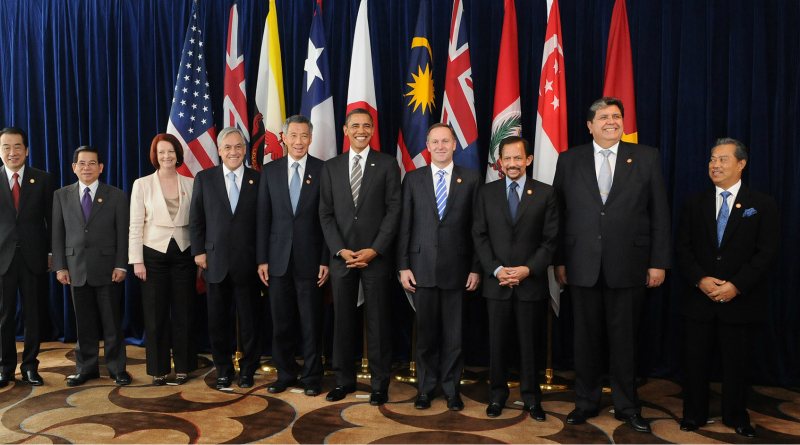
                          Leader of TPP Member States. From: Gobierno de Chile.


By Chandler Foust, Research Associate at the Council on Hemispheric Affairs 
 
On June 12, the U.S. House of Representatives passed Trade Promotion Authority (TPA) while rejecting Trade Adjustment Assistance (TAA). The Senate version of the bill, with TAA and TPA adjoined, passed. Typically, a bill such as TAA would have strong Democratic support because it provides assistance to individuals who lose jobs due to trade deals. However, since the bills were separate in the House and adjoined in the Senate, House Democrats voted it down to prevent TPA from being signed into law. Many Democrats opposed TPA because if signed into law, President Obama would have fast track authority to ratify the Trans-Pacific Partnership (TPP), which many Democrats are against. By rejecting TAA, House Democrats forced the Senate to separate the TAA from the TPA and vote on it again.

President Obama was then left to rely on Republican Senate Majority Leader Mitch McConnell and Republican Speaker of the House John Boehner to deliver the legislation, and they came through. On June 25, the Senate voted to pass TPA, without TAA, which means that the bill will be sent to the President.[1] With TPA sent to the president and the House of Representatives passing TAA the second time around, the Obama Administration can chalk this round up as a victory.[2] Regardless of what happens next though, the fact that the President’s own party initially abandoned him leads to a much-needed discussion on the role trade agreements play in determining policy in a democratic society.