Showing posts with label Workers' Party (PT). Show all posts

April 19, 2020

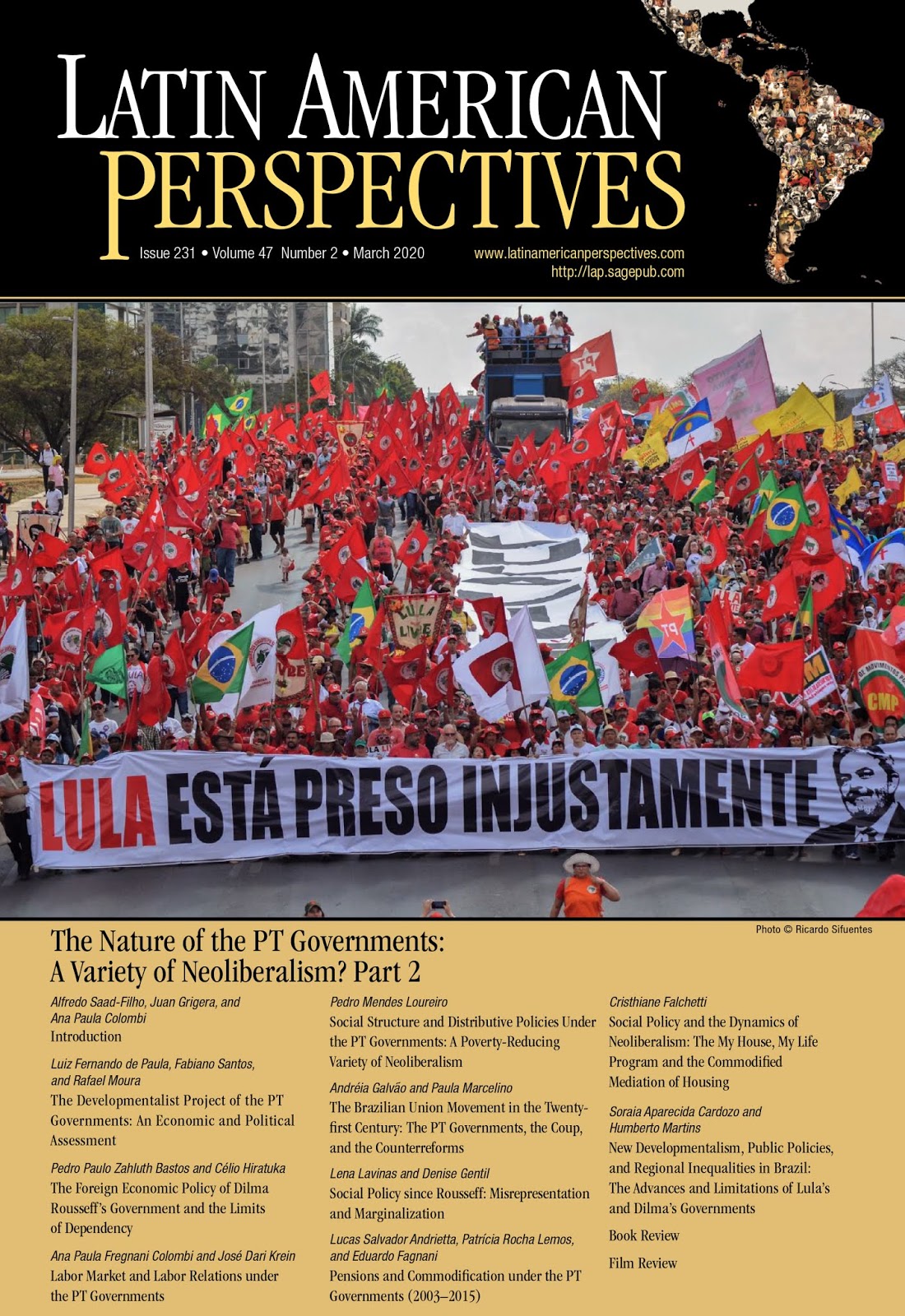
Abstract: The Developmentalist Project of the PT Governments: An Economic and Political Assessment

:::::: Abstract ::::::


The Developmentalist Project of the PT Governments: An Economic and Political Assessment

by Luiz Fernando de Paula, Fabiano Santos, Rafael Moura


An analysis of the endogenous and exogenous political and economic factors that conditioned the Partido dos Trabalhadores’s (PT) social-developmentalist project in 2003–2016 in the light of financialization and the “confidence game” conditioned by the volatility of external liquidity and commodities prices concludes that the first Lula administration faced the problem of a crisis of confidence and adopted orthodox policies but was able, with the improvement of international conditions, to launch policies of a more interventionist and distributive trend. Dilma Rousseff, facing a downright unfavorable international context, explicitly broke with the confidence game by applying the policy set of the new macroeconomic matrix. In her second term she radically reversed the policy orientation, moving toward a strong fiscal adjustment and monetary orthodoxy, and this eventually undermined her few sources of political support. The economic crisis from the second half of 2014 on undoubtedly contributed to the political crisis, which in turn made infeasible any attempt to implement policies to reverse the situation of economic crisis. Dilma’s impeachment finally interrupted the PT’s developmentalist project, allowing the emergence of new political actors.


January 14, 2020

Abstract, Sailing Against the Wind: The Rise and Crisis of a Low-Conflict Progressivism

:::::: Abstract ::::::


Sailing Against the Wind: The Rise and Crisis of a Low-Conflict Progressivism

by Gustavo Codas Friedmann, Claudio A. Castelo Branco Puty


The governments of the Partido dos Trabalhadores (Workers’ Party—PT) in Brazil (2003– 2016) were part of a cycle of progressive governments in Latin America whose differences are more specific to the conditions of political struggle in each country—the conditions of arrival in government, the structure of the political system—than fundamentally programmatic. They can be characterized as a low-conflict progressivism in that, although there was no promotion of a neoliberal agenda on the model of European social liberalism, there was accommodation within the framework of the established order that was ultimately fundamental to the success of the 2016 parliamentary-judicial coup.


January 9, 2020

Abstract, The Government of the Workers' Party: Capitalist Development Pattern and Macroeconomic Policy Regimes

:::::: Abstract ::::::


The Government of the Workers' Party: Capitalist Development Pattern and Macroeconomic Policy Regimes

by Luis Filgueiras


From the point of view of their capitalist development pattern, the governments of Fernando Collor de Mello, Fernando Henrique Cardoso, and Michel Temer, on the one hand, and Lula da Silva and Dilma Rousseff, on the other, were similar: the former were actively promoting that pattern and the latter accepting it as irreversible, the limit of the possible, and adapting to it. They differed, however, in the macroeconomic policy regimes they adopted. The development pattern of the Workers’ Party governments may be described as the peripheral-liberal pattern, the form assumed by neoliberalism in Brazil.


January 7, 2020

Abstract, Varieties of Neoliberalism in Brazil

:::::: Abstract ::::::


Varieties of Neoliberalism in Brazil (2003-2019)

by Alfredo Saad-Filho


The main feature of capital accumulation in Brazil during the administrations led by Luís Inácio Lula da Silva and Dilma Rousseff of the Partido dos Trabalhadores (Workers’ Party—PT) was the continuity of neoliberalism of two varieties: inclusive (2003–2006) and developmental (2006–2013). The PT’s attachment to neoliberalism was mitigated by the party’s (shifting) commitment to (mild) developmental outcomes, redistribution of income (at the margin), social inclusion (within narrow limits), and democratization of the state (bounded by the 1988 Constitution). Achievements in these areas were further constrained by the inability or unwillingness of the PT to confront the institutionalization of neoliberalism in the fields of economics, politics, ideology, the media, and class relations. The political crisis unfolding in Brazil since 2013 and the imposition of authoritarian neoliberalism after Rousseff’s impeachment can be examined from the perspective of the contradictions in the dominant varieties of neoliberalism under the PT and the limitations of the party’s political ambitions.


May 28, 2019

Abstract: The Palestinian Diaspora and Latin American Solidarity with the Palestinian Cause: Brazil as a Model

:::::: Abstract ::::::


The Palestinian Diaspora and Latin American Solidarity with the Palestinian Cause: Brazil as a Model


by Rasem Bisharat


The Palestinian diaspora and Arab communities in Latin America, especially in Brazil, have contributed significantly to the Palestinian cause in Latin America. The convergence between these communities and union and left parties encouraged the left to include the Palestinian cause on its agenda. Brazil may be considered a model in this respect because of the influence of its Partido dos Trabalhadores (Workers’ Party—PT), which led the Latin American left after the founding of the São Paulo Forum in 1992. The Palestinian community has an even greater role to play today, the more so since the PT’s exclusion from power favors Israel at the expense of the Palestinian cause.

A diáspora palestina e as comunidades árabes na América Latina, especialmente no Brasil, teem contribuído significativamente para a causa palestina na América Latina. A convergência entre essas comunidades, sindicatos e partidos de esquerda levou a esquerda a incluir a causa palestina em sua agenda. O Brasil pode ser considerado um modelo nesse aspecto devido à influência do Partido dos Trabalhadores (PT), que liderou a esquerda latino-americana após a fundação do Fórum de São Paulo em 1992. A comunidade palestina tem uma relevância ainda maior já que a perda de poder do PT favorece Israel em detrimento da causa palestina.

January 15, 2019

Abstract, Pink-Tide Governments: Pragmatic and Populist Responses to Challenges from the Right

:::::: Abstract ::::::


Pink-Tide Governments: Pragmatic and Populist Responses to Challenges from the Right
by Steve Ellner


The downturn in international commodity prices after 2008 heavily impacted leftist and center-leftist Latin American governments, leading to economic contraction and political confrontation and culminating in a series of setbacks beginning in 2015. Adversaries to the right ascribed the problems to the flaws inherent in the model that those governments had adopted. As could have been expected, some government critics pointed to the model of leftist-style populism as the root cause. Ironically, the Mexican scholar Jorge Castañeda, who had viewed Brazil’s Workers’ Party as the quintessence of the “good left” in contrast to the “populist left” personified by Hugo Chávez, by 2015 classified the nation’s president Dilma Rousseff as a populist and pointed to her allegedly populist policies as responsible for her downfall (Castañeda, 2015; Castañeda and Morales, 2008: 9–11). Other analysts on the right attributed the political and economic woes faced by progressive governments to economic interventionism, a model they considered to be tantamount to socialism (Ellner, 2015; 2016).


CONTINUE READING THE FULL ARTICLE HERE

SaveSave
SaveSave
SaveSave
SaveSave
SaveSave


SaveSave
SaveSave
SaveSave
SaveSave
SaveSave
SaveSave

January 10, 2019

Abstract, Chronicle of a Defeat Foretold: The PT Administrations from Compromise to the Coup

:::::: Abstract ::::::


Chronicle of a Defeat Foretold: The PT Administrations from Compromise to the Coup
by Ricardo Antunes, Marco Aurelio Santana, and Luci Praun


The period in which the Workers’ Party (Partido dos Trabalhadores—PT) was in power in Brazil was characterized by limits and contradictions with regard to policies on employment, unions, and the fight against poverty. An analysis of the factors that contributed to the end of the 14-year cycle of consecutive presidential terms highlights the combined impacts of the international economic crisis, a deepening political crisis with charges of corruption, the destabilization of the party’s political alliances, and mass discontent intensified by fiscal adjustment measures that further penalized the already stressed working class. The PT once in power did not motivate resistance, advances in social and union struggles, or social movements, and when it finally attempted to reach out to other social movements it was too late. With the coup represented by the impeachment of Dilma Rousseff in 2016, Brazil entered once again into what Florestan Fernandes has called “preventive counterrevolution.”


CONTINUE READING THE FULL ARTICLE HERE

SaveSave
SaveSave
SaveSave
SaveSave
SaveSave


SaveSave
SaveSave
SaveSave
SaveSave
SaveSave
SaveSave

January 8, 2019

Abstract: The Limits of Pragmatism: The Rise and Fall of the Brazilian Workers’ Party (2002–2016)

:::::: Abstract ::::::


The Limits of Pragmatism: The Rise and Fall of the Brazilian Workers’ Party (2002–2016)
by Pedro Mendes Loureiro, Alfredo Saad-Filho


Under favorable external circumstances, the pragmatic political and economic strategy of Brazil’s Partido dos Trabalhadores (Workers’ Party—PT) helped to secure short-term political stability, boosted growth, and supported an unprecedented distribution of income. However, it also meant that the PT had to accommodate to rather than transform the constraints on growth in Brazil and that stability would involve unwieldy political alliances preventing deeper reforms. When it was confronted with deteriorating global economic conditions and increasingly ineffectual economic policies, the PT’s strategy immobilized the party, facilitated the dissolution of its base of support, and expedited its ouster from power. The Brazilian experience suggests that political pragmatism can, within limits, support progressive economic change but that the outcomes depend heavily on external circumstances and the stability of the political coalitions supporting the administration.


CONTINUE READING THE FULL ARTICLE HERE

SaveSave
SaveSave
SaveSave
SaveSave
SaveSave


SaveSave
SaveSave
SaveSave
SaveSave
SaveSave
SaveSave

October 12, 2018

Political Report # 1375 The Workers’ Party electoral struggle in Brazil


            To be anti-PT in Brazil these days, makes one a member of the country’s largest political “party.” The PT is Brazil’s famous Workers’ Party, which was formed by leftists, neighborhood activists and labor union militants in order to renovate democratic politics and escape the stale pull of Brazil’s communist parties as the country’s 21-year-long military dictatorship (1964-1985) came to a tortured end. After many attempts, the PT’s founding light, Luís Ignacio Lula da Silva, served twice as Brazil’s president (2003-2010). His protégé, Dilma Rousseff, was also elected twice for president, becoming Brazil’s first female executive, but her second term ended abruptly in a parliamentary coup d’etat in 2016.

            On Sunday, October 7, the size of the anti-PT vote became apparent when more than 49 million citizens marked their ballots for Jair Bolsonaro, a retired army captain and current Rio de Janeiro congressional representative, who is campaigning to be Brazil’s president on the ticket of the Social Liberal Party (PSL). Critics call Bolsonaro a “fascist” due to his expressions of authoritarianism, ultra-nationalism, machismo, and racism. His aggressive rhetoric and meteoric growth in popularity certainly mark him as Brazil’s contribution to the rightward tilt of politics internationally, something of a Brazilian Donald Trump. In this first round of elections, the voters’ top two choices were Bolsonaro, with 46 percent of the vote, and Fernando Haddad, the PT’s candidate, with 29 percent of the vote. The remaining electorate cast their votes for one or another of the remaining 11 candidates. In essence, 70 percent of 107 million electors voted against the PT.

            Due to polling, the overall results surprised few. Nevertheless, nearly all earlier polls had shown a rejection rate for Bolsonaro of over 60 percent. Now, a short time before the final election round on October 28, reliable polls show Bolsonaro winning with 58 percent of the vote. Many worry that a country that struggled so hard to overcome military rule is about to vote for military rule. In fact, Bolsonaro rose to rank during the later stages of the dictatorship. His vice presidential running mate is a retired Army general and another general is coordinating the work of some 30 study-groups developing policies for governing the country. Many additional military officials man each of these groups. Military men are capable of respecting the law, but leading officials in Bolsonaro’s camp express their disdain for laws and regulations, like those controlling deforestation and protecting minorities. Just about four years ago, the country passed through a period of reckoning, involving truth commissions at every level - from local institutions to the federal government - analyzing the dictatorship and its crimes on the 50th anniversary of the 1964 coup d’etat. The current resurgence of the military in politics seems in part to be a reaction, as they have stridently rejected any wrong-doing and oppose reparations for violating the human rights of their victims.

October 9, 2018

Political Report # 1373 The Bolsonaro Effect

Jair Bolsonaro is an unavoidable name in Brazilian politics nowadays. In fact, it has been for a few years. A few days before election day on October 7, the most recent polls indicate that Bolsonaro is now the leading candidate in the presidential race, followed by Fernando Haddad of the Workers Party (PT).
Bolsonaro’s political language is hatred. He often calls for the annihilation of the Left. A few days after talking about shooting PT supporters with a machine gun at a campaign rally, a man stabbed him in the stomach. As the situation in Brazil escalates, and the possibility of Bolsonaro becoming president increases, it’s important to understand more about the far-right candidate.
The “Protest Vote”
Jair Bolsonaro is a former military officer from the small Social Liberal Party (PSL) and now serves as a federal congressman. He is a far-right politician who combines liberal economic positions with inflammatory declarations against human rights. He is an anticommunist and an apologist for the dictatorship’s use of torture. His public security motto is “a good criminal is a dead criminal.” When it comes to economics, he defers to neoliberal economist Paulo Guedes, who he’s tapped to head economic policy in a Bolsonaro government.
Although the stereotypical Bolsonaro voter is sexist, racist, and aligned with far-right politics, this is not always the case. For many, voting for Bolsonaro means a renewal of hope and political energy. Some even call it a “revolutionary” or “protest vote.” Our research shows a surprising diversity of people and ideology among his voter base.
Just recently, we were discussing politics with a group of young men in a restaurant in the impoverished periphery of Porto Alegre, in the south of Brazil. Two waiters interrupted the conversation to spontaneously declare their vote for Bolsonaro. Two other men from the next table then jumped into the conversation to proudly yell “me too!” In a matter of seconds, others were chiming in, enthusiastically saying that for the first time they could support a candidate’s campaign based on “faith,” “love,” and “hope,” rather than in exchange for money or jobs - a standard practice in the clientelist politics still prevalent in many parts of Brazil.

December 30, 2016

Film Review, Criticism and Condescension: The Triumph of the Poor in The Second Mother

:::::: Film Review ::::::


Criticism and Condescension: The Triumph of the Poor in The Second Mother
Bruna Della Torre de Carvalho Lima                                                                 


During the 14 years of the Workers’ Party’s government in Brazil, a new phenomenon disrupted an old tense and fragile balance in the country’s social order. Anna Muylaert builds her movie The Second Mother around this new phenomenon.


November 30, 2016

Film Review, Criticism and Condescension: The Triumph of the Poor in The Second Mother

:::::: Film Review ::::::


Criticism and Condescension: The Triumph of the Poor in The Second Mother
Bruna Della Torre de Carvalho Lima                                                                 


During the 14 years of the Workers’ Party’s government in Brazil, a new phenomenon disrupted an old tense and fragile balance in the country’s social order. Anna Muylaert builds her movie The Second Mother around this new phenomenon.


November 7, 2016

Film Review, Criticism and Condescension: The Triumph of the Poor in The Second Mother

:::::: Film Review ::::::


Criticism and Condescension: The Triumph of the Poor in The Second Mother
Bruna Della Torre de Carvalho Lima                                                                 


During the 14 years of the Workers’ Party’s government in Brazil, a new phenomenon disrupted an old tense and fragile balance in the country’s social order. Anna Muylaert builds her movie The Second Mother around this new phenomenon.


September 26, 2016

Political Report # 1186 Death of Democracy: Brazilian President Impeached by Majority of Senate Votes


Political Report # 1186


Death of Democracy: Brazilian President Impeached by Majority of Senate Votes


By Hector Perla Jr., Senior Research Fellow at the Council on Hemispheric Affairs and Laura Sholtz & Liliana Muscarella, Research Associates at the Council on Hemispheric Affairs


In a historic vote on August 31, Brazil’s democratically elected President Dilma Rousseff was formally ousted by the Brazilian Senate, surpassing the required two-thirds majority with 61 votes in favor and 20 votes against.[i] The controversial impeachment formalizes the provisional government of former Vice President Michel Temer and his Partido do Movimento Democrático Brasileiro (Brazilian Democratic Movement Party, PMDB), bringing an end to 13 years of governance by Rousseff’s own Partido dos Trabalhadores (Worker’s Party, PT). This decision not only signifies a drastic change in Brazil’s government, but it also has major implications for the country’s near-term future. Allegations of corruption continue to hang over Temer’s interim administration, including leaked audio recordings that suggest that Rousseff’s ouster was politically manipulated to halt the charges against congressmen from Temer’s cabinet and party.[ii] Rousseff’s impeachment is a devastating blow to Brazil’s democracy, constituting a “soft coup”-an undemocratic process of regime change tainted by political malfeasance, selective justice, and a non-electoral transfer of power cloaked in the guise of the rule of law.
What Now?
Interim President Temer and former speaker of the House of Representatives Eduardo Cunha are recognized as the primary instigators of Rousseff’s suspension in May of this year.[iii] While the two have been accused of various acts of fiscal and electoral corruption, the spotlight has been focused primarily on Rousseff’s alleged fiscal mismanagement. Following Rousseff’s impeachment, Temer was sworn in as Brazil’s president and, barring a Supreme Court intervention, receives immunity from further investigation of any crimes that took place before he assumed the presidency.[iv]
Temer will likely remain in office until the end of 2018. The next presidential elections are scheduled for October 2018 and a new president would take office January 1, 2019. However, with growing discontent from actors along the entire political spectrum, including senators and constituents from Temer’s own PMDB, there has been a good deal of speculation that his presidency may not endure.[v] Another impeachment, while a remote possibility, is not unthinkable, especially given the lack of support within Temer’s own party and the potential that new allegations of corruption may be brought against him. At that point, the Supreme Court could choose to suspend Temer’s presidential immunity and allow for the initiation of impeachment proceedings against him.[vi]
If Temer were to suffer impeachment before the end of 2016, the Brazilian Constitution requires that new national elections be called within 90 days. Otherwise, if he were to be removed after January 1, 2017, indirect elections within the Brazilian Congress would decide which current senator would assume the position.[vii] Considering recent strategies by the PMDB, such technicalities could easily be exploited by the Temer administration, further highlighting the murky nature of recent events and calling into question the legitimacy of Brazilian democracy.
Implications for Democracy in Brazil
Rousseff’s ouster sets a negative precedent for the country in two ways. On the one hand, it institutionalizes the political abuse of power by politicians seeking to avoid corruption charges. On the other, it shamefully obscures the underlying motive for removing the PT from office: a desire to return to conservative rule and neoliberalism. Both of these strategies subvert the democracy that Brazil has worked hard to uphold.
First, the installation of a new administration with weak democratic standards does not bode well for Brazil, especially given the corruption that has traditionally pervaded its government. The PMDB saw an opportunity to evade charges against its leaders while simultaneously gaining the presidency-an accomplishment that has eluded them at the voting booth for more than 20 years. All they had to do was turn on Rousseff, their electoral coalition partner. Thus, PMDB’s leaders led the impeachment of the president, even though an independent federal prosecutor found that she had not violated any fiscal laws.[viii] This practice, known as pedaladas fiscais, or “accounting tricks,” has been recently employed by more than a dozen state governors without legal repercussions.[ix] Meanwhile, Temer has been convicted of electoral fraud and accused of other acts of corruption, but by assuming the presidency he evades existing investigations, such as Operação Lava Jato, that would have proven his guilt or his innocence.  Such hypocrisy and double standards seriously impugn the legitimacy of the impeachment process and the entire democratic institution.
Temer’s interim government almost immediately implemented a far more conservative agenda than the Rousseff Administration with neoliberal ideals that seemed to have been waiting in the wings for an opportunity to be reinstated. Among his first actions was the naming of an all-white, male cabinet, several of whom were under investigation for corruption at the time of their appointment. Additionally, as a cost-cutting measure, Temer eliminated the ministries of culture, agrarian development, science and technology, women, racial equality, and human rights (although some were since reinstated due to popular pressure).[x] Furthermore, the interim administration wasted no time in rolling back the hallmark of the PT’s government: social programs and policies that Rousseff had fought hard to continue.[xi] Temer immediately slashed funding for programs that benefit the rural and urban poor, women, afro-descendants, the LGBTQ community, and indigenous people.[xii] These changes augur how Temer will govern now that he has been sworn into office. His radical departure from the policies of the platform under which he was elected as Rousseff’s vice president lends further credence to the claim that her ouster is the result of a political witch-hunt rather than a legitimate impeachment process for a criminal offense as required by the Constitution.
It is undoubtable that the non-electoral and undemocratic ouster of Brazil’s first female president constitutes a perilous democratic regression for South America’s largest nation. In fact, the process constitutes a “soft coup” against the Rousseff presidency and a political attack against the PT.[xiii] Conservative parties came together to secure what they had been unable to achieve through popular elections: a presidential victory over the PT. By circumventing the electoral process, the impeachment strikes a huge blow to the country’s democracy, especially given the advances it has made since the impunity typical of the military government (1964-1985).[xiv]
The Future of Brazil and Beyond
The PT is not going to accept Dilma’s ouster without a fight. On its Twitter page Wednesday afternoon, it posted a letter from the Frente Brasil Popular (People’s Brazilian Front), which is a coalition of trade unions, progressive and social movement organizations, and political parties. In the letter, the Front promised that, “Our struggle against the coup government and its program of rolling back our achievements will be relentless.”[xv] Protests against the proceedings, which have been ongoing since the impeachment process began, have been increasing and are also likely to intensify in the coming days.[xvi]
The ramifications of Rousseff’s impeachment are not limited to Brazil. The reverberations throughout the Western Hemisphere, where progressive governments are on the defensive against similar right-wing attacks, began immediately when Bolivia, Ecuador, and Venezuela recalled their ambassadors from Brasília. Progressive governments of the region see Brazil as the latest example of the epidemic of “soft coups” that have brought down Pink Tide governments that came to power through democratic elections. Increasingly, right-wing forces opposed to progressive governments and discontent with their social and economic programs-but unable to defeat them in popular elections-have turned to judicial and institutional processes to roll back the left’s hold on executive office.[xvii]
Despite the rhetorical anti-corruption façade that characterized the impeachment proceedings, President Rousseff’s ouster was actually a careful orchestration designed to exploit recent public discontent with her administration’s handling of the economy. Temer is nearly as unpopular as was Rousseff, yet he and the PMDB were able to channel common grievances and direct them against President Rousseff in order to capitalize on them politically. Moving forward, Brazil is in the hands of a Trojan Horse government-one that has presented itself as one of the few hopes for democracy while subverting the very institutions that the term represents. The Council on Hemispheric Affairs (COHA) stands with Rousseff and echoes the statement she made while on trial: “Today, I only fear the death of democracy.”[xviii]


Original article and sources can be found at:
http://www.coha.org/death-of-democracy-brazilian-president-impeached-by-majority-of-senate-votes/