Recognizing that mistakes have been made in the development of this sector in the past (communes, direct or indirect social property, under worker, campesino or state control) is not an excuse to stop assuming it as a strategic task.
If there are major “mistakes” that have been made which have led to the current crisis, these are undoubtedly ones that have to do with the business class that is once again being called upon to enact the new plan, despite its links to corruption and bureaucracy.
Furthermore, this demand [of support for social or small-scale production] has constitutional backing, assumed by Chavez as the progressive implementation of article 308 of the Bolivarian Constitution:
The state shall protect and promote small and medium-sized manufacturers. I always say that we support and should go on supporting small and medium-sized private manufacturers, but communal manufacturing also fits in here, alongside the private small and medium-sized industries, mixed enterprises, different types and combinations. Going back to the beginning, the state shall protect and promote small and medium-sized manufacturers, cooperatives, savings banks, as well as family-sized companies, micro-enterprises and any other form of community association for work, savings and consumption, under collective property regime (I’m quoting from the Constitution of the Bolivarian Republic of Venezuela), with the goal of strengthening the economic development of the country, sustained by popular initiative, training, technical assistance and necessary financing will be provided. Collective property includes collective property that is private, mixed, as well as collective social property. Direct social property is an example of this latter form of collective property. (3) |

Showing posts with label Economic Disparity. Show all posts
Showing posts with label Economic Disparity. Show all posts
October 15, 2018
Political Report # 1376 Where Is Socialism in Maduro's Economic Recovery Plan?

September 24, 2018
Political Report # 1369 How Puerto Rico Became the Newest Tax Haven for the Super Rich
A year after the tragedy of Hurricane Maria, the 51st state has become the favorite playground for extremely wealthy Americans looking to keep their money from the taxman. The only catch? They have to cut all ties to the mainland (wink, wink).
The party known as Cocktails and Compliance-so called for mixing alcohol with tax advice-was thrown on a Friday evening in May, in a warehouse turned art gallery in Old San Juan. The host had kept his guest list confidential: It contained the names of hundreds of ultra-wealthy mainland Americans who'd moved to Puerto Rico to avoid paying taxes, most of whom were reluctant to advertise that fact. More than 1,500 mainlanders have established residency here since 2012, when the island rebranded itself as a tax haven, and the annual Cocktails is at the center of their social calendar.
At a high table, polishing off a bourbon on the rocks, sat a compact man in his 60s wearing a black T-shirt and black suede loafers, no socks. This was Mark Gold, the Florida-born kingpin of traffic-ticket contesting. Gold has attended Cocktails and Compliance every year since moving to Puerto Rico in 2016. “I was looking at different tax havens,” he said, “Andorra, Lichtenstein, Monaco. But the problem is, you have to give up your U.S. passport. When I heard about this, it was too good to be true. But it's real. I live in paradise. I live at the Ritz-Carlton. I drive my golf cart to the beach club for breakfast. Then I go to my sunset yoga class on the beach.”
A waiter offered to replace his drink. “Why not?” said Gold.
Only seven months had passed since Hurricane Maria laid waste to the island's power grid, and one month remained until hurricane season returned. A reliable estimate placed the death toll at 4,600; 11,000 still reportedly lacked electricity. Residents were showering with pots and plastic cups. In Manhattan, a federal judge was trying to mediate between the various hedge funds that held billions of dollars of the island's debt. Every so often the MIT-educated governor went on television to extol the virtues of austerity.
In San Juan, the recovery had been notably uneven. Brand-new shopping centers abutted hotels that looked arsonized; traffic lights stared dead-eyed into the street; FEMA was shuttling relief supplies from the waterfront to staging areas. Inside Cocktails and Compliance, however, the atmosphere resembled the aftermath not of a natural disaster but of a corporate convention, with people who usually saw one another in the daytime gradually succumbing to alcohol and dim lighting.
|
August 31, 2018
Political Report # 1367 Brazil austerity policies devastating to rural communities: analysis
CAMPOS LINDOS, Brazil - Seu Raimundo Miranda, age 61, is a small-scale farmer and honey producer who lives with his wife and three children in a small home he built himself on the outskirts of Campos Lindos city in Tocantins state. Until 2016, his wife received vital economic support from Brazil’s Bolsa Familia program. Then the benefit was suddenly cut, with no reason given for the loss.
His wife called the local aid bureau dozens of times, explaining how important the money was to the family, and pleading for the benefit to be reinstated. Each time, she was refused aid without explanation.
Raimundo, his wife and children used to live in the rural countryside where they grew crops and raised cattle, but were forced to move to the city after several family members became severely ill due to pesticide poisoning. The small land plot where Raimundo now grows food isn’t very productive, and people from the city regularly steal the crops he does grow.
“All of this is so painful for us,” he says. On many days the parents struggle to bring enough food to the table to feed their teenage children, one of whom has now taken a low paying job as a laborer, clearing land for a soy farmer. “I don’t like that he does that kind of work, and I know they don’t treat him well, but we need the money,” Raimundo explains.
The family is just one of many thousands in Brazil suffering deepening privation as, over recent years, the national government has used the nation’s extreme economic crisis as justification for the implementation of what critics call severe austerity measures.
Especially impactful have been sweeping funding cuts to institutions and programs hugely important to the health and wellbeing of poor rural communities in the Amazon and Cerrado regions, according to NGOs, academics and commentators who have drawn a compelling link between these drastic reductions and decreased quality of life in these areas.
|
Introduction, Open Veins Revisited: Charting the Social, Economic, and Political Contours of the New Extractivism in Latin America
:::::: Introduction ::::::

Open Veins Revisited: Charting the Social, Economic, and Political Contours of the New Extractivism in Latin America
by Nicole Fabricant and Linda Farthing
Ever since the search for the elusive El Dorado began in the sixteenth century, the history of Latin America has been a tale of resource extraction. Key resources (such as silver, gold, tin, and copper) drew foreign investment but left local populations deeply impoverished. As Eduardo Galeano (1973: 29) described it, “the Spanish colonies’ economic structure was born subordinated to the external market and thus centralized around the export sector, where profit and power were concentrated.” Five centuries later, this overall pattern remains unchanged.
Its persistence propelled twentieth-century social scientists to use Marxist analytic frames, Raúl Prebisch and Hans Singer’s theories on declining terms of trade, and dependency theory more generally to explain how resource extraction created geographic and historic asymmetries between nation-states and peoples.....

Open Veins Revisited: Charting the Social, Economic, and Political Contours of the New Extractivism in Latin America
by Nicole Fabricant and Linda Farthing
Ever since the search for the elusive El Dorado began in the sixteenth century, the history of Latin America has been a tale of resource extraction. Key resources (such as silver, gold, tin, and copper) drew foreign investment but left local populations deeply impoverished. As Eduardo Galeano (1973: 29) described it, “the Spanish colonies’ economic structure was born subordinated to the external market and thus centralized around the export sector, where profit and power were concentrated.” Five centuries later, this overall pattern remains unchanged.
Its persistence propelled twentieth-century social scientists to use Marxist analytic frames, Raúl Prebisch and Hans Singer’s theories on declining terms of trade, and dependency theory more generally to explain how resource extraction created geographic and historic asymmetries between nation-states and peoples.....
August 27, 2018
Political Report # 1365 Puerto Rico's Crisis Has Been Good for Many - Just Not the Island’s Residents
With its authority recently upheld by the courts, Puerto Rico's Federal Management and Oversight Board (known simply as "the Board") continues to impose harsh austerity measures on the people of Puerto Rico. But while residents face pension cuts, school closures, massive layoffs, and a continued recession, the same austerity does not apply to the Board itself, which is spending hundreds of millions on its own expenses and a myriad of consultants, advisers, and lawyers. Nor does the austerity appear to apply to some of Puerto Rico's bondholders either.
Last week, the Board, along with the government of Puerto Rico, announced they reached a deal with owners of bonds in Puerto Rico's Sales Tax Financing Corporation (COFINA), proudly claiming it would save the commonwealth $17.5 billion in debt service. While technically true, the claim obscures the fact that the deal will still see Puerto Rico use its scarce resources to pay these creditors some $33 billion over the next 40 years on what was initially $17 billion in principal. Overall, the bondholders will recover nearly 75 percent of the initial value of their investment, a fairly generous settlement from a bankrupt entity still trying to recover from a lost decade - without economic growth - followed by the devastation of Hurricane Maria.
In fact, judging from the Board's most recent fiscal plan, Puerto Rico won't even have the money to pay for the bonds that would be issued as part of the settlement. The board projects the island to have about a $4 billion surplus over the next 40 years, leaving authorities at least $28 billion short of satisfying this deal with creditors. The settlement is actually based on revenue projections from an earlier version of the Board's fiscal plan, which were revised down in June when the newest version of the plan was certified. This mistake, rather than the overall generosity of the offer, now puts in question the future of this deal. Will the Board revise its fiscal plan yet again to demand even greater austerity in order to satisfy these creditors' claims?
To make matters worse, a close look at who the current COFINA bondholders are reveals a series of vulture funds that bought the bonds at steep discounts after the initial default, and immediately after Hurricane Maria. Investors now stand to make huge profits from that move, while most Puerto Ricans suffer through continued austerity. One of the largest investors in COFINA bonds, GoldenTree Asset Management, more than doubled its holdings in the aftermath of Hurricane Maria. Court filings show that as of August 1, 2018, GoldenTree owned $1.5 billion in COFINA bonds, up from $587 million in August 2017. The bonds in question traded as low as 20 cents on the dollar during this time period, which means a 75 percent recovery rate could amount to an enormous profit.
|
August 13, 2018
Political Report # 1360 Puerto Rico’s Fiscal Control Board: A Parallel Government Full of Lawyers and Consultants
Martin Bienenstock sits in the audience, looking at his tablet. As the twelfth public meeting of Puerto Rico’s Fiscal Control Board takes place, he raises his eyes, adjusts his glasses, frowns and pays attention to the discussion. Nothing seems to happen and his eyes go back to the electronic device.
Bienenstock, a partner at New York-based Proskauer Rose, is a well-known lawyer in the corporate restructuring industry. With almost 40 years of experience, he has participated in many of the largest bankruptcies in the U.S., including a key role in the restructuring of General Motors and Chrysler, and representing now-defunct Enron in its Chapter 11 bankruptcy.
His biography highlights how Bienenstock has been a staple for the past decade on the National Law Journal’s list of the 100 Most Influential Bankruptcy Lawyers, as well as an “MVP” among bankruptcy lawyers, according to Law 360.
Since late 2016, Bienenstock leads the legal counsel of Puerto Rico’s federally appointed board, particularly in the bankruptcy cases filed under Title III of PROMESA. From May 2017 to June 2018, he dedicated more than 1,500 hours to Puerto Rico’s bankruptcy. Each minute of Bienenstock costs $12.65, and for his work, he has invoiced more than $1.3 million for the one-year period. Bienenstock didn’t answer a request for comment made by the Center for Investigative Journalism (CPI by its Spanish initials).
|
June 27, 2018
Political Report # 1351 On the Eve of National Elections, Mexico's Economy Struggles to Emerge from Decades of "Economic Failure," Report Concludes
Washington, DC - Five years after leaders of Mexico's then most prominent political parties agreed on a "Pact for Mexico," Mexico's economy is mired in a "trap of low investment and low growth," and imperiled by liberalization of financial markets that makes it especially vulnerable to the effects of interest rate increases by the US Federal Reserve, as well as global turbulence in financial markets.
These are some conclusions of a new research paper from the Center for Economic and Policy Research (CEPR) being released just ahead of Mexico's national elections on Sunday, July 1. The report, "The Pact for Mexico After Five Years: How Has it Fared?" concludes: "the country's persistent sluggish growth, poverty, and inequality are rooted in a set of important economic policy choices that have been made consistently for a long time."
"It is clear that the Pact for Mexico has failed to produce the economic gains that were promised," CEPR co-director and lead author of the report Mark Weisbrot said. "But it's worse than that: the current government and policymakers are committed to a set of economic policies that have failed for decades and don't look any more likely to succeed going forward."
The report looks at overly restrictive fiscal and monetary policies, as well as a lack of public investment, as important contributors to Mexico's long-term economic failure. In the twenty-first century, Mexico's growth in real income per person has placed it 18th of 20 Latin American countries.
|
March 23, 2018
Abstract, Progress and Development: One and the Same in Latin America?
:::::: Abstract ::::::

Progress and Development: One and the Same in Latin America?
by Elizabeth Cabalé Miranda and Gabriel Modesto Rodríguez Pérez de Agreda
The error of the theses about Latin America that Rodolfo Stavenhagen criticized was mainly that they attempted to impose the capitalist class’s view of the world on the rest of society and that they were hegemonic. Stavenhagen’s arguments were not only counterhegemonic but directed at social praxis and social change. As he pointed out, Latin America’s internal colonialism is the result of capitalism’s subjugating and alienating mode of production, and therefore the solution to it cannot come from more capitalism. Any project for change must begin with breaking down our countries’ enormous social differences. Progress or development in Latin America will come not from economic growth but from the introduction of modes of production associated with the solidary economy.

Progress and Development: One and the Same in Latin America?
by Elizabeth Cabalé Miranda and Gabriel Modesto Rodríguez Pérez de Agreda
The error of the theses about Latin America that Rodolfo Stavenhagen criticized was mainly that they attempted to impose the capitalist class’s view of the world on the rest of society and that they were hegemonic. Stavenhagen’s arguments were not only counterhegemonic but directed at social praxis and social change. As he pointed out, Latin America’s internal colonialism is the result of capitalism’s subjugating and alienating mode of production, and therefore the solution to it cannot come from more capitalism. Any project for change must begin with breaking down our countries’ enormous social differences. Progress or development in Latin America will come not from economic growth but from the introduction of modes of production associated with the solidary economy.
March 12, 2018
Introduction, The Legacy of Rodolfo Stavenhagen (1932–2016): Linking Critical Scholarship and Social Justice
:::::: Introduction ::::::

The Legacy of Rodolfo Stavenhagen (1932–2016): Linking Critical Scholarship and Social Justice
by Arturo Alvarado, Serena Chew Plascencia and Jan Rus
Rodolfo Stavenhagen’s 1965 essay critical of seven theses about Latin America challenged the way social scientists thought about the region’s political economy and history. Serialized for a popular audience in the Mexico City daily El Día on June 25 and 26, 1965, it questioned the prevailing assumption among North American political economists and in Eurocentric thought that “modernization” through capitalist development could solve Latin America’s persistent backwardness and underdevelopment. It also reflected thinking among a younger generation of progressive intellectuals who questioned the thesis that backwardness in the region was a consequence of feudalism or semifeudalism, instead attributing it to the capitalist development of underdevelopment through the imperialist relationship between rich and poor nations in the world economy and to dependent relationships involving wealth and poverty between regions within Latin American countries.

The Legacy of Rodolfo Stavenhagen (1932–2016): Linking Critical Scholarship and Social Justice
by Arturo Alvarado, Serena Chew Plascencia and Jan Rus
Rodolfo Stavenhagen’s 1965 essay critical of seven theses about Latin America challenged the way social scientists thought about the region’s political economy and history. Serialized for a popular audience in the Mexico City daily El Día on June 25 and 26, 1965, it questioned the prevailing assumption among North American political economists and in Eurocentric thought that “modernization” through capitalist development could solve Latin America’s persistent backwardness and underdevelopment. It also reflected thinking among a younger generation of progressive intellectuals who questioned the thesis that backwardness in the region was a consequence of feudalism or semifeudalism, instead attributing it to the capitalist development of underdevelopment through the imperialist relationship between rich and poor nations in the world economy and to dependent relationships involving wealth and poverty between regions within Latin American countries.
January 12, 2018
Introduction, The Urban Informal Economy Revisited
:::::: Introduction ::::::

The Urban Informal Economy Revisited
by Ray Bromley and Tamar Diana Wilson
One of the most cited definitions of the informal economy is “a process of income generation characterized by one central feature: it is unregulated by the institutions of society, in a legal and social environment in which similar activities are regulated” (Castells and Portes, 1989: 12). Among those the International Labour Organization (ILO) (2013: 3) identifies as being part of the informal economy are those who work in the informal sector as employers and employees in informal enterprises and as self-employed workers. Also included are those who labor outside the informal sector and are informally employed in formal firms or as domestic workers, not covered by labor law protections. The employees in the informal economy also include unpaid family workers, whether employed in informal enterprises or in formal firms or in domestic service.
For decades there have been debates over whether the informal economy is procyclical, expanding as the capitalist economy expands, or countercyclical, contracting as that economy expands. Both things may be happening, depending on which part of the informal economy is under scrutiny: the informally self-employed or informalized wage workers in either informal or formal enterprises (FORLAC, 2015: 2). For example, informal microenterprises that market their products directly to customers or retail outlets may show countercyclical tendencies, whereas informal microenterprises that are subcontracted by large businesses, whether national or multinational, may show procyclical tendencies. More domestic workers may be employed when the economy expands, whereas self-employment in artisanal work and vending may expand when waged employment dries up.

The Urban Informal Economy Revisited
by Ray Bromley and Tamar Diana Wilson
One of the most cited definitions of the informal economy is “a process of income generation characterized by one central feature: it is unregulated by the institutions of society, in a legal and social environment in which similar activities are regulated” (Castells and Portes, 1989: 12). Among those the International Labour Organization (ILO) (2013: 3) identifies as being part of the informal economy are those who work in the informal sector as employers and employees in informal enterprises and as self-employed workers. Also included are those who labor outside the informal sector and are informally employed in formal firms or as domestic workers, not covered by labor law protections. The employees in the informal economy also include unpaid family workers, whether employed in informal enterprises or in formal firms or in domestic service.
For decades there have been debates over whether the informal economy is procyclical, expanding as the capitalist economy expands, or countercyclical, contracting as that economy expands. Both things may be happening, depending on which part of the informal economy is under scrutiny: the informally self-employed or informalized wage workers in either informal or formal enterprises (FORLAC, 2015: 2). For example, informal microenterprises that market their products directly to customers or retail outlets may show countercyclical tendencies, whereas informal microenterprises that are subcontracted by large businesses, whether national or multinational, may show procyclical tendencies. More domestic workers may be employed when the economy expands, whereas self-employment in artisanal work and vending may expand when waged employment dries up.
December 8, 2017
Introduction, The Urban Informal Economy Revisited
:::::: Introduction ::::::
The Urban Informal Economy Revisited
by Ray Bromley and Tamar Diana Wilson
One of the most cited definitions of the informal economy is “a process of income generation characterized by one central feature: it is unregulated by the institutions of society, in a legal and social environment in which similar activities are regulated” (Castells and Portes, 1989: 12). Among those the International Labour Organization (ILO) (2013: 3) identifies as being part of the informal economy are those who work in the informal sector as employers and employees in informal enterprises and as self-employed workers. Also included are those who labor outside the informal sector and are informally employed in formal firms or as domestic workers, not covered by labor law protections. The employees in the informal economy also include unpaid family workers, whether employed in informal enterprises or in formal firms or in domestic service.
For decades there have been debates over whether the informal economy is procyclical, expanding as the capitalist economy expands, or countercyclical, contracting as that economy expands. Both things may be happening, depending on which part of the informal economy is under scrutiny: the informally self-employed or informalized wage workers in either informal or formal enterprises (FORLAC, 2015: 2). For example, informal microenterprises that market their products directly to customers or retail outlets may show countercyclical tendencies, whereas informal microenterprises that are subcontracted by large businesses, whether national or multinational, may show procyclical tendencies. More domestic workers may be employed when the economy expands, whereas self-employment in artisanal work and vending may expand when waged employment dries up.
The Urban Informal Economy Revisited
by Ray Bromley and Tamar Diana Wilson
One of the most cited definitions of the informal economy is “a process of income generation characterized by one central feature: it is unregulated by the institutions of society, in a legal and social environment in which similar activities are regulated” (Castells and Portes, 1989: 12). Among those the International Labour Organization (ILO) (2013: 3) identifies as being part of the informal economy are those who work in the informal sector as employers and employees in informal enterprises and as self-employed workers. Also included are those who labor outside the informal sector and are informally employed in formal firms or as domestic workers, not covered by labor law protections. The employees in the informal economy also include unpaid family workers, whether employed in informal enterprises or in formal firms or in domestic service.
For decades there have been debates over whether the informal economy is procyclical, expanding as the capitalist economy expands, or countercyclical, contracting as that economy expands. Both things may be happening, depending on which part of the informal economy is under scrutiny: the informally self-employed or informalized wage workers in either informal or formal enterprises (FORLAC, 2015: 2). For example, informal microenterprises that market their products directly to customers or retail outlets may show countercyclical tendencies, whereas informal microenterprises that are subcontracted by large businesses, whether national or multinational, may show procyclical tendencies. More domestic workers may be employed when the economy expands, whereas self-employment in artisanal work and vending may expand when waged employment dries up.
November 20, 2017
Abstract, The Tip of the Iceberg: Media Coverage of “Slave Labor” in Argentina
:::::: Abstract ::::::

The Tip of the Iceberg: Media Coverage of “Slave Labor” in Argentina
by Marina Kabat, Agustina Desalvo, Julia Egan
The Argentina media often report “slave labor” conditions in clothing production and seed nurseries. A critical assessment of the types of coercion (economic and noneconomic) that hold workers under these brutal conditions indicates that instances of extraeconomic coercion are merely the extreme manifestation of a general situation in which economic coercion predominates. The determinants of the deterioration of working conditions in these two sectors include relative overpopulation and technological backwardness.

The Tip of the Iceberg: Media Coverage of “Slave Labor” in Argentina
by Marina Kabat, Agustina Desalvo, Julia Egan
The Argentina media often report “slave labor” conditions in clothing production and seed nurseries. A critical assessment of the types of coercion (economic and noneconomic) that hold workers under these brutal conditions indicates that instances of extraeconomic coercion are merely the extreme manifestation of a general situation in which economic coercion predominates. The determinants of the deterioration of working conditions in these two sectors include relative overpopulation and technological backwardness.
October 25, 2017
Abstract, The Tip of the Iceberg: Media Coverage of “Slave Labor” in Argentina
:::::: Abstract ::::::
The Tip of the Iceberg: Media Coverage of “Slave Labor” in Argentina
by Marina Kabat, Agustina Desalvo, Julia Egan
The Argentina media often report “slave labor” conditions in clothing production and seed nurseries. A critical assessment of the types of coercion (economic and noneconomic) that hold workers under these brutal conditions indicates that instances of extraeconomic coercion are merely the extreme manifestation of a general situation in which economic coercion predominates. The determinants of the deterioration of working conditions in these two sectors include relative overpopulation and technological backwardness.
The Tip of the Iceberg: Media Coverage of “Slave Labor” in Argentina
by Marina Kabat, Agustina Desalvo, Julia Egan
The Argentina media often report “slave labor” conditions in clothing production and seed nurseries. A critical assessment of the types of coercion (economic and noneconomic) that hold workers under these brutal conditions indicates that instances of extraeconomic coercion are merely the extreme manifestation of a general situation in which economic coercion predominates. The determinants of the deterioration of working conditions in these two sectors include relative overpopulation and technological backwardness.
July 7, 2017
The Chilean Earthquake of 2010: Challenging the Capabilities of the Neoliberal State
Edited by: Kirsten Sehnbruch
Issue 215 | Volume 44 | Number 4 | July 2017

On February 27th 2010, southern Chile was hit by an 8.8 magnitude earthquake followed by several devastating tsunamis. The disaster cost 575 lives and economic losses equivalent to 18% of Chile’s GDP. Although Chile’s earthquake resistant construction prevented far greater damage and its institutions proved to be relatively well equipped for disaster relief, all the weaknesses of an atrophied neoliberal state became evident during a reconstruction process based on decentralized public-private partnerships formed to implement over 100 local “master plans.” This special issues analyses the responses from politicians, policy makers, corporations, and civil society and situates them in their institutional and constitutional context.
June 7, 2017
Political Report # 1250 Passive Revolution: The Transnational Capitalist Class Unravels Latin America's Pink Tide
The day after the Organization of American States (OAS) met in Washington, DC, on May 31 at the behest of the US and right-wing Latin American governments to debate the crisis in Venezuela, judge Nelson Moncada was gunned down at an opposition protest in Caracas, in a crime that some claimed was an act of revenge for his involvement in the sentencing of a prominent opposition politician. The OAS, however, remained silent on the crime, as well as on the deepening crisis and escalating state repression against mass protests sweeping Brazil and Colombia. Bolivian President Evo Morales accused the OAS of seeking to "politically eliminate the anti-imperialist presidents and governments" in Latin America in line with the historic pattern of US intervention in the region to prop up right-wing dictatorships and crush revolutionary and progressive movements.
The leftist governments in Latin America that swept to power in the early 21st century, known collectively as the Pink Tide, transformed the political landscape in the Americas and inspired popular and revolutionary struggles around the world. The Pink Tide governments came to power on the heels of mass popular resistance to the late 20th century juggernaut of neoliberalism and capitalist globalization in the region. Yet nearly two decades after the turn to the left, the right has resumed power with a vengeance in Brazil, Argentina, Paraguay and Honduras, while the Venezuelan revolution is in deep crisis and the leftist projects in Bolivia, Ecuador, Uruguay, Nicaragua and El Salvador have been emptied of much of their socialist pretensions. If this ebbing of the Pink Tide demonstrates the limits of parliamentary changes in the era of global capitalism, it also points to the renewed hegemony of the transnational capitalist class over the region.
The social model pursued by the Pink Tide governments involved the capture and redistribution of surpluses generated by the export of raw materials to global markets. Notwithstanding the leftist rhetoric, these governments oversaw a massive expansion of raw material production in partnership with foreign and local contingents of the transnational capitalist class, that is, the transnationally integrated ruling capitalist groups that emerged in countries around the world through globalization and that exercise collective control over the new globalized system of production and finance. As a result, the Pink Tide countries became ever more integrated into emergent transnational circuits of global capitalism and dependent on global commodity and capital markets.
There was no attempt to break with this extractivist model, even in the more radical experiments in Venezuela, Bolivia and Ecuador, where energy and other natural resources were nationalized. All three countries deepened their dependence on the export of hydrocarbons and industrial and precious minerals. Venezuela is even more dependent on oil exports in 2017 than it was at the turn of the century. Soy production in Argentina, Brazil, Paraguay, Uruguay and Bolivia experienced an explosive expansion as transnational corporate agribusiness displaced millions of smallholders and converted the countryside into a vast sea of industrial-scale soy plantations.
With the exception of Venezuela during the height of the Bolivarian revolution, what stood out were the absence of any shift in basic property and class relations despite changes in political blocs, a discourse in favor of the popular classes, and an expansion of social welfare programs. In effect, these governments carried out what Italian Marxist theorist and politician Antonio Gramsci referred to as passive revolution, whereby dominant groups undertake reform from above that defuses mobilization from below for more far-reaching transformation. The Pink Tide governments were "progressive" insofar as they introduced limited redistribution and restored a role for the state, less in regulating accumulation than in administering its expansion in more inclusionary ways. When we cut through the rhetoric, many of the Pink Tide states were able to push forward a new wave of capitalist globalization with greater credibility than their orthodox and politically bankrupt neoliberal predecessors.
The commodities boom financed the expansion of social programs that reduced poverty and raised the standard of living of the working and popular classes. Yet because there were no more substantial structural transformations that could address the root causes of poverty and inequality, these social programs were subject to the vagaries of global markets over which the Pink Tide states exercised no control. Once the 2008 world financial crisis hit, they came up against the limits of redistributive reform within the logic of global capitalism. The extreme dependence on raw materials exports threw these countries into economic turmoil when global commodities markets collapsed, undermining governments' abilities to sustain social programs and generating political tensions that helped fuel popular protest and open up space for a right-wing resurgence.
Brazil was most indicative of the mild reformist thrust of many Pink Tide governments, and the most tragic for the popular classes. President Luiz Inácio Lula da Silva won the 2002 election only after his wing of the Workers' Party moved sharply toward the political center and promised not to default on the country's foreign debt. In Brazil, as elsewhere, the Pink Tide state remained a part of the larger institutional networks of the global financial system and beholden to transnational finance capital. The Workers' Party government demobilized the mass social movements that brought it to power and then imposed austerity after the collapse. Only in this light can we understand the brazen return of the far right.
US intervention, of course, is a critical part of the story of the unraveling of the Pink Tide. As in other historical moments of counterrevolution, such as in Chile under Salvador Allende in the early 1970s and Nicaragua in the 1980s, US strategists have been deft at exploiting mistakes and limitations of the Pink Tide governments and manipulating legitimate grievances among the popular sectors in these countries for the purposes of destabilization. This is especially the case with the Bolivarian project in Venezuela -- by far the most radical and socialist-oriented experiment among the Pink Tide -- that has faced an all-out strategy of US counter-revolution since its inception.
There are other factors to consider as well, such as the particular dynamics of class and social struggles in each country that shaped the trajectory of Pink Tide experiences and the attempts at building an alternative regional economic bloc around the Bolivarian Alliance for the Peoples of Our America (ALBA).
Yet these dimensions played out to the drumbeat of the expansion of capitalist globalization in the region followed by crisis. The transnational capitalist class used its structural power in the global political economy to defuse the Pink Tide challenge to its rule. In this way the transnational capitalist class demonstrated its capacity to subordinate leftist projects at the national and regional levels to its logic of global accumulation. The lesson seems to be that a viable project from below requires a more significant rupture with that logic than the Pink Tide was able or willing to undertake.
Original article and sources can be found here:
http://www.truth-out.org/news/item/40837-passive-revolution-the-transnational-capitalist-class-unravels-latin-america-s-pink-tide
|
March 8, 2017
Political Report # 1233 Ecuadoreans' Legal Fight Against Chevron Continues in Canada
In 1993, US lawyer Steven Donziger and others filed a lawsuit in New York against Texaco on behalf of Indigenous nationalities and campesino communities in Ecuador's Amazon whose land and water had been thoroughly contaminated over a 26-year period.
From 1964-1990, Texaco ran all drilling, waste disposal, and pipeline operations in the region and admitted it had dumped 16 billion gallons of oil waste into rivers and streams relied on by local inhabitants for their drinking water, bathing, and fishing. The damage has been called the "Amazon Chernobyl" by locals and is considered by some experts to be the worst oil-related environmental disaster on the planet and credibly linked to unusually high cancer rates in the area.
Texaco spent almost 10 years fighting to get the lawsuit moved to Ecuador's courts, which it praised in numerous sworn affidavits. In 2001, Chevron (which had just merged with Texaco) won that battle and agreed to abide by any judgment issued in Ecuador, subject only to narrow enforcement defenses.
|
December 15, 2016
Book, Estados Unidos más allá de la crisis
:::::: Book ::::::

Estados Unidos más allá de la crisis
by Dídimo Castillo Fernández. Marco A. Gandásegui, hijo. [Coordinadores]
by Dídimo Castillo Fernández. Marco A. Gandásegui, hijo. [Coordinadores]
El presente libro, Estados Unidos. Mas allá de la crisis, está integrado por 20 capítulos resultantes de la investigación realizada por el grupo de trabajo Estudios sobre Estados Unidos del Consejo Latinoamericano de Ciencias Sociales (CLACSO). El libro analiza la crisis capitalista actual, su carácter y efectos sobre Estados Unidos, así como sus relaciones con América Latina y el resto del mundo. La recesión, que afectó sobre todo a Estados Unidos, tiene por lo menos dos interpretaciones. La primera, que sostiene que el ciclo económico debe contrarrestarse con políticas que garanticen la recuperación del sector financiero mediante políticas de austeridad. La segunda interpretación de la crisis tiene como eje lo que los analistas consideran el colapso de la "economía real" que ha cerrado centros de producción y ha lanzado al desempleo a decenas de millones de trabajadores.
October 4, 2016
Book, "Mobilizing Democracy: Globalization and Citizen Protest" by Paul Almeida

Mobilizing Democracy: Globalization and Citizen Protest
Paul Almeida’s comparative study of the largest social movement campaigns that existed between 1980 and 2013 in every Central American country (Costa Rica, El Salvador, Guatemala, Honduras, Nicaragua, and Panama) provides a granular examination of the forces that spark mass mobilizations against state economic policy, whether those factors are electricity rate hikes or water and health care privatization. Many scholars have explained connections between global economic changes and local economic conditions, but most of the research has remained at the macro level. Mobilizing Democracy contributes to our knowledge about the protest groups "on the ground" and what makes some localities successful at mobilizing and others less successful. His work enhances our understanding of what ingredients contribute to effective protest movements as well as how multiple protagonists—labor unions, students, teachers, indigenous groups, nongovernmental organizations, women’s groups, environmental organizations, and oppositional political parties—coalesce to make protest more likely to win major concessions.
August 18, 2016
Exclusive, Ecología Política 51. Political Ecology in Latin America by Nemer E. Narchi

For nearly four decades studies in Political Ecology has proven the well known effects that power relations have over the quality of and availability and access to natural resources. Nonetheless, the neo-Maltusian discourse [1], which highlights population growth as the single-most salient factor promoting anthropogenic impacts on the environment, is still a prevailing idea among prominent thinkers and opinion leaders.
Optimal scenarios for understanding how unbalanced exercises of political and economical power create environmental costs and benefits can be observed throughout the world due to an overarching colonial past. However, when scrutinizing the recent history of Latin America, there is no question that the region could provide a myriad of textbook-scenarios.
August 10, 2016
Political Report # 1170 The Broken Promise of the Rio Olympics
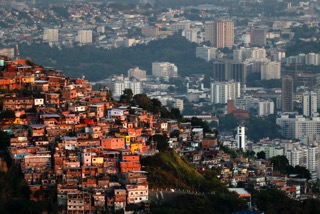
A slum in Rio de Janeiro Sergio Moraes / Reuters
By The Atlantic
|
The Rio de Janeiro you see advertised in videos promoting the Olympics is the iconic one everyone knows: Ipanema, Sugarloaf Mountain, the statue of Christ the Redeemer. But that's just a tiny slice of this sprawling metropolis of 12 million people, most of whom live miles from the beach. You can see the other Rio, their Rio, as you drive into town from the international airport, past the walls enclosing the freeway: a sea of red cinderblock shacks stacked precariously atop one another, with narrow roads snaking in between. One in seven Rio residents make their home in so-called favelas like these.
When Brazil won the right to hold this year's Summer Games back in 2009, it seemed ready to vault into the club of developed nations. Luiz Inácio Lula da Silva, then the country's wildly popular president, pitched the Olympics as an opportunity to develop Rio's infrastructure, and remake the city into a new world capital. But this was also a rare moment of Brazilian self-confidence-one ultimately undone by hubris.
|
Subscribe to:
Posts (Atom)