Showing posts with label City Development. Show all posts

May 31, 2017

Abstract, “A New Poblador Is Being Born”: Housing Struggles in a Gentrified Area of Santiago

:::::: Abstract ::::::


“A New Poblador Is Being Born”: Housing Struggles in a Gentrified Area of Santiago
by Miguel Pérez                                                     


Since the early 1990s, Chilean democratic governments after Augusto Pinochet’s dictatorship have made an effort to allocate publicly subsidized housing to the lower classes. Nevertheless, the dominance of market principles in urban policies has contributed to the formation of highly segregated neighborhoods and the gentrification of peripheral neighborhoods. As a result, Chilean public opinion is witnessing the rearticulation of what in the mid-twentieth century was known as the pobladores movement—social mobilizations demanding housing solutions for the poor. In the old working-class municipality of Peñalolén, severe gentrification since the late 1980s has triggered the appearance of autonomous grassroots organizations such as the Movimiento de Pobladores en Lucha (MPL). The movement has been able to fight social and spatial injustice in Santiago through a subversive appropriation of state policies. Its experience reveals the potentialities of such mobilizations for democratizing cities under a neoliberal regime.

May 30, 2017

Abstract, Gendering the Urban Social Movement and Public Housing Policy in São Paulo

:::::: Abstract ::::::


Gendering the Urban Social Movement and Public Housing Policy in São Paulo
by Charmain Levy, Anne Latendresse, and Marianne Carle-Marsan                                                             


A deteriorating economic scenario, a critical mass of unmarried female heads of households, and the institutionalization of the São Paulo housing movement in the 2000s contributed to women’s taking on a new public role within the movement. The strong presence of women at different levels of this social movement was a necessary but not determining factor in generating public awareness about gender-differentiated needs and claims for access to housing. Female leadership and a strategic alliance with the women’s movement and with nongovernmental organizations and local elected officials contributed to the development of gender-specific public housing policies.

May 1, 2017

Abstract, “A New Poblador Is Being Born”: Housing Struggles in a Gentrified Area of Santiago

:::::: Abstract ::::::


“A New Poblador Is Being Born”: Housing Struggles in a Gentrified Area of Santiago
by Miguel Pérez                                                     


Since the early 1990s, Chilean democratic governments after Augusto Pinochet’s dictatorship have made an effort to allocate publicly subsidized housing to the lower classes. Nevertheless, the dominance of market principles in urban policies has contributed to the formation of highly segregated neighborhoods and the gentrification of peripheral neighborhoods. As a result, Chilean public opinion is witnessing the rearticulation of what in the mid-twentieth century was known as the pobladores movement—social mobilizations demanding housing solutions for the poor. In the old working-class municipality of Peñalolén, severe gentrification since the late 1980s has triggered the appearance of autonomous grassroots organizations such as the Movimiento de Pobladores en Lucha (MPL). The movement has been able to fight social and spatial injustice in Santiago through a subversive appropriation of state policies. Its experience reveals the potentialities of such mobilizations for democratizing cities under a neoliberal regime.

April 28, 2017

Abstract, Gendering the Urban Social Movement and Public Housing Policy in São Paulo

:::::: Abstract ::::::


Gendering the Urban Social Movement and Public Housing Policy in São Paulo
by Charmain Levy, Anne Latendresse, and Marianne Carle-Marsan                                                             


A deteriorating economic scenario, a critical mass of unmarried female heads of households, and the institutionalization of the São Paulo housing movement in the 2000s contributed to women’s taking on a new public role within the movement. The strong presence of women at different levels of this social movement was a necessary but not determining factor in generating public awareness about gender-differentiated needs and claims for access to housing. Female leadership and a strategic alliance with the women’s movement and with nongovernmental organizations and local elected officials contributed to the development of gender-specific public housing policies.

April 21, 2017

Abstract, Urban Governance and Economic Development in Medellín An “Urban Miracle”?

:::::: Abstract ::::::


Urban Governance and Economic Development in Medellín An “Urban Miracle”?
by Tobias Franz


Many of the academic analyses calling Medellín’s development an “urban miracle” fall short with regard to discussion of the political economic implications of institutional shifts. An emerging transnational capitalist class promoted ‘good governance’ reforms and the embedding of neoliberalism in the urban context. Medellín’s neoliberal development agenda is not only a market-led strategy but also a particular form of hierarchic rule and distribution of power. Increased economic activities in the tertiary sector, the promotion of flexible labor markets, and the incorporation of the city into the global economy at the lower end of the value chain have not served as sustainable growth escalators for Medellín’s economy. The city continues to have high rates of un- and underemployment and is still the country’s most unequal city. These developments can by no means be described as miraculous.


March 13, 2017

Abstract, Urban Governance and Economic Development in Medellín An “Urban Miracle”?

:::::: Abstract ::::::


Urban Governance and Economic Development in Medellín An “Urban Miracle”?
by Tobias Franz


Many of the academic analyses calling Medellín’s development an “urban miracle” fall short with regard to discussion of the political economic implications of institutional shifts. An emerging transnational capitalist class promoted ‘good governance’ reforms and the embedding of neoliberalism in the urban context. Medellín’s neoliberal development agenda is not only a market-led strategy but also a particular form of hierarchic rule and distribution of power. Increased economic activities in the tertiary sector, the promotion of flexible labor markets, and the incorporation of the city into the global economy at the lower end of the value chain have not served as sustainable growth escalators for Medellín’s economy. The city continues to have high rates of un- and underemployment and is still the country’s most unequal city. These developments can by no means be described as miraculous.


December 22, 2016

Book, City Making and Urban Governance in the Americas: Curitiba and Portland

:::::: Book ::::::


City Making and Urban Governance in the Americas: Curitiba and Portland 
by Clara Irazabal


Cities in both North and South America are confronting tremendous challenges in urban growth and management as they enter the new century. Curitiba in Brazil and Portland in Oregon, US are cities that have achieved recognition for exemplary urban planning programmes over the past three decades. As such, they provide particularly useful illustrations of the intense development pressures that many urban areas currently face. 

August 10, 2016

Political Report # 1170 The Broken Promise of the Rio Olympics


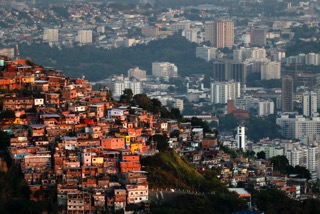
A slum in Rio de Janeiro Sergio Moraes / Reuters


By  The Atlantic


The Rio de Janeiro you see advertised in videos promoting the Olympics is the iconic one everyone knows: Ipanema, Sugarloaf Mountain, the statue of Christ the Redeemer. But that's just a tiny slice of this sprawling metropolis of 12 million people, most of whom live miles from the beach. You can see the other Rio, their Rio, as you drive into town from the international airport, past the walls enclosing the freeway: a sea of red cinderblock shacks stacked precariously atop one another, with narrow roads snaking in between. One in seven Rio residents make their home in so-called favelas like these.
When Brazil won the right to hold this year's Summer Games back in 2009, it seemed ready to vault into the club of developed nations. Luiz Inácio Lula da Silva, then the country's wildly popular president, pitched the Olympics as an opportunity to develop Rio's infrastructure, and remake the city into a new world capital. But this was also a rare moment of Brazilian self-confidence-one ultimately undone by hubris.

August 3, 2016

Political Report # 1167 Defeating Fear: Lessons From Mexico's Housing Movement


By Liam Barrington-Bush, ROAR Magazine

"The biggest challenge was to defeat our fears," proclaimed Mexican housing activist, Enrique Reynoso on a recent visit to London. As one of the epicenters of the European and North American housing crisis, London was an important stop on his recent European tour of grassroots movement spaces.
Enrique has been active in the Francisco Villa Popular Independent Leftist Organization (FPFVI in Spanish) since the 1980s. With even a glimpse into what Los Panchos (a shorthand for the FPFVI, based on the nickname of the Mexican revolutionary for whom the organization is named) have achieved since the mid-80s, this quote can sound like an oversimplification of some magnitude.
Can the creation of an alternative society of many thousands, built over decades on the principles of solidarity, cooperation and mutual aid, within what has been called "the perfect dictatorship," really be chalked-up to "defeating fear"? But as simple as it sounds, the statement holds a profound and fundamental truth -- that for most of us, collective power is daunting, even if we intellectually desire it and want to work towards it. Wherever we find ourselves in the world, fear is a barrier to change. But as Los Panchos have demonstrated, it is not an insurmountable one.