
Rural Brazil during the Lula Administrations: Agreements with Agribusiness and Disputes in Agrarian Policies
by Sérgio Sauer


Truthout
|
Mindo is a small village in the lush, tropical cloud forest that descends from the Andes to the coast just outside of Quito, Ecuador. The cloud forest is home to an abundance of wildlife, such as brightly colored lizards, wild cats, spectacled bear, and over 600 species of birds. Mindo was recently named one of the top 10 places to birdwatch in the world by National Geographic, and those who live there are known for their conservationist stances and fights against oil corporations. The area is so rich in biodiversity that it has won the Audubon Christmas bird count competition seven times with the highest number of species.
Last week, Mindo residents were among the thousands who took to the streets all across Ecuador in a march to the presidential palace in Quito, to demand an end to mining. Mining has existed since pre-Incan times in the metal-rich landscapes of these tropical forests, but until the 1980s, the projects were small-scale and much lower impact. Over the past year, however, the government has been distancing itself from its conservationist stance and has opened huge portions of land to corporations interested in running large-scale open-pit mining projects.
In the past few months, these corporate land grabs have intensified. In November 2017, local governments across northwestern Ecuador received letters from the mining corporations informing them that thousands of acres of forest had been signed away in more than 40 contracts with the central government. The Ministry of Mining had not consulted with communities and Indigenous nations before signing these contracts. This constitutes a violation of the Ecuadorian constitution passed in 2008 on several counts. Sumak Kawsay, a tenet of the constitution (meaning "life at its fullest" in Quechua), guarantees the right to live in peace and free of contamination. It grants the environment the same rights as a citizen, including the rights to be respected in its entirety through its vital cycles, as well as the right to restoration. This tenet of the constitution also promises to involve and consult all local populations about activities that have an impact on their environment.
|

Sao Paolo and Brasilia, Brazil -- Warwick Manfrinato, the director of Brazil's Department of Protected Areas, has a deep understanding of biological interdependence, as well as its importance.
"If we are of utter service to nature, then we provide the benefits to all other living things on the planet," Manfrinato told Truthout in his office at Brazil's capital city recently. "I have the same value as a human as a jaguar has in nature, and both should be protected, otherwise we all go extinct, no matter what."
Manfrinato, whose department falls within the Secretariat of Biodiversity in Brazil's Ministry of Environment, is working on a variety of projects, including the establishment of a whale sanctuary that will cover the better part of the entire South Atlantic Ocean between Brazil's vast coastal area all the way across to the west coast of Africa. And on June 23, he and his colleagues launched a national "Corridors Program," with the goal of fostering "connectivity and genetic flux."
"We know the flow of genetics in biomes [biological systems] in life is critical," Manfrinato said. "We have to re-establish this, so a jaguar that exists in Mexico should be able to come all the way here without being killed. Physical connectivity allows for genetic connectivity. A monkey should be able to travel from one part of Brazil to another, without having to pass through land that has been cleared, where there is no forest."
Manfrinato's colleague, Everton Lucero, who is Brazil's secretary for Climate Change and Environmental Quality, was blunt with Truthout about what could happen if dramatic action is not taken to address the impacts of anthropogenic climate disruption (ACD).
|
Just three years ago, the Swiss transnational food and drink company Nestlé established a zero-tolerance policy on land grabs.
The company's Commitment on Land & Land Rights was as clear as day. As of July 2014, Nestlé would "engage with and seek the support of those who could be affected by investment decisions," they would "seek free, prior, and informed consent with regard to the rights of Indigenous Peoples," and they would ensure respect for land rights in relation to land acquisitions.
"Nestlé is against all forms of land acquisitions that are illegal and/or have an adverse impact on local communities' livelihoods (land grabs)," the company states. "It is committed to develop its business in a way that complies with national laws and respects human rights, and particularly the customary rights to land and natural resources of Indigenous Peoples, traditional peoples, and communities that are impacted or potentially impacted by the company's business activities."
On paper, Nestlé's commitment stands as a rare recognition of indigenous rights and a welcomed departure from countless other transnational corporations that continue to thrive on the theft of indigenous lands and rivers, and the commodification of nature. But if the company practices what it preaches, it needs to get out of Guaraní lands and waters.
|

By Liam Barrington-Bush, ROAR Magazine
|
"The biggest challenge was to defeat our fears," proclaimed Mexican housing activist, Enrique Reynoso on a recent visit to London. As one of the epicenters of the European and North American housing crisis, London was an important stop on his recent European tour of grassroots movement spaces.
Enrique has been active in the Francisco Villa Popular Independent Leftist Organization (FPFVI in Spanish) since the 1980s. With even a glimpse into what Los Panchos (a shorthand for the FPFVI, based on the nickname of the Mexican revolutionary for whom the organization is named) have achieved since the mid-80s, this quote can sound like an oversimplification of some magnitude.
Can the creation of an alternative society of many thousands, built over decades on the principles of solidarity, cooperation and mutual aid, within what has been called "the perfect dictatorship," really be chalked-up to "defeating fear"? But as simple as it sounds, the statement holds a profound and fundamental truth -- that for most of us, collective power is daunting, even if we intellectually desire it and want to work towards it. Wherever we find ourselves in the world, fear is a barrier to change. But as Los Panchos have demonstrated, it is not an insurmountable one.
|

Indigenous from various parts of Brazil watch the hoisting of a flag with an image of Indian leader Arnaldo Kaba of the village Mundurukoe, during a demonstration to defend the territorial rights of the Indigenous population against the government, agribusiness and large mining and energy companies. | Photo: Reuters
by Maria Luisa Mendonça, TeleSur
|
Historically, Indigenous and peasant communities in Brazil have resisted against violence and displacement. Land concentration is a root cause of social and economic inequality, in a country where 1 percent of large landowners control over 90 percent of agricultural land. In the past 12 years, 390 Guarani Kaiowa Indigenous people were assassinated in the state of Mato Grosso do Sul, where agribusiness corporations and local large landowners have expanded monocropping of commodities.
The BAMAPITO region, which combines the states of Bahia, Maranhão, Piauí and Tocantins, has also become a target for land speculation and the expansion of agribusiness. This savanna area, rich in biodiversity, has been the home of traditional peasant communities for hundreds of years. Recently, this so called "last agricultural frontier" is at risk of destruction by a wave of land speculation, deforestation and pollution of water sources. Land market speculation consists of the same logic as the stock market, by the "secret" purchase of "cheap" land and its negotiation at higher prices.
|

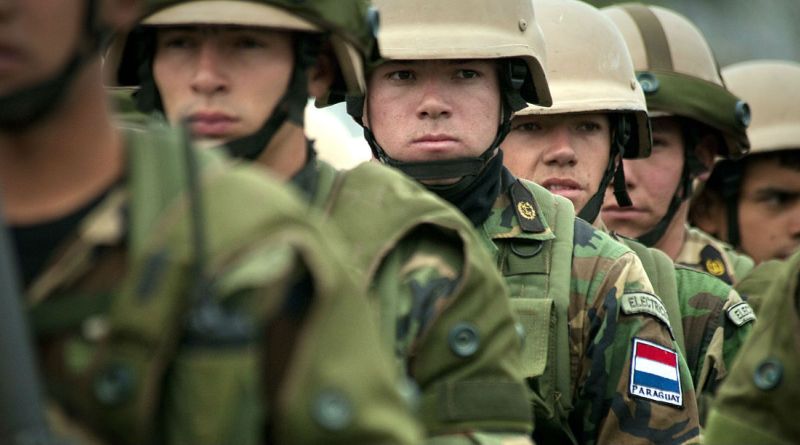
Featured Photo: “Paraguayan marines at Ancon Marine Base” (Brien Aho)
|
Since the end of the Stroessner dictatorship in 1989, Paraguay has struggled in its efforts to reform its weak institutional structures. Systemic corruption, growing poverty, and media censorship have all contributed to the perpetuation of the country’s stagnation over the years. Paraguay’s consistent failure to institute comprehensive land reform has even contributed to the rise of a local guerrilla movement that has not been neutralized by a corrupt military. While President Horacio Cartes has acknowledged the existence of corruption within the national police and military, many of Paraguay’s structural problems remain mercilessly neglected. |
