
Beasts of Prey or Rational Animals? Private Governance in Brazil’s Jogo do Bicho

By William I. Robinson
NACLA
William I. Robinson is also a LAP Editor
|
The decline of global capitalism points to another total economic collapse of Central America, reminiscent of the regional upheaval of the 1970s and 80s.
Some three decades after the wars of revolution and counterinsurgency came to an end in Central America, the region is once again on the brink of implosion. The Isthmus has been gripped by renewed mass struggle and state repression, the cracking of fragile political systems, unprecedented corruption, drug violence, and the displacement and forced migration of millions of workers and peasants. The backdrop to this second implosion of Central America, reflecting the spiraling crisis of global capitalism itself, is the exhaustion of a new round of capitalist development in recent years to the same drumbeat as the globalization that took place in the wake of the 1980s upheavals.
Lost in the headlines on Central American refugees fleeing to the United States is both the historical context that has sparked the exodus and the structural transformations through capitalist globalization that has brought the region to where it is today. The mass revolutionary movements of the 1970s and 1980s did manage to dislodge entrenched military-civilian dictatorships and open up political systems to electoral competition, but they were unable to achieve any substantial social justice or democratization of the socioeconomic order.
Capitalist globalization in the Isthmus in the wake of pacification unleashed a new cycle of modernization and accumulation. It transformed the old oligarchic class structures, generated new transnationally oriented elites and capitalists and high-consumption middle classes even as it displaced millions, aggravated poverty, inequality, and social exclusion, and wreaked havoc on the environment, triggering waves of outmigration and new rounds of mass mobilization among those who stayed behind. Hence the very conditions that gave rise to the conflict in the first place were aggravated by capitalist globalization.
|
The New Yorker
|
We live in a world where it is no longer shocking to learn that major heads of state-Vladimir Putin, Donald Trump, Rodrigo Duterte, Benjamin Netanyahu-are under suspicion for having misused the power of their office, although none of these has yet been formally charged with any wrongdoing. In Latin America, on the other hand, a slew of sitting and former Presidents have been swept up in corruption scandals, a number have been investigated and indicted, and several have gone to jail. Last month, in Peru, Pedro Pablo Kuczynski resigned rather than face impeachment over corruption allegations, and his predecessor, Ollanta Humala, is in jail awaiting trial for alleged corruption. Ricardo Martinelli, the former President of Panama, has been in jail in Miami since June, pending extradition on corruption charges. El Salvador’s former President Antonio Saca is in prison on charges of embezzling public funds, while his predecessor, Francisco Flores, died, of a cerebral hemorrhage, while under house arrest pending his trial. (Flores was accused of having diverted, to his own pocket, several million dollars in foreign aid intended for earthquake victims.) In neighboring Guatemala, two former Presidents, Álvaro Colom and Otto Pérez Molina, are also facing trial, also for corruption. Others, accused of a variety of crimes, mostly bribery or embezzlement of public funds, are fighting in the courts, while a couple-Alejandro Toledo, of Peru, and Mauricio Funes, of El Salvador-have become fugitives, living in the United States and Nicaragua, respectively.
|
By Alex Cuadros,The New Yorker |
Last month, during a lecture at the Grande Oriente Masonic Lodge, in Brasília, a Brazilian Army general named Antonio Hamilton Martins Mourão said that the country’s military leaders had discussed overthrowing the government. Corruption investigations have ensnared successive Presidential administrations in Brazil, and Mourão said there was a limit to the political chaos the armed forces could tolerate. “Either the institutions solve the political problem through the courts, removing those elements involved in illegal acts from public life, or we will have to impose the solution,” he said. Wearing his official uniform, his chest laden with decorations, Mourão explained that his colleagues in the Army’s high command shared his view. “We have very well-made plans,” he went on, before ominously adding, “This solution won’t be easy. It will bring trouble, you can be sure of that.” When he finished, the audience broke into applause.
Brazil is all too familiar with military coups-the last one, in 1964, brought on a twenty-one-year dictatorship. Mourão’s speech, then, was troubling enough on its own. But his superiors’ reactions were even more disturbing. No one in the civilian Administration publicly condemned his remarks, and the commander of the Army, General Eduardo Villas Bôas, refused to censure his subordinate for violating the prohibition on political speech by active officers. Instead, he called Mourão “a great soldier.” Confronted by a journalist on TV, he was compelled to weakly acknowledge that “dictatorship is never the best” solution, but he only doubled down on Mourão’s dark suggestion, saying that the armed forces had the constitutional authority to “intervene” when the country finds itself “in the imminence of chaos.” As the columnist Josias de Souza noted, Brazil’s constitution grants the military no such power. That did not stop another general, Luiz Eduardo Rocha Paiva, from making the same claim in a newspaper op-ed two weeks later.
|
|
The new federal penitentiary in Santa Barbara, Honduras, occupies a strip of land between a highway and cloudy, forested hills. "El Pozo," or The Pit, as it's known, is surrounded by barbed wire and has two additional checkpoints beyond the first gate. It's a maximum-security facility, one of three that have popped up since 2009. Before these were built, Honduras had no maximum-security prisons. El Pozo is one of the products of a United States international prison management program that infuses Latin American penitentiary cultures with some of the most inhumane aspects of US prison systems, and provides no benefit in terms of real security.
At least $22 million have been devoted to a US international prison program focused mainly on Central American prisons. This program operates out of a web of government offices and programs, most prominently the Bureau of International Narcotics and Law Enforcement Affairs (INL) of the US State Department. Because of the extent to which information is classified, it is difficult to track exactly what prison management entails, but it's clear that the US has in some way been involved in the prison systems of at least 34 countries. US activities include training, imparting management strategies and building new prisons.
The sprawling El Pozo is a departure from Honduras's prisons before 2009, when the US prison program began in Honduras. It looks exactly like a US prison -- it even has a disabled parking spot (unlike, unfortunately, almost any other building in Honduras). Just 15 kilometers away from El Pozo in the city of Santa Barbara, the local, pre-2009 prison is more typical. Located one block from the city's main square, it is a nondescript yellow building built on a steep hill, marked only by a hand-painted sign. The sidewalk outside is occupied by pedestrians and vendors selling goods under awnings. Prison policy permits regular family visits, and family may bring food and some other items. Compared to many US prisons, the prison at Santa Barbara is relatively open to the outside community. This is the type of prison that, with the advent of the US program, has now been deemed inadequate for many of Honduras's incarcerated people.
Indeed, Honduran prisons have long been home to corruption and violence. It is a common occurrence for dozens of incarcerated gang members to escape all at once while guards look the other way, or for an unchecked fire to massacre hundreds. Many of the elites of organized crime remain involved in criminal enterprise while on the inside. The right-wing Honduran government chooses not to view these problems as symptoms of broader societal corruption and impunity, but instead as an issue of weak prison facilities.
|

By Aline Piva, COHA
|
The tragic death of Teori Zavascki, the Brazilian Supreme Court Justice who died in an airplane crash on January 19, has sparked many questions amongst millions of dumbfounded Brazilians. Zavascki was in charge of overseeing the tense judicial procedures involved in investigating Operation Car Wash, the scheme of corruption in the Brazilian state-owned oil company Petrobras which has involved many politicians and powerful global business figures. Not only do the sensitive circumstances of the accident remain murky, but they also raise the question about how Zavascki's death could potentially benefit the current unelected president of Brazil, Michel Temer, and his political allies. These circumstances have made many doubt that the crash was merely a tragic accident.
The aforementioned tragedy happened only a few miles off Rio de Janeiro's coast. Zavascki and four other people were on board of the small aircraft when it went down on Thursday, January 19.[i] The technical reasons that might have contributed to the accident, such as the factor of bad weather and problems with the aircraft or with the pilot, are presently under investigation by the Center for Research and Prevention of Aeronautical Accidents (CENIPA), which was at the site shortly after the crash. The Federal Prosecutor's Office (MPF) and the Federal Police (PF) will determine if there had been any deliberate attempt to dismantle the plane. The investigations are currently under judicial secrecy, but preliminary analyses of recorded conversations revealed no signs of panic in the cockpit or abnormalities with the aircraft, fueling intense speculation over the mysterious cause of the tragedy.[ii]
|

The former Brazilian president Luiz Inácio Lula da Silva during a news conference in March. Credit Lalo de Almeida for The New York Times
By Simon Romero, New York Times
|
Rio De Janeiro - Federal prosecutors in Brazil filed corruption charges Wednesday against Luiz Inácio Lula da Silva, the former president who has wielded influence across Latin America for decades, portraying him as the mastermind of a sprawling graft scheme intended to maintain his party’s grip on the presidency.
Deltan Dallagnol, a prosecutor, called Mr. da Silva the “ultimate commander” of bribery and kickback schemes that allowed his leftist Workers’ Party to build coalitions in Congress, describing him as “the general” at the helm.
The actual charges against Mr. da Silva, who was president from 2003 to 2010, focus on a much narrower claim: Prosecutors accuse Mr. da Silva and his wife of illegally receiving about $1.1 million in improvements and expenses for a beachfront apartment paid for by a large construction company seeking public contracts.
But beyond the specific charges, which must still be accepted by a judge, the prosecutors said Mr. da Silva had been instrumental in a bigger corruption scheme that has thrown Brazil’s political system into turmoil for more than two years.
In their complaint on Wednesday, prosecutors contended that Mr. da Silva had overseen a far-reaching system of illicit payments, kickbacks and campaign donations in which the construction company O.A.S. paid as much as $26 million to obtain contracts from Brazil’s oil giant, Petrobras.
The prosecutors did not claim that Mr. da Silva personally pocketed that money. Instead, they asserted that it went to oil executives, Workers’ Party leaders and lawmakers in the governing coalition to help maintain the party’s grip on power. The prosecutors are now demanding that Mr. da Silva return that amount of money to public coffers.
The charges and broader allegations are a major blow to Mr. da Silva, adding to a mounting list of legal problems that have complicated his ambitions of returning to the presidency.
Just a few years ago, Mr. da Silva, a former labor leader who never finished elementary school, ranked among Brazil’s most powerful politicians. His party held the president’s office for 13 years, overseeing a period of brisk economic growth during which millions were lifted out of poverty.
But bribery scandals and a severe economic crisis have tarnished his legacy, ending with the ouster of his handpicked successor, Dilma Rousseff, who was removed by the Senate in August in a contentious impeachment trial.
Prosecutors in São Paulo had already filed corruption charges against Mr. da Silva at the state level in March, arguing that he had sought to conceal his ownership of the apartment.
Mr. da Silva will also stand trial on charges of obstructing the investigation into the bribery scheme surrounding the national oil company, Petrobras, a federal judge ruled last month.
Nearly 40 politicians and business leaders have been jailed since prosecutors discovered the Petrobras scheme in 2014.
In all, investigators say that contractors paid nearly $3 billion in bribes to executives at the oil giant, who pocketed some of the gains while also channeling funds to politicians in the governing coalition led by the Workers’ Party.
Mr. da Silva and his lawyers have repeatedly said that he did nothing illegal in relation to the apartment in Guarujá, a seaside city near São Paulo.
But investigators said O.A.S., a large Brazilian construction company, had illegally paid for a series of improvements at the property. Prosecutors also filed corruption charges against the former chief executive of O.A.S.
Mr. da Silva’s lawyers, Cristiano Zanin Martins and Roberto Teixeira, said in a statement that the charges and the broader allegations “attack the democratic rule of law and the intelligence of Brazilian citizens,” and that their client was innocent.
The charges were filed after months of simmering tension related to Mr. da Silva’s legal battles.
Federal Police agents raided his home in March and briefly held him for questioning. After that, Ms. Rousseff, the president at the time, offered him a cabinet post that would have given him broad legal protections from being jailed. But Brazil’s Supreme Court blocked the nomination.
Rui Falcão, the president of the Workers’ Party, described the latest charges as an effort to hamper Mr. da Silva’s involvement in politics. Mr. da Silva has signaled that he plans to run for president again in 2018, and polls have placed him among the leading contenders.
“These charges were expected as part of an effort to criminalize Lula,” Mr. Falcão said.
The amount of money that Mr. da Silva is accused of receiving in the form of an apartment upgrade pales in comparison with what others have been accused of pocketing in recent years.
Eduardo Cunha, the conservative former speaker of the lower house of Congress, who orchestrated the effort to oust Ms. Rousseff, is charged with taking as much as $40 million in bribes and laundering them through an evangelical megachurch. And Sérgio Machado, a former chief executive of a Petrobras unit who was a member of the centrist party of Brazil’s new president, Michel Temer, has agreed to return more than $20 million in bribes.
Brazil’s entire political system is struggling to react to the steady drip of charges and revelations from various bribery scandals. The new administration of Mr. Temer, the former vice president who engaged in a bitter power struggle with Ms. Rousseff, is facing dismal approval ratings and doubts about its legitimacy after various cabinet ministers were forced out of their posts over reports that they were seeking to stymie corruption inquiries.
Mr. Temer’s former attorney general, Fábio Medina Osório, claimed over the weekend that he had been fired after seeking damages from construction companies involved in the Petrobras scheme.
Mr. Medina Osório told the magazine Veja that Mr. Temer’s government was seeking to “smother” the inquiry, which is popularly known as Car Wash, after a gas station in Brasília that a black-market money dealer used to launder bribes and kickbacks.
Heightening the sense of distrust, some figures involved in the scheme have been secretly recording one another, with the idea of using the information to reach plea deals with prosecutors.
Original article and sources can be found at:
http://www.nytimes.com/2016/09/15/world/americas/brazil-lula-corruption-charges.html?emc=eta1&_r=0
|

By By Aline Piva, Research Fellow at COHA
|
The already fragile legitimacy of Michel Temer's interim government in Brazil took a huge blow last week. Leaked audios involving Temer's closest allies revealed a plot to oust democratically elected Brazilian President Dilma Rousseff as part of a plan to put an end to Operation Carwash (Operação Lava Jato), the operation that is investigating the scheme involving bribery and kickbacks in Petrobras, the Brazil state-owned oil company. [1][2] |
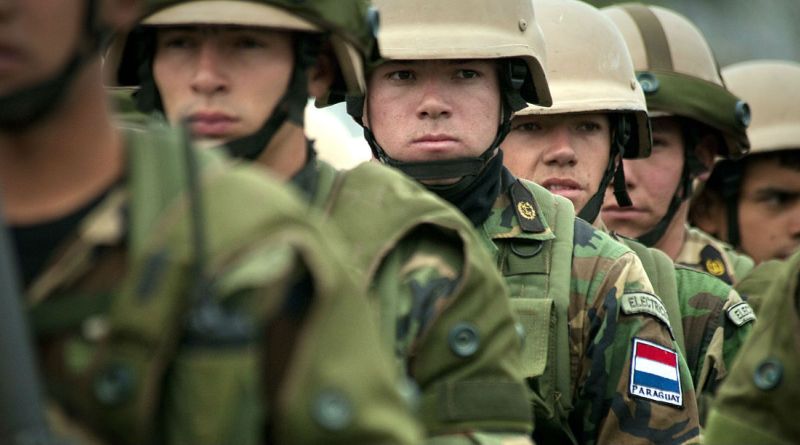
Featured Photo: “Paraguayan marines at Ancon Marine Base” (Brien Aho)
|
Since the end of the Stroessner dictatorship in 1989, Paraguay has struggled in its efforts to reform its weak institutional structures. Systemic corruption, growing poverty, and media censorship have all contributed to the perpetuation of the country’s stagnation over the years. Paraguay’s consistent failure to institute comprehensive land reform has even contributed to the rise of a local guerrilla movement that has not been neutralized by a corrupt military. While President Horacio Cartes has acknowledged the existence of corruption within the national police and military, many of Paraguay’s structural problems remain mercilessly neglected. |

Honduran women protest violence and human rights abuses. (photo: Reuters)
|
Six years ago Sunday, a U.S.-backed military coup ousted democratically elected President Manuel Zelaya, flying him to exile in Costa Rica in the early hours of the morning on June 28. Zelaya had planned to hold a non-binding poll on whether to hold a referendum in the upcoming election on convening a constituent assembly to rewrite the Honduran constitution.
Zelaya, of the Liberal Party, showed a progressive turn during his presidency by raising the minimum wage, negotiating land deals with campesino movements, and joining the Venezuelan-led regional energy alternative ALBA, in addition to opening the conversation on a constituent assembly.
Coup-backers accused Zelaya of attempting to manipulate the Honduran constitution to extend his presidency, which was limited to one term in Honduras before the recent Supreme Court ruling to change the wording in the constitution. The non-binding poll under Zelaya would not have changed the fact that he could not run for re-election in the November 2013 general election.
The coup against Zelaya was widely condemned by governments across Latin America, the European Union, the Organization of American States and other regional blocs.
|
