Showing posts with label Economy. Show all posts

April 20, 2020

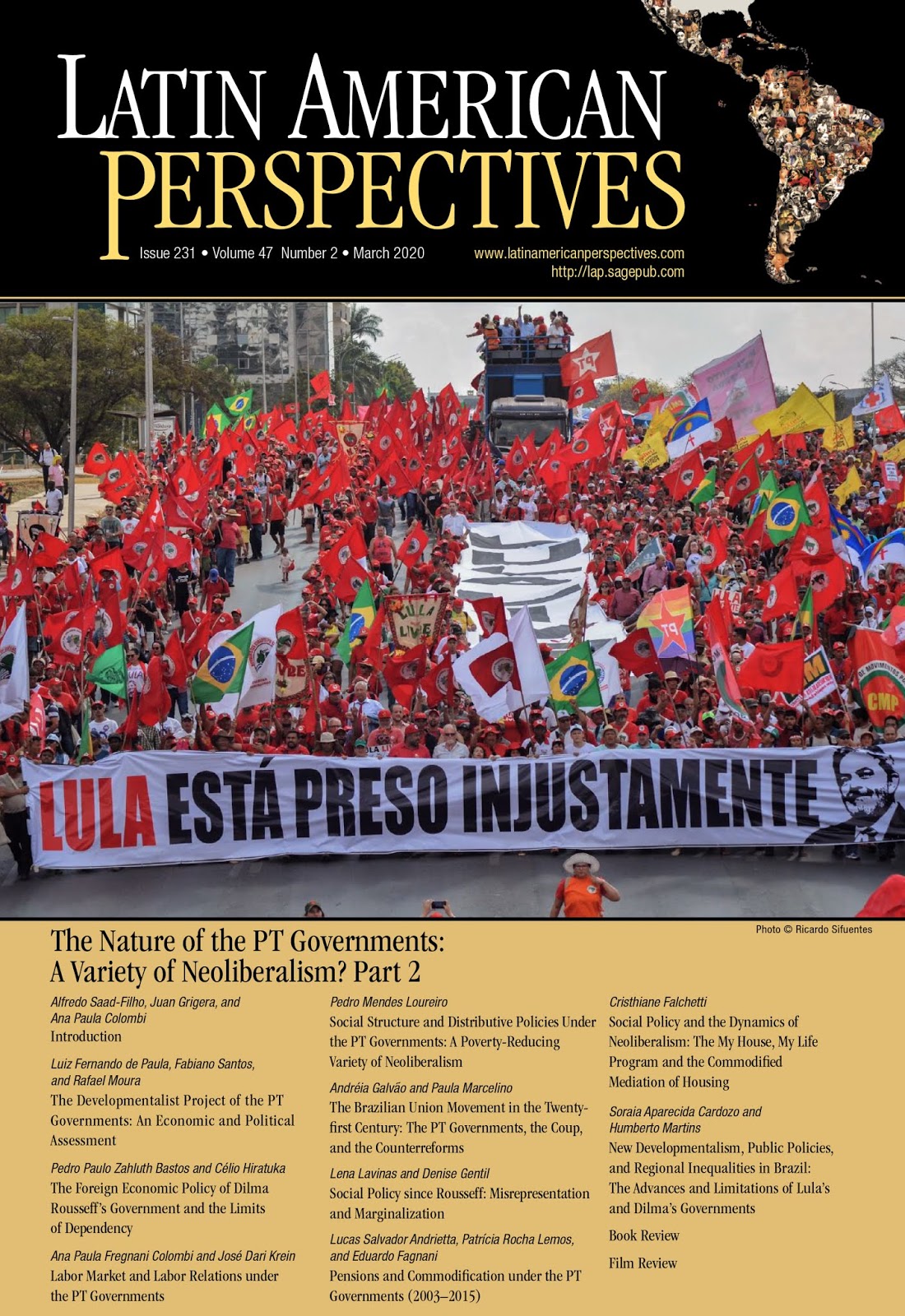
Abstract - The Foreign Economic Policy of Dilma Rousseff’s Government and the Limits of Dependency

:::::: Abstract ::::::


The Foreign Economic Policy of Dilma Rousseff’s Government and the Limits of Dependency

by Pedro Paulo Zahluth Bastos, Célio Hiratuka


There is some consensus on the foreign policy of Dilma Rousseff’s government that Brazil lost prestige and international influence because of her lesser personal dedication. Against this consensus, the paper presents two alternative hypotheses for explaining its unsatisfactory outcomes: that there was no change in policy objectives but an adaptation to a more hostile context and that its limitations were structurally related to dependency on global corporations and to the increasing rejection of South-South politics by domestic business. If this analysis is correct, the structural limitations described require that the struggle to achieve an independent foreign policy involve deeper political and ideological battles and a more radical questioning of neoliberal capitalism.


March 25, 2020

Political Report #1436 Beyond the Economic Chaos of Coronavirus Is a Global War Economy


Political Report #1436 

Beyond the Economic Chaos of Coronavirus Is a Global War Economy


What does a virus have to do with war and repression? The coronavirus has disrupted global supply networks and spread panic throughout the world’s stock markets. The pandemic will pass, not without a heavy toll. But in the larger picture, the fallout from the virus exposes the fragility of a global economy that never fully recovered from the 2008 financial collapse and has been teetering on the brink of renewed crisis for years.


The crisis of global capitalism is as much structural as it is political. Politically, the system faces a crisis of capitalist hegemony and state legitimacy. As is now well-known, the level of global social polarization and inequality is unprecedented. In 2018, the richest 1 percent of humanity controlled more than half of the world’s wealth while the bottom 80 percent had to make do with just 4.5 percent of this wealth. Such stark global inequalities are politically explosive, and to the extent that the system is simply unable to reverse them, it turns to ever more violent forms of containment to manage immiserated populations.


Structurally, the system faces a crisis of what is known as overaccumulation. As inequalities escalate, the system churns out more and more wealth that the mass of working people cannot actually consume. As a result, the global market cannot absorb the output of the global economy. Overaccumulation refers to a situation in which enormous amounts of capital (profits) are accumulated, yet this capital cannot be reinvested profitably and becomes stagnant.


Indeed, corporations enjoyed record profits during the 2010s at the same time that corporate investment declined. Worldwide corporate cash reserves topped $12 trillion in 2017, more than the foreign exchange reserves of the world’s central governments, yet transnational corporations cannot find enough opportunities to profitably reinvest their profits. As this uninvested capital accumulates, enormous pressures build up to find outlets for unloading the surplus. By the 21st century, the transnational capitalist class turned to several mechanisms in order to sustain global accumulation in the face of overaccumulation, above all, financial speculation in the global casino, along with the plunder of public finances, debt-driven growth and state-organized militarized accumulation.


Militarized Accumulation
It is the last of these mechanisms, what I have termed militarized accumulation, that I want to focus on here. The crisis is pushing us toward a veritable global police state. The global economy is becoming ever more dependent on the development and deployment of systems of warfare, social control and repression, apart from political considerations, simply as a means of making profit and continuing to accumulate capital in the face of stagnation. The so-called wars on drugs and terrorism; the undeclared wars on immigrants, refugees, gangs, and poor, dark-skinned and working-class youth more generally; the construction of border walls, immigrant jails, prison-industrial complexes, systems of mass surveillance, and the spread of private security guard and mercenary companies, have all become major sources of profit-making.


The events of September 11, 2001, marked the start of an era of a permanent global war in which logistics, warfare, intelligence, repression, surveillance, and even military personnel are more and more the privatized domain of transnational capital. Criminalization of surplus humanity activates state-sanctioned repression that opens up new profit-making opportunities for the transnational capitalist class. Permanent war involves endless cycles of destruction and reconstruction, each phase in the cycle fueling new rounds and accumulation, and also results in the ongoing enclosure of resources that become available to the capitalist class.


The Pentagon budget increased 91 percent in real terms between 1998 and 2011, while worldwide, total defense outlays grew by 50 percent from 2006 to 2015, from $1.4 trillion to $2.03 trillion, although this figure does not take into account secret budgets, contingency operations and “homeland security” spending. The global market in homeland security reached $431 billion in 2018 and was expected to climb to $606 billion by 2024. In the decade from 2001 to 2011, military industry profits nearly quadrupled. In total, the United States spent a mind-boggling nearly $6 trillion from 2001 to 2018 on its Middle East wars alone.


Led by the United States as the predominant world power, military expansion in different countries has taken place through parallel (and often conflictive) processes, yet all show the same relationship between state militarization and global capital accumulation. In 2015, for instance, the Chinese government announced that it was setting out to develop its own military-industrial complex modeled after the United States, in which private capital would assume the leading role. Worldwide, official state military outlays in 2015 represented about 3 percent of the gross world product of $75 trillion (this does not include state military spending not made public).


But militarized accumulation involves vastly more than activities generated by state military budgets. There are immense sums involved in state spending and private corporate accumulation through militarization and other forms of generating profit through repressive social control that do not involve militarization per se, such as structural controls over the poor through debt collection enforcement mechanisms or accumulation opportunities opened up by criminalization.


The Privatization of War and Repression
The various wars, conflicts, and campaigns of social control and repression around the world involve the fusion of private accumulation with state militarization. In this relationship, the state facilitates the expansion of opportunities for private capital to accumulate through militarization. The most obvious way that the state opens up these opportunities is to facilitate global weapons sales by military-industrial-security firms, the amounts of which have reached unprecedented levels. Between 2003 and 2010 alone, the Global South bought nearly half a trillion dollars in weapons from global arms dealers. Global weapons sales by the top 100 weapons manufacturers and military service companies increased by 38 percent between 2002 and 2016.


The U.S.-led wars in Iraq and Afghanistan precipitated the explosion in private military and security contractors around the world deployed to protect the transnational capitalist class. Private military contractors in Iraq and Afghanistan during the height of those wars exceeded the number of U.S. combat troops in both countries, and outnumbered U.S. troops in Afghanistan by a three-to-one margin. Beyond the United States, private military and security firms have proliferated worldwide and their deployment is not limited to the major conflict zones in the Middle East, South Asia and Africa. In his study, Corporate Warriors, P.W. Singer documents how privatized military forces (PMFs) have come to play an ever more central role in military conflicts and wars. “A new global industry has emerged,” he noted. “It is outsourcing and privatization of a twenty-first century variety, and it changes many of the old rules of international politics and warfare. It has become global in both its scope and activity.” Beyond the many based in the United States, PMFs come from numerous countries around the world, including Russia, South Africa, Colombia, Mexico, India, the EU countries and Israel, among others.


Beyond wars, PMFs open up access to economic resources and corporate investment opportunities — deployed, for instance, to mining areas and oil fields — leading Singer to term PMFs “investment enablers.” PMF clients include states, corporations, landowners, nongovernmental organizations, even the Colombian and Mexican drug cartels. From 2005 to 2010, the Pentagon contracted some 150 firms from around the world for support and security operations in Iraq alone. By 2018, private military companies employed some 15 million people around the world, deploying forces to guard corporate property; provide personal security for corporate executives and their families; collect data; conduct police, paramilitary, counterinsurgency and surveillance operations; carry out mass crowd control and repression of protesters; manage prisons; run private detention and interrogation facilities; and participate in outright warfare.


Meanwhile, the private security (policing) business is one of the fastest growing economic sectors in many countries and has come to overshadow public security around the world. According to Singer, the amount spent on private security in 2003, the year of the invasion of Iraq, was 73 percent higher than that spent in the public sphere, and three times as many persons were employed in private forces as in official law enforcement agencies. In parts of Asia, the private security industry grew at 20 percent to 30 percent per year. Perhaps the biggest explosion of private security was the near complete breakdown of public agencies in post-Soviet Russia, with over 10,000 new security firms opening since 1989. There were an outstanding 20 million private security workers worldwide in 2017, and the industry was expected to be worth over $240 billion by 2020. In half of the world’s countries, private security agents outnumber police officers.


As all of global society becomes a highly surveilled and controlled and wildly profitable battlespace, we must not forget that the technologies of the global police state are driven as much, or more, by the campaign to open up new outlets for accumulation as they are by strategic or political considerations. The rise of the digital economy and the blurring of the boundaries between military and civilian sectors fuse several fractions of capital — especially finance, military-industrial and tech companies — around a combined process of financial speculation and militarized accumulation. The market for new social control systems made possible by digital technology runs into the hundreds of billions. The global biometrics market, for instance, was expected to jump from its $15 billion value in 2015 to $35 billion by 2020.


As the tech industry emerged in the 1990s, it was from its inception tied to the military-industrial-security complex and the global police state. Over the years, for instance, Google has supplied mapping technology used by the U.S. Army in Iraq, hosted data for the Central Intelligence Agency, indexed the National Security Agency’s vast intelligence databases, built military robots, co-launched a spy satellite with the Pentagon, and leased its cloud computing platform to help police departments predict crime. Amazon, Facebook, Microsoft and the other tech giants are thoroughly intertwined with the military-industrial and security complex.


Criminalization and the War on Immigrants and Refugees
Criminalization of the poor, racially oppressed, immigrants, refugees and other vulnerable communities is the most clear-cut method of accumulation by repression. This type of criminalization activates “legitimate” state repression to enforce the accumulation of capital, whereby the state turns to private capital to carry out repression against those criminalized.


There has been a rapid increase in imprisonment in countries around the world, led by the United States, which has been exporting its own system of mass incarceration. In 2019, it was involved in the prison systems of at least 33 different countries, while the global prison population grew by 24 percent from 2000 to 2018. This carceral state opens up enormous opportunities at multiple levels for militarized accumulation. Worldwide, there were in the early 21st century some 200 privately operated prisons on all continents and many more “public-private partnerships” that involved privatized prison services and other forms of for-profit custodial services such as privatized electronic monitoring programs. The countries that were developing private prisons ranged from most member states of the European Union, to Israel, Russia, Thailand, Hong Kong, South Africa, New Zealand, Ecuador, Australia, Costa Rica, Chile, Peru, Brazil and Canada.


Those criminalized include millions of migrants and refugees around the world. Repressive state controls over the migrant and refugee population and criminalization of non-citizen workers makes this sector of the global working class vulnerable to super-exploitation and hyper-surveillance. In turn, this self-same repression in and of itself becomes an ever more important source of accumulation for transnational capital. Every phase in the war on migrants and refugees has become a wellspring of profit making, from private, for-profit migrant jails and the provision of services inside them such as health care, food, phone systems, to other ancillary activities of the deportation regime, such as government contracting of private charter flights to ferry deportees back home, and the equipping of armies of border agents.


Undocumented immigrants constitute the fastest-growing sector of the U.S. prison population and are detained in private migrant jails and deported by private companies contracted out by the U.S. state. As of 2010, there were 270 immigration jails in the U.S. that caged on any given day over 30,000 immigrants and annually locked up some 400,000 individuals, compared to just a few dozen people in immigrant detention each day prior to the 1980s. From 2010 to 2018, federal spending on these detentions jumped from $1.8 billion to $3.1 billion. Given that such for-profit prison companies as CoreCivic and GEO Group are traded on the Wall Street stock exchange, investors from anywhere around the world may buy and sell their stock, and in this way, develop a stake in immigrant repression quite removed from, if not entirely independent, of the more pointed political and ideological objectives of this repression.


In the United States, the border security industry was set to double in value from $305 billion in 2011 to some $740 billion in 2023. Mexican researcher Juan Manuel Sandoval traces how the U.S.-Mexico border region has been reconfigured into a “global space for the expansion of transnational capital.” This “global space” is centered on the U.S. side around high-tech military and aerospace related industries, military bases, and the deploying of other civilian and military forces for combating “immigration, drug trafficking, and terrorism through a strategy of low-intensity warfare.” On the Mexican side, it involves the expansion of maquiladoras (sweatshops), mining and industry in the framework of capitalist globalization and North American integration.


The tech sector in the United States has become heavily involved in the war on immigrants as Silicon Valley plays an increasingly central role in the expansion and acceleration of arrests, detentions and deportations. As their profits rise from participation in this war, leading tech companies have in turn pushed for an expansion of incarceration and deportation of immigrants, and lobbied the state to use their innovative social control and surveillance technologies in anti-immigrant campaigns.


In Europe, the refugee crisis and EU’s program to “secure borders” has provided a bonanza to military and security companies providing equipment to border military forces, surveillance systems and information technology infrastructure. The budget for the EU public-private border security agency, Frontex, increased a whopping 3,688 percent between 2005 and 2016, while the European border security market was expected to nearly double, from some $18 billion in 2015 to approximately $34 billion in 2022.


The Coronavirus Is Not to Blame


As stock markets around the world began to plummet starting in late February, mainstream commentators blamed the coronavirus for the mounting crisis. But the virus was only the spark that ignited the financial implosion. The plunge in stock markets suggests that for some time to come, financial speculation will be less able to serve as an outlet for over-accumulated capital. When the pandemic comes to an end, we will be left with a global economy even more dependent on militarized accumulation than before the virus hit.


We must remember that accumulation by war, social control and repression is driven by a dual logic of providing outlets for over-accumulated capital in the face of stagnation, and of social control and repression as capitalist hegemony breaks down. The more the global economy comes to depend on militarization and conflict, the greater the drive to war and the higher the stakes for humanity. There is a built-in war drive to the current course of capitalist globalization. Historically, wars have pulled the capitalist system out of crisis while they have also served to deflect attention from political tensions and problems of legitimacy. Whether or not a global police state driven by the twin imperatives of social control and militarized accumulation becomes entrenched is contingent on the outcome of the struggles raging around the world among social and class forces and their competing political projects.


Original article can be found (here).
URL:      https://truthout.org/articles/beyond-the-economic-chaos-of-coronavirus-is-a-global-war-economy/

February 3, 2020

Abstract: Profitability and Distribution: The Origin of the Brazilian Economic and Political Crisis

:::::: Abstract ::::::


Profitability and Distribution: The Origin of the Brazilian Economic and Political Crisis


by Adalmir Antonio Marquetti, Cecilia Hoff, and Alessandro Miebach


The PT governments combined elements of developmentalism and neoliberalism in a contradictory construction, organizing a large political coalition of workers and capitalists that allowed expanding the real wage and reducing poverty and inequality while maintaining the gains of productive and financing capitals. The decline of profitability after the 2008 crisis broke the class coalition constructed during Lula’s administration. The Dilma Rousseff government adopted a series of fiscal stimuli for private capital accumulation with meager economic growth. After her reelection, the government implemented an austerity program that resulted in negative growth rates. With the deepening economic crisis and without political support, Rousseff was removed from power.


January 20, 2020

Abstract: Growth, Distribution, and Crisis: The Worker's Party Administrations

:::::: Abstract ::::::


Growth, Distribution, and Crisis: The Worker's Party Administrations


by Pedro Cezar Dutra Friedmann and Claudio A. Castelo Branco Puty


The economic policies of the governments of Lula da Silva (2003–2010) and Dilma Rousseff (2011–2016) combined orthodox measures with distinctive pro-growth measures that, although they deviated from neoliberalism, cannot be called “developmentalist” either. They lacked a long-term strategy for reversing the deindustrialization of the country or advancing to a new technological paradigm. They did, however, have a historical commitment to income redistribution that was largely implemented. The broad social pact proposed by Lula acknowledged the hegemony of financial capital, and its contradiction was that it protected the hegemonic group by means of monetary and fiscal policies that required growth in the gross domestic product, a favorable balance of payments, and a gap between wages and productivity. When these conditions no longer held, Rousseff responded to the crisis with a “new macroeconomic matrix” that amounted to the abandonment of Lula’s class-coalition pact.


August 4, 2017

Political Report # 1265 What Is Behind the Renegotiation of NAFTA? Trumpism and the New Global Economy

The Trump administration's decision to renegotiate with Mexico the North American Free Trade Agreement (NAFTA) has been interpreted by most observers as the opening salvos of a new wave of US protectionism. But Trump's public discourse should not be confused with the essence of his government's economic         program and likely trade policies. A better explanation for the renegotiation, which may begin as early as mid-August, is to be sought in the transformation of the US and the global economy in the years since NAFTA went into effect in 1994.
The North American economic region is part of a globally integrated production and financial system. Even if they were so motivated, US political and economic elites could not, without utterly disrupting and destabilizing the country, disentangle the United States (or the North American region) from the vast network of chains of subcontracting and outsourcing that characterize the global economy. Trump and his billionaire cabinet members are part of the transnational capitalist class. The Trump family's business empire spans the globe, including factories in Mexico that take advantage of cheap labor and export back to the United States, thanks to the provisions of NAFTA.
Trump railed against NAFTA during his electoral campaign as part of his strategy of garnering a base of support among sectors of the US working class who face heightened insecurity and downward mobility as a result of capitalist globalization. No viable candidate can hope to be elected without putting forward a populist message. Hillary Clinton was forced as well during the campaign to come out against the Trans-Pacific Partnership (TPP) that Trump jettisoned upon taking office, just as Obama lashed out against globalization and its devastating effects on working people when he first ran for the presidency.

April 29, 2016

Political Report # 1136 Brazilian Politics, Players, Panama and Perpetual Motion By Nomi Prins


Political Report # 1136


Brazilian Politics, Players, Panama and Perpetual Motion


By Nomi Prins, Nomi Prins' Website


There is no simplifying Brazil's political or economic situation. Anyone "certain" about the outcome is sure to get smacked in its crossfires sooner or later. Corruption might be bi-partisan in the United States, legalized in many cases, but in Brazil, it's the full multi-party monty. Eduardo Cunha, the Lower House speaker gunning for President (and political rival) Dilma Rousseff's impeachment,  has just been fingered by the Panama Papers for stashing millions in Switzerland.
He was also under Carwash corruption investigations. No one so tainted, should risk throwing stones so blithely at a sitting, elected president. Brazil's new Attorney General, Jose Eduardo Cardozo, said as much, yesterday, on the grounds there are no legal reasons to impeach her, and that doing so would be to "rip up the constitution."
The domestic and international implications associated with Brazil's internal turmoil transcend the walls of the Planalto Palace in Brasilia, a planned city that belies its far less organized and cohesive government.


February 3, 2016

Political Report # 1110 UR-Cuba Relations By Cuba Central


Last Spring, when President Obama addressed the White House Correspondents' Association Dinner, he said to the reporters on hand at the annual 'Washington Celebrates Itself' Gala, "Welcome to the fourth quarter of my presidency."
 "I am determined to make the most of every moment I have left." He said, "After the mid-term elections, my advisors asked me, 'Mr. President, do you have a bucket list?'...Well, I have something that rhymes with bucket list."
In a series of punchlines that the White House transcript dutifully reports as eliciting laughter and applause, the president mentioned taking executive action on immigration, climate change, and Cuba policy.
Funny thing was, he meant it. Roll the tape forward to this month - roll past diplomatic relations, Cuba getting off the terror list, new embassies, new travel and trade rules, State, Commerce, Agriculture Secretary visits and other changes - and the President is now telling the Wall Street Journal that he is prepared to do more.
Before considering what specific items that might add to the President's "bucket list," let's take a step back and look at the big picture.
Last year, when President Obama announced he was determined to normalize relations with Cuba, he stood up against the policy he'd inherited from his predecessors, saying it "does not serve America's interests, or the Cuban people, to try to push Cuba toward collapse."
The old policy - immiserating Cubans to force their government to succumb to our demands - was both cruel and futile. No American president had ever conceded that truth.
Secretary of State John Kerry was captured by the same thought on a walk he took following the flag-raising at the U.S. Embassy in Cuba. "Walking the streets of Old Havana, and seeing the faces of young Cubans, I felt the futility of trying to make them fit their dreams into a Cold War straight-jacket.
"They deserve more than that," Kerry wrote, and "through our diplomacy we hope to help them achieve more than that."
Yes, in 2016, we can expect to see intensified diplomacy between Cuba and the U.S. on a host of issues - law enforcement, property claims, human trafficking and human rights - that our two countries never discussed when the thrust of U.S. policy was trying to make Cuba's system fail.
But, the president apparently will use what remains of his fourth quarter to do more than that.
"On Cuba," the Journal says, "that means taking additional executive actions so Americans become accustomed to traveling to the island-nation 90 miles off the coast of Florida and U.S. businesses are deeply invested there."
Reforms already implemented by the President this year have boosted travel by Americans to Cuba by over 70 percent over travel in 2014, as the Nation reported last week.  The surge                                                   in travelers will help fill the seats of planes poised to take advantage of the new agreement between Cuba and the U.S. to resume regularly scheduled commercial service.
But short of repealing the ban on tourist travel, which requires an Act of Congress, the President can substantially increase those visits by applying to individuals the same rules that currently apply to trips by groups under the people-to-people. He has the authority to do that today.
As Senators Flake and Leahy said in their letter to the President last week, he has the authority to increase substantially the flow of commerce between our countries. They advocate changes in regulations to increase access for Cubans to U.S. tools, equipment, and                                                   consumer products, and expanding the ability of Cubans in private enterprise to benefit from U.S. services in the areas of finance and planning.
Despite helpful and well-meaning policy changes the President already ordered to lighten the regulatory burden on companies who want to do business in Cuba, Bill LeoGrande makes a strong case - as others have - that U.S. firms are still "terrified" of running afoul of sanctions and incurring ruinous financial penalties.
To alleviate regulatory risks, LeoGrande says:
"Obama could license U.S. businesses to provide credit to Cuban customers to stimulate nonagricultural trade (agricultural credits are prohibited by law). He could authorize Cuban banks to establish correspondence accounts with U.S. banks to facilitate payments to Cuban customers. Finally, he could issue a general license to U.S. banks to process dollar-denominated transactions conducted by foreign banks (so-called "U-turn" transactions) that must be processed through a U.S. financial institution."
Let's be clear. Cuba has a lot of work that it can do to increase economic activity, as the government has already pledged to do, so it can address the island's economic crisis and create a future for the Cuban people that is more compelling than migrating to the United States.
Cubans want this relationship to work for a host of reasons, not the least of which is to increase prosperity by increasing trade and travel income from the United States. Not all Cubans, as Tracey Eaton documents here, are sharing in the increased prosperity driven in part by President Obama's reforms. Our friend Portia Siegelbaum tweeted a forlorn picture of dimmer Christmas lights in Havana than she saw, as we did, one year ago.
The President has the capacity - and now we're told the willingness - to drive this new policy much farther in the time remaining in the fourth quarter of his presidency. He can act                                                   knowing that his new policy has put him on the right side of history, and that taking additional steps will improve the lives of those his policy is designed to benefit - the Cuban people.
Sure, there will be dissent among the dwindling numbers of naysayers who want America to go back to the Cold War ways of doing things. To them, he can just say, "Bucket. Let's make these changes irreversible," and plough forward with more ambitious reforms.
It is, after all, the fourth quarter. Who could possibly argue with that?
U.S.-Cuba Relations
Prominent editorial boards call for further changes in U.S.- Cuba relations editorial
"Houston, we have a problem," as Tom Hanks said in Apollo 13.  Except, it's the hometown paper, The Houston Chronicle, making the statement, and it's about the embargo against Cuba.
Following the one-year anniversary of the U.S.-Cuba diplomatic rapprochement marked last week,  the editorial boards of The New York Times,  the Los Angeles Times, and the Houston Chronicle this week called for additional reforms in U.S. policy.
The New York Times Editorial Board urged U.S. policymakers to end preferential treatment                                                 for Cuban migrants under the 1966 Cuban Adjustment Act. The Los Angeles Times Editorial Board affirmed its support for negotiations with Cuba and for ending the embargo.
Perhaps, most strikingly, was the editorial published by the Houston Chronicle.  In arguing for repeal of the embargo, it calls the policy "a major hurdle to good relations and, in our opinion, to change on the island."  The paper adds that the embargo's "attempt at economic coercion only hardened the [Cuban] government's resistance to change, gave it an excuse for the country's problems and severely limited U.S. influence."
Against the grain of tough talk dominating the debate over U.S. foreign policy, the paper concludes "In America, we're accustomed to tough talk and bellicose foreign policy, but sometimes - maybe a lot of times - soft power works best. That's what Obama is trying with                                                 Cuba. Congress can help by ending the embargo as quickly as possible so that American business can fully access the market and commercial ties between the two countries can grow."
The New York Times called on Congress to repeal the preferential treatment enjoyed by Cuban migrants under the 1966 Cuban Adjustment Act, saying it "has been a boon for human smugglers in Latin America and created burdens for countries from Ecuador to Mexico through which they move."  Should Congress fail to act, the editorial went on to say that the Obama administration should use its executive authority to "negotiate a new agreement with the Cuban government that makes orderly immigration the norm. Cubans who arrive in the United States without authorization should be sent back unless they show a credible fear of persecution."
The editorial also endorsed an end to the Cuban Medical Professional Parole Program, a program which allows Cuban doctors working in third party countries to enter the U.S., which was adopted by an executive action under President Bush. Earlier this year, 14 Members of Congress called on the President to end this program, arguing in part that it undermines what Cuban medical professionals are doing globally for underserved communities and in response to crises like the Ebola outbreak in West Africa.
Like the Houston Chronicle, the Los Angeles Times Editorial Board endorsed ending the embargo, saying "The embargo has not only exacerbated the hardships faced by people living under the Castros' totalitarian regime, it has harmed Americans and American companies without weakening the Castros' grip on power."
The editorial also urged the U.S. and Cuba to look to the future in its negotiations, particularly in the compromises needed to resolve longstanding compensation claims- saying, "The administration should ensure through these crucial negotiations that Americans who lost property to the Cuban revolution receive some measure of justice."
Do editorials matter any longer in the public policy discourse?  Read this study "The Persistent Advocate: The New York Times Editorials and the Normalization of U.S. Ties with Cuba," published last week by the Shorenstein Center on Media, Politics and Public Policy, and reach your own conclusion.
A year in reflection, opponents and supporters of normalization speak outad
Sunday, a prominent group of Cuban American businessmen, including Carlos Gutierrez, former U.S. Commerce Secretary under President George W. Bush, and Mike Fernandez, a top backer of Jeb Bush's campaign, took out a full-page ad in the Miami Herald calling on their fellow Cuban-Americans to recognize progress in Cuba. Their words stood in sharp contrast to two open letters sent to President Obama last week in opposition to the administration's Cuba policy.
Carlos Gutierrez and Mike Fernandez paid for Sunday's ad explaining that, while visiting Cuba, "We saw progress beyond what we could have imagined...We saw entrepreneurs with a thirst for knowledge and families benefiting from the newfound freedom of enterprise..." The letter eschewed political interest affirming, "We have arrived at the point in our lives where we have no interest in personal advancement, but only in what would be good for 'nuestra gente.'" Gutierrez, who has traveled to Cuba three times this year added, "It's so difficult to have a point of view understanding the changes that are going on unless you go to Cuba."
Those who signed the ad were denounced by unpersuaded members of the exile community.  Silvia Iriono, in Babalublog, wrote "These gentlemen are not my fellow Cuban                                                 Americans." Another essay labeled the signers as dollar-hungry opportunists under the sway of handlers by the Cuban government.
Last week's letters in opposition, one published jointly by the Cuban Resistance Assembly and the Democratic Directorate and the other published by former political prisoners, complain that the U.S. policy of normalization has had "negative consequences" for human rights on the island.
The Cuban Resistance Assembly and the Democratic Directorate publicized their letter at the University of Miami's Institute for Cuban and Cuban American Studies with Bertha Antúnez, sister of Jorge Luis García Pérez "Antúnez," a prominent pro-democracy activist in Cuba, and Míriam and Mario de la Peña, parents of Mario Manuel de la Peña, one of four                                                 Brothers to the Rescue members shot down by Cuban forces in 1996. The letter from political prisoners highlights the increasing number of arbitrary detentions in Cuba as evidence that normalization has, in their words, "...has taken a bad situation and made it worse."
By contrast, as the ad cosigned by the new Cuban American supporters of U.S. policy suggests, "As fellow Cuban-Americans, let us recognize the progress that has been made on both sides of the 90-mile Florida Straits, albeit halting, in the right direction. Just consider what has been accomplished in the last 12 months versus what has been accomplished in the last century."
Cuba re-opens market to Arkansas poultrychicken
This past Saturday, Tyson Foods and Simmons Foods announced that poultry trade will resume between Cuba and Arkansas this year, reports Arkansas Online. Governor Asa Hutchinson, who traveled to Cuba in September, said that Cuba's government has ordered 4,500 tons of poultry from Arkansas companies scheduled to ship in January.
Cuba's government banned poultry imports from Arkansas earlier this year after an outbreak of bird flu. Governor Hutchinson confirmed that, "Because of our trip we got this success story of the poultry contract."
Global U.S. poultry and egg exports took a huge hit early in 2015, with export sales falling from $2.4 billion in 2014 to only $386.3 million over the same period in 2015. Most bans on U.S. poultry were lifted earlier in the year but Cuba remained a hold out.
In September, the governor led a 3-day trade mission to Cuba accompanied by poultry industry executives and others. For more on Governor Hutchinson's trip to Cuba, check out our previous reporting.
In Cuba
Cuba's economy grows 4 percent, boost over previous yearsecon
In a year of détente with the U.S., Cuba's Gross Domestic Product grew by 4 percent reports state media. From 2011-2014, despite Cuba's economic reform measures, the economy grew by only 2.3 percent.
The official economic report makes no mention of this year's normalization process, highlighting instead that growth continues despite sanctions faced by Cuba, reports Reuters. Cuba's government hopes to reach 7 percent economic growth for "significant development."
State media reports a 30 percent increase in productivity for the first six months of 2015 and salary growth of 12 percent. This brings the Cuban monthly salary to roughly 700 Cuban pesos (CUP) or approximately 26 USD.
Falling import costs, including decreasing oil and food prices, likely boosted growth while declining export prices in oil products, nickel, and sugar likely constrained growth. The report does not mention sectors directly benefiting from normalization, namely tourism and remittances. It also remains silent on revenue from professional exports to Venezuela.
The report maintains that Cuba will provide the same level of basic service in education and health to the Cuban people for the coming year. This year's economic plan will be presented for approval before the National Assembly on December 29.
For more on Cuba's economic reforms, see our previous publications.
Cuba reports a new record in aquaculture productionfish
Cuban aquaculture produced a record 27,228 tons of fish this year, which is 1,200 more than what they expected to produce in 2015, according to officials. The national director of aquaculture, Nelson Pérez, declared that they hope to close the year with 27,500 tons of fish. More than 20,000 of the fish are silver carp (or "tench"), 1,150 are tilapia, and 6,150 are "clarias." Shrimp production also had a record year with more than 4,678 tons in 2015.
Sancti Spriitus, Camagüey, and Villa Clara produced largest supply of fish. Pérez attributed the result to better organization, fishing gear insurance, better feed supply, and management collectives, along with more motivation between workers and management collectives.
The majority of aquaculture production is used as primary material in the production of croquetas, embutidos, picadillo, and other Cuban foods products. The director highlighted the success despite the drought in the country, which affected some fish stations.
Aquaculture in Cuba depends on the importation of feed and other products; development in this sector requires large investments. When U.S. agriculture leaders visited the island in March 2015, they noted that "Aquaculture is a sophisticated growth industry, and the Cuban                                                 waters 'are pristine.'" The Norwegian government currently supports an aquaculture facility in the Bay of Pigs, but U.S. investment in this area is still restricted by the economic embargo.
Cuba's Foreign Relations

Update: Costa Rica suspends its SICA membership over Cuban migration, region fails to agree on solutionSICA
Effective last Saturday, Costa Rica will no longer give Cuban migrants temporary visas. President Luis Guillermo Solis explained, "the national capacity to address the migrants has                                                 reached its limit."
Previously, the government of Costa Rica pledged that no Cuban migrant would be deported from Costa Rica, a promise it continues to honor for over 5,000 Cuban migrants already within its borders. New migrants entering the country will be deported according to President Solis who strongly discouraged would be migrants from attempting to enter Costa Rica.
Friday, Costa Rica suspended its membership in the Sistema de Integración Centroamericana (SICA), a regional body designed to mediate issues between participants. Leading up to the meeting, Costa Rica refused to participate in the SICA summit unless the issue of Cuban migrants was discussed. While the issue surfaced, no agreement was reached, causing a frustrated President Solis, to withdraw all political participation with SICA according to Progreso Semanal. Costa Rica will remain a participant in the economic, commercial, and technical bodies of SICA.
Guatemala, Nicaragua, and Belize refuse to allow Cubans passage through their territory for the migrants headed northward. As we have reported previously, the uptick in Cuban migration is at least in part due to suspicions among Cubans that the 1966 Cuban Adjustment Act (which established the so-called "wet foot, dry foot" policy allowing Cubans to expedite their path to permanent residency in the U.S) will end as relations normalize.
Last week, U.S. Representative Carlos Curbelo (FL-26) introduced legislation to begin treating Cuban immigrants like immigrants from other countries, reports the Miami Herald. Under his legislation, Cubans would be required to file a claim for asylum and enter the pipeline for approval, a process that can take years. Curbelo acknowledged that his legislation, HR 4247, could be seen as a "first step" in rewriting CAA, although the legislation as written only amends the Refugee Education Assistant Act, the Immigration and Nationality Act, and the Personal Responsibility and Work Opportunity Reconciliation Act of 1996.
Representative Curbelo is not the first to propose reforms to the CAA, Representative Paul Grosar (AZ-4) introduced a bill in October to repeal the CAA as we previously reported, and hardliners including Representatives Ileana Ros-Lehtinen (FL-27) and Mario Diaz-Balart (FL-25) have proposed curtailing the benefits of CAA for some migrants, reports the Sun Sentinel.


Original and sources article can be found:
http://campaign.r20.constantcontact.com/render?ca=07d1d7e3-4d85-468a-887c-f9996e60e81e&c=744170d0-45c0-11e3-92fd-d4ae52806905&ch=7581b900-45c0-11e3-9384-d4ae52806905