Showing posts with label Donald Trump. Show all posts

July 3, 2020

Political Report #1446


Trump’s Second Thoughts on Juan Guaido are Not Enough
by Steve Ellner

Consortium News


After nearly a year and a half of all-out efforts at regime change in Venezuela which took a major toll on the Venezuelan people, Trump now tells the world he was never big on the strategy in the first place. On Friday, Trump appeared to shove the blame onto advisors, and added “I think that I wasn’t necessarily in favor” of the policy of recognizing Juan Guaidó as president, but “I was OK with it.”

Trump’s statements made it seem as if Guaidó's only sin was that he did not manage to seize power. This might-makes-right mindset belies what is happening on the ground in Venezuela which is much more complicated than just one leader’s approval rating. It also ignores the horrendous suffering of the Venezuelan people due to crippling sanctions imposed in August 2019, the result of a foreign policy decision that Trump now brushes off as a simple mistake. A price is being paid even by those in Washington who are singularly concerned with U.S. prestige.

The real story is that Washington placed all its faith in an untested leader of a radical, somewhat fringe, party, that strong resentment against the U.S. is now being expressed among Venezuelan leaders and voters who previously thought differently, and that with Trump’s recent statements, U.S. credibility sinks to an all-time low.

The latest news on Trump’s change of heart requires an analysis of the sea of change that has occurred politically in Venezuela. Such an analysis is much needed because Trump's statement is unexplainable for those whose only source of information on Venezuela is the mainstream media. The analysis is also urgent because this week the White House is walking back Trump’s statement at the same time that Joe Biden is opposing any change in policy. In spite of these words in favor of staying the course, events have shown that our man in Venezuela, Juan Guaidó, has proved to be adept at (in the words of Bloomberg) “diplomatic grandstanding” but completely lacking in political realism.

August 4, 2017

Political Report # 1265 What Is Behind the Renegotiation of NAFTA? Trumpism and the New Global Economy

The Trump administration's decision to renegotiate with Mexico the North American Free Trade Agreement (NAFTA) has been interpreted by most observers as the opening salvos of a new wave of US protectionism. But Trump's public discourse should not be confused with the essence of his government's economic         program and likely trade policies. A better explanation for the renegotiation, which may begin as early as mid-August, is to be sought in the transformation of the US and the global economy in the years since NAFTA went into effect in 1994.
The North American economic region is part of a globally integrated production and financial system. Even if they were so motivated, US political and economic elites could not, without utterly disrupting and destabilizing the country, disentangle the United States (or the North American region) from the vast network of chains of subcontracting and outsourcing that characterize the global economy. Trump and his billionaire cabinet members are part of the transnational capitalist class. The Trump family's business empire spans the globe, including factories in Mexico that take advantage of cheap labor and export back to the United States, thanks to the provisions of NAFTA.
Trump railed against NAFTA during his electoral campaign as part of his strategy of garnering a base of support among sectors of the US working class who face heightened insecurity and downward mobility as a result of capitalist globalization. No viable candidate can hope to be elected without putting forward a populist message. Hillary Clinton was forced as well during the campaign to come out against the Trans-Pacific Partnership (TPP) that Trump jettisoned upon taking office, just as Obama lashed out against globalization and its devastating effects on working people when he first ran for the presidency.

Political Report # 1265 What Is Behind the Renegotiation of NAFTA? Trumpism and the New Global Economy


Political Report # 1265


What Is Behind the Renegotiation of NAFTA? Trumpism and the New Global Economy
The Trump administration's decision to renegotiate with Mexico the North American Free Trade Agreement (NAFTA) has been interpreted by most observers as the opening salvos of a new wave of US protectionism. But Trump's public discourse should not be confused with the essence of his government's economic         program and likely trade policies. A better explanation for the renegotiation, which may begin as early as mid-August, is to be sought in the transformation of the US and the global economy in the years since NAFTA went into effect in 1994.
The North American economic region is part of a globally integrated production and financial system. Even if they were so motivated, US political and economic elites could not, without utterly disrupting and destabilizing the country, disentangle the United States (or the North American region) from the vast network of chains of subcontracting and outsourcing that characterize the global economy. Trump and his billionaire cabinet members are part of the transnational capitalist class. The Trump family's business empire spans the globe, including factories in Mexico that take advantage of cheap labor and export back to the United States, thanks to the provisions of NAFTA.

June 9, 2017

Political Report # 1251 Russia, Cuba, Comey, And Trump

President Trump has a knack for bad optics. The day after he fired FBI Director James Comey in hopes of taking the pressure off the investigation into whether his campaign colluded with the Kremlin during the 2016 election, Trump received Russian Foreign Minister Sergei Lavrov and Ambassador Sergei Kislyak in the Oval Office. Now, as Comey prepares to testify before Congress about Trump's request that the FBI halt the investigation of former National Security Advisor Michael Flynn's ties to Russia, the president is preparing to announce a Cuba policy that would clear the way for Moscow to re-establish itself as Cuba's principal foreign patron.
According to press reports, Trump is on the verge of reversing key elements of Barack Obama's policy of engagement with Cuba, even though his own government's review concluded it is producing positive results across a range of issues, including security. If the United States reverts to a policy of hostility, U.S. adversaries will once again reap the rewards, and Russia will be first in line-just like it was in 1960.
The end of the Cold War severed Cuba's partnership with the Soviet Union, but Vladimir Putin has been restoring Russia's global influence by repairing relations with traditional allies. Russia's resurgence in the Caribbean dates to Putin's 2000 trip to Havana, followed by Raúl Castro's 2009 visit to Moscow-the first since the end of the Cold War.
In July 2014, Putin visited the island again and agreed to forgive 90% of Cuba's $32 billion in Soviet-era debt. By the time Raúl Castro returned to Moscow in 2015, Russia had signed agreements to invest in infrastructure development and oil exploration, and agreed to lend Cuba 1.2 billion Euros to develop thermal energy. When Venezuela failed to meet its promised oil shipments to Cuba, Russia stepped in to cover the shortfall.

April 12, 2017

Political Report # 1243 Canada: Trump's Terrier at the OAS


Outrageous? Shameless? The sheer audacity of what happened a day ago at the OAS defies our vocabulary. But most of all, it was a profound disappointment for those of us who hoped that the government led by Justin Trudeau would have a foreign policy different from, and more honourable than, that of the government led by Steven Harper.
The United States and Canada rounded up the rightwing neoliberal governments of the region for a meeting to condemn Venezuela. These countries were Argentina, Brazil, Chile, Colombia, Costa Rica, Guatemala, Honduras, Mexico, Panama, Paraguay, and Peru. Bolivia's representative as President of the Permanent Council of the OAS, stated that such a meeting was out of order, not following the OAS rules. Mr. Diego Pary, who wanted time to analyze the welcomed revision of Venezuela's Supreme Court recent decisions, was totally disregarded.  The meeting was called despite his protests and that of the Vice-president held by the representative of Haiti. The representative of Honduras, in an ad hoc fashion, was made chair of that irregular meeting. This was a coup d'etat at the OAS.
Here is the astonishing part: only 17 countries so very concerned over the niceties of rules, tearing their robes over details of democratic processes in Venezuela, simply disregarded their own OAS rules, ignored their own president and vice-president, and condemned Venezuela's democracy without taking a vote of the full 35 member states. They issued declarations to the press that there was "consensus" implying that all member states voted, which is a falsehood. They did not want to put it to a vote because they know they would not have the two-third majority needed.
The principle of no-intervention in the affairs of a sovereign country - supposedly a principle of the OAS- was just cast aside by virtue of the opinions of the Venezuelan opposition, which are taken at their face value with little or no relation to facts or evidence.

April 10, 2017

Political Report # 1242 Resurrecting the Unholy Trinity: Torture, Rendition and Indefinite Detention Under Trump


When George W. Bush and Dick Cheney launched their forever wars -- under the banner of a "Global War on Terror" -- they unleashed an unholy trinity of tactics. Torture, rendition, and indefinite detention became the order of the day. After a partial suspension of these policies in the Obama years, they now appear poised for resurrection.
For eight years under President Obama, this country's forever wars continued, although his administration retired the expression "war on terror," preferring to describe its war-making more vaguely as an effort to "degrade and destroy" violent jihadists like ISIS. Nevertheless, he made major efforts to suspend Bush-era violations of U.S. and international law, signing executive orders to that effect on the day he took office in 2009.  Executive Order 13491, "Ensuring Lawful Interrogations," closed the CIA's secret torture centers -- the "black sites" -- and ended permission for the Agency to use what had euphemistically become known as "enhanced interrogation techniques."
On that same day in 2009, Obama issued Executive Order 13492, designed -- unsuccessfully, as it turned out -- to close the U.S. military prison at Guantánamo Bay, the site of apparently endless detention without charges or trials. In 2015, Congress reinforced Obama's first order in a clause for the next year's National Defense Authorization Act that limited permissible interrogation techniques to those described in the U.S. Army Field Manual section on "human intelligence collector operations."

February 17, 2017

Political Report # 1227 Deported Mothers, Separated From Their Children, Wait in Limbo at the Mexican Border


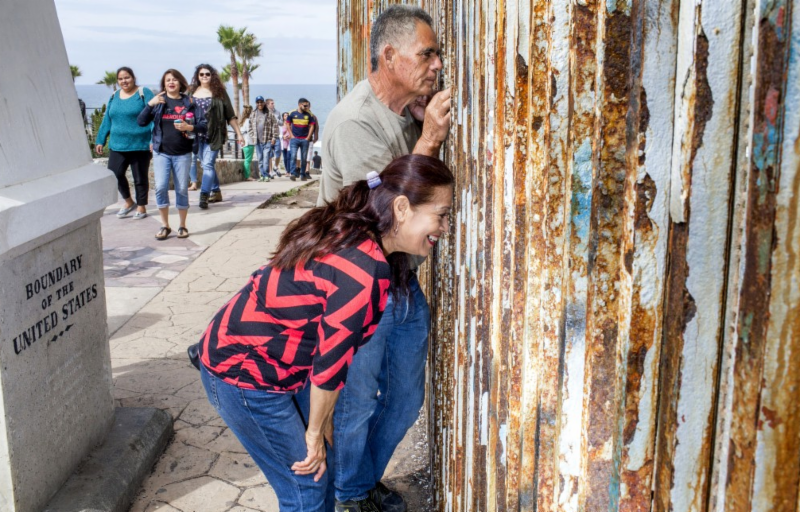
Leticia Orozco and Manuel Aguirre peer through the border at their children and grandchildren at Friendship Park in Tijuana on April 9. (Photo: Natalie Keyssar)

Political Report # 1227

Deported Mothers, Separated From Their Children, Wait in Limbo at the Mexican Border
When deported mother Yolanda Varona received a call from photojournalist Natalie Keyssar on Friday morning, her voice was quivering. Varona, a Mexican mother of two and leader of the Dreamers Moms of Tijuana, spoke clearly - and forcefully - about her feelings on Donald Trump’s plans to build a wall to fortify the border between the United States and Mexico. In an executive order signed Wednesday evening, President Trump called for the “immediate” construction of the barrier that has already escalated tensions between the two nations.

January 26, 2017

Political Report # 1220 Get Ready for the First Shocks of Trump's Disaster Capitalism


By Naomi Klein, The Intercept


We already know that the Trump administration plans to deregulate markets, wage all-out war on “radical Islamic terrorism,” trash climate science and unleash a fossil-fuel frenzy. It’s a vision that can be counted on to generate a tsunami of crises and shocks: economic shocks, as market bubbles burst; security shocks, as blowback from foreign belligerence comes home; weather shocks, as our climate is further destabilized; and industrial shocks, as oil pipelines spill and rigs collapse, which they tend to do, especially when enjoying light-touch regulation.
All this is dangerous enough. What’s even worse is the way the Trump administration can be counted on to exploit these shocks politically and economically.
Speculation is unnecessary. All that’s required is a little knowledge of recent history. Ten years ago, I published “The Shock Doctrine,” a history of the ways in which crises have been systematically exploited over the last half century to further a radical pro-corporate agenda. The book begins and ends with the response to Hurricane Katrina, because it stands as such a harrowing blueprint for disaster capitalism.
That’s relevant because of the central, if little-recalled role played by the man who is now the U.S. vice president, Mike Pence. At the time Katrina hit New Orleans, Pence was chairman of the powerful and highly ideological Republican Study Committee. On September 13, 2005 - just 14 days after the levees were breached and with parts of New Orleans still underwater - the RSC convened a fateful meeting at the offices of the Heritage Foundation in Washington, D.C.
Under Pence’s leadership, the group came up with a list of “Pro-Free-Market Ideas for Responding to Hurricane Katrina and High Gas Prices” - 32 policies in all, each one straight out of the disaster capitalism playbook.

December 26, 2016

Political Report # 1211 Obama keeps on deporting Central American teens. What will Trump do?


rotesters hold signs as they march in opposition to the election of President-elect Donald Trump on Sunday, Nov. 13, 2016, in St. Louis. AP Photo/Jeff Roberson. All rights reserved.


By Donica Jorden, openDemocracy


The blueprint established under the Obama administration to deport Central American teenagers soon after they reach the age of majority continues to operate unabated. Despite the intercession of public officials and a pending appeal in Federal Immigration Court, North Carolina teenager Pedro Arturo Salmerón was deported from the United States to El Salvador on Saturday, November 12, just days after Donald Trump was elected president.
The deportation marks the continuation of a policy begun last year under the Obama government to respond to an unprecedented number of minors and mothers with small children who arrived at the US/Mexican border from the northern Central American countries of El Salvador, Guatemala and Honduras during the summer of 2014. In the wake of an escalation in violence that rendered those countries the most dangerous places on earth and set off the mass migration, the US Department of Homeland Security (DHS) issued a directive in December 2015 taking aim at the young and vulnerable asylum seekers as soon as they aged out of protected status.
Though DHS and President Obama insisted that they were only targeting dangerous criminals for arrest and deportation, in reality the opposite seems to be true. It appears that innocent applicants for asylum and relief, who are easily identifiable and located as they faithfully offer all their personal information, are at the highest risk.
Then 17, Pedro fled El Salvador to rejoin his family in Charlotte, NC in June 2014, following the brutal murder and decapitation of his cousin by gang members. The gang, his family says, was also threatening his life.
But his time with mother Carmen and other family members was abruptly cut short. Pedro immediately applied for humanitarian asylum and the opportunity to live with his family in North Carolina upon arriving in the United States, and the family tirelessly pursued his case, spending thousands of dollars. The Vance High School student was arrested by ICE (Immigration and Customs Enforcement, the police arm of the DHS) agents on his way to school on January 26, 2016.
Able to play several instruments and with dreams of a career in music, Pedro also excelled in sciences and literature at Vance. After his arrest, he was mainly held for the last 10 months at Stewart Detention Center in Lumpkin, Georgia, 400 miles (640 km) from his family and supporters in North Carolina, in an atmosphere he described as one of "disappointment and despair."
The slight and soft-spoken youth, who wears his hair in long, glossy curls down his back, was first slated to be transported to Houston, Texas, on Saturday when the plane he was to take was deemed unable to fly. This was the third time that Pedro and his family had to endure a false start to removal proceedings. At 1 am on July 31, he was moved out of Stewart for imminent deportation, only to be returned to Georgia the next day. The same thing had happened twice earlier that week. Pedro's lawyer said he believed that it was "in retaliation" for having lodged a complaint about a previous move to a facility in Louisiana.
Congresswoman Alma S. Adams, representing the 12th congressional district in North Carolina, has been speaking out and supporting Pedro and the Salmeron family all year, including travelling to Stewart to see him. Pedro also was counting on the support of three other congresspersons, Representatives John Lewis (D-GA), Hank Johnson (D-GA), and G.K. Butterfield (D-NC), who with Adams wrote a letter to DHS director Jeh Johnson requesting a "humane solution" for the youthful immigrants.
But attitudes to these young immigrants do not fall strictly along party lines.
Kay Hagen, Democratic Party senator who represented North Carolina in Washington DC from 2009-2015, was vehemently opposed to the DREAM Act (Development, Relief and Education for Alien Minors ).  "Dreamers" are undocumented students who were born in other countries but raised and educated in the United States, and the act allows them to continue their studies in the US In 2010, Hagen was one of only five Democratic senators who opposed the act.
Meanwhile, across the aisle, Lindsay Graham, the Republican senator from South Carolina, is currently working on legislation with Senator Jeff Flake (R-Arizona) to extend President Obama's 2012 initiative known as DACA (Deferred Action for Childhood Arrivals). Under DACA, DHS is supposed to refrain from deporting undocumented persons who came to the United States as children, were educated here, and have no criminal histories. These undocumented immigrants are then granted temporary visas to live and work, which must be renewed every two years.
The files of 750,000 DACA applicants and a million DREAMers may prove too tempting for President-Elect Donald Trump, who vociferously declared his intention to deport millions of undocumented immigrants on many occasions during his campaign. After years of scapegoating immigrants and convincing his followers, if not a large part of the American public, that immigrants are "rapists and murderers," it would be easy to demonize the entire immigrant population in order to justify refugee and student deportations and more easily achieve his promised numbers.
Bring it on, declares immigrant advocate Viridiana Martínez, one of the founders of NC Dream Team and Alerta Migratoria NC. "Obama told us the right things, but he did the wrong ones," Martinez said. But under Trump, "I am glad the cards are now on the table and there is not a hidden agenda. Because then we can fight accordingly."


Original article and sources can be found here:
https://www.opendemocracy.net/democraciaabierta/danica-jorden/obama-keeps-on-deporting-central-american-teens-what-will-trump-do

December 16, 2016

Political Report # 1209 Presidente Trump, Mexico's Worst Nightmare


By Laura Carlsen, Americas Program


Mexico's proximity to the United States has always been a big headache for Mexico. Popular proverbs such as "When the U.S. sneezes, Mexico gets pneumonia" and "Poor Mexico, so far from God and so close to the United States" speak to the downside of being next-door neighbors to the world's superpower. Now, with the election of Donald Trump to the presidency of the United States, that headache has developed into a brain tumor.
Trump used Mexico as what's called a "wedge issue" in U.S. political nomenclature. This is a subject that divides the population, but consolidates and mobilizes a core nucleus of support. At a time when even the Republican Party believed that direct insults to Mexicans (referred to as "thieves", "rapists" and "bad men", in various Trump speeches) would lead to the loss of the critical Latino vote, Trump took advantage of it, proving that U.S. society is a lot more racist than we thought.
Skillfully, and with the widespread use of lies, he blamed Mexico for unemployment ("Mexico robs us of jobs"), the loss of purchasing power among working families, and the trade deficit. And he won the election, in the anti-democratic Electoral College. Trump's victory puts Mexico up against the wall. We're looking at the prospect of imminent political, social and economic crisis.
What are the implications of Trump's triumph and his policy agenda for the U.S.'s third largest trade partner?

November 23, 2016

Political Report # 1201 "Obama Built the Structures for Trump": A Terrifying Legacy of Mass Deportation


Jose Juan Moreno sits in the room at the University Church on Chicago's Southside where he has sought sanctuary from Immigration and Customs Enforcement (ICE) since April. (Photo: Hoda Katebi)


By Alex Shams, Truthout


For the last six months, Jose Juan Moreno has been confined to a small room above the University Church on Chicago's South Side. Safe inside, he cannot venture more than 50 steps from the corner where he sleeps. If he goes beyond that, US authorities have promised to deport him from the country.
Although he has lived 17 years in Chicago -- the only home any of his five American-born children have ever known -- Moreno originally crossed the border from Mexico without papers. Under US law, that means he is subject to arrest and deportation at any time, a status he shares with 11 million people in the United States considered "undocumented."
Earlier this year, Moreno received a deportation order from Immigration and Customs Enforcement (ICE), the authority that carries out the raids and arrests that represent the strong arm of national immigration policy. He was told to leave by April 15, otherwise he'd be deported.
In response, Moreno did the only thing he could think of -- he sought sanctuary in the church, praying that even if the authorities would not respect his family or his long years of work in the US, at least they might respect the sanctity of a holy place.
So far, they have. But for how much longer is anybody's guess.

September 21, 2016

Political Report # 1185 Is Trump an Aberration?,The Dark History of the "Nation of Immigrants"


By Aviva Chomsky, via Tom Dispatch


Liberal Americans like to think of Donald Trump as an aberration and believe that his idea of building a great wall along the U.S.-Mexico border to prevent immigrants from entering the country goes against American values. After all, as Hillary Clinton says, "We are a nation of immigrants." In certain ways, in terms of the grim history of this country, they couldn't be more wrong.
Donald Trump may differ from other contemporary politicians in so openly stating his antipathy to immigrants of a certain sort.  (He's actually urged the opening of the country to more European immigrants.)  Democrats like Barack Obama and Bill and Hillary Clinton sound so much less hateful and so much more tolerant.  But the policies Trump is advocating, including that well-publicized wall and mass deportations, are really nothing new.  They are the very policies initiated by Bill Clinton in the 1990s and -- from border militarization to mass deportations -- enthusiastically promoted by Barack Obama.  The president is, in fact, responsible for raising such deportations to levels previously unknown in American history.
And were you to take a long look back into that very history, you would find that Trump's open appeal to white fears of a future non-white majority, and his support of immigration policies aimed at racial whitening, are really nothing new either.  The policies he's promoting are, in an eerie way, a logical continuation of centuries of policymaking that sought to create a country of white people.
The first step in that process was to deport the indigenous population starting in the 1600s.  Later, deportation policies started to focus on Mexicans -- seen by many whites as practically indistinguishable from Indians.  Except, white settlers found, Mexicans were more willing to work as wage laborers.  Since the middle of the nineteenth century, Mexicans have been treated as disposable workers.  As Europeans were invited to immigrate here permanently and become citizens, Mexican workers were invited into the country to work -- but not to become citizens.

March 21, 2016

Political Report # 1128 Presidential Elections 2016: The Revolt of the Masses By James Petras


Introduction
            The presidential elections of 2016 have several unique characteristics that defy common wisdom about political practices in 21st century America.
            Clearly the established political machinery - party elites and their corporate backers -have (in part) lost control of the nomination process and confront ‘unwanted’ candidates who are campaigning with programs and pronouncements that polarize the electorate.
            But there are other more specific factors, which have energized the electorate and speak to recent US history.  These portend and reflect a realignment of US politics.
            In this essay, we will outline these changes and their larger consequences for the future of American politics.
            We will examine how these factors affect each of the two major parties.