Mendez Pineda is seeking political asylum over death threats in one of the most dangerous countries in the world for journalists.
Reporters Without Borders is calling on U.S. authorities to admit Mexican journalist Martin Mendez Pineda into the United States, detained at the border for the past 60 days while fleeing threats of violence in his home country to seek asylum north of the border.
In a statement released Wednesday, the group explained that Mendez Pineda, the target of attacks and death threats in his home state of Guerrero, has been waiting for a response to his political asylum request since Feb. 5.
While he passed the "credible fear interview" on March 1, which authorities use to decide whether a real threat exists, and would ordinarily have been allowed to enter the United States, he instead has been detained under "deplorable conditions," according to his lawyer.
"We call on ICE to release Martin Mendez Pineda without delay," Emmanuel Colombie, the head of the Latin America bureau of Reporters Without Borders, also known as RSF, said in the statement. "This journalist, who has been persecuted and threatened with death in his country, must be allowed to present his case for political asylum freely and with dignity before an immigration judge."
After covering a number of violent arrests made by federal police officers in February, Mendez Pineda, a former journalist with Novedades Acapulco, was attacked by these same police officers. Weeks later, armed men threatened to kill him outside his home. He then decided to resign from Novedades Acapulco, file a complaint with Mexico's National Human Rights Commission and flee to the United States.
According to the RSF, journalism is a dangerous job in Guerrero, with 11 journalists having been murdered in Guerrero since 2003. The most recent victim was Cecilio Pineda Birto, a crime reporter who was gunned down in the violence-ridden state of Guerrero last month.
The rest of Mexico is just as deadly for reporters - the country is the most dangerous place to be a journalist in the Western hemisphere.
Recently, the newspaper Norte was forced to shut down in the city of Juarez. Its editor penned an editorial informing readers of the publication's decision to shut down, citing the story of Miroslava Breach, a journalist from a city nearby who was shot in the head eight times while she was in her car with her child. The slain La Jornada reporter, who often collaborated with Norte, was left with a note by the gunman that read, "For being a loudmouth."
And just last month, a spate of other murders took place, with two journalists killed in Veracruz, in addition to the ones in Guerrero and Chihuahua. An armed attack on a journalist in San Jose del Cabo, Baja California Sur, also left his bodyguard dead.
The Committee to Protect Journalists reported that at least 38 journalists have been killed in the country since 1992 for motives linked to their reporting, with another 50 slain in the same time period for unclear reasons.
A recent report by the Inter-American Press Association found that 13 journalists have been killed in Latin America just in the last 6 months, with Mexico leading in the number of these deaths. Since last October, Mexico has seen 5 journalists murdered; Peru has seen three; Guatemala and the Dominican Republic, two; and Honduras, one.
Meanwhile, a new report by press freedom group Article 19, found that people who kill journalists in Mexico get away with murder 99.7 percent of the time. It points out that 2016 was "the most violent year for the press in Mexico" with a record of 426 attacks and 11 journalists murdered, the largest number in the last 10 years.
Original article and sources can be found here:
http://www.telesurtv.net/english/news/Mexican-Journalist-Seeking-Asylum-for-Facing-Death-Threats-Detained-at-US-Border-for-60-Days-20170405-0011.html
|

Showing posts with label Deportation. Show all posts
Showing posts with label Deportation. Show all posts
April 14, 2017
Political Report # 1244 Mexican Journalist Seeking Asylum for Facing Death Threats Detained at US Border for 60 Days

March 13, 2017
Political Report # 1234 The Long History of Deportation Scare Tactics at the US-Mexico Border
The Trump administration's first moves on immigration enforcement represent an unprecedented hard-line position, envisioning thousands of new agents, enlisting local police as immigration enforcers, making virtually anyone a priority for deportation, bypassing immigration courts, and, of course, ordering the construction of the infamous wall along the Mexican border. And then there is the president's own rhetoric equating immigrants with criminals - after campaign talk characterizing Mexicans as rapists, this week he referred to his immigration policy as a "military operation" against gang members, "drug lords," and "bad dudes."
Despite the emotionally charged rollout of these policies, it remains to be seen whether they will be fully implemented; the money and manpower required to do so would be extraordinary. There are parallels between Trump's efforts and previous U.S. immigration crackdowns, when rhetoric about "criminal aliens," hyped-up raids, and inflated deportation numbers created what was essentially a "terror campaign" in Mexican immigrant communities, says Kelly Lytle Hernandez, a historian at the University of California, Los Angeles.
"I think it would serve us to do our best to fight back against the scare campaign" promoting Trump's enforcement operations, she said. "I don't want to suggest that the terror isn't real. But we don't want to inflate it. I don't want to fulfill Trump's vision of mass deportation by fueling the panic and fear."
|
February 17, 2017
Political Report # 1227 Deported Mothers, Separated From Their Children, Wait in Limbo at the Mexican Border
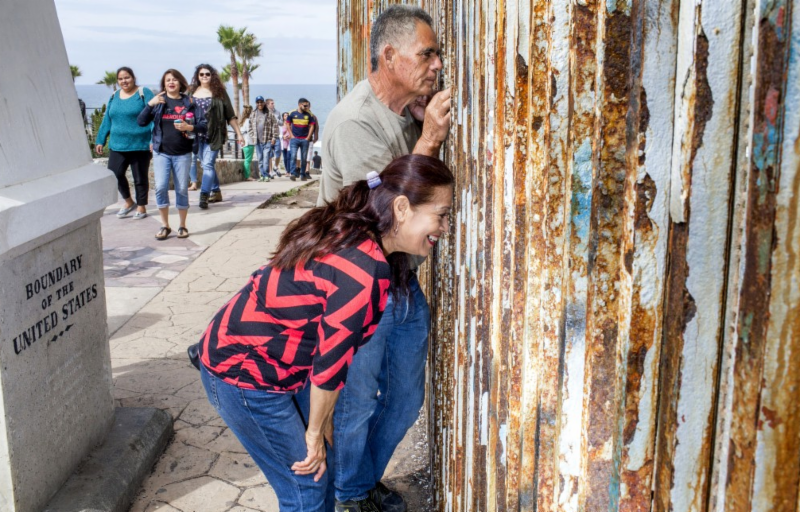
Leticia Orozco and Manuel Aguirre peer through the border at their children and grandchildren at Friendship Park in Tijuana on April 9. (Photo: Natalie Keyssar)
Political Report # 1227
Deported Mothers, Separated From Their Children, Wait in Limbo at the Mexican Border |
When deported mother Yolanda Varona received a call from photojournalist Natalie Keyssar on Friday morning, her voice was quivering. Varona, a Mexican mother of two and leader of the Dreamers Moms of Tijuana, spoke clearly - and forcefully - about her feelings on Donald Trump’s plans to build a wall to fortify the border between the United States and Mexico. In an executive order signed Wednesday evening, President Trump called for the “immediate” construction of the barrier that has already escalated tensions between the two nations.
|
December 28, 2016
Political Report # 1212 Deportation Profits: El Salvador's Call-Center Industry Is Profiting off US Deportees
By Hilary Goodfriend, Jacobin
|
had chosen a Mr. Donut café in San Salvador to meet Raúl. An agent in El Salvador's burgeoning call-center industry, Raúl had been a member of the so-called 1.5 Generation of immigrants who were born abroad but spent their formative years in the United States, before he was deported. The donut shop sits in the shadow of the iconic Salvador del Mundo monument, now dwarfed by several towering call centers. That day, they were giving out two-for-one donuts to celebrate Civic Month, which marks the country's independence from the Spanish Crown, in a deal that has become a patriotic ritual in El Salvador.
Raúl was taken off guard by the festival of patriotic gluttony. Like mine, Raul's civic education had taken place elsewhere. In effortless English, he tells me, "Growing up pledging allegiance to the American flag, it sinks into you . . . To this day, for example, I hear the national anthem at a football game, I'm not gonna lie, I get teary-eyed. I mean, when I hear the Salvadorian national anthem it's like, okay."
He laughs and shrugs his shoulders. "I mean, it's my country, I know I'm born here, but my life has been over there."
Raúl and other 1.5-Generation deportees have been forcibly removed from the only homes they know and deposited in foreign territories to which they no longer have any connection - often, they don't even speak the language. While much contemporary literature on deportation relies on the metaphor of waste - like Nicholas De Genova's work on how migrant labor is made "disposable," or Jock Young's concept of a "bulimic society" - these workers' experiences suggest something different: recycling.
|
December 26, 2016
Political Report # 1211 Obama keeps on deporting Central American teens. What will Trump do?

rotesters hold signs as they march in opposition to the election of President-elect Donald Trump on Sunday, Nov. 13, 2016, in St. Louis. AP Photo/Jeff Roberson. All rights reserved.
By Donica Jorden, openDemocracy
|
The blueprint established under the Obama administration to deport Central American teenagers soon after they reach the age of majority continues to operate unabated. Despite the intercession of public officials and a pending appeal in Federal Immigration Court, North Carolina teenager Pedro Arturo Salmerón was deported from the United States to El Salvador on Saturday, November 12, just days after Donald Trump was elected president.
The deportation marks the continuation of a policy begun last year under the Obama government to respond to an unprecedented number of minors and mothers with small children who arrived at the US/Mexican border from the northern Central American countries of El Salvador, Guatemala and Honduras during the summer of 2014. In the wake of an escalation in violence that rendered those countries the most dangerous places on earth and set off the mass migration, the US Department of Homeland Security (DHS) issued a directive in December 2015 taking aim at the young and vulnerable asylum seekers as soon as they aged out of protected status.
Though DHS and President Obama insisted that they were only targeting dangerous criminals for arrest and deportation, in reality the opposite seems to be true. It appears that innocent applicants for asylum and relief, who are easily identifiable and located as they faithfully offer all their personal information, are at the highest risk.
Then 17, Pedro fled El Salvador to rejoin his family in Charlotte, NC in June 2014, following the brutal murder and decapitation of his cousin by gang members. The gang, his family says, was also threatening his life.
But his time with mother Carmen and other family members was abruptly cut short. Pedro immediately applied for humanitarian asylum and the opportunity to live with his family in North Carolina upon arriving in the United States, and the family tirelessly pursued his case, spending thousands of dollars. The Vance High School student was arrested by ICE (Immigration and Customs Enforcement, the police arm of the DHS) agents on his way to school on January 26, 2016.
Able to play several instruments and with dreams of a career in music, Pedro also excelled in sciences and literature at Vance. After his arrest, he was mainly held for the last 10 months at Stewart Detention Center in Lumpkin, Georgia, 400 miles (640 km) from his family and supporters in North Carolina, in an atmosphere he described as one of "disappointment and despair."
The slight and soft-spoken youth, who wears his hair in long, glossy curls down his back, was first slated to be transported to Houston, Texas, on Saturday when the plane he was to take was deemed unable to fly. This was the third time that Pedro and his family had to endure a false start to removal proceedings. At 1 am on July 31, he was moved out of Stewart for imminent deportation, only to be returned to Georgia the next day. The same thing had happened twice earlier that week. Pedro's lawyer said he believed that it was "in retaliation" for having lodged a complaint about a previous move to a facility in Louisiana.
Congresswoman Alma S. Adams, representing the 12th congressional district in North Carolina, has been speaking out and supporting Pedro and the Salmeron family all year, including travelling to Stewart to see him. Pedro also was counting on the support of three other congresspersons, Representatives John Lewis (D-GA), Hank Johnson (D-GA), and G.K. Butterfield (D-NC), who with Adams wrote a letter to DHS director Jeh Johnson requesting a "humane solution" for the youthful immigrants.
But attitudes to these young immigrants do not fall strictly along party lines.
Kay Hagen, Democratic Party senator who represented North Carolina in Washington DC from 2009-2015, was vehemently opposed to the DREAM Act (Development, Relief and Education for Alien Minors ). "Dreamers" are undocumented students who were born in other countries but raised and educated in the United States, and the act allows them to continue their studies in the US In 2010, Hagen was one of only five Democratic senators who opposed the act.
Meanwhile, across the aisle, Lindsay Graham, the Republican senator from South Carolina, is currently working on legislation with Senator Jeff Flake (R-Arizona) to extend President Obama's 2012 initiative known as DACA (Deferred Action for Childhood Arrivals). Under DACA, DHS is supposed to refrain from deporting undocumented persons who came to the United States as children, were educated here, and have no criminal histories. These undocumented immigrants are then granted temporary visas to live and work, which must be renewed every two years.
The files of 750,000 DACA applicants and a million DREAMers may prove too tempting for President-Elect Donald Trump, who vociferously declared his intention to deport millions of undocumented immigrants on many occasions during his campaign. After years of scapegoating immigrants and convincing his followers, if not a large part of the American public, that immigrants are "rapists and murderers," it would be easy to demonize the entire immigrant population in order to justify refugee and student deportations and more easily achieve his promised numbers.
Bring it on, declares immigrant advocate Viridiana Martínez, one of the founders of NC Dream Team and Alerta Migratoria NC. "Obama told us the right things, but he did the wrong ones," Martinez said. But under Trump, "I am glad the cards are now on the table and there is not a hidden agenda. Because then we can fight accordingly."
Original article and sources can be found here:
|
December 16, 2016
Political Report # 1209 Presidente Trump, Mexico's Worst Nightmare

By Laura Carlsen, Americas Program
|
Mexico's proximity to the United States has always been a big headache for Mexico. Popular proverbs such as "When the U.S. sneezes, Mexico gets pneumonia" and "Poor Mexico, so far from God and so close to the United States" speak to the downside of being next-door neighbors to the world's superpower. Now, with the election of Donald Trump to the presidency of the United States, that headache has developed into a brain tumor.
Trump used Mexico as what's called a "wedge issue" in U.S. political nomenclature. This is a subject that divides the population, but consolidates and mobilizes a core nucleus of support. At a time when even the Republican Party believed that direct insults to Mexicans (referred to as "thieves", "rapists" and "bad men", in various Trump speeches) would lead to the loss of the critical Latino vote, Trump took advantage of it, proving that U.S. society is a lot more racist than we thought.
Skillfully, and with the widespread use of lies, he blamed Mexico for unemployment ("Mexico robs us of jobs"), the loss of purchasing power among working families, and the trade deficit. And he won the election, in the anti-democratic Electoral College. Trump's victory puts Mexico up against the wall. We're looking at the prospect of imminent political, social and economic crisis.
What are the implications of Trump's triumph and his policy agenda for the U.S.'s third largest trade partner?
|
March 2, 2016
Political Report # 1121 Five Children Murdered After Being Deported From US to Honduras By Esther Yu-Hsi Lee, ThinkProgres

Immigrant families and children's advocates rally in response to President Barack Obama's statement on the crisis of unaccompanied children and families illegally entering the United States, outside the Los Angeles Federal building in July. (photo: Nick Ut/AP)
By Esther Yu-Hsi Lee, ThinkProgres
|
Between five and ten migrant children have been killed since February after the United States deported them back to Honduras, a morgue director told the Los Angeles Times. Lawmakers have yet to come up with best practices to deal with the waves of unaccompanied children apprehended by Border Patrol agents, but some politicians refute claims that children are fleeing violence and are opting instead to fund legislation that would fast-track their deportations.
San Pedro Sula morgue director Hector Hernandez told the Los Angeles Times that his morgue has taken in 42 dead children since February. According to an interview with relatives by the LA Times, one teenager was shot dead hours after getting deported. Last year, San Pedro Sula saw 187 killings for every 100,000 residents, a statistic that has given the city the gruesome distinction as the murder capital of the world. That distinction has also been backed up by an U.S. Customs and Border Protection agency infographic, which found that many Honduran children are on the run from extremely violent regions “where they probably perceive the risk of traveling alone to the U.S. preferable to remaining at home.” Hugo Ramon Maldonado of the Committee for the Protection of Human Rights in Honduras believes that about 80 percent of Hondurans making the exodus are fleeing crime or violence. |
February 1, 2016
Political Report # 1109 The Salvadoran Dream Is Now Survival Even if It Means Illegal Migration to the US By Carolina Campos and Andrew Stefan

The sister of Alberto Hernández Escalante mourns over the body of her brother, found in a clandestine grave near Caserio el Chumpe, El Salvador. Killings spiked by nearly 70 percent in the country in 2015.
(photo: Manu Brabo/AP)
By Carolina Campos and Andrew Stefan,
Reader Supported News |
|
For many in the United States, the growing number of Central American immigrants crossing into the US is an issue of major concern. Whether we consider Donald Trump's presidential aspirations to implement a national program of mass deportation, ongoing citizen attacks on Latin Americans, or the Obama administration's latest campaign of anti-immigrant raids, the message is clear: people in the US are frightened and lashing out at those who migrate here.
While immigration is a staple topic of the US news media, what's typically missing from the discussion is context - an understanding of the conditions that fuel mass migration to the US from Central America and Mexico. What's rarely reported is that, at present, thousands of Central Americans are being forced to flee from their countries by escalating levels of violence. The gravest example of this phenomenon is currently playing out in El Salvador, where the motivations underlying migration extend beyond the pursuit of personal fulfillment or economic mobility. For many, migration is the only option for survival.
On a hot, sunny day in San Salvador, heading to the home of Carmen López, we arrive at the heart of one of the country's "red zone" neighborhoods - the designation indicates an extremely high level of gang violence.
Some of the houses are made of concrete. Others are constructed from sheets, complete with colored patchwork walls. Despite the ever-looming threat of gang attacks, the people of the community are friendly and greet us with hellos. Children play on the narrow streets and somehow dare to smile. However, the pavement, we notice, is unmistakably stained by blood. |
December 21, 2015
Political Report #1100, 7,000 Honduran Child Migrants Deported From US and Mexico By TeleSur

Children join a protest to call on Obama to protect undocumented children. (photo: AFP)
Political Report #1100
By TeleSur
|
Mexico's role in deporting Central American migrants has been rapidly expanding.
Immigration authorities in the U.S. and Mexico deported a total of 6,986 underage Honduran migrants in the first 11 months of this year, as the number of unaccompanied minors apprehended on the U.S.-Mexico border continues to soar. |
July 2, 2015
Political Report # 1051 This Morning, Hundreds of Thousands in the Dominican Republic Woke Up Stateless By Amalia Perez, Research Associate at the Council on Hemispheric Affairs

Featured Photo: Dominican Flag
|
Beginning this week, the Dominican government will move forward with the deportation of an estimated 210,000 allegedly Haitian refugees living in the Dominican Republic (DR). A large majority of them have lived in the Dominican Republic for generations, have never visited Haiti or spoken Creole, or were brought over from Haiti as children.[1] They will be rendered stateless under the DR’s draconian immigration laws, which targets and expels those “dark-skinned Dominicans with Haitian facial features” who cannot prove, with birth certificates or citizenship papers, they legally belong in the DR.[2]
The Dominican government has been creating a stateless underclass out of those of Haitian descent for decades, however, the decision to deport them in massive premeditated quantities-despite fervent opposition by foreign governments and international legal and humanitarian bodies-is a decisive escalation from structural violence to physical violence at the hands of President Danilo Medina’s government. The prevalence of antihaitanismo, a pejorative ideology which “serves elite interests well and has even been accepted by the great majority of the Dominican people as part of their political culture”, has its roots in the era of Dominican dictator Rafael Trujillo, whose regime infamously warned against “Haitianizing influences, whose consequences will always be extremely fatal for Dominican society.”[3] This ideology pulsed throughout the Parsley Massacre of 1937, in which the Trujillo regime murdered upwards of 20,000 alleged Haitians on the basis of whether or not they could trill the “r” in perejil, the Spanish term for parsley-a perverse semantic exercise that often proved morbid for native Haitian Creole speakers.[4]
|
Subscribe to:
Posts (Atom)