Showing posts with label Security. Show all posts

December 12, 2019

abstract: Threat Construction and Military Intervention in Internal Security: The Political Use of Terrorism and Drug Trafficking in Contemporary Argentina by Jorge Battaglino

:::::: Abstract ::::::


Threat Construction and Military Intervention in Internal Security: The Political Use of Terrorism and Drug Trafficking in Contemporary Argentina

by Jorge Battaglino


Argentina has a deeply rooted tradition of rejecting participation by the military in internal security and legislation that prohibits such involvement. The current construction of a threat from drug trafficking and terrorism and the proposal of intervention by the armed forces to contend with them is the result of a narrative justifying the implementation of various government policies. Exploration of the mechanism of discursive threat construction, or securitization, from the critical perspective of the Copenhagen School demonstrates how security discourse and practices allow actors and institutions to mobilize resources, control agendas, and use violence with greater discretion.

December 3, 2019

Abstract: Crime Prevention and the Coproduction of Security: Outcomes of Citizen Participation at the Neighborhood Level in Neoliberal Chile

:::::: Abstract ::::::


Crime Prevention and the Coproduction of Security: Outcomes of Citizen Participation at the Neighborhood Level in Neoliberal Chile

by Maria Paz Trebilcock and Alejandra Luneke


A study of the implications of the coproduction-of-security policy implemented by Chile’s postdictatorship governments shows that the appeal for citizen participation in security provision has resulted in individual practices of home defense and protection rather than the development of the associative programs promoted by the state. This has come about in a context of extreme fear of crime and mistrust of the institutions in charge of security. The fact that the discourse of security coproduction is interwoven with the individuation and privatization that characterize Chilean society calls for a review of the agenda of citizen participation in security issues.

May 28, 2018

Political Report # 1342 US-Trained Special Forces Joined Police Crackdown on Dam Protesters in Honduras


By Sandra Cuffe, Truthout
It started at dawn. A vehicle full of Honduran police officers showed up at around 5 am on May 3 in front of the community protest camp in Pajuiles, where residents have been present day and night for more than a year to prevent the passage of hydroelectric dam construction machinery. Less than two hours later, the whole area was crawling with hundreds of members of various police units, including regular national police, the Police Investigations Directorate, the elite COBRAS unit and the TIGRES special forces, which are heavily supported by the US and trained by Green Berets from the 7th Special Forces Group (Airborne).
"It was like a war zone," Pajuiles community leader Albertina López told Truthout.
Police forces lined the immediate area along the nearby highway that runs from El Progreso up to Tela, along the Caribbean coast in the Atlántida Department. Soon they were also lining the road past the camp and up to the contested construction site of the Mezapa River dam. They showed up in convoys, escorting machinery, construction materials and company personnel up to the site, where the Honduran company HIDROCEP has been trying to build a 1.3 megawatt dam.
"People were scared," said López. Nevertheless, she and a few other women made an attempt to stop the machinery, lying down in the road in front of the protest camp to try to stop the machinery's passage. "That's when they started firing tear gas at us," she said. People scattered, ushering a 75-year-old protester and children to safety, but López and others maintained their permanent presence at the roadside resistance camp throughout the police operations that lasted two full days.
State violence against community resistance to natural resource exploitation projects continues unabated in Honduras. The recent crackdown in Pajuiles to impose a fiercely contested hydroelectric dam project is just one of the latest incidents, but it provides a clear example of the involvement of US-trained and -supported special forces in repression against community activists.

February 23, 2018

Political Report # 1314 Green for Blue in the Mexican Security State


By Nicola Chavez Courtright

NACLA


On December 19, exactly three months after the earthquake that left over 360 dead in central Mexico, the iconic Arena México in Mexico City was gearing up for its regular Tuesday evening show. According to the event's flyer, however, the night of lucha libre would be punctuated by a special event: an homage to "the Mexican heroes who participated in rescue missions" after the September 19th quake.
In a pause between lucha rounds, dozens of uniformed men and women marched into the arena in step with the Zacatecas March, played by the wind section of the National Defense Secretary band. While soldiers posed before the green, white, and red of the Mexican flag waving across huge LED screens, the celebration uplifted the military's role as the genuine heroes of the disaster, sidelining the roles taken on by civilian rescue groups in the quake's aftermath.
The act exuded all the grandeur of an army that had just been given sweeping powers to conduct military operations against its own population. More than just a commemoration, the display at Arena México tacitly acknowledged a concerning sign of army encroachment into civilian life.
Four days earlier, Mexico had adopted its Ley de Seguridad Interior, or Internal Security Law, which amends the constitution to enable the executive branch to grant certain police responsibilities to Mexican armed forces-a response that has become increasingly normalized since the beginning of Mexico's Drug War in 2006. In 2017, Mexico registered the highest number of homicides since the drug war began. Rather than a panacea, however, the law stands to create new sources of terror for an already-terrorized population caught in the ongoing U.S.-backed drug war ravaging the region.

December 4, 2017

Political Report # 1299 Top U.S.-Backed Honduran Security Minister Is Running Drugs, According to Court Testimony


Jake Johnston
The Intercept


The Honduran minister of security, who was intimately involved in solidifying the 2009 coup, is tied up in drug trafficking, according to testimony from a Mexican drug-trafficker-turned-DEA-informant in U.S. court.
In November 2016, as the world’s attention was fixated on the surprise election of Donald Trump as president of the United States, two nephews of Venezuelan President Nicolás Maduro were found guilty on drug trafficking charges. The conviction was another feather in the cap of U.S. prosecutors who have been targeting the Venezuelan government with corruption and drug trafficking investigations.
But in the South Florida courtroom, the testimony of José Santos Peña also implicated Julián Pacheco Tinoco, a former Honduran military official with long ties to the U.S. security apparatus.
A U.S. prosecutor asked the informant about a meeting in Honduras he had participated in a few years earlier. The purpose of the meeting with Honduras’s current security minister and then-head of military intelligence Pacheco Tinoco was “so that he could give me help to receive shipments from Colombia to Honduras,” the informant told the court.
“What type of shipments?” the prosecutor asked.
“Cocaine,” the informant clarified.
According to the prosecution, one of the defendants in the case had deleted from his Samsung phone chat records and contact information bearing Pacheco’s name. But the allegation that the top security official of one of the United States’s closest regional allies was involved in drug trafficking was treated as a non-event in Washington; not a single major media story mentioned the Drug Enforcement Agency informant’s testimony.

November 1, 2017

Political Report # 1287 Stalker Law, or How Did The Government Legalize Mass Surveillance of Innocent Peruvians


Political Report # 1287


Stalker Law, or How Did The Government Legalize Mass Surveillance of Innocent Peruvians


By Katitza Rodriguez,
 Electronic Frontier Foundation
Peruvians understand the dangers of pervasive surveillance. Peru's ex-spy chief, Vladimiro Montesinos is serving a long jail sentence for corruption and human rights abuses. In 2000, Peruvian authorities seized about 2,400 videotapes made by Montesinos, which he used to manipulate political opponents and journalists whom he caught on film, a scandal also known as the “Vladivideos”. That’s why so many in the country recognise the dangers of a pervasive surveillance state.
At the end of July, the Peruvian President adopted a new Decree which allows the police to access location data of any cell phone without a prior court authorization. In other words, law enforcement agencies in Peru no longer need a court order allowing real-time access to localization data. The Decree also compels local ISPs and telephone companies to retain communications and location details of the entire Peruvian population for a period of three years. The retained data could be accessible to law enforcement with a court order for possible use in the future.
Put simply, with the new Decree, the Peruvian government has shifted from surveillance of communications records based on individualized suspicion to the mass untargeted collection of communications data of ordinary, non-suspect people. No wonder it’s been dubbed by Peruvians as #Leystalker (“Stalker Law”), which has been described as someone who uses technology to spy on people every online movement, step-by-step.
Miguel Morachimo, Director of the Peruvian NGO Hiperderecho, an EFF ally who has been analyzing the law in Peru, told us:

August 2, 2017

Political Report # 1264 My Visit With One of the Forgotten Prisoners of Guantánamo

 15 years later, the detention camp has become a place where time has no meaning.

Last month, I took my first trip to the US military detention camp at Guantánamo Bay to visit Sufyian Barhoumi. As a military handler drove me and my colleagues from the Center for Constitutional Rights (CCR) down the winding road from the ferry landing to the camp, I marveled at the lush green hills and sparkling blue water around us. The serenely beautiful setting stands in stark contrast to the detention camp, which is jarringly ugly: Endless rolls of rusty barbed wire, layers of fencing enmeshed with opaque green cloth, cages with peeling paint, gravel pits where grass should be. A warehouse to store men we don’t know what to do with.
Guantánamo is a sprawling network of several smaller detention camps. Many of the camps, such as Camp Iguana, where children were held, are no longer in use. Currently, detainees are housed in two different camps. Fourteen “high value detainees,” who were interrogated at the CIA’s notorious “black sites” prior to being shipped to Guantánamo, are held in Camp 7. The rest, like Sufyian, are held in Camp 6. At Camp Echo, the site designated for client meetings, my colleagues and I are ushered into a tiny office. We submit our papers to a member of the Privilege Review Team (PRT), who must approve and stamp them before we can bring them into our meeting. The detainees and anyone who interacts with them are subject to a gag order. Very little information is allowed in, and very little is allowed out.
Attorneys must obtain security clearances to meet with their clients because everything the detainees say is presumptively classified, even now, a decade and a half after they were brought here. The PRT must ensure that their utterances don’t pose a threat to national security before they can be declassified and shared with the public. I applied for my clearance to see Sufyian a few months before I graduated from law school; it took nearly 10 months to process.

April 27, 2017

Global Security Watch—Venezuela

:::::: Book ::::::


Global Security Watch—Venezuela
by Daniel Hellinger


This in-depth study provides a timely assessment of how the foreign, military, and security policies of Venezuela shape relations with the United States in the Chavez era.

The growing importance of Venezuela in the global oil market along with the controversial nature of its leadership provoke concern among some world powers—especially the United States, whose international policies have been heavily criticized by Venezuelan president Hugo Chavez. This critical look at American/Venezuelan relations presents perceptions held by each government of the other and examines the sources of tensions—and points of confluence—between the two countries.

Global Security Watch—Venezuela traces the political relations between the United States and Venezuela from the early roots based in Pan Americanism to the domestic and foreign policies of the Chavez regime, including petro-diplomacy. This book provides a serious examination of the allegations about Venezuelan involvement in the drug trade, terrorism, and intervention; the view that the unilateralism of the United States threatens world peace; and the future of relations between the two countries.


February 21, 2017

Book, Global Security Watch—Venezuela

:::::: Book ::::::


Global Security Watch—Venezuela
by Daniel Hellinger


This in-depth study provides a timely assessment of how the foreign, military, and security policies of Venezuela shape relations with the United States in the Chavez era.

The growing importance of Venezuela in the global oil market along with the controversial nature of its leadership provoke concern among some world powers—especially the United States, whose international policies have been heavily criticized by Venezuelan president Hugo Chavez. This critical look at American/Venezuelan relations presents perceptions held by each government of the other and examines the sources of tensions—and points of confluence—between the two countries.

Global Security Watch—Venezuela traces the political relations between the United States and Venezuela from the early roots based in Pan Americanism to the domestic and foreign policies of the Chavez regime, including petro-diplomacy. This book provides a serious examination of the allegations about Venezuelan involvement in the drug trade, terrorism, and intervention; the view that the unilateralism of the United States threatens world peace; and the future of relations between the two countries.


December 27, 2016

Book, Global Security Watch—Venezuela

:::::: Book ::::::


Global Security Watch—Venezuela
by Daniel Hellinger


This in-depth study provides a timely assessment of how the foreign, military, and security policies of Venezuela shape relations with the United States in the Chavez era.

The growing importance of Venezuela in the global oil market along with the controversial nature of its leadership provoke concern among some world powers—especially the United States, whose international policies have been heavily criticized by Venezuelan president Hugo Chavez. This critical look at American/Venezuelan relations presents perceptions held by each government of the other and examines the sources of tensions—and points of confluence—between the two countries.

Global Security Watch—Venezuela traces the political relations between the United States and Venezuela from the early roots based in Pan Americanism to the domestic and foreign policies of the Chavez regime, including petro-diplomacy. This book provides a serious examination of the allegations about Venezuelan involvement in the drug trade, terrorism, and intervention; the view that the unilateralism of the United States threatens world peace; and the future of relations between the two countries.


September 26, 2016

Abstract, "Colombia’s Gallery of Memory: Reexamining Democracy through Human Rights Lenses" by Erika Márquez

:::::: Abstract ::::::


Colombia’s Gallery of Memory Reexamining Democracy through Human Rights Lenses
by Erika Márquez

The Gallery of Memory, a street exhibit organized by Colombian activists affiliated with the Victims of State Crimes Movement to memorialize human rights violations, connects individual cases of human rights abuse with a larger critique of state violence. Through this exercise, activists bring together earlier and current violations of human rights and provide a framework that situates present undemocratic currents within the trajectory of the state’s politics of exception and its correlates, national security and the internal enemy. Critical reflection on the potential for place-based, coproduced resignification of security measures in a context of systemic violence suggests that the Gallery has become part of the movement-based human rights repertoire for democratizing citizenship in Colombia.

September 16, 2016

Political Report # 1183 Guilty by Association: How Washington is Complicit in Human Rights Abuses in Honduras


Crowd. Taken from Flickr.


Political Report # 1183


Guilty by Association: How Washington is Complicit in Human Rights Abuses in Honduras


By Jessica Farber, Research Associate at the COHA


In an opinion piece that appeared in the New York Times on August 11, titled "How the Most Dangerous Place on Earth got Safer," Sonia Nazario paints a misguided picture of Honduras as a country that was once ravaged with violence, but has since been bravely rescued and is now stable thanks to aid from the United States.[i] On the one hand, the author highlights an important point: some violence-prevention programs funded by the United States in Honduras are indeed working, and their focus on human capital and social justice is a welcome departure from the "iron-fisted" security measures that have characterized U.S. aid in the past. What the author neglects to mention, however, is that an enormous portion of the same aid package is also funneled to a government that, in conjunction with a corrupt military and police force, is carrying out massive human rights violations against its citizens. Given the increasing number of activists killed with impunity under the rightwing government, whose power the United States helped to consolidate following the 2009 coup against democratically elected President Manuel Zelaya, continued funding to Honduras deserves additional scrutiny.
A Contradictory Approach
As Nazario rightfully acknowledges, the withdrawal of all funding to Honduras could be harmful because it would interrupt successful violence-prevention initiatives at the local level. The pilot programs she describes, in which the U.S. Agency for International Development (U.S.A.I.D.) partners with community leaders to implement programs that engage and counsel gang members and other vulnerable youth, are both novel and exemplary. With such programs, the United States finally seems to acknowledge that simply intensifying security measures to kill off gang members does nothing but fuel the fire. Nazario admirably emphasizes the need to address the long-term structural factors behind gang violence and advocates for the implementation of more of these types of programs throughout Central America. Furthermore, in "a striking rebuke against the rising isolationists in American politics," Nazario highlights the positive impact that U.S. spending can have for both Americans -in terms of stemming the flow of migrants- as well as for marginalized populations in the developing world.[ii] The Council on Hemispheric Affairs (COHA), a longtime proponent of grassroots and social justice programs, applauds Nazario for her intentions in this respect.[iii]
While Nazario is not wrong to shed light on the specific U.S. initiatives that are succeeding in violence prevention, it is far too soon to claim that the United States has single-handedly created a dramatically safer Honduras. On the contrary, such a position ignores the complex roots of the violence in Honduras, and leads one to question whether the author is not trying to obfuscate U.S. complicity in the violence. As Nazario mentions in her article, crime and violence are major issues plaguing Honduran society, but she erroneously attributes most of this violence to gangs, narco-trafficking and other forms of organized crime that the Honduran government needs help in dealing with. To genuinely contribute to the overall sustainable development of Honduras, it is essential for the United States to acknowledge that much of the gang and drug-related violence, as well as the scores of uninvestigated murders of activists, are politically motivated and are carried out at the urging of elements of the military and the police. The article effectively distracts readers from the government's abysmal human rights record and its own role in perpetuating violence in a country where 98 percent of crimes go unsolved.[iv] Amnesty International's Marselha Gonçalves Margerin recently told National Public Radio that "the U.S. government has been treating these [Central American] governments as victims of organized crimes and not really making them responsible for how they are treating, and failing to protect, their citizens."[v]
Berta Cáceres: A Symbol of Impunity
This year, the collusion between private actors, the military and the government in Honduras, was placed in the international spotlight. The assassination of indigenous activist Berta Cáceres six months ago is just the tip of the iceberg in terms of human rights violations in Honduras over the past seven years. Her death, however, is the "smoking gun" that makes it impossible for the United States to turn a blind eye to the Honduran government's complicity in human rights violations against opposition activists.
Just before midnight on March 2 of this year, 44-year-old Berta Cáceres, founder of the Civic Council of Popular and Indigenous Hondurans (COPINH), was gunned down in her home. In the months leading up to her death, Berta had been carrying out a peaceful yet vocal campaign to prevent the construction of the Agua Zarca dam on a sacred river belonging to the indigenous Lenca population. While the government was entirely aware of the threats to Berta's life, and was repeatedly urged by the Inter-American Commission on Human Rights (IACHR) to offer her protection, any protection given was clearly inadequate. Given Berta's stature as the winner of the international 2015 Goldman Environmental Prize, and an inspiring leader of a global movement to preserve indigenous rights, her death triggered fear among activists all over Honduras.
The response of the Honduran government to Cáceres' death was wholly inadequate and emblematic of the way it deals with human rights violations against opposition leaders. Instead of immediately interviewing individuals from any of the 33 construction companies against whom she had lodged complaints of death threats, the government selectively interrogated individuals within Berta's own COPINH organization. It was not until May 2, exactly two months after Berta's assassination, that the government finally launched a so-called "comprehensive" investigation to find the culprits.[vi]
This state-led "Jaguar Operation," initiated in large part due to growing international scrutiny over the government's inaction, finally resulted in the arrests of five individuals. Unsurprisingly, two of the charged individuals were linked to the construction company behind the dam, Desarollos Energéticos S.A. (DESA), two others were active members of the military and one was a retired military officer. Yet evidence increasingly indicates that the assassins were not alone in plotting the attack, and that they received their orders from the state.[vii] In a previous article, COHA referred to the Jaguar Operation as a "sham investigation" that "was designed not to serve justice," but was rather a "strategy to protect the masterminds behind Berta Cáceres' murder."[viii]
What the inherently biased investigation did reveal, however, is "the blatant collusion between private interests linked to DESA, active members of the Honduran army, and a corrupt administration," according to COHA Research Associate, Emma Tyrou.[ix] A June report in The Guardian exposed further proof of the state's ties to the murder. The article disclosed testimony from a former Honduran military sergeant Rodrigo Cruz, suggesting that Berta's name had appeared on a military "hit-list." "I'm 100% certain that Berta Cáceres was killed by the army," he told the newspaper.[x] The government's reluctance to interview the sole eyewitness to the murder-Mexican activist Gustavo Soto who was also a victim of the attack-as well as its initial attribution of the crime to little more than a failed attempt at burglary, further suggests the government's likely role in scuttling the investigation.[xi]
In the six months since Berta's death, the administration of President Juan Orlando Hernandez has continuously neglected the pleas of her family and the international community to allow an independent investigation to take place. Since the IAHCR derives its mandate from the Organization of the American States, and is therefore a competent authority in Honduras, it is the only body that can create a commission of independent experts to carry out an impartial investigation.[xii] "The Honduran state is too closely linked to the murder of my mother to carry out an independent investigation," Berta's youngest daughter, Laura Cáceres, 23, told the Guardian in May. [xiii] "It is the government who awarded the dam commission and the government who sent military and police to work with DESA's private security guards, who threatened my mother."[xiv] To date, the Honduran state has refused to allow experts from the IACHR into the country, further suggesting it has something to hide.[xv]
As the closest ally of the right-wing Honduran government and the country's largest bilateral donor, the United States is uniquely positioned to pressure President Hernandez to do something about the appalling state of human rights in Honduras. At the very least, such pressure could seek to persuade him to allow an independent investigation of the Cáceres murder to take place.
The Honduran government's murky role in the case of Berta Cáceres illustrates the controversial nature of U.S. aid to the country. Berta's assassination is not an isolated incident and the United States cannot view it as such-she remains a symbol of the hundreds of Honduran activists targeted and killed by government, military, and police forces. Just days after Berta's death, environmental activist, Nelson García was killed, and in July Lesbia Yaneth Garcia, another COPINH employee, was found dead with a machete wound in her skull. At least one member of the military and one man working on the hydroelectric project she was protesting have been implicated in Yaneth García's death.[xvi] Global Witness recently reported that Honduras is the second most deadly country in which to be an environmental activist, and the Spanish newspaper, El País, described the nation as "a field of death for environmentalists."[xvii] So while the overall number of homicides in the country may have decreased over the past few years, as Nazario notes in her article, the number of activists killed has markedly increased. Since 2010, 114 environmentalists have been murdered in Honduras.[xviii] And environmental defenders are not alone; anyone who publicly voices opposition to the state faces similar danger. According to the National Human Rights Commissioner of Honduras (CONADEH), 43 journalists were murdered between 2010 and 2014, and only twelve of the alleged murders had been brought to trial by the end of that year.[xix] The IACHR received reports of the murders of 86 legal practitioners and 22 human rights defenders in the same period.[xx] The Human Rights Watch World Report 2016 also found that peasants' rights activists as well as LGBTQ activists have been victims of hundreds of uninvestigated attacks.[xxi] Essentially, it is no longer possible to express dissatisfaction with the government without becoming a target of the state.
 Towards a "More Safe" Honduras
The uptick in activist murders can be traced back to the period directly following the 2009 coup d'état against President Manuel Zelaya. Zelaya had supported rural peasant and environmental movements, such as Berta's, in their fight against land dispossession and mining. However, after 2009, the new administration led by President Porfirio Lobo cut subsidies for social programs, rolled back progressive land reforms, and sought to open infrastructure construction to foreign investors, declaring in 2011 that Honduras was "open for business." [xxii] Encouraged by the United States, the successive rightwing governments have proceeded to grant mining concessions and dam-building contracts to foreign companies, displacing many indigenous communities in the process.[xxiii] This has made peasants' rights groups and indigenous activists -who argue that the affected communities were not properly consulted by the foreign firms-political opponents of the government.[xxiv] As Greg Grandin reported in The Nation, "since Zelaya's ouster, there's been an all-out assault on these decent people-torture, murder, militarization of the countryside, repressive laws, such as the absolute banning of the morning-after pill, the rise of paramilitary security forces, and the wholesale deliverance of the country's land and resources to transnational pillagers."[xxv]
While the existing evidence is not sufficient to prove the United States' involvement in plotting the coup, it is now clear that the State Department under Hillary Clinton was a key player in legitimizing the post-coup government and effectively prevented Zelaya from running for re-election. Though the Obama administration initially criticized the military coup that put Roberto Michelletti in the presidency and other leaders of the coup in his cabinet, the United States was the first to recognize the new Porfirio Lobo government that was put in place by elections months later.[xxvi] This recognition was granted despite the fact that all opposition candidates had boycotted the elections and all international observers (besides the U.S. Republican party) withdrew, refusing to recognize the elections' legitimacy.[xxvii] While the U.N. General Assembly called for the "immediate and unconditional return of Zelaya," and the Union of South American Nations (UNASUR) refused to recognize the outcome of the elections, the U.S. State Department blocked the Organization of American States' (OAS) resolution to not recognize elections held under the de facto government.[xxviii] Instead the United States praised Lobo for "restoring democracy" and promoting "national reconciliation."[xxix]
Perhaps unsurprisingly, Washington continues to stand idly by as the rule of law in Honduras deteriorates. While former Secretary of State and current presidential candidate Hillary Clinton continues to deflect criticism of her involvement in the 2009 coup and her running mate, Tim Kaine, touts his time in Honduras as the most formative eight months of his life, the U.S. government maintains its commitment to propping up the very agents who are perpetuating injustice. Since 2009, the U.S. has sent $200 million USD in aid directly to the military and police force in the name of fighting crime and drug trafficking.[xxx] Instead, this money has allowed the state and the military to maintain the status quo, which is the violent repression of its citizens. Only a shallow analysis could describe such aid as a heroic contribution towards a safer Honduras. By solely focusing on the role of non-military spending in Honduras, Nazario's article upholds the narrative that an infusion of U.S. taxpayer dollars will help to pull Honduras from the depths of poverty and violence. Last year, Congress approved a $750 million USD budget for the Alliance for Prosperity Plan (APP) to be administered by the U.S., Guatemalan, Honduran, and Salvadoran governments. The plan aims to address the "push factors" of violence in the so-called Northern Triangle. As analyzed in previous COHA articles, the APP could, in theory, be beneficial, but an alarming 60 percent of the funds to Honduras go to military financing and training.[xxxi] It remains to be seen how the vague conditions on this aid play out in practice.[xxxii]
With so much money invested in the training of the Honduran security forces, the United States cannot remain oblivious to the mounting evidence that the military is behind the recent murders. Fusina, one of the units of the military that allegedly received the "hit-list" with Berta Cacéres' name on it, receives direct military training from the U.S. Marine Corps and the F.B.I.[xxxiii]
The Honduran police force teems with corruption as well. Marvin Ponce, Vice President of the Honduran Congress estimates that over 40 percent of the police force is involved in organized crime. [xxxiv] Additionally, Human Rights Watch reports that "the use of lethal force by the national police is a chronic problem... Investigations into police abuses are marred by inefficiency and corruption ... and impunity is the rule."[xxxv] Perhaps even more concerning, the assassinations of two Honduran investigators (in 2009 and 2011) looking at the complicity between drug traffickers, police leaders, and organized crime, were found to be linked to top Honduran police officials, according to leaked documents.[xxxvi] Of course, the Honduran government has fiercely refuted claims that either the state or the military are involved in human rights violations.[xxxvii] Following President Hernandez' lead, U.S. State Department spokesperson John Kirby claimed at a June 22 press briefing that "there's no specific credible allegations of gross violations of human rights" in Honduras.[xxxviii]
So why is it that the United States so steadfastly supports the Honduran state, despite all the evidence that it is allowing its citizens to be murdered with impunity? The answer stems from the strategic economic and military importance of Honduras. Honduras holds the United States' only air base between South America and the United States, and since the contra war in Nicaragua in the 1980s, Honduras has served as the regional hub for U.S. military operations in Central America. American corporations also have extensive mining and hydroelectric investments in Honduras, as well as banana companies like Dole and Chiquita, and apparel, auto industry and other manufacturing plants. Out of all the Central American governments, the Honduran government is also the most ideologically aligned with the United States.
Public Pressure Mounts in the United States
Aside from Berta Cáceres' three daughters who have traveled the world in recent months to call for international pressure on the Honduran government, international organizations, civil society groups, and U.S. policymakers alike have urged the Obama administration to leverage its financial support of the Honduran state to call for justice. Ever since 2009, in the face of mounting evidence that the United States is funding a criminal regime whose collusion with private interests is now well-documented, pressure on the U.S. government has grown. In 2010, thirty congressmen sent a letter to then Secretary of State Hillary Clinton, urging the Obama administration to stop funding the Honduran state, especially the police and military, until the culture of impunity is addressed. [xxxix]
After years of similar pressure on the State Department, including another congressional letter to Secretary John Kerry last year with lackluster results, opposition to the funding reached a crescendo this summer after Berta's death. In June and July, a vocal campaign to "Stop Aid to Honduras" gained traction in the United States, using the U.S. Leahy law as the crux of its argument. Under this law, the State Department and Department of Defense are prohibited from contributing funds to any foreign military unit where there is "credible evidence of human rights abuses."[xl] The United States is also prohibited from providing funds to a government instituted through a military coup.[xli] Despite a Wikileaks-exposed email from the U.S. ambassador to Honduras stating that the overthrow of Zelaya undoubtedly "constituted an illegal and unconstitutional coup," the Obama administration has avoided calling it a military coup so that aid can continue unabated.[xlii]
On June 14, Henry C. Johnson (D-GA) proposed the Berta Cáceres Human Rights Act, which offers the opportunity for the United States to hold the Honduran government accountable for its actions. The bill would halt all aid to Honduras for military operations, training, and arms until the government carries out exhaustive and transparent investigations into the deaths of activists that have been linked to the Honduran police and military.[xliii] This is the bill to which Nazario refers in her article, classifying the legislation as "an attack from the left." Though she acknowledges that the human rights concerns that the bill represents are legitimate, she claims that its passage "would be a mistake," due to the beneficial violence prevention programs carried out by the police.
Conclusion
Because of the United States' tightly bound relationship with Honduras-most importantly, the Honduran government's dependency on U.S. aid-Washington has a responsibility to the Honduran people to make a serious commitment to ending the ongoing human rights crisis. Simply providing the government funds to "reform itself" will no longer suffice. It is time for the United States to recognize its complicity in funding a criminal regime, and halt all aid to the Honduran military and police until that government can prove its own commitment to justice. Once this happens, the United States can continue to fund beneficial social justice programs such as the ones Nazario mentions in her article. Until that happens, however, human and environmental rights defenders will face extreme peril at the hands of a government that does nothing to protect them and is in collusion with the very actors who use violence to maintain control over marginalized groups. In Berta Cáceres' own words in her acceptance speech of the 2015 Goldman Prize, "Despertemos, despertemos humanidad, ya no hay tiempo"-wake up humanity, we're out of time.
By Jessica Farber, Research Associate at the Council on Hemispheric Affairs


Original article and sources can be found at:
http://www.coha.org/guilty-by-association-how-the-united-states-is-permitting-human-rights-abuses-in-honduras/

August 31, 2016

Abstract, Colombia’s Gallery of Memory Reexamining Democracy through Human Rights Lenses

:::::: Abstract ::::::


Colombia’s Gallery of Memory Reexamining Democracy through Human Rights Lenses
by Erika Márquez

The Gallery of Memory, a street exhibit organized by Colombian activists affiliated with the Victims of State Crimes Movement to memorialize human rights violations, connects individual cases of human rights abuse with a larger critique of state violence. Through this exercise, activists bring together earlier and current violations of human rights and provide a framework that situates present undemocratic currents within the trajectory of the state’s politics of exception and its correlates, national security and the internal enemy. Critical reflection on the potential for place-based, coproduced resignification of security measures in a context of systemic violence suggests that the Gallery has become part of the movement-based human rights repertoire for democratizing citizenship in Colombia.

June 27, 2016

Abstract, "Colombia’s Gallery of Memory: Reexamining Democracy through Human Rights Lenses" by Erika Márquez

:::::: Abstract ::::::

Colombia’s Gallery of Memory. Reexamining Democracy through Human Rights Lenses 
by Erika Márquez

The Gallery of Memory, a street exhibit organized by Colombian activists affiliated with the Victims of State Crimes Movement to memorialize human rights violations, connects individual cases of human rights abuse with a larger critique of state violence. Through this exercise, activists bring together earlier and current violations of human rights and provide a framework that situates present undemocratic currents within the trajectory of the state’s politics of exception and its correlates, national security and the internal enemy. Critical reflection on the potential for place-based, coproduced resignification of security measures in a context of systemic violence suggests that the Gallery has become part of the movement-based human rights repertoire for democratizing citizenship in Colombia.

June 14, 2016

Abstract, "Colombia’s Gallery of Memory: Reexamining Democracy through Human Rights Lenses" by Erika Márquez

:::::: Abstract ::::::

Colombia’s Gallery of Memory. Reexamining Democracy through Human Rights Lenses 
by Erika Márquez

The Gallery of Memory, a street exhibit organized by Colombian activists affiliated with the Victims of State Crimes Movement to memorialize human rights violations, connects individual cases of human rights abuse with a larger critique of state violence. Through this exercise, activists bring together earlier and current violations of human rights and provide a framework that situates present undemocratic currents within the trajectory of the state’s politics of exception and its correlates, national security and the internal enemy. Critical reflection on the potential for place-based, coproduced resignification of security measures in a context of systemic violence suggests that the Gallery has become part of the movement-based human rights repertoire for democratizing citizenship in Colombia.

December 2, 2015

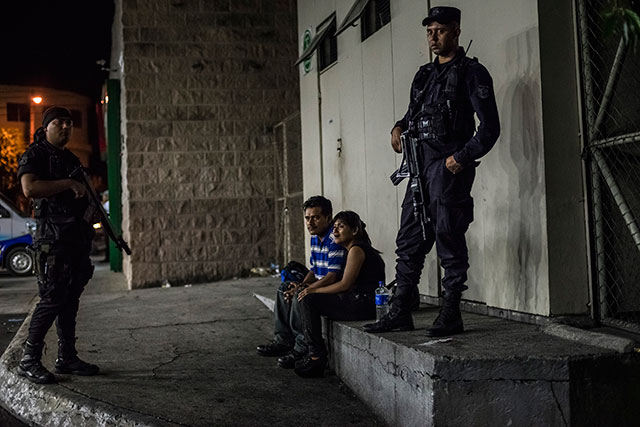
Political Report # 1094 Hearts, Minds and Body Counts: The Politics of El Salvador's Security Crisis By Hilary Goodfriend, Truthout


Members of the Salvadorian police force detain a man in possession of an illegal firearm in San Salvador, El Salvador, May 26, 2015. (Meridith Kohut / The New York Times)


By Hilary Goodfriend, Truthout
Estela Ramírez knows firsthand the debilitating effect that insecurity has on individuals and communities.
As longtime union activists in the precarious garment industry, she and her fellow organizers are increasingly fearful to navigate the working-class neighborhoods that host both garment factories and their employees - neighborhoods with steadily rising murder rates. They are also increasingly concerned about braving the bus routes that take workers to union meetings and activities. Some of her colleagues have faced gang threats, intimidation and violence at the behest of employers for their labor activism in the maquila factories. Ramírez sighs. "All this bloodshed is directed at the poor," she says. "Here, the rich don't die. Poor people die."