The defeat of Colombia's referendum in October of 2016 was a shocking development. Liberal and left-wing observers failed to predict that voters would be won over by the Right's fear-mongering anti-peace campaign.
In Colombia, ideological vestiges of the Cold War have been refashioned to direct fear and anger towards a fictional "gender ideology" that supposedly poses a spiritual threat to Christian values. In the lead-up to the peace referendum, right-wing groups were able mobilize the imaginary threat of a queer, communist conspiracy to generate panic and turn it into political capital.
It's time we grappled with the gruesome consequences of a political conjuncture in which online media figures, conservative religious movements, and a generalized politics of fear all intersect to shore up support for the Right, even in a country poised to overcome a persistent conflict that has raged for more than fifty years.
The War on "Gender Ideology"
After four years of negotiations between the government and the Revolutionary Armed Forces of Colombia-Popular Army (FARC-EP), an end to Colombia's long internal conflict seemed near. But in October 2016, with only 37 percent of the almost 35 million eligible voters showing up to the polls, the peace agreement was rejected by a margin of just 50.21 percent.
A few days after the failed referendum, Juan Carlos Vélez, manager of the campaign opposing the peace agreement, was interviewed by La República, a well known newspaper in Colombia. According to Vélez, the success of his campaign was due to two factors: 1) the importance of digital social networks over other media sources, and 2) a differential approach to messaging that targeted different class audiences.
|

Showing posts with label Religion. Show all posts
Showing posts with label Religion. Show all posts
June 23, 2017
Political Report # 1256 Colombia's Christian Alt-Right

June 23, 2016
Abstract, "Religion and Politics in Argentina: Religious Influence on Legislative Decisions on Sexual and Reproductive Rights" by Juan Cruz Esquivel
:::::: Abstract ::::::
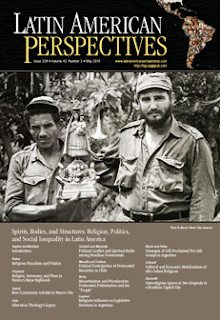
Religion and Politics in Argentina: Religious Influence on Legislative Decisions on Sexual and Reproductive Rights
by Juan Cruz Esquivel
The interactions between the state and religious institutions in Argentina are expressed on the municipal, provincial, and national levels, in the sphere of legislation and public policy, and in a wide range of undefined informal relationships. Politics and religion have historically been intertwined, and their relationship can be described as subsidiary laicism, in which the recognition of civil rights coexists with significant intervention of the Church in the implementation of public policy and in which state support of religion at an intermediate level is considered legitimate. Religious institutions and convictions influence votes in the Congress on laws expanding sexual and reproductive rights, and under such influence provincial and municipal governments delay the implementation of those laws.
by Juan Cruz Esquivel
The interactions between the state and religious institutions in Argentina are expressed on the municipal, provincial, and national levels, in the sphere of legislation and public policy, and in a wide range of undefined informal relationships. Politics and religion have historically been intertwined, and their relationship can be described as subsidiary laicism, in which the recognition of civil rights coexists with significant intervention of the Church in the implementation of public policy and in which state support of religion at an intermediate level is considered legitimate. Religious institutions and convictions influence votes in the Congress on laws expanding sexual and reproductive rights, and under such influence provincial and municipal governments delay the implementation of those laws.
June 17, 2016
Abstract, "Religion, Autonomy, and the Priority of Place in Mexico’s Maya Highlands" by Ruth J. Chojnacki
:::::: Abstract ::::::
Religion, Autonomy, and the Priority of Place in Mexico’s Maya Highlands
by Ruth J. Chojnacki
The irruption of Mexico’s highland Maya on the world stage with the 1994 New Year’s Day uprising by the Zapatista Army of National Liberation generated a torrent of publications. Relatively neglected in this literature is the deconstruction of costumbre (ancestral Maya tradition) by Maya youth dislocated by Mexico’s early-1980s economic collapse. In one exemplary Tzotzil Maya pueblo, the acquisition of biblical literacy and the cognitive skills it entails in Catholic Church–sponsored courses oriented to liberation theology propelled a generational religious revolt. The ensuing reclamation of ancestral territory from ladino ranchers upended colonial relations, enabling indigenous peasants in this and other highland Maya communities to institute autonomous modes of production. Driven by a dialectic of religious ritual and agricultural labor, this assertion of Maya agency attests to the salience of religion and the priority of place as indispensable resources for indigenous socioeconomic autonomy confronting neoliberal assault.
by Ruth J. Chojnacki
The irruption of Mexico’s highland Maya on the world stage with the 1994 New Year’s Day uprising by the Zapatista Army of National Liberation generated a torrent of publications. Relatively neglected in this literature is the deconstruction of costumbre (ancestral Maya tradition) by Maya youth dislocated by Mexico’s early-1980s economic collapse. In one exemplary Tzotzil Maya pueblo, the acquisition of biblical literacy and the cognitive skills it entails in Catholic Church–sponsored courses oriented to liberation theology propelled a generational religious revolt. The ensuing reclamation of ancestral territory from ladino ranchers upended colonial relations, enabling indigenous peasants in this and other highland Maya communities to institute autonomous modes of production. Driven by a dialectic of religious ritual and agricultural labor, this assertion of Maya agency attests to the salience of religion and the priority of place as indispensable resources for indigenous socioeconomic autonomy confronting neoliberal assault.
June 10, 2016
Abstract, "Public Policy and Religious Diversity: Interreligious Spaces in Two Hospitals in a Brazilian Capital City" by Emerson Giumbelli
:::::: Abstract ::::::
Public Policy and Religious Diversity: Interreligious Spaces in Two Hospitals in a Brazilian Capital City
by Emerson Giumbelli
Recently in Brazil, diversity has become a guiding principle in formulating public policy, and “interreligious spaces” have been established in public hospitals for the use of religious groups of various kinds. An examination of the use of these spaces in two major public hospitals in Porto Alegre makes it clear that religious diversity has fundamental political dimensions involving the representation and recognition of social groups and that a commitment to religious pluralism does not rule out other hegemonies.
by Emerson Giumbelli
Recently in Brazil, diversity has become a guiding principle in formulating public policy, and “interreligious spaces” have been established in public hospitals for the use of religious groups of various kinds. An examination of the use of these spaces in two major public hospitals in Porto Alegre makes it clear that religious diversity has fundamental political dimensions involving the representation and recognition of social groups and that a commitment to religious pluralism does not rule out other hegemonies.
June 8, 2016
Abstract, "The Antidote to Wall Street?: Cultural and Economic Mobilizations of Afro-Cuban Religions" by Jalane D. Schmidt
:::::: Abstract ::::::
The Antidote to Wall Street?: Cultural and Economic Mobilizations of Afro-Cuban Religions
by Jalane D. Schmidt
When revolutionary Cuba’s governmental cultural policy apparatus cast Afro-Cuban religions as “folklore,” certain religious forms, especially Santería, gained visibility in scholarly investigations, publications, documentary films, and state-sponsored cultural programming. Since the 1990s these discursive treatments of Santería have been monetized by the Cuban tourism industry and state-owned manufacturers and repackaged as merchandise that garners the attention and revenues of Cuban consumers and international visitors. This “ethno-business” produces a paradox: Afro-Cuban popular religions—long admired by the nation’s intellectual and artistic avant-garde as subaltern cultural rebuttals of dominant Cuban bourgeois opinion and U.S. economic pressures alike—are now promoted and consumed in a manner that conforms to neoliberal logic. The Cuban state confronts the challenges of late socialism with the methods of late capitalism. To some extent, the commodification of Afro-Cuban religions acts to fortify and extend revolutionary cultural policy.
by Jalane D. Schmidt
When revolutionary Cuba’s governmental cultural policy apparatus cast Afro-Cuban religions as “folklore,” certain religious forms, especially Santería, gained visibility in scholarly investigations, publications, documentary films, and state-sponsored cultural programming. Since the 1990s these discursive treatments of Santería have been monetized by the Cuban tourism industry and state-owned manufacturers and repackaged as merchandise that garners the attention and revenues of Cuban consumers and international visitors. This “ethno-business” produces a paradox: Afro-Cuban popular religions—long admired by the nation’s intellectual and artistic avant-garde as subaltern cultural rebuttals of dominant Cuban bourgeois opinion and U.S. economic pressures alike—are now promoted and consumed in a manner that conforms to neoliberal logic. The Cuban state confronts the challenges of late socialism with the methods of late capitalism. To some extent, the commodification of Afro-Cuban religions acts to fortify and extend revolutionary cultural policy.
June 3, 2016
Abstract, "Religion and Politics in Argentina: Religious Influence on Legislative Decisions on Sexual and Reproductive Rights" by Juan Cruz Esquivel
:::::: Abstract ::::::
Religion and Politics in Argentina: Religious Influence on Legislative Decisions on Sexual and Reproductive Rights
by Juan Cruz Esquivel
The interactions between the state and religious institutions in Argentina are expressed on the municipal, provincial, and national levels, in the sphere of legislation and public policy, and in a wide range of undefined informal relationships. Politics and religion have historically been intertwined, and their relationship can be described as subsidiary laicism, in which the recognition of civil rights coexists with significant intervention of the Church in the implementation of public policy and in which state support of religion at an intermediate level is considered legitimate. Religious institutions and convictions influence votes in the Congress on laws expanding sexual and reproductive rights, and under such influence provincial and municipal governments delay the implementation of those laws.
by Juan Cruz Esquivel
The interactions between the state and religious institutions in Argentina are expressed on the municipal, provincial, and national levels, in the sphere of legislation and public policy, and in a wide range of undefined informal relationships. Politics and religion have historically been intertwined, and their relationship can be described as subsidiary laicism, in which the recognition of civil rights coexists with significant intervention of the Church in the implementation of public policy and in which state support of religion at an intermediate level is considered legitimate. Religious institutions and convictions influence votes in the Congress on laws expanding sexual and reproductive rights, and under such influence provincial and municipal governments delay the implementation of those laws.
May 20, 2016
Abstract, "Religion, Autonomy, and the Priority of Place in Mexico’s Maya Highlands" by Ruth J. Chojnacki
:::::: Abstract ::::::
Religion, Autonomy, and the Priority of Place in Mexico’s Maya Highlands
by Ruth J. Chojnacki
The irruption of Mexico’s highland Maya on the world stage with the 1994 New Year’s Day uprising by the Zapatista Army of National Liberation generated a torrent of publications. Relatively neglected in this literature is the deconstruction of costumbre (ancestral Maya tradition) by Maya youth dislocated by Mexico’s early-1980s economic collapse. In one exemplary Tzotzil Maya pueblo, the acquisition of biblical literacy and the cognitive skills it entails in Catholic Church–sponsored courses oriented to liberation theology propelled a generational religious revolt. The ensuing reclamation of ancestral territory from ladino ranchers upended colonial relations, enabling indigenous peasants in this and other highland Maya communities to institute autonomous modes of production. Driven by a dialectic of religious ritual and agricultural labor, this assertion of Maya agency attests to the salience of religion and the priority of place as indispensable resources for indigenous socioeconomic autonomy confronting neoliberal assault.
by Ruth J. Chojnacki
The irruption of Mexico’s highland Maya on the world stage with the 1994 New Year’s Day uprising by the Zapatista Army of National Liberation generated a torrent of publications. Relatively neglected in this literature is the deconstruction of costumbre (ancestral Maya tradition) by Maya youth dislocated by Mexico’s early-1980s economic collapse. In one exemplary Tzotzil Maya pueblo, the acquisition of biblical literacy and the cognitive skills it entails in Catholic Church–sponsored courses oriented to liberation theology propelled a generational religious revolt. The ensuing reclamation of ancestral territory from ladino ranchers upended colonial relations, enabling indigenous peasants in this and other highland Maya communities to institute autonomous modes of production. Driven by a dialectic of religious ritual and agricultural labor, this assertion of Maya agency attests to the salience of religion and the priority of place as indispensable resources for indigenous socioeconomic autonomy confronting neoliberal assault.
May 13, 2016
Abstract, "Public Policy and Religious Diversity: Interreligious Spaces in Two Hospitals in a Brazilian Capital City" by Emerson Giumbelli
:::::: Abstract ::::::
Public Policy and Religious Diversity: Interreligious Spaces in Two Hospitals in a Brazilian Capital City
by Emerson Giumbelli
Recently in Brazil, diversity has become a guiding principle in formulating public policy, and “interreligious spaces” have been established in public hospitals for the use of religious groups of various kinds. An examination of the use of these spaces in two major public hospitals in Porto Alegre makes it clear that religious diversity has fundamental political dimensions involving the representation and recognition of social groups and that a commitment to religious pluralism does not rule out other hegemonies.
by Emerson Giumbelli
Recently in Brazil, diversity has become a guiding principle in formulating public policy, and “interreligious spaces” have been established in public hospitals for the use of religious groups of various kinds. An examination of the use of these spaces in two major public hospitals in Porto Alegre makes it clear that religious diversity has fundamental political dimensions involving the representation and recognition of social groups and that a commitment to religious pluralism does not rule out other hegemonies.
May 11, 2016
Abstract, "The Antidote to Wall Street?: Cultural and Economic Mobilizations of Afro-Cuban Religions" by Jalane D. Schmidt
:::::: Abstract ::::::
The Antidote to Wall Street?: Cultural and Economic Mobilizations of Afro-Cuban Religions
by Jalane D. Schmidt
When revolutionary Cuba’s governmental cultural policy apparatus cast Afro-Cuban religions as “folklore,” certain religious forms, especially Santería, gained visibility in scholarly investigations, publications, documentary films, and state-sponsored cultural programming. Since the 1990s these discursive treatments of Santería have been monetized by the Cuban tourism industry and state-owned manufacturers and repackaged as merchandise that garners the attention and revenues of Cuban consumers and international visitors. This “ethno-business” produces a paradox: Afro-Cuban popular religions—long admired by the nation’s intellectual and artistic avant-garde as subaltern cultural rebuttals of dominant Cuban bourgeois opinion and U.S. economic pressures alike—are now promoted and consumed in a manner that conforms to neoliberal logic. The Cuban state confronts the challenges of late socialism with the methods of late capitalism. To some extent, the commodification of Afro-Cuban religions acts to fortify and extend revolutionary cultural policy.
by Jalane D. Schmidt
When revolutionary Cuba’s governmental cultural policy apparatus cast Afro-Cuban religions as “folklore,” certain religious forms, especially Santería, gained visibility in scholarly investigations, publications, documentary films, and state-sponsored cultural programming. Since the 1990s these discursive treatments of Santería have been monetized by the Cuban tourism industry and state-owned manufacturers and repackaged as merchandise that garners the attention and revenues of Cuban consumers and international visitors. This “ethno-business” produces a paradox: Afro-Cuban popular religions—long admired by the nation’s intellectual and artistic avant-garde as subaltern cultural rebuttals of dominant Cuban bourgeois opinion and U.S. economic pressures alike—are now promoted and consumed in a manner that conforms to neoliberal logic. The Cuban state confronts the challenges of late socialism with the methods of late capitalism. To some extent, the commodification of Afro-Cuban religions acts to fortify and extend revolutionary cultural policy.
May 6, 2016
Abstract, "Religion and Politics in Argentina: Religious Influence on Legislative Decisions on Sexual and Reproductive Rights" by Juan Cruz Esquivel
:::::: Abstract ::::::
Religion and Politics in Argentina: Religious Influence on Legislative Decisions on Sexual and Reproductive Rights
by Juan Cruz Esquivel
The interactions between the state and religious institutions in Argentina are expressed on the municipal, provincial, and national levels, in the sphere of legislation and public policy, and in a wide range of undefined informal relationships. Politics and religion have historically been intertwined, and their relationship can be described as subsidiary laicism, in which the recognition of civil rights coexists with significant intervention of the Church in the implementation of public policy and in which state support of religion at an intermediate level is considered legitimate. Religious institutions and convictions influence votes in the Congress on laws expanding sexual and reproductive rights, and under such influence provincial and municipal governments delay the implementation of those laws.
by Juan Cruz Esquivel
The interactions between the state and religious institutions in Argentina are expressed on the municipal, provincial, and national levels, in the sphere of legislation and public policy, and in a wide range of undefined informal relationships. Politics and religion have historically been intertwined, and their relationship can be described as subsidiary laicism, in which the recognition of civil rights coexists with significant intervention of the Church in the implementation of public policy and in which state support of religion at an intermediate level is considered legitimate. Religious institutions and convictions influence votes in the Congress on laws expanding sexual and reproductive rights, and under such influence provincial and municipal governments delay the implementation of those laws.
April 22, 2016
Abstract, "Religion, Autonomy, and the Priority of Place in Mexico’s Maya Highlands" by Ruth J. Chojnacki
:::::: Abstract ::::::
Religion, Autonomy, and the Priority of Place in Mexico’s Maya Highlands
by Ruth J. Chojnacki
The irruption of Mexico’s highland Maya on the world stage with the 1994 New Year’s Day uprising by the Zapatista Army of National Liberation generated a torrent of publications. Relatively neglected in this literature is the deconstruction of costumbre (ancestral Maya tradition) by Maya youth dislocated by Mexico’s early-1980s economic collapse. In one exemplary Tzotzil Maya pueblo, the acquisition of biblical literacy and the cognitive skills it entails in Catholic Church–sponsored courses oriented to liberation theology propelled a generational religious revolt. The ensuing reclamation of ancestral territory from ladino ranchers upended colonial relations, enabling indigenous peasants in this and other highland Maya communities to institute autonomous modes of production. Driven by a dialectic of religious ritual and agricultural labor, this assertion of Maya agency attests to the salience of religion and the priority of place as indispensable resources for indigenous socioeconomic autonomy confronting neoliberal assault.
by Ruth J. Chojnacki
The irruption of Mexico’s highland Maya on the world stage with the 1994 New Year’s Day uprising by the Zapatista Army of National Liberation generated a torrent of publications. Relatively neglected in this literature is the deconstruction of costumbre (ancestral Maya tradition) by Maya youth dislocated by Mexico’s early-1980s economic collapse. In one exemplary Tzotzil Maya pueblo, the acquisition of biblical literacy and the cognitive skills it entails in Catholic Church–sponsored courses oriented to liberation theology propelled a generational religious revolt. The ensuing reclamation of ancestral territory from ladino ranchers upended colonial relations, enabling indigenous peasants in this and other highland Maya communities to institute autonomous modes of production. Driven by a dialectic of religious ritual and agricultural labor, this assertion of Maya agency attests to the salience of religion and the priority of place as indispensable resources for indigenous socioeconomic autonomy confronting neoliberal assault.
Subscribe to:
Posts (Atom)