Showing posts with label Blacks. Show all posts

September 13, 2021

Political Report #1460 - The Census, Skin Color and Social Analysis

by Esteban Morales Domínguez


Although it still causes many prejudices, misunderstandings and challenges, there is no choice but to pay attention to skin color. Above all, in its consideration within the media and national statistics.

Cuban society is a multiracial society, or rather, multicolored, mestizo. And that reality has to be registered statistically. Not by handling the Census as a simply numerical matter, but as a cultural demographic one.


It is about the fact that color is a legacy of slavery. It is not possible to avoid it, since it has marked Cuban society since its origins.

When the Spaniards arrived in Cuba, in 1492, they did it with white credentials and that is how they stayed. Those who came of their own free will did so in search of a fortune, which they often found.

But Spain is not White. Colonized by the Arabs for 800 years, it is impossible to consider it as such. Even when the Spanish do not assume that identity.


So, the colonizers of our Archipelago were not white. Their power did not consist in being white, but in having arrived with the cross and the sword.


They arrived in a territory of indigenous people, of low culture and they only used them to find gold. They exploited them mercilessly and their population mass did not last long, although we still have representatives of that original population in Cuba.


Chinese also came, brought by means of a system of contracts that turned them into slaves. The so-called “culíes” [coolies], who since then added their beauty to the population of the Island, becoming a part of our nationality. These three large groups were the ones that formed the Cuban population. Later, other Antilleans joined, although not in the magnitude of the first ones, also merging with our population.  

June 8, 2016

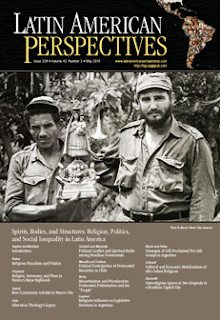
Abstract, "The Antidote to Wall Street?: Cultural and Economic Mobilizations of Afro-Cuban Religions" by Jalane D. Schmidt

:::::: Abstract ::::::

The Antidote to Wall Street?: Cultural and Economic Mobilizations of Afro-Cuban Religions 
by Jalane D. Schmidt

When revolutionary Cuba’s governmental cultural policy apparatus cast Afro-Cuban religions as “folklore,” certain religious forms, especially Santería, gained visibility in scholarly investigations, publications, documentary films, and state-sponsored cultural programming. Since the 1990s these discursive treatments of Santería have been monetized by the Cuban tourism industry and state-owned manufacturers and repackaged as merchandise that garners the attention and revenues of Cuban consumers and international visitors. This “ethno-business” produces a paradox: Afro-Cuban popular religions—long admired by the nation’s intellectual and artistic avant-garde as subaltern cultural rebuttals of dominant Cuban bourgeois opinion and U.S. economic pressures alike—are now promoted and consumed in a manner that conforms to neoliberal logic. The Cuban state confronts the challenges of late socialism with the methods of late capitalism. To some extent, the commodification of Afro-Cuban religions acts to fortify and extend revolutionary cultural policy.

May 11, 2016

Abstract, "The Antidote to Wall Street?: Cultural and Economic Mobilizations of Afro-Cuban Religions" by Jalane D. Schmidt

:::::: Abstract ::::::

The Antidote to Wall Street?: Cultural and Economic Mobilizations of Afro-Cuban Religions 
by Jalane D. Schmidt

When revolutionary Cuba’s governmental cultural policy apparatus cast Afro-Cuban religions as “folklore,” certain religious forms, especially Santería, gained visibility in scholarly investigations, publications, documentary films, and state-sponsored cultural programming. Since the 1990s these discursive treatments of Santería have been monetized by the Cuban tourism industry and state-owned manufacturers and repackaged as merchandise that garners the attention and revenues of Cuban consumers and international visitors. This “ethno-business” produces a paradox: Afro-Cuban popular religions—long admired by the nation’s intellectual and artistic avant-garde as subaltern cultural rebuttals of dominant Cuban bourgeois opinion and U.S. economic pressures alike—are now promoted and consumed in a manner that conforms to neoliberal logic. The Cuban state confronts the challenges of late socialism with the methods of late capitalism. To some extent, the commodification of Afro-Cuban religions acts to fortify and extend revolutionary cultural policy.