Showing posts with label Zapatistas. Show all posts

May 11, 2018

Political Report # 1335 Zapatista Women Inspire the Fight Against Patriarchy


By Shirin Hess, Waging Nonviolence

Dawn had only just broken over the mountains. While most of the women and children on the camping grounds were still asleep, others were already wide awake, huddling together in the first rays of sunlight and drinking coffee.
To a casual observer, this place might have seemed similar to any mainstream festival campsite. A distinguishing factor, however, was that there wasn't a single man in sight. The sign on the main entrance left no one in doubt that only women and children were welcome at this event: "Men not permitted to enter."
Women's participation in Mexico's 25-year-old Zapatista National Liberation Army, or EZLN movement, has represented an incredible organizational achievement since its original uprising in 1994. On International Women's Day, the female militants of the EZLN did not fail to meet expectations when welcoming 7,000 people to the "First International Political, Artistic, Sports, and Cultural Encounter for Women who Struggle."
Two thousand indigenous Zapatista women from various parts of Chiapas state and 5,000 visitors from all over the world came to Caracol Morelia, near the northeastern town of Altamirano, to hear what they had to say.

March 2, 2018

Political Report # 1316 Cracks in the Wall of Capitalism: The Zapatistas and the Struggle to Decolonize Science


By  David Meek

Toward Freedom


Below images of Mexican revolutionary Emiliano Zapata, and a many-headed hydra consuming humanity, sit two groups. To the right, facing a stage, are approximately 200 delegates of the Zapatista National Liberation Army (EZLN), seated as a homogenous block. Wearing black ski masks, they furiously take notes. To the left, 300 scientists and observers from throughout the world are seated.
With a tiny pink ribbon pinned to her mask, Julía, a Zapatista delegate from Oventic, Chiapas, takes the microphone: "The rivers are drying up. We know that the people before had a way of planting their crops, but now it doesn't rain like it's expected to. Now, there are epidemics that weren't common before, like cancer and diabetes..."
Julía is unequivocal about the linkages between science and capitalism in perpetuating this crisis. "Medicines just create dependence on the pharmaceutical industry," she tells us. But Julía is also clear that science can function as a tool of resistance, if reimagined from the grassroots: "Brother and sister scientists, we ask you, according to your studies: why does all this happen? And who is responsible? We have come to hear you and bring this knowledge to the peoples, to our peoples."
Over four days, from December 27th-30th 2017, the second iteration of ConCiencias, a conference creating dialogue between the Zapatista's and leading left-wing scientists from throughout the world, took place at CIDECI-Universidad de la Tierra, located on the outskirts of San Cristobal de Las Casas-a city in Chiapas which has long been associated with the Zapatista's struggle. Although it might seem tangential, the struggle to decolonize knowledge is part and parcel of the Zapatista's broader project of resisting indigenous genocide, neoliberal capitalism, and political repression.
Las ConCiencias, the title of the conference, brings together the Spanish words for science and awareness. The moniker pinpoints the conference's dual purpose. First, the Zapatistas convened the meeting to critically explore the ways in which science has historically been a social endeavor largely devoid of consciousness, a project in the service of capital, an endeavor that contributes to the marginalization of indigenous peoples throughout the world. Second, the conference is a space of dialogue to explore the counter-hegemonic potential of science; how can its power be harnessed to identify the cracks in the wall of capitalism, and expand upon them, leading to its dissolution and the resurgent sovereignty of indigenous peoples.

July 28, 2017

Abstract, Societies in Movement vs. Institutional Continuities? Insights from the Zapatista Experience

:::::: Abstract ::::::


Societies in Movement vs. Institutional Continuities? Insights from the Zapatista Experience
by Diana Guillén        

In Latin America and other parts of the world, the social volatility of the past two decades has focused attention on the traditional concepts of what political structures and practices should be, highlighting what might be characterized as an empirical bursting at the seams of the classic normative frameworks. In this context it is of interest to analyze the proposal of the Ejército Zapatista de Liberación Nacional (Zapatista Army of National Liberation—EZLN) to establish a political-social organization parallel to the institutional framework recognized by Mexican law and contribute to the debate that has arisen about this kind of experiment and its transformational potential.


July 19, 2017

Political Report # 1260 Dismantling Power: The Zapatista Indigenous Presidential Candidate’s Vision to Transform Mexico from Below

The Zapatistas and National Indigenous Congress (CNI) held an assembly in May in which they chose María de Jesús Patricio Martínez, a Nahua indigenous healer, as their spokesperson and presidential candidate for the 2018 elections in Mexico.
Patricio’s candidacy and radical vision for Mexico challenges conventional politics and marks a new phase for the Zapatista and indigenous struggle in the country.
The 57-year-old traditional Nahua indigenous doctor and mother of three from western Mexico is the first indigenous woman to run for the presidency in Mexico.
Patricio joined the struggles related to the Zapatista Army of National Liberation in 1996, when she was involved in the formation of the CNI, a network of indigenous communities in the country. She began helping out sick members of her community with herbal remedies when she was 20-years-old. Her skills as a healer were passed down to her from elders in the community, and are based on a close relationship with the local ecosystem.
“Back then, there was a shortage of doctors and medicine and the health department had no answers,” Patricio told the Guardian. “But we have so many plants and so much knowledge from our elders. My grandmother would give us special teas to cure stress, coughs or diarrhea, and they worked. So I thought: why not give herbal remedies to those who can’t afford medicine?” Her work as an herbalist has influenced her political views: “The political class only see the earth and our natural resources as means of making money, not things that benefit the community and need protecting.”

June 17, 2016

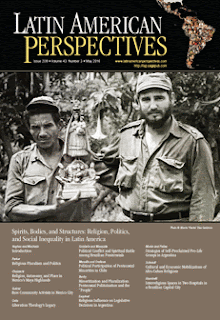
Abstract, "Religion, Autonomy, and the Priority of Place in Mexico’s Maya Highlands" by Ruth J. Chojnacki

:::::: Abstract ::::::

Religion, Autonomy, and the Priority of Place in Mexico’s Maya Highlands 
by Ruth J. Chojnacki

The irruption of Mexico’s highland Maya on the world stage with the 1994 New Year’s Day uprising by the Zapatista Army of National Liberation generated a torrent of publications. Relatively neglected in this literature is the deconstruction of costumbre (ancestral Maya tradition) by Maya youth dislocated by Mexico’s early-1980s economic collapse. In one exemplary Tzotzil Maya pueblo, the acquisition of biblical literacy and the cognitive skills it entails in Catholic Church–sponsored courses oriented to liberation theology propelled a generational religious revolt. The ensuing reclamation of ancestral territory from ladino ranchers upended colonial relations, enabling indigenous peasants in this and other highland Maya communities to institute autonomous modes of production. Driven by a dialectic of religious ritual and agricultural labor, this assertion of Maya agency attests to the salience of religion and the priority of place as indispensable resources for indigenous socioeconomic autonomy confronting neoliberal assault.

May 20, 2016

Abstract, "Religion, Autonomy, and the Priority of Place in Mexico’s Maya Highlands" by Ruth J. Chojnacki

:::::: Abstract ::::::

Religion, Autonomy, and the Priority of Place in Mexico’s Maya Highlands 
by Ruth J. Chojnacki

The irruption of Mexico’s highland Maya on the world stage with the 1994 New Year’s Day uprising by the Zapatista Army of National Liberation generated a torrent of publications. Relatively neglected in this literature is the deconstruction of costumbre (ancestral Maya tradition) by Maya youth dislocated by Mexico’s early-1980s economic collapse. In one exemplary Tzotzil Maya pueblo, the acquisition of biblical literacy and the cognitive skills it entails in Catholic Church–sponsored courses oriented to liberation theology propelled a generational religious revolt. The ensuing reclamation of ancestral territory from ladino ranchers upended colonial relations, enabling indigenous peasants in this and other highland Maya communities to institute autonomous modes of production. Driven by a dialectic of religious ritual and agricultural labor, this assertion of Maya agency attests to the salience of religion and the priority of place as indispensable resources for indigenous socioeconomic autonomy confronting neoliberal assault.

April 22, 2016

Abstract, "Religion, Autonomy, and the Priority of Place in Mexico’s Maya Highlands" by Ruth J. Chojnacki

:::::: Abstract ::::::

Religion, Autonomy, and the Priority of Place in Mexico’s Maya Highlands 
by Ruth J. Chojnacki

The irruption of Mexico’s highland Maya on the world stage with the 1994 New Year’s Day uprising by the Zapatista Army of National Liberation generated a torrent of publications. Relatively neglected in this literature is the deconstruction of costumbre (ancestral Maya tradition) by Maya youth dislocated by Mexico’s early-1980s economic collapse. In one exemplary Tzotzil Maya pueblo, the acquisition of biblical literacy and the cognitive skills it entails in Catholic Church–sponsored courses oriented to liberation theology propelled a generational religious revolt. The ensuing reclamation of ancestral territory from ladino ranchers upended colonial relations, enabling indigenous peasants in this and other highland Maya communities to institute autonomous modes of production. Driven by a dialectic of religious ritual and agricultural labor, this assertion of Maya agency attests to the salience of religion and the priority of place as indispensable resources for indigenous socioeconomic autonomy confronting neoliberal assault.