Showing posts with label IMF. Show all posts

January 17, 2019

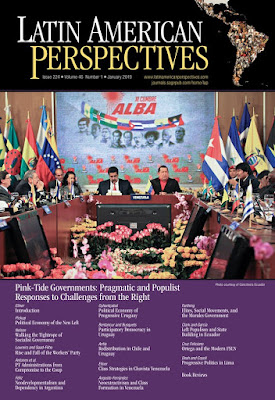
Abstract, Neodevelopmentalism and Dependency in Twenty-first-Century Argentina: Insights from the Work of Ruy Mauro Marini

:::::: Abstract ::::::


Neodevelopmentalism and Dependency in Twenty-first-Century Argentina: Insights from the Work of Ruy Mauro Marini
by Mariano Féliz


For Ruy Mauro Marini, writing in the mid-1990s, neodevelopmentalism in Latin America ended with the moratoria on debt repayment in Mexico and Brazil in the early 1980s, which ushered in an era of International Monetary Fund control. For him this demonstrated the inability of the Latin American bourgeoisie to achieve autonomy at the international level. Neodevelopmentalism returned in early-twenty-first-century Argentina in the local context of a new class politics and a wider context marked by the emergence of China in the world economy and the influence of Chavismo. It consisted of an economic policy that consolidated the new hegemonic groups led by transnational capital through the superexploitation of labor and nature and the revival of the myth of development expressed by the notion of “growth with social inclusion.” For a time the project was characterized by high rates of profit and high levels of (albeit precarious) employment, but, as the global crisis of 2008 revealed its limitations and the “fine-tuning” of economic policy produced a decline of real incomes and consumption, it led to fragmentation of the political spectrum and a realignment of its principal actors. Mauricio Macri’s election to the presidency in 2015 represented a counterrevolution that, as Marini predicted decades ago, would involve more violent superexploitation and stronger imperialist influence.


CONTINUE READING THE FULL ARTICLE HERE

SaveSave
SaveSave
SaveSave
SaveSave
SaveSave


SaveSave
SaveSave
SaveSave
SaveSave
SaveSave
SaveSave

February 19, 2016

Political Report # 1117 International Monetary Fund's Rogues Gallery Crooks, Rapists and Swindlers By James Petras LAP Editor


Introduction
            The IMF is the leading international monetary agency whose public purpose is to maintain the stability of the global financial system through loans linked to proposals designed to enhance economic recovery and growth.
            In fact, the IMF has been under the control of the US and Western European states and its policies have been designed to further the expansion, domination and profits of their leading multi-national corporations and financial institutions.
            The US and European states practice a division of powers:  The executive directors of the IMF are Europeans; their counterparts in the World Bank (WB) are from the US.
            The executive directors of the IMF and WB operate in close consultation with their governments and especially the Treasury Departments in deciding priorities, deciding what countries will receive loans, under what terms and how much.
            The loans and terms set by the IMF are closely coordinated with the private banking system.  Once the IMF signs an agreement with a debtor country, it is a signal for the big private banks to lend, invest and proceed with a multiplicity of favorable financial transactions.  From the above it can be deduced that the IMF plays the role of general command for the global financial system.
            The IMF lays the groundwork for the major banks' conquest of the financial systems of the world's vulnerable states.

July 29, 2015

Political Report # 1063 by LAP Editor Boaventura de Sousa Santos - Tests Fatales


                                   Por Boaventura de Sousa Santos, LAP Editor
 
Europa se ha convertido en un laboratorio del futuro. Lo que en él se experimenta debe causar preocupación a cualquier demócrata y, más aún, a cualquier persona de izquierda. Dos experiencias se están desarrollando en ambiente de laboratorio, es decir, supuestamente controlado. La primera es un test de estrés a la democracia. La hipótesis que orienta el test es la siguiente: la deliberación democrática de un país fuerte puede superponerse antidemocráticamente a la deliberación democrática de un país débil sin alterar la normalidad de la vida política europea. Las condiciones para el éxito de esta experiencia son tres: controlar la opinión pública de modo que los intereses nacionales del país más fuerte se conviertan en el interés común de la zona del euro; disponer de un conjunto de instituciones no electas (Eurogrupo, BCE, FMI, Comisión Europea) capaces de neutralizar y castigar cualquier deliberación democrática que desobedezca el diktat del país dominante; y demonizar al país más débil de manera que no suscite ninguna simpatía entre los electores del resto de países europeos, sobre todo entre los votantes de los países candidatos a desobedecer.