Showing posts with label Mauricio Macri. Show all posts

January 17, 2019

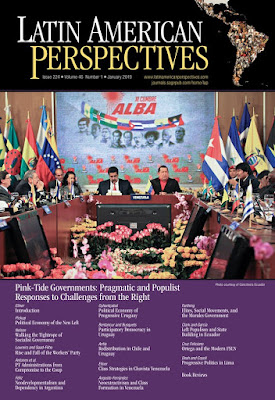
Abstract, Neodevelopmentalism and Dependency in Twenty-first-Century Argentina: Insights from the Work of Ruy Mauro Marini

:::::: Abstract ::::::


Neodevelopmentalism and Dependency in Twenty-first-Century Argentina: Insights from the Work of Ruy Mauro Marini
by Mariano Féliz


For Ruy Mauro Marini, writing in the mid-1990s, neodevelopmentalism in Latin America ended with the moratoria on debt repayment in Mexico and Brazil in the early 1980s, which ushered in an era of International Monetary Fund control. For him this demonstrated the inability of the Latin American bourgeoisie to achieve autonomy at the international level. Neodevelopmentalism returned in early-twenty-first-century Argentina in the local context of a new class politics and a wider context marked by the emergence of China in the world economy and the influence of Chavismo. It consisted of an economic policy that consolidated the new hegemonic groups led by transnational capital through the superexploitation of labor and nature and the revival of the myth of development expressed by the notion of “growth with social inclusion.” For a time the project was characterized by high rates of profit and high levels of (albeit precarious) employment, but, as the global crisis of 2008 revealed its limitations and the “fine-tuning” of economic policy produced a decline of real incomes and consumption, it led to fragmentation of the political spectrum and a realignment of its principal actors. Mauricio Macri’s election to the presidency in 2015 represented a counterrevolution that, as Marini predicted decades ago, would involve more violent superexploitation and stronger imperialist influence.


CONTINUE READING THE FULL ARTICLE HERE

SaveSave
SaveSave
SaveSave
SaveSave
SaveSave


SaveSave
SaveSave
SaveSave
SaveSave
SaveSave
SaveSave

August 15, 2018

Political Report # 1361 Repression Intensifies in Argentina After President Empowers the Military

Weeks after Argentina signed a deal for a new $50 billion loan from the International Monetary Fund (IMF) and only days after hosting G20 leaders in Buenos Aires, Argentine President Mauricio Macri issued a decree July 23 that would allow the country’s armed forces to intervene in questions of domestic security.
The decree violates laws passed after the country’s last military dictatorship - an authoritarian military junta that took power in a coup in 1976 and used force and repression to silence all opposition - ended in 1983, which limited the role of the armed forces, and points to a disturbing trend of militarization and repression under the right-wing government. The decision sparked immediate outrage from human rights organizations and social movements who have since organized massive protests around the country.
In his statement, President Macri referred to issues of “national security,” drug-trafficking and protecting the national border to justify giving the military expanded powers. He also stated a more general need for the armed forces to “modernize” in response to 21st century threats, including “internal threats.” These statements have worried many human rights organizations who fear a return to the type of repression experienced under the dictatorship - when armed forces were likewise allowed to intervene in domestic issues.
According to the Center for Legal and Social Studies, the decree is in violation of the Defense and Security Laws, a series of laws that separate national defense from domestic security, considered fundamental to Argentina’s democracy and necessary to prevent a return to the state terrorism of the dictatorship. During that period, the state and the armed forces were responsible for the “disappearance” of 30,000 people from 1976 to 1983: kidnapping, torturing and murdering them using similar rhetoric about “internal enemies.” In a statement against the decree, the Center argues that, “This new paradigm builds the idea of internal enemies and increases violence. Involving Armed Forces in interior security puts at risk the civilian government and human rights.”

May 14, 2018

Political Report # 1336 Macri's Argentina Has Become a Hotbed of Neoliberalism and Police Violence


By Hugo Goeury, Truthout 
After 12 years of center-left rule under Néstor Kirchner (2003-2007) and his wife Cristina Fernández de Kirchner (2007-2015), Argentina took a decisive turn to the right in November 2015 with the election of Mauricio Macri, a former businessman and mayor of Buenos Aires from 2007 to 2015.
If the first decade of the 21st century had seen left and center-left governments dominate the Latin American political scene -- a period that is often called the "Pink Tide" -- Macri's election marked the beginning of a regional shift to the right. Since then, the left has faced many challenges and setbacks in Latin America. Those include, among others: the controversial removal of Brazil's first female president Dilma Rousseff by parliament in August 2016, followed by the current judicial attacks aimed at preventing former President Luiz Inácio Lula da Silva from running in the upcoming presidential election; the recent election of right-wing, multibillionaire and former president (2010-2014) Sebastián Piñera in Chile; and the confrontation between Rafael Correa and his successor, ex-Vice President Lenín Moreno in Ecuador.
Meanwhile, in Argentina, the resurgence of the right and the implementation of Macri's neoliberal project has not only been synonymous with constant assaults against social rights, but also of increasing levels of state violence.

April 13, 2018

Political Report # 1330 Argentina at the Crossroads: Crisis and Resistance Under Neoliberal President Macri


By Dario Farcy
Toward Freedom


Argentinian history is convulsive and for the ones who look at it from outside, it might seem impossible to understand. But a closer look reveals some of the roots and contours of today's crisis.
In the 19th century, Argentina was founded upon the idea of a great nation. Its ruling class was inspired by the bourgeois from France, United Kingdom, and Germany. But when entering the world market, Argentina had to define its position: would it stay under the wing of the already industrialized countries or take the difficult path of national development? Clearly, the first option had all the sweetness of being part of the chosen group of nations selected by the central economies; yet the second one presented the opportunity to autonomously decide over its fate as a nation. As we know from history, the ruling elite most often has chosen the first route. Why? Because they always felt closer to their partners in Europe or the USA than to the ones who live, suffer, and fight in Latin America. And it is this elite, that wished it had been born in Paris or New York, which is ruling Argentina once again.
There is no doubt, 2017 was a bittersweet year for the government and its project of re-founding Argentina, since it started and ended with huge demonstrations against the austerity policies promoted by Cambiemos, the ruling political party coalition of Argentina. Yet, it was not until the legislative elections of October 2017 that the government really advanced some of its most unpopular policies, policies which reflected the elite's vision of a new Argentina based on neoliberal ideology. It is this ideology and the corresponding actions taken by the government, which - in contrast to the declarations of the Argentinian president Mauricio Macri in front of the Davos Forum, where he said that unemployment and poverty in the country had been reduced - have provoked a severe economic and social crisis in Argentina. Consider the following examples which illustrate this crisis.

July 11, 2017

Interview with Tomás Crowder-Taraborrelli on Macri's Presidency in Argentina


Dr. Tomas Crowder-Taraborrelli, a coordinating editor for LAP, discusses the economic and social policies of current Argentine president Mauricio Macri and popular resistance against them.


Argentina a Decade after the Collapse: The Causes of the Crisis and Structural Changes 
Latin American Perspectives 
Issue 200 Vol. 42 #1 January 2015
Available here.


Argentina a Decade after the Collapse: Old and New Social Movements
Latin American Perspectives 
Issue 201 Vol. 42 #2 March 2015
Available here.


December 7, 2016

Political Report # 1205 Does Henry Kissinger Have a Conscience?


By Jon Lee Anderson, The New Yorker


Last March, when President Obama travelled to Argentina to meet with the country's new President, Mauricio Macri, his public appearances were dogged by protesters who noisily demanded explanations, and apologies, for U.S. policies, past and present. There are few countries in the West where anti-Americanism is as vociferously expressed as in Argentina, where a highly politicized culture of grievance has evolved in which many of the country's problems are blamed on the United States. On the left, especially, there is lingering resentment over the support extended by the U.S. government to Argentina's right-wing military, which seized power in March of 1976 and launched a "Dirty War" against leftists that took thousands of lives over the following seven years.
Obama's visit coincided with the fortieth anniversary of the coup. He pointedly paid homage to the Dirty War's victims by visiting a shrine built in their honor on the outskirts of Buenos Aires. In an address he gave at the shrine, Obama acknowledged what he characterized as American sins of omission, but he stopped short of issuing an outright apology. "Democracies have to have the courage to acknowledge when we don't live up to the ideals that we stand for," he said. "And we've been slow to speak out for human rights, and that was the case here."

May 17, 2016

Political Report # 1143 Obama's Victory Dance in Argentina By Michael Corcoran, Truthout

President Obama and Argentine President Mauricio Macri visit the Parque de la Memoria to honor victim's of Argentina's dirty war, in Buenos Aires, Argentina, March 24, 2016. 
(Stephen Crowley / The New York Times)


By Michael Corcoran, Truthout


US President Barack Obama recently went to Argentina to welcome its newly elected right-wing president, Mauricio Macri. Obama appeared to be in a celebratory mood -- while he was there he danced the tango. It made for a nice photo op. Media outlets in the United States loved the image, and praised "Argentina's reemergence" as a chance for the country to "rejoin the Western world."
While in Argentina, Obama was effusive in his praise of Macri; the two stood together touting this new alliance and the prospects for new trade deals and security agreements. Macri is replacing the populist, Bolivarian-style leader, Cristina Kirchner. This change instantly turns Argentina from one of the United States' most important foes in the region into an important ally. Obama must have been well aware that Macri, despite having been in power for just 114 days, has relentlessly engaged in what the Guardian described as a "rapid succession of controversial presidential decrees."
Macri's unsettling record includes gutting a historic media law protecting against monopolies, drawing the ire of Pope Francis by arresting the prominent human rights activist Milagro Sala, sneaking through Supreme Court justices and giving himself broad new powers by declaring a state of emergency. All of this was done within the first 100 days of his presidency, while the opposition-led Congress was away on recess. Still, Obama showered Macri with praise for his "contributions to the defense of human rights in the region."

December 30, 2015

Political Report #1103, Latin America: The Aborted Neo-Liberal Offensive By James Petras, LAP Editor

Introduction 

Pundits and commentators on the Left and Right are pronouncing 'the end of the progressive cycle in Latin America'.  They cite the recent presidential elections:

1.      Argentina, where hard-right Mauricio Macri was elected;
2.      Brazil, where President Dilma Rousseff has appointed a neo-liberal 'Chicago Boy' economist, Joaquin Levy, as Finance Minister and launched an IMF-style regressive structural adjustment policy designed to reduce social expenditures and attract financial speculators; and
3.      Venezuela, where Washington channeled millions of dollars to far-right parties, as well as violent extra-parliamentary and paramilitary groups, to destabilize the center-left Maduro government; right-wing Democratic Unity Coalition  (MUD) won the legislative elections in December 2015 with more than 2:1 margin over the Chavista Venezuelan United Socialist Party (PSUV).