Showing posts with label Progressive Governments. Show all posts

January 24, 2019

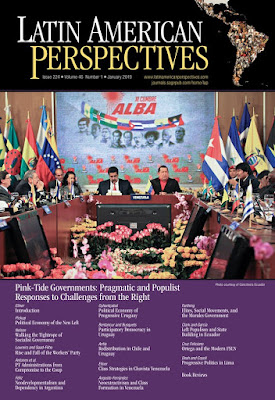
Abstract, The Governing Left in Uruguay (2005–2015): A Participatory Democratic Experiment

:::::: Abstract ::::::


The Governing Left in Uruguay (2005–2015): A Participatory Democratic Experiment


by Nicolás Bentancur and José Miguel Busquets

An account of the first 10 years of government of a leftist party in Uruguay—the Frente Amplio—focusing on a mode of designing public policies that prioritized participation by civil society organizations suggests that this strategy distinguishes it from the preceding traditional party administrations and challenges the “liberal-democratic” label assigned to it by some of the high-profile specialized literature.


CONTINUE READING THE FULL ARTICLE HERE

SaveSave
SaveSave
SaveSave
SaveSave
SaveSave


SaveSave
SaveSave
SaveSave
SaveSave
SaveSave
SaveSave

November 1, 2016

Book, Jose Carlos Mariategui: An Anthology by Harry E. Vanden and Marc Becker

:::::: Book ::::::


Jose Carlos Mariategui: An Anthology 
by Harry E. Vanden and Marc Becker


José Carlos Mariátegui is one of Latin America’s most profound but overlooked thinkers. A self-taught journalist, social scientist, and activist from Peru, he was the first to emphasize that those fighting for the revolutionary transformation of society must adapt classical Marxist theory to the particular conditions of Latin American. He also stressed that indigenous peoples must take an active, if not leading, role in any revolutionary struggle.

Today Latin America is the scene of great social upheaval. More progressive governments are in power than ever before, and grassroots movements of indigenous peoples, workers, and peasants are increasingly shaping the political landscape. The time is perfect for a rediscovery of Mariátegui, who is considered an intellectual precursor of today’s struggles in Latin America but virtually unknown in the English-speaking world. This volume collects his essential writings, including many that have never been translated and some that have never been published. The scope of this collection, masterful translation, and thoughtful commentary make it an essential book for scholars of Latin America and all of those fighting for a new world, waiting to be born.

March 2, 2016

Abstract, Political Change, State Autonomy, and Post-Neoliberalism in Ecuador, 2007–2012 by Franklin Ramírez Gallegos

:::::: Abstract ::::::


Political Change, State Autonomy, and Post-Neoliberalism in Ecuador, 2007–2012 
by Franklin Ramírez Gallegos

Along with other progressive experiments in the region, the government of the Citizens’ Revolution has restored the state to a central position with regard to social coordination and the promotion of economic development. The open conflict created by the return of the state between 2007 and 2012 transformed power relationships, allowing civil government to expand the state’s relative autonomy and orient it toward constructing a public policy agenda associated with transcending neoliberalism. The challenge of this transition has been to modify the pattern of commodity specialization away from the primacy of primary exports. While reappropriating the surplus that comes from the income from strategic resources increases national sovereignty, it may also contribute to preserving the nation’s position in the international division of labor. The National Plan for Living Well aims at overcoming the centrality of the primary sector and of oil exports in the national economy.

February 17, 2016

Abstract, Post-Neoliberalism’s Difficult Hegemonic Consolidation: A Comparative Analysis of the Ecuadorean and Bolivian Processes by Íñigo Errejón and Juan Guijarro

:::::: Abstract ::::::


Post-Neoliberalism’s Difficult Hegemonic Consolidation: A Comparative Analysis of the Ecuadorean and Bolivian Processes 
by Íñigo Errejón and Juan Guijarro

The current governments of Ecuador and Bolivia came to power after across-the-board crises of the political system. One of their immediate challenges is to consolidate the hegemony forged in the struggles against the neoliberal state. However, the allegiances created through the conflict are hard to transfer to an institutionalization of the new correlation of forces, and some groups have experienced disenchantment with the progressive governments. A comparative analysis of the hegemonic transition in the two cases suggests that, in contrast to that of Bolivia’s Movimiento al Socialismo, the hegemonic capacity of Ecuador’s electoral alliance, weakly organized and centered around the charismatic leadership of an “outsider,” depends more on its ability to dismantle possible opponents than on the appeal of its official identity, forcing it into constant reaffirmation of political boundaries.

January 25, 2016

Abstract, Political Change, State Autonomy, and Post-Neoliberalism in Ecuador, 2007–2012 by Franklin Ramírez Gallegos

:::::: Abstract ::::::


Political Change, State Autonomy, and Post-Neoliberalism in Ecuador, 2007–2012 
by Franklin Ramírez Gallegos

Along with other progressive experiments in the region, the government of the Citizens’ Revolution has restored the state to a central position with regard to social coordination and the promotion of economic development. The open conflict created by the return of the state between 2007 and 2012 transformed power relationships, allowing civil government to expand the state’s relative autonomy and orient it toward constructing a public policy agenda associated with transcending neoliberalism. The challenge of this transition has been to modify the pattern of commodity specialization away from the primacy of primary exports. While reappropriating the surplus that comes from the income from strategic resources increases national sovereignty, it may also contribute to preserving the nation’s position in the international division of labor. The National Plan for Living Well aims at overcoming the centrality of the primary sector and of oil exports in the national economy.

January 11, 2016

Abstract, Post-Neoliberalism’s Difficult Hegemonic Consolidation: A Comparative Analysis of the Ecuadorean and Bolivian Processes by Íñigo Errejón and Juan Guijarro

:::::: Abstract ::::::


Post-Neoliberalism’s Difficult Hegemonic Consolidation: A Comparative Analysis of the Ecuadorean and Bolivian Processes 
by Íñigo Errejón and Juan Guijarro

The current governments of Ecuador and Bolivia came to power after across-the-board crises of the political system. One of their immediate challenges is to consolidate the hegemony forged in the struggles against the neoliberal state. However, the allegiances created through the conflict are hard to transfer to an institutionalization of the new correlation of forces, and some groups have experienced disenchantment with the progressive governments. A comparative analysis of the hegemonic transition in the two cases suggests that, in contrast to that of Bolivia’s Movimiento al Socialismo, the hegemonic capacity of Ecuador’s electoral alliance, weakly organized and centered around the charismatic leadership of an “outsider,” depends more on its ability to dismantle possible opponents than on the appeal of its official identity, forcing it into constant reaffirmation of political boundaries.