Showing posts with label LAP Podcast. Show all posts

May 1, 2018

NEW LAP Issue! Media, Politics, and Democratization in Latin America


Edited by: Javier Campo and Tomás Crowder-Taraborrelli
Issue 220 | Volume 45 | Number 3 | May 2018


TABLE OF CONTENTS


This special issue of Latin American Perspectives investigates a matter that has undergone critical transformations in recent years. From the period of progressive governments to the current neoliberal restoration, the media went from being thought of as a public service to a private business. This issue features articles on Ecuador, Brazil, Bolivia, Chile, Mexico and Argentina and covers a broad disciplinary spectrum of studies: from the laws of communication put into practice or projected, to the deregulation of the most advanced legislations of Latin America, to communication rights, audiovisual analysis, memory studies and historiographies of the Latin American left.

The editors were committed to organizing a special issue about the favorable democratization of the media, but in the process, the media landscape was transformed into a reactionary onslaught of the monopolies of information and communication; a process that ended in the electoral victories of right-wing corporatists.

LISTEN TO THE PODCAST!

August 23, 2017

Listen to the Podcast for our latest issue!

Democracy, Repression, and the Defense of Human Rights 
by William Avilés and Leila Celis


Tomas Ocampo, Outreach Coordinator for Latin American Perspectives, interviews issue editors William Avilés and Leila Celis on: Democracy, Repression, and the Defense of Human Rights published in September 2017.

CLICK HERE to listen to the podcast!

Podcast is also available in SPANISH! Listen here. 


You can also listen to past podcasts by clicking here!

January 19, 2017

New LAP Issue! The Legacy of Hugo Chávez

The Legacy of Hugo Chavez

by Daniel Hellinger and Anthony Petros Spanakos


Following his death in March 2013, Hugo Chávez left a significant legacy, but one that is highly contested. It could hardly be any other way given the level of polarization in Venezuela and scholarship about Venezuela. Too often discussion of Chávez paints him and the political movement he led with little subtlety in Manichean or hagiographic terms. The purpose of this special issue is contribute to a better understanding of the possibilities and limits of the Bolivarian project, ranging from democratic innovations to economic experimentation, from alternative economic integration to the role of charisma in revolutionary politics. Contributions include analysis of what it means to be a citizen in a post-neoliberal democracy in Venezuela; the extent to which Chavismo achieved a real redistribution of socio-economic and political power in Venezuela; lessons for other countries dependent upon extraction; what sort of domestic political and economic institutional structures have been developed under Chávez’s government, and how these affect the question of succession and future governability; the sustainability of the Bolivarian project since the decline in oil prices; and the relationship of Venezuela with the United States and other Latin American countries.


Tomas Ocampo, Outreach Coordinator for Latin American Perspectives, interviews issue editors Daniel Hellinger and Anthony Spanakos about LAP issue, "The Legacy of Hugo Chávez," published in January 2017.

CLICK HERE to listen to the podcast!
Podcast is also available in SPANISH! Listen here. 

You can also listen to past podcasts by clicking here!

September 22, 2016

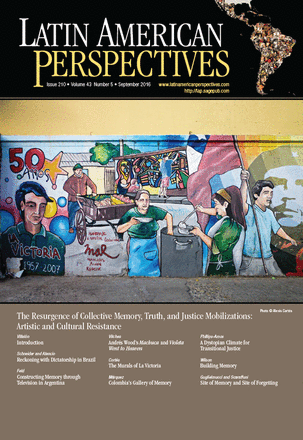
LAP Sept. Issue 2016, The Resurgence of Collective Memory, Truth, and Justice Mobilizations Part 2: Artistic and Cultural Resistance

Edited by: Roberta Villalón
Issue 210 | Volume 43 | Number 5 | September 2016

Table of Contents
Since the turn of the century, various Latin American countries have witnessed a second wave of memory, truth, and justice mobilizations to address unresolved human rights abuses of past military regimes and civil conflicts. This issue-the second of a three-part series on the politics of collective memory-illustrate how artistic and cultural expressions have been created and used to tackle these dilemmas and informed memorialization, justice seeking, and reconciliation in Brazil, Argentina, Chile, Colombia, and Uruguay. These studies point to how the limitations of democratization, peace, and reconciliation processes have shaken communities into collective mobilization including the use of artistic and cultural means to keep memory alive and push for justice.


Microphone
Tomas Ocampo, Outreach Coordinator for Latin American Perspectives, interviews issue editor Roberta Villalón about the LAP issue, "The Resurgence of Collective Memory, Truth, and Justice Mobilizations Part 2," published in September 2016.

CLICK HERE to listen to the podcast!
Podcast is also available in Spanish! Listen here.

You can also listen to past podcasts by clicking here!