Showing posts with label Economic Elite. Show all posts

July 1, 2020

Abstract, Remittances, the Rescaling of Social Conflicts, and the Stasis of Elite Rule in El Salvador

:::::: Abstract ::::::


Remittances, the Rescaling of Social Conflicts, and the Stasis of Elite Rule in El Salvador 

by Hannes Warnecke-Berger 

Remittances are the dominant factor in the contemporary economy of El Salvador, which is enjoying a new comparative advantage in the international economic system—the export of cheap labor to the Global North and particularly the United States. The Salvadoran economy is part of a transnational economic space, but this space is perverse: Although the poor are nominally receiving more money, remittances cause them to be caught in a vicious cycle of economic instability. At the same time, the elites are able to access remittances indirectly by becoming a Keynesian oligarchy—an oligarchy that extracts wealth by controlling the demand structure of the economy instead of production. Remittances represent bread and butter for the poor and a vehicle for transnationalization for the rich, and this leads to a new stasis of elite rule: remittances provoke the rescaling of social conflicts in favor of elites. Transnationalism in this regard must be interpreted as an elite strategy for suppressing the bargaining power of the subaltern class. In this transnational remittances economy, opportunities for the subaltern class and migrants to participate directly in reshaping this economic space are limited or nonexistent. As a consequence, they must rely on translocal moral economies linking migrants with their families at home, where they are still able to impose some control. Meanwhile, elites foster transnationalism by dismantling these very modes of control. In this sense, remittances are the silver bullet for facilitating neoliberalism in the Global South. In El Salvador, they produce ultrastability for the oligarchy and chaos for the poor.


February 7, 2019

Abstract, An Opportunity Squandered? Elites, Social Movements, and the Government of Evo Morales

:::::: Abstract ::::::


An Opportunity Squandered? Elites, Social Movements, and the Government of Evo Morales

by Linda Farthing

Over its 12 years in power, Bolivia’s MAS government has made significant advances in expanding inclusion and reducing poverty. In the process, it has steadily been transformed into a hegemonic force that is increasingly dependent on expedient and pragmatically based compromises with economic elites. Concurrently, social movement influence and participation in the government have steadily declined. After 2009, when an uprising by Eastern elites had been quashed and MAS gained a congressional majority, the MAS missed an opening to advance its original project of structural change, opting instead for a more expedient strategy that has kept it in power at the cost of accommodating elites and debilitating social movements.


CONTINUE READING THE FULL ARTICLE HERE

SaveSave
SaveSave
SaveSave
SaveSave
SaveSave


SaveSave
SaveSave
SaveSave
SaveSave
SaveSave
SaveSave

January 31, 2019

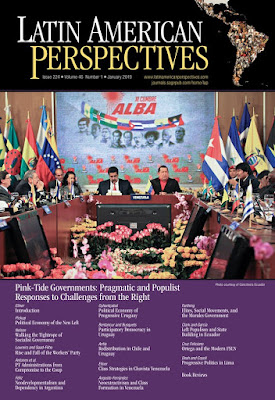
Abstract, Class Strategies in Chavista Venezuela: Pragmatic and Populist Policies in a Broader Context

:::::: Abstract ::::::


Class Strategies in Chavista Venezuela: Pragmatic and Populist Policies in a Broader Context


by Steve Ellner

The governments of Hugo Chávez and Nicolás Maduro responded to the opposition’s attempts at regime change by implementing pragmatic policies favoring businesspeople who refused to participate in destabilization actions, as well as populist social measures benefiting the nonprivileged. Both sets of policies have to be placed in political context. The characterization of allegedly pro-government businesspeople as a new ruling elite referred to as the boliburguesía fails to take into account the sharp tensions between them and the Chavista leadership. The primary importance of social programs in the Chavista political triumphs over an extended period of time and of the periodic initiatives that sparked life into individual programs implicitly rules out claims regarding the government’s failure to alleviate poverty or achieve other social objectives. The Chavista governments failed to take full advantage of favorable periods and junctures when the opposition was demoralized following defeats in order to correct the negative side effects of pragmatic and populist class policies, such as bureaucratization and crony capitalism.


CONTINUE READING THE FULL ARTICLE HERE

SaveSave
SaveSave
SaveSave
SaveSave
SaveSave


SaveSave
SaveSave
SaveSave
SaveSave
SaveSave
SaveSave

September 24, 2018

Political Report # 1369 How Puerto Rico Became the Newest Tax Haven for the Super Rich

A year after the tragedy of Hurricane Maria, the 51st state has become the favorite playground for extremely wealthy Americans looking to keep their money from the taxman. The only catch? They have to cut all ties to the mainland (wink, wink).
The party known as Cocktails and Compliance-so called for mixing alcohol with tax advice-was thrown on a Friday evening in May, in a warehouse turned art gallery in Old San Juan. The host had kept his guest list confidential: It contained the names of hundreds of ultra-wealthy mainland Americans who'd moved to Puerto Rico to avoid paying taxes, most of whom were reluctant to advertise that fact. More than 1,500 mainlanders have established residency here since 2012, when the island rebranded itself as a tax haven, and the annual Cocktails is at the center of their social calendar.
At a high table, polishing off a bourbon on the rocks, sat a compact man in his 60s wearing a black T-shirt and black suede loafers, no socks. This was Mark Gold, the Florida-born kingpin of traffic-ticket contesting. Gold has attended Cocktails and Compliance every year since moving to Puerto Rico in 2016. “I was looking at different tax havens,” he said, “Andorra, Lichtenstein, Monaco. But the problem is, you have to give up your U.S. passport. When I heard about this, it was too good to be true. But it's real. I live in paradise. I live at the Ritz-Carlton. I drive my golf cart to the beach club for breakfast. Then I go to my sunset yoga class on the beach.”
A waiter offered to replace his drink. “Why not?” said Gold.
Only seven months had passed since Hurricane Maria laid waste to the island's power grid, and one month remained until hurricane season returned. A reliable estimate placed the death toll at 4,600; 11,000 still reportedly lacked electricity. Residents were showering with pots and plastic cups. In Manhattan, a federal judge was trying to mediate between the various hedge funds that held billions of dollars of the island's debt. Every so often the MIT-educated governor went on television to extol the virtues of austerity.
In San Juan, the recovery had been notably uneven. Brand-new shopping centers abutted hotels that looked arsonized; traffic lights stared dead-eyed into the street; FEMA was shuttling relief supplies from the waterfront to staging areas. Inside Cocktails and Compliance, however, the atmosphere resembled the aftermath not of a natural disaster but of a corporate convention, with people who usually saw one another in the daytime gradually succumbing to alcohol and dim lighting.

February 24, 2016

Abstract, Constructing a State in the Face of Regional Power: The Case of Guayaquil by Verónica Silva

:::::: Abstract ::::::


Constructing a State in the Face of Regional Power: The Case of Guayaquil 
by Verónica Silva

The city of Guayaquil is a territory in which economic actors play a central role in the configuration of subnational power. This has generated a kind of pseudo- or half-finished democracy in which, although elections are held, there is only one actor, the Madera de Guerrero Social Christian Party, representing the local economic elite that has held power since 1992. Following the theory of Edward Gibson, this situation can be viewed as sort of subnational authoritarianism: the parochialization of power, the nationalization of influence, and control of institutional and noninstitutional links have allowed this subnational power to achieve local control and influence in the national arena during various periods.

January 18, 2016

Abstract, Constructing a State in the Face of Regional Power: The Case of Guayaquil by Verónica Silva

:::::: Abstract ::::::


Constructing a State in the Face of Regional Power: The Case of Guayaquil 
by Verónica Silva

The city of Guayaquil is a territory in which economic actors play a central role in the configuration of subnational power. This has generated a kind of pseudo- or half-finished democracy in which, although elections are held, there is only one actor, the Madera de Guerrero Social Christian Party, representing the local economic elite that has held power since 1992. Following the theory of Edward Gibson, this situation can be viewed as sort of subnational authoritarianism: the parochialization of power, the nationalization of influence, and control of institutional and noninstitutional links have allowed this subnational power to achieve local control and influence in the national arena during various periods.