
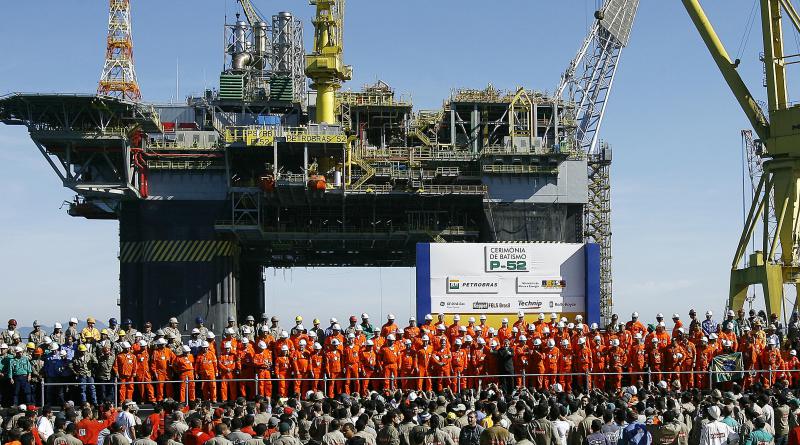
Featured Photo: Brazilian President Lula da Silva on the launch of the P-52 oil Platform From: Wikipedia
By Eliza Davis, Research Associate at COHA
|
On June 19, leaders of the two largest construction firms in Brazil, Marcelo Odebrecht of Odebrecht SA and Otávio Marquez Azevedo of Andrade Gutierrez, were arrested as part of an extensive corruption probe into the state-owned oil company Petrobras. Petrobras has been accused of various forms of malpractice including bribery and money laundering. While in the past, corruption in oil companies has led to blatant inaction-partly due to highly institutionalized venality-this probe has led to the indictment of over a hundred individuals affiliated with the company and has implicated dozens more. Bribes involving construction firms alone have totaled $2.1 billion USD[1] and the scandal has cost the company over $16 billion USD.[2] Accusations of corruption against Petrobras are emblematic of a larger problem across oil industries in the region, especially in Brazil, Mexico and Venezuela. Each new allegation seems to come with an increasingly dramatic loss of funds. Tackling corruption in an industry that has remained so crucial to the health of the Latin American economy is one method of helping to eliminate institutionalized corruption in other industries equally vital to economic success and to further augment political and economic credibility for the region.
Corruption is not uncommon in Latin America. Global Financial Integrity reported in December of 2014 that the average annual percentage of illicit outflows from Latin America is equivalent to 3.3 percent of Latin America's GDP. [3] Meanwhile, the Institute for International Finance (IIF) reported in February that annual GDP growth for all of Latin America in 2014 was only 0.4 percent and forecasted that growth for 2015 will only be 0.2 percent.[4] This means that the amount of money spent on corruption is over eight times that of region's annual growth.
|

