Showing posts with label Cuban Revolution. Show all posts

August 21, 2017

Book Review, Cien Años de Lucha: Narratives of Cuba’s Revolutionary History

:::::: Book Review ::::::


Cien Años de Lucha: Narratives of Cuba’s Revolutionary History
by William M. LeoGrande

Cuba, the Media, and the Challenge of Impartiality
Lamrani Salim Cuba, the Media, and the Challenge of Impartiality. New York: Monthly Review Press, 2015.
The Last Soldiers of the Cold War: The Story of the Cuban Five
Morais Fernando The Last Soldiers of the Cold War: The Story of the Cuban Five. London: Verso, 2015.
Entrepreneurial Cuba: The Changing Policy Landscape
Ritter Archibald R. M. & Henken Ted A. Entrepreneurial Cuba: The Changing Policy Landscape. Boulder: Lynne Rienner, 2015.
The Structure of Cuban History: Meaning and Purpose of the Past
Perez Louis A.,Jr. The Structure of Cuban History: Meaning and Purpose of the Past. Chapel Hill: University of North Carolina Press, 2013.
Visions of Power in Cuba: Revolution, Redemption, and Resistance, 1959–1979
Guerra Lillian Visions of Power in Cuba: Revolution, Redemption, and Resistance, 1959–1979. Chapel Hill: University of North Carolina Press, 2012.
Revolutionary Cuba: A History
Martínez-Fernández Luis Revolutionary Cuba: A History. Gainesville: University Press of Florida, 2014.


“Revolution means . . . changing everything that must be changed,” said Fidel Castro on May 1, 2000. This slogan has become the watchword for the far-reaching changes under way since 2008, when Raúl Castro succeeded Fidel as president.1 In 2011 Cuba embarked upon a fundamental reorganization of the economy as outlined in the Guidelines of the Economic and Social Policy of the Party and the Revolution adopted at the Sixth Congress of the Communist Party of Cuba (PCC, 2011). Then on December 17, 2014, President Castro and President Barack Obama stunned the world by announcing their agreement to begin normalizing U.S.-Cuban relations, setting aside half a century of hostility.


August 8, 2017

Book Review, Between Loyalty and Legitimacy: Leadership in the Cuban Revolution

:::::: Book Review ::::::


Between Loyalty and Legitimacy: Leadership in the Cuban Revolution
by Daniel Salas-González

Leadership in the Cuban Revolution: The Unseen Story
Kapcia Antoni Leadership in the Cuban Revolution: The Unseen Story. London and Halifax/Winnipeg: Zed Books/Fernwood Publishing, 2014.


For decades, historical and political studies about revolutionary Cuba have placed the personality of Fidel Castro at the center of their interpretive approaches. This sort of narrative has blurred the understanding of the Cuban case by exaggerating the role of the “commander in chief.” In Leadership in the Cuban Revolution: The Unseen Story, the historian Antoni Kapcia challenges “the assumption that he [Fidel Castro], and he alone, created, engineered, determined and . . . perhaps distorted and destroyed the Revolution” (1).


December 14, 2016

Political Report # 1208 Cubans respond intelligently to new realities


Photo : Yin Yang/Getty Images/IStockphoto


Political Report # 1208


Cubans respond intelligently to new realities


By Salim Lamrani, Global Research


Salim Lamrani is an expert in US-Cuba relations. He explains the reasons behind Fidel Castro's aura and the leader's place in the revolution in a changing society.  


As a Cuba specialist you have just published a book dedicated to Fidel Castro (1). Is it possible to characterise the trajectory of this man, whose stature is recognized even by his detractors?
Salim Lamrani: To my mind, three aspects characterize the personality of Fidel Castro. First and above all, he is the architect of national sovereignty who made real what the Apostle and the national hero José Martí had only dreamed about: an independent Cuba. Fidel Castro has given back the people of the island their dignity back. Next, he is a social reformer who came to grips with the social realities and plight of the underprivileged, by moulding a society that is one of the least unjust in the Third World. Finally, he is an internationalist who has lent a generous hand to people who need it and has placed solidarity and integration at the heart of Cuba's foreign policy. 
How do you make sense of the aura that he enjoys in Cuba and across the world?
SL: Fidel Castro is a controversial person in the West because the Western media tends to present a caricatured image of him. In contrast, he is revered by the people of Latin America and the Third World for whom he symbolizes resistance to oppression. He is also seen as someone who champions the aspirations of the people of the countries of the South : independence, sovereignty and self-determination. He is a mythic rebel, who, while still alive, entered the Pantheon of the great liberators of the American continent. The former guerrilla of the Sierra Maestra saw his prestige spread beyond the confines of the continent, making him the archetype of 20th Century anti-imperialism and the bearer of a universal message of emancipation.
Western media throughout the world have failed to grasp the importance of the figure of Fidel Castro. Since Marti, there has been no other personality that has so forcefully symbolized the aspirations of the Cuban people to national sovereignty, economic independence and social justice. Fidel Castro is a symbol of pride, dignity, resistance and loyalty to principles. The historic leader of the Cuban revolution has taken up arms on behalf of the oppressed and has championed their right to a decent life.
At the time of his withdrawal from political life in 2006, a number of commentators predicted the end of the Cuban revolution. They thought that following Fidel's departure the revolution would fail to survive. What has become of it ten years later?
           
SL: The mistake made by many observers was thinking that the Cuban revolutionary process rested on the shoulders of one man alone, Fidel Castro. In fact, the revolution has been built by several generations of Cubans. Today, Cuba's institutions are robust and a numerous cadre have taken up the challenge following the gradual retirement of the historic generation. No cataclysm has come to pass in Cuba following the retirement of Fidel Castro in 2006 because the island's people share a highly developed political conscience and are attached to their country's independence, its political system and social model.
At the announcement of Fidel Castro's death, an immense sentiment of sadness entered the hearts of all Cubans, a sadness triggered by loss of their moral guide, their political compass, someone who always stood in the front line of defense of the right of his people to self-determination. Fidel Castro's legacy is a just and generous idea: it is an eternal struggle for the dignity of those bereft of privilege, a fairer division of wealth and an unyielding solidarity with any people struggling for a better life.  
Following his retirement, what place did Fidel Castro play in a Cuban society undergoing rapid change?
 SL : Fidel Castro  has defined himself as a "soldier of ideas".  He was a sort of spiritual father for the Cuban people, the savant that one consulted, in light of his immense experience, on strategic decisions. Up until his final breath, Fidel Castro attentively observed Cuban and world society, expressing serious concerns over climate change and the nuclear threat. 
What did he think of the normalization of relations with the US?
            SL :  We might well recall the historical truth. Following the triumph of the Cuban revolution in 1959, Fidel Castro had expressed his desire to maintain friendly and peaceful relations with the United States, both for reasons of principle as well as more pragmatic considerations. In return, Washington would be required to respect three basic non-negotiable principles: sovereign equality between states; reciprocity and non-interference in internal affairs.
           
Thus, while Havana held out an olive branch to its neighbour, Washington responded by imposing a openly hostile policy on Cuba. Since 1960, the United States has imposed implacable sanctions that to this day inflict intolerable suffering on the Cuban people. President Kennedy then organized the invasion of the Bay of Pigs in 1961 and threatened the island with nuclear disintegration during the missile crisis of 1962. The CIA multiplied terrorist attacks against Cuba, which have cost the lives of 3,478 persons and inflicted permanent injury on 2,099 civilians. Since 1959, the United States has led a political, diplomatic and media war against Cuba.
Also, we should recall that the conflict that Washington has imposed on Havana is asymmetric because the hostility is unilateral. It is the United States that is imposing sanctions on Cuba; the US, that is illegally occupying part of Cuba's territory (Guantanamo) and funding internal opposition through which it seeks to secure regime change.
Barack Obama recognized that US policy towards Cuba was obsolete and unjust and chose to establish a dialogue with Raul Castro. Fidel who has worked so hard for peace throughout the world, of course endorsed the peaceful resolution of the conflict between Washington and Havana even if he did not sugar-coat the true intentions of Cuba's Northern Neighbour. 
Raul Castro has announced that he would not continue with his duties past 2018, a gesture that signifies the end of the "revolutionary generation".  How has this political change been received?
            SL :  The Cubans have known for several years that Raul Castro will definitively end his political career in 2018. They will thus be required to face three considerable challenges: the generational change at the head of the country, the current reform of the economic model and the new relationship with the United States. But history has shown that the Cuban people have always responded with intelligence to new realities and that they are attached to the basic values that cement the Cuban revolution.
Since 2009, the island has been engaged in a process of structural economic reforms. Do these conflict with the ideals that have prevailed till now and that Fidel Castro defended up until his death?
SL : Fidel Castro lent his complete support, without reservation, to the process of updating the Cuban economic model because it was necessary to do so. As he said in his celebrated definition of the concept, enunciated on May 1, 2000, « Revolution means changing that which must be changed ». There is no rejection whatsoever of socialist ideas. The State still retains control over the means of production and the strategic sectors. While the new economic model has introduced market mechanisms, it remains based on socialist planning at all levels and the enterprise of the Socialist State still remains the principal form in the national economy.  The country is opening up to foreign investment - in order to attract capital essential to the development of the nation - through the vehicle of mixed enterprises wherein the Cuban state always maintains a majority ownership of at least 51%.
Thus, the new Cuban economic model is based upon planning and a policy of central pricing. It prohibits the concentration of wealth, introduces both a minimum and maximum salary and protects all groups within the population, notably the most vulnerable, (there have not been, for example, massive layoffs). Thus, it remains undeniably socialist. But, based upon the philosophy of Jose Marti, according to whom "the first duty of man is to be a man of his epoch", it has adapted to its time. The new Cuban economic model aims to achieve greater economic efficiency, fight bureaucracy and corruption, preserve the social gains won in the Cuban revolution, reinforce the socialist Republic and improve the material and spiritual well-being of all Cubans.
(1) Fidel Castro, héros des déshérités, Paris, Editions Estrella, 2016.
Translated by Anoosha Boralessa


Original article and sources can be found here:

December 9, 2016

Political Report # 1206 Cubans Remember Fidel


A man on a bus in Havana (Thomas Leuthard/Flickr)


By Elizabeth Dore, NACLA


Whether Cubans on the island worship Fidel Castro despite his flaws, loathe him, or are indifferent to a figure they now regard as a historical anachronism depends more on their age than anything else.

Olga, a former University teacher, remembered her faithful devotion to Fidel Castro when she was growing up in Santiago more than forty years ago. "Before the triumph of the Revolution I went to a Baptist private school. After I went to a state school, and I grew disenchanted with religion. This happened not only to me, it happened to my entire generation," she said. "The change was profound. Fidel replaced the God we had believed in. He was a very significant leader for everyone, but in particular for us of the younger generation. We threw ourselves into the struggle to make the revolution. Life was very difficult after the sugar harvest of 1970 failed. We suffered a lot, but we still had that belief, that determination, that we had to fight for the revolution. We thought of Fidel as our God the saviour, and we all closed ranks, and we struggled, and we tried not to see his errors, his flaws. I did not return to the church for many, many years.'
I first interviewed Olga (not her real name) twelve years ago, when, alongside a team of Cuban and British researchers, I began recording life histories of Cuban men and women living on the island. Olga and I last met several months ago, in Miami, where she now lives. Our team has collected the life histories of 125 Cubans from different generations, social positions and political views, of diverse racial, gender, sexual and religious identities. Many talked with us multiple times, recounting how their lives and attitudes have changed over the years.  
Cubans over the age of fifty frequently brought up Fidel in our conversations. Usually they portrayed him favourably, but not always. Fearing their criticisms might be overheard, in place of his name they tapped their shoulder, [indicating his epaulets], or stroked their chin [the beard], or referred simply to "He."

December 1, 2016

Book, Sexual Revolutions in Cuba: Passion, Politics, and Memory

:::::: Book ::::::


Sexual Revolutions in Cuba: Passion, Politics, and Memory
by Carrie Hamilton, Elizabeth Dore (Foreword)


In "Sexual Revolutions in Cuba" Carrie Hamilton delves into the relationship between passion and politics in revolutionary Cuba to present a comprehensive history of sexuality on the island from the triumph of the Revolution in 1959 into the twenty-first century. Drawing on an unused body of oral history interviews as well as press accounts, literary works, and other published sources, Hamilton pushes beyond official government rhetoric and explores how the wider changes initiated by the Revolution have affected the sexual lives of Cuban citizens. She foregrounds the memories and emotions of ordinary Cubans and compares these experiences with changing policies and wider social, political, and economic developments to reveal the complex dynamic between sexual desire and repression in revolutionary Cuba. 

August 24, 2016

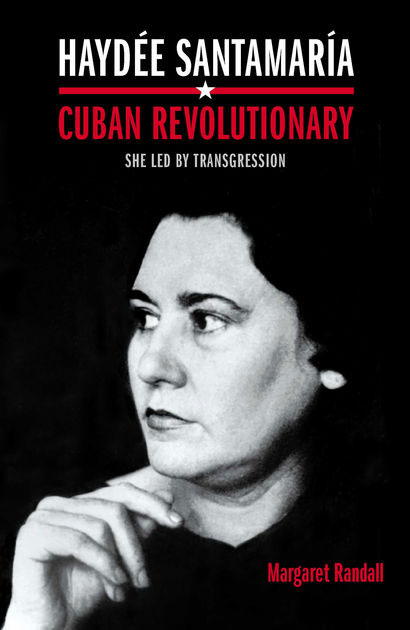
Political Report # 1175 "She Led by Transgression": Margaret Randall on Cuban Feminist Haydée Santamaría


(Image: Duke University Press)


By Peter McLaren, Truthout


The award-winning author and oral historian Margaret Randall first met Cuban revolutionary Haydée Santamaría Cuadrado in 1967 at a gathering of poets and critics held to celebrate Ruben Dario, the great Nicaraguan modernist.
"I was immediately attracted to her passion, to the way she looked everyone in the eye, really saw us, really listened," Randall told me, adding that she met Santamaría again at the Havana Cultural Congress in 1968 and got to know her better after she went to live in Cuba in 1969. "She was always special to me. She seemed to embody the best of that human capital that had risked so much to change their nation's future."
Now Randall has released a new book, Haydée Santamaría, Cuban Revolutionary: She Led by Transgression. Beautifully crafted, comprehensive and emotionally riveting, the book illustrates with historical precision and emotional power the life and times of one of the great revolutionary figures of all time.
Randall herself is also an inspiring figure whose work I have been following since the late 1980s when I read her oral history, Sandino's Daughters: Testimonies of Nicaraguan Women in Struggle, which had won praise from luminaries, such as Adrienne Rich and musicians, such as Holly Near.

March 16, 2009

Reflections on the Cuban Revolution by Gary Prevost

Reflections on the Cuban Revolution 
by Gary Prevost
Gary Prevost has been Professor of Political Science at St. John’s University since 1977.

When I visited Cuba in the first few days of 1992, it was not clear that the revolution would survive. Food was in relatively short supply and electricity blackouts were common. Even long-time supporters of the revolution were pessimistic about the future. Everything that had been accomplished in its first 32 years seemed in jeopardy when the Soviet Union went out of existence at the end of 1991 and canceled most of its trade deals with Cuba. The country’s gross domestic product was in the process of shrinking by 50 percent. How did the Cuban Revolution survive that shock, and how is it now coping with the illness of Fidel Castro and the transfer of power to his brother, Raúl?

The Municipal University Centers: Past, Present, and Future by Jorge González Corona

The Municipal University Centers:  Past, Present, and Future
by Jorge González Corona
Translated by Mariana Ortega Breña
Jorge González Corona is Professor of Political Science at the Manuel Bisbé Municipal University. Mariana Ortega Breña is a freelance translator based in Canberra, Australia. 

The development of education in Cuba since January 1, 1959, has gone through several phases. The 1960's witnessed the National Literacy Campaign of 1961, the implementation of universal access to elementary education, the adult post-literacy programs, the massive training of teachers, and the University Reform of 1962. In the next period, 1970–1980, universal access to secondary education was achieved, as was a nationwide university network. These efforts were accompanied by substantial investment in the creation of the necessary material base for education and the accelerated training and upgrading of teachers and professors.

Cuban Exceptionalism by Ken Cole

Cuban Exceptionalism: A Personal View 
by Ken Cole
Ken Cole is a member of the International Institute for the Study of Cuba at London Metropolitan University. 

January 1, 2009, marks the fiftieth anniversary of victory in Cuba’s third war of independence. In his first speech of the Cuban Revolution, given in Santiago de Cuba on January 1, 1959, Fidel Castro declared that for the first time in four centuries Cubans were free. Whereas Carlos Manuel de Céspedes and José Martí had led the previous wars, in 1868 and 1895, against Spanish colonial dominion, Castro’s July 26th Movement (named after the day in 1953 when the attack on the Moncada barracks marked the commencement of the revolution) challenged the economic domination of Cuba by the United States.

Reflections on the Cuban Revolution by Gary Prevost

Reflections on the Cuban Revolution
by Gary Prevost
Gary Prevost has been Professor of Political Science at St. John’s University since 1977.


When I visited Cuba in the first few days of 1992, it was not clear that the revolution would survive. Food was in relatively short supply and electricity blackouts were common. Even long-time supporters of the revolution were pessimistic about the future. Everything that had been accomplished in its first 32 years seemed in jeopardy when the Soviet Union went out of existence
at the end of 1991 and canceled most of its trade deals with Cuba. The country’s gross domestic product was in the process of shrinking by 50 percent.

March 2, 2009

Cuban Solidarity and Disaster Response by August Nimtz

Cuban Solidarity and Disaster Response 
by August Nimtz
August Nimtz is Professor of Political Science at the University of Minnesota and the author of Marx, Tocqueville, and Race in America (2003). A more detailed version of the argument presented here can be found in “Natural versus Social Phenomena: Cuba and the Lessons of Katrina” (The Black Scholar, 2006, 36 [4]). 

How is it that an underdeveloped country that is incessantly alleged to be under a dictatorship can do a far better job of saving the lives of its citizens when a hurricane strikes than a rich country with all the trappings of liberal democracy? The aftermath of Hurricane Katrina demonstrates that this is not just an interesting academic question but a matter of life and death. Even before then, international bodies such as the United Nations and the International Red Cross often cited Cuba for its exemplary practices in dealing with hurricanes. Measured in terms of preparation, loss of lives, and recovery, the differences between Cuba and the United States Gulf Coast persist. Even in the 2008 season, when Cuba was assaulted by the most powerful hurricanes on record, it experienced the loss of only five lives.

January 16, 2009

The Cuban Revolution. Half a Century. by Saul Landau

The Cuban Revolution. Half a Century.
by Saul Landau
Saul Landau is a senior fellow at the Institute for Policy Studies. He has produced 10 books and more than 40 films on social, political, and historical issues and worldwide human rights and is the recipient of Chile’s Bernardo O’Higgins award for human rights. 

Five Cuban intelligence agents sit in federal penitentiaries across the United States because they infiltrated anti-revolutionary groups in Miami intent on doing violence in Cuba. These five men represent a long line of those who have acted from an understanding of their roles in the long human historical drama.

Cuba! Cuba! Cuba! by William I. Robinson

Cuba! Cuba! Cuba! 
by William I. Robinson 
William Robinson is Professor of Sociology, Global Studies, and Latin American Studies at the University of California, Santa Barbara. His most recent book is Latin America and Global Capitalism: A Critical Globalization Perspective, published in 2008. 

It was Fall 1980. I had recently returned to New York from a three-year stint in Africa and would shortly be heading to Nicaragua, where I would spend the next 10 years. At the time I did not know much about the Cuban Revolution, but my political awakening had taken place on a continent that was still in the process of overthrowing the shackles of colonialism.

A Retrospective by Ronald H. Chilcote

A Retrospective 
by Ronald H. Chilcote 

Ronald H. Chilcote is the managing editor of Latin American Perspectives. 

My familiarity with Cuba began during a September 1958 visit to Havana, the culmination of four months’ travel throughout Latin America. Life in the city was corrupt, with gambling and prostitution. The Cuban Revolution brought hope for profound change everywhere. Those days of graduate study at Stanford revolved around the revolution and the fellow students who joined together to analyze the role of revolution and the left. With one of our professors, Ronald Hilton, we exposed the Bay of Pigs plans well before the April 1961 invasion. Another of our professors, John J. Johnson, wrote on the military’s assumption of a professional role in Latin America, and in fact his work contributed to the United States’ counterinsurgency plans. The Pentagon sent six of its young officers to learn about Latin America at Stanford and then to participate in some of the coups that later overthrew legitimate regimes. Two of them, for example, worked with U.S. Ambassador Lincoln Gordon in the 1964 overthrow of the Brazilian president João Goulart. My work on Brazil, Portugal, and the Portuguese colonies of Africa was fundamentally framed within the Cuban experience. I wrote a monograph on the great African revolutionary Amílcar Cabral, who was deeply influential, along with Che and Fidel, in the Tricontinental, based in Havana. I returned to Cuba three times, first for six weeks during 1968 and twice during the 1980s, once to participate in a conference and once to attend the Latin American Film Festival. 

Cuba Reflections by Donald W. Bray and Marjorie Woodford Bray

Cuba Reflections
by Donald W. Bray and Marjorie Woodford Bray 

Donald W. Bray and Marjorie Woodford Bray teach at California State University, Los Angeles, and are coordinating editors of Latin American Perspectives. 

Our admiration for the Cuban Revolution and support and concern for its success go way back, and the Cubans’ transformation of their country into a nation of social justice and equality has inspired our teaching and informed our lives.