Showing posts with label Leopoldo López. Show all posts

March 5, 2018

Political Report # 1317 The New York Times' Uncanny Comparison Of Leopoldo Lopez With Martin Luther King


By  Steve Ellner

LAP Editor


commentary response to:


Can Venezuela be Saved? 
By Wil S. Hylton, New York Times
(found here)


The corporate media reached an all-time low this week in its one-sided reporting on Venezuela.  Wil H. Hylton in a lengthy article in New York Times' magazine section compared jailed opposition leader Leopoldo López with Martin Luther King. Throughout the article, Hylton weaves together the topic of King's employment of civil disobedience in the struggle to achieve equality for African-Americans and the protests promoted by López in 2014 known as the "guarimba." The comparison has to be seen as part of an ongoing effort promoted by international actors including the Trump administration to demonstrate that the Maduro government is a dictatorship, or a dictatorship in the making. The comparison falls short for a number of reasons.

In the first place, the four-month "guarimba" in 2014 and again in 2017 had as its principal objective the achievement of regime change. This goal was embraced by the protesters in spite of the fact that the opposition parties (including López's Voluntad Popular party), which would have assumed power had the guarimba been successful, are highly unpopular - they are certainly not any more popular than the Chavista movement. Unlike King's civil rights movement with its well-defined concrete objectives, Lopez's guarimba protest was an insurrectional movement. López publicly declared that the guarimba would continue until the Maduro government was ousted.

August 20, 2015

Political Report # 1068 MUD's Murky Future in Venezuelan Politics By: Emma Scully and Daniel A. Tovar, Research Associates at COHA


Featured Photo: Capriles sobre verjas. From: Julio César Mesa


By: Emma Scully and Daniel A. Tovar, Research Associates at the Council on Hemispheric Affairs
 
Henrique Capriles Radonski, opposition politician and governor of Venezuela's Miranda state, disclosed a pressing reality of Venezuelan politics in an interview with the Spanish newspaper El País on June 13. When asked if the Venezuelan opposition is unified, Capriles, two-time presidential candidate who came close to defeating Nicolás Maduro in the 2013 elections, expressed confidence that the opposition is "going to be unified," thus confirming the existence of intra-opposition divisions that have gradually chipped away at the fabric of the Mesa de la Unidad Democrática (Democratic Unity Roundtable; MUD), the electoral coalition of Venezuelan opposition parties.[1] The purpose of this article is to trace and outline the sources of the divisions within MUD that have transformed it into a splintered opposition coalition plagued by party factionalism. Failure to resurface as a cohesive coalition may help the current government to retain a majority in the national assembly in this year's parliamentary elections on December 6.

August 6, 2015

Political Report # 1066 TThe Making of Leopoldo López


                  By Roberto Lovato, Foreign Policy
 
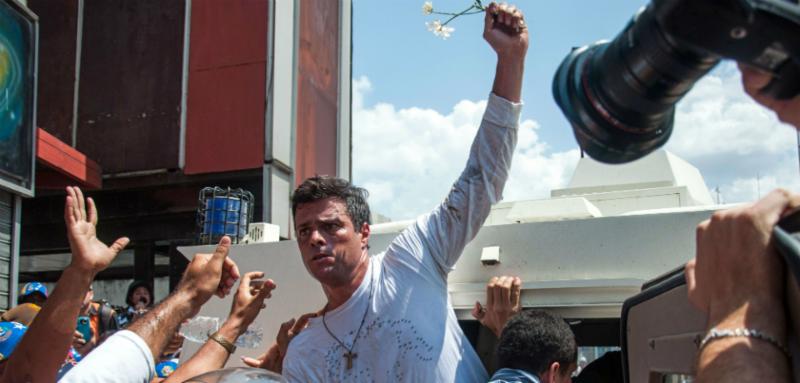
In the nearly year and a half since street protests rocked Caracas, the U.S. press has been kind to Leopoldo López, the 44-year-old jailed leader of Venezuela's radical opposition. He has been painted as a combination of Nelson Mandela, Gandhi, and his distant grand uncle, Simón Bolívar, for his magnetic brand of in-your-face politics. Newsweek wrote of his "twinkling chocolate-colored eyes and high cheekbones" and called López a "revolutionary who has it all." The New York Times published a photo of him, jaw out, fist in the air, in front of a crowd of screaming protesters and gave him a platform on its op-ed page. In New York, when the United Nations met last September, protestors rallied to show support for López, and President Barack Obama listed him among a group of political prisoners from repressive countries such as China and Egypt who "deserve to be free." López, who has done interviews shirtless, came to embody freedom and democracy for audiences across the globe, with stars from Kevin Spacey to Cher rallying to his cause, while the hashtag #freeleopoldo rocketed across Twitter.

 
But in Venezuela the picture is far more complicated. López has been in jail since February 2014 on charges of arson, public incitement, and conspiracy related to the first big anti-government protest that year, on Feb. 12, 2014, which left three protesters dead and kicked off weeks of rallies, street blockades, vandalism, and violence. The charges against him, which Amnesty International has called "politically motivated," could carry a prison sentence of 10 years. Outside the courtroom, the public debate continues to swirl between those who believe López is a freedom fighter facing trumped-up charges and those who believe he is the violent "fascista" the government of President Nicolás Maduro claims.