Showing posts with label Social Inequality. Show all posts

July 1, 2020

Abstract, Remittances, the Rescaling of Social Conflicts, and the Stasis of Elite Rule in El Salvador

:::::: Abstract ::::::


Remittances, the Rescaling of Social Conflicts, and the Stasis of Elite Rule in El Salvador 

by Hannes Warnecke-Berger 

Remittances are the dominant factor in the contemporary economy of El Salvador, which is enjoying a new comparative advantage in the international economic system—the export of cheap labor to the Global North and particularly the United States. The Salvadoran economy is part of a transnational economic space, but this space is perverse: Although the poor are nominally receiving more money, remittances cause them to be caught in a vicious cycle of economic instability. At the same time, the elites are able to access remittances indirectly by becoming a Keynesian oligarchy—an oligarchy that extracts wealth by controlling the demand structure of the economy instead of production. Remittances represent bread and butter for the poor and a vehicle for transnationalization for the rich, and this leads to a new stasis of elite rule: remittances provoke the rescaling of social conflicts in favor of elites. Transnationalism in this regard must be interpreted as an elite strategy for suppressing the bargaining power of the subaltern class. In this transnational remittances economy, opportunities for the subaltern class and migrants to participate directly in reshaping this economic space are limited or nonexistent. As a consequence, they must rely on translocal moral economies linking migrants with their families at home, where they are still able to impose some control. Meanwhile, elites foster transnationalism by dismantling these very modes of control. In this sense, remittances are the silver bullet for facilitating neoliberalism in the Global South. In El Salvador, they produce ultrastability for the oligarchy and chaos for the poor.


November 26, 2019

Abstract: Social Inequality and Mental Health in Chile, Ecuador, and Colombia

:::::: Abstract ::::::


Social Inequality and Mental Health in Chile, Ecuador, and Colombia

by Yanet Quijada, Loreto Villagrán, Pamela Vaccari Jiménez, Carlos Reyes, Luz Dary Gallardo


The results of a comparative study of social inequality and mental health show that Chile and Colombia, which have enormous social gaps despite their economic growth, are characterized by poor mental health indicators and social discontent, while the better equity indicators in Ecuador are not clearly linked to mental health. The concept of social defeat is suggested as a mediator between social inequality and individual and collective mental health, and participation and empowerment are suggested as ways of improving social well-being.


July 29, 2019

Abstract, Interpretations of Brazil and Global Capitalism

:::::: Abstract ::::::


Interpretations of Brazil and Global Capitalism

by Victor Coutinho Lage


Certain interpretations of Brazil may be read as texts providing theorizations of global capitalism. Study of a set of these texts focusing on Florestan Fernandes’s A revolução burguesa no Brasil exposes the connections between the internal and the external and the articulations of past, present, and future in the production of inequality within and among countries. Renewed attention to them is likely to be fruitful for debates on global capitalism that are not of exclusive interest to the Brazilian case and to challenge a certain global division of intellectual labor.


July 23, 2019

Political Report # 1401 Why Half a Million Puerto Ricans Are Protesting in the Streets


By Ed Morales,
The Nation


This week has been unlike any other in Puerto Rican history. An estimated 500,000 demonstrators filled Old San Juan’s cobblestone streets on Wednesday to demand the resignation of Governor Ricardo Rosselló. He has lost public confidence because of mounting scandals in his government and damning revelations from a leaked trove of private chats, published on July 13 by the island’s Center for Investigative Journalism.
The staggering diversity of the demonstrators-straddling age groups, political orientations, and social class-has elicited fresh declarations of the slogan “Puerto Rico se levanta” (“Puerto Rico is waking up”). The phrase, previously used as a rallying cry for fundraising in the wake of Hurricane Maria, lost its luster as the difficult realities of recovery set in. “We’re writing history,” said Juan Carlos Rivera Ramos, an activist in Puerto Rico when I contacted him this week. “Our people, in all their diversity of colors and flavors, ideological plurality, are expressing dignity on the streets. My eyes are tearing.”

July 15, 2019

Abstract, From Euphoria to Retreat: Formal Employment in Twenty-first-Century Brazil

:::::: Abstract ::::::


From Euphoria to Retreat: Formal Employment in Twenty-first-Century Brazil


by Jacqueline Aslan Souen and Guilherme Caldas de Souza Campos


In the 1990s the Brazilian labor market underwent a destructuring process that had profound consequences for Brazilian society. This situation, characterized by high levels of unemployment and informality, began to be modified only with the rise of a government focused on reconciling workers’ interests with the interests of capital associated with the economic growth that began with the international commodity cycle in the early 2000s. The result was a new phenomenon for the labor market—the strong growth of formal employment and labor income and the decline of other types of occupation—that was one of the pillars of social transformation of the country in this period. In recent years, however, a deep economic, political, and institutional crisis has reversed the favorable conditions that allowed this advance, producing a change in the labor market structuring of the previous period. Analysis of the labor market regression of these years using information from the Monthly Employment Survey (PME) and the new continuous National Household Sample Survey (PNAD) helps clarify the determinants and consequences of the recent economic crisis.


August 27, 2018

Political Report # 1365 Puerto Rico's Crisis Has Been Good for Many - Just Not the Island’s Residents

With its authority recently upheld by the courts, Puerto Rico's Federal Management and Oversight Board (known simply as "the Board") continues to impose harsh austerity measures on the people of Puerto Rico. But while residents face pension cuts, school closures, massive layoffs, and a continued recession, the same austerity does not apply to the Board itself, which is spending hundreds of millions on its own expenses and a myriad of consultants, advisers, and lawyers. Nor does the austerity appear to apply to some of Puerto Rico's bondholders either.
Last week, the Board, along with the government of Puerto Rico, announced they reached a deal with owners of bonds in Puerto Rico's Sales Tax Financing Corporation (COFINA), proudly claiming it would save the commonwealth $17.5 billion in debt service. While technically true, the claim obscures the fact that the deal will still see Puerto Rico use its scarce resources to pay these creditors some $33 billion over the next 40 years on what was initially $17 billion in principal. Overall, the bondholders will recover nearly 75 percent of the initial value of their investment, a fairly generous settlement from a bankrupt entity still trying to recover from a lost decade - without economic growth - followed by  the devastation of Hurricane Maria.
In fact, judging from the Board's most recent fiscal plan, Puerto Rico won't even have the money to pay for the bonds that would be issued as part of the settlement. The board projects the island to have about a $4 billion surplus over the next 40 years, leaving authorities at least $28 billion short of satisfying this deal with creditors. The settlement is actually based on revenue projections from an earlier version of the Board's fiscal plan, which were revised down in June when the newest version of the plan was certified. This mistake, rather than the overall generosity of the offer, now puts in question the future of this deal. Will the Board revise its fiscal plan yet again to demand even greater austerity in order to satisfy these creditors' claims?
To make matters worse, a close look at who the current COFINA bondholders are reveals a series of vulture funds that bought the bonds at steep discounts after the initial default, and immediately after Hurricane Maria. Investors now stand to make huge profits from that move, while most Puerto Ricans suffer through continued austerity. One of the largest investors in COFINA bonds, GoldenTree Asset Management, more than doubled its holdings in the aftermath of Hurricane Maria. Court filings show that as of August 1, 2018, GoldenTree owned $1.5 billion in COFINA bonds, up from $587 million in August 2017. The bonds in question traded as low as 20 cents on the dollar during this time period, which means a 75 percent recovery rate could amount to an enormous profit.

August 1, 2018

Political Report # 1357 Amid an Uprising, Can Haitian President Jovenel Moïse Deliver on His Promises?


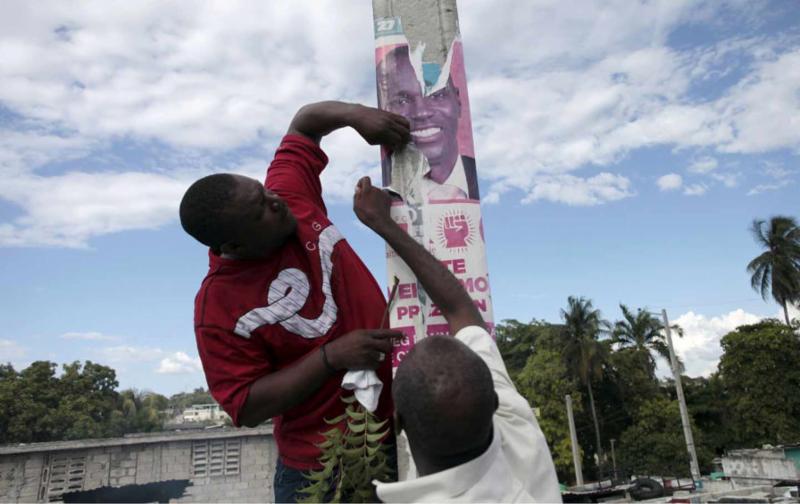
Protesters rip an electoral poster of president Jovenel Moïse during a demonstration against the electoral process in Port-au-Prince, Haiti, on November 6, 2015. (Reuters / Andres Martinez Casares)


Political Report # 1357
Haiti’s “Banana Man” compared himself to Trump-he was more right than we realized.

The announcement came on a Friday afternoon, late in the second half of the World Cup quarterfinal match between Belgium and Brazil, the national team adopted by most Haitian soccer fans. Minutes later, Brazil had lost the match. And soon after, thousands of Haitians were in the streets, though not because of the game’s disappointing result.
The government stated it would be eliminating fuel subsidies, sending the price of gasoline soaring by 38 percent overnight, to $4.50 a gallon. Kerosene, heavily relied upon by the country’s poorest citizens, would increase by 51 percent, to almost $4 a gallon. If the thought was that most Haitians would be distracted by soccer, the plan failed.
The government had agreed to end the subsidies months earlier as part of an agreement with the International Monetary Fund (IMF). “The people were waiting for that decision,” a law-enforcement source explained, “and everyone in each area was prepared to react.”
Though fuel subsidies predominantly benefit the wealthy, any increase in the cost of living can be catastrophic in a country where 60 percent of the population scrapes by on less than $2.40 a day. Protesters built roadblocks and burned tires throughout the capital, Port-au-Prince, and soon demonstrations had broken out across the country. By Saturday morning the situation had worsened. An uprising had begun.
Protesters appeared to target hotels catering to the international market and a supermarket owned by one of Haiti’s richest families. But just as the country’s economic malaise has hit the middle class, so too did the protests; overall some 80 businesses of all sizes were damaged. International airlines canceled flights to Haiti, while some of the wealthy boarded helicopters or private jets and fled the country. As many as 20 people were killed, and more than 50 arrested.
Less than 24 hours after the initial announcement, the government walked back the price increase. And a week later, on July 14, Prime Minister Jack Guy Lafontant was forced to resign rather than succumb to an embarrassing no-confidence vote in Parliament. But the aftershocks of that initial decision have continued to reverberate and have exposed fault lines that continue to threaten Haiti’s democracy.
President Jovenel Moïse, who took office in February 2017, now finds himself alone atop the government, but he faces the stiffest test of his presidency.
An agricultural entrepreneur from rural Haiti, Moïse was put forward as the candidate who could feed a hungry nation. And he came to office with lofty promises of food security, paved roads, electricity across the country, and a crackdown on corruption. After the election, Moïse likened his own victory to that of another businessman turned president: Donald Trump. “President Trump and I are entrepreneurs, and all an entrepreneur wants is results,” he said at the time.
But results have been elusive. Food scarcity remains high, and multiple years of double-digit inflation, coupled with the local currency’s losing half of its value, have eroded purchasing power in a country that is highly dependent on imports. Haiti remains one of the world’s most unequal societies, while government waste and inaction have fueled the perception that the country’s politicians are more interested in their own bottom line than that of their constituents.
The response to the elimination of subsidies appeared to come as a shock to Moïse and his administration, as if they could not see the reality surrounding them. But the fuel-price announcement was like tossing a lit match on a gasoline-soaked pile of kindling; it shouldn’t have been a surprise when it went up in flames.
Trou-du-Nord in Northeast Haiti is Moïse’s hometown and the site of the banana plantation that gave him his nickname, Neg Bannann, or Banana Man in Haitian Kreyol.
In a former colony subject to centuries of foreign interference and exploitation, the moniker would have been too clichéd for a Graham Greene novel. But it resonated across the country, and served as a selling point for the political neophyte.
In September 2015, just one day before the official launch of his presidential campaign, Moïse stood amid his fields of produce and proudly exclaimed, “Our bananas are now on their way to Europe.” It was his company’s first shipment, and, the company said, Haiti’s first export of bananas in more than 50 years.
Moïse, the ruling party’s pick to take the reins of government, officially received the most votes in the 2015 election, only to see those results tossed out because of “widespread” irregularities. His predecessor, Michel Martelly, left office at the end of his term and was replaced by an interim government, largely made up of political opponents. Then, in October 2016, Hurricane Matthew devastated Haiti’s southern peninsula, delaying the rerun elections even further.
Moïse was the best-funded among Haiti’s sprawling field of candidates, 54 in total, and with a slick international public-relations company at his back, he was able to keep up the campaign as others faded through the delays. With food stocks-including bananas and, far more common in Haiti, plantains-decimated by the hurricane, Moïse appeared to be the perfect antidote.
“Without [the plantation],” Jean-Max Bellerive, a former prime minister who also held a position with the interim government, explained to me, “there is no way he’s president.”
Still, less than 20 percent of registered voters turned out. While Moïse emerged with a parliamentary majority and the presidency, the popular mandate he claimed was never there-as has become clear with the recent unrest.
A banana tree can go from planting to harvest in nine months. In November 2017, a year after Moïse’s election and nine months since he had taken office, I traveled to the plantation that catapulted him to the presidency to see for myself if the Banana Man was beginning to bear fruit.
A fence, formed by green stalks of bamboo threaded together with barely visible strands of barbed wire, lined the road to Moïse’s 2,500-acre banana plantation, an area three times the size of New York’s Central Park. In 2013 the Haitian government declared this land part of its first-ever agricultural free-trade zone. The government granted tax-free access to the land and a $6 million loan to a new company, Agritrans, owned by Moïse, the president of the local chamber of commerce. Anonymous investors contributed at least another $10 million.
Back on the road, the bamboo fence gives way to Agritrans’s entrance. There is no real office here. Just a tall metal gate, a few empty shipping containers, a faded sign, and land-lots of land.
A handful of workers watched as a new Hyundai excavator fired up its engine and began slowly poking into the earth, now largely overgrown with grass. In the distance, a dozen or so workers appeared to be planting cuttings in a small newly tilled area. As I would come to discover, no bananas had been shipped since the Banana Man’s election.
“After the election, they cashed in,” a water technician on site explained, with a shrug. I could see an irrigation system snaking through the fields before disappearing into the distance. He pointed to a small building a few hundred yards away where I could find the man in charge.
Erlin Tijerino, a Costan Rican agronomist and banana specialist, was perched on a stalled conveyor belt in the processing area. Tijerino didn’t have an office, but this worked for him. The belt hadn’t moved in more than a year-since he was hired.
When Tijerino showed up for his first day of work, soon after Moïse won the election, all of the banana trees were already dead. “The soil was not right,” he explained, “it was difficult to grow bananas.”
It took a moment for the implication of what he said to sink in.
When I met him, Tijerino was overseeing a process to improve the soil and was just beginning to plant a new variety that he hoped would be better suited for the land. The first small harvest would come in early 2018, he expected. Less than a hundred acres had been replanted-about 5 percent of the land that lay behind the bamboo fence. It would take time to make it viable. The soil, he explained, had been better suited for small-scale production of foods such as peanuts, corn, and beans.
“We used to sell our goods at the market to buy local produce,” Nadia told me. But now, she continued, her expression hardening, “It is mostly imported rice we eat.”
We were standing next to a quarter-built cinder-block frame, wedged between Nadia’s mother’s house and the road that runs alongside it. Across that road is Agritrans’s fence, and behind that, open land. But that land is no longer open to Nadia or to the rest of the crowd that assembled beside her stunted home.
Nadia still remembered the day, more than four years earlier, when Moïse showed up with the tractors. Her family had lived and farmed this land for more than 30 years, she told me. Then, one day the fence went up-with her home inside it. Days later, the tractors came and demolished that home, and what remained of her previous life along with it.
Nadia and her husband moved across the street, to her mother’s house. Slowly, Nadia and her husband saved up and started building a house of their own on the same lot. But he passed away soon afterward. Since then she hasn’t been able to afford to keep building. And so the quarter-built house sits empty, a constant reminder of all that has been lost.
Agritrans promised that some 3,000 local farmers would find work on the plantation. But the farmers who had gathered at Nadia’s house claimed not to have worked a day on the Agritrans land. At the plantation, employees told me that only a few dozen worked there full-time. And for the few farmers lucky enough to get rotational shifts preparing fields, the daily pay is about $3.50.
Jennifer Vansteenkiste is a Canadian anthropologist who was doing field work around Trou-du-Nord when Agritrans took over the land. Her research provides a rare glimpse into the actual impact on those communities displaced by megaprojects such as Agritrans. Her before-and-after study, published in May 2017, showed a drastic change in diet, and a significant loss of income. On average, she found, each person lost about $1,400 a year. Some families received a small, one-time payment as compensation for losing their land and their livelihood. But no one I spoke with had received more than about $700.
But when I asked those gathered at Nadia’s for whom they voted, nearly every resident quickly proclaimed “Neg Bannann!” Moïse received more than 85 percent of the vote in Trou-du-Nord. He’s from here, they said. He made promises, they said.
Even after taking office, the Banana Man’s campaign never really ended. En route to the northeast, I stopped in the fertile rice fields of the Artibonite Valley. It was here where, upon taking office, Moïse launched the “Caravan for Change,” a catchall development program that he pledged would travel the country and restore agricultural production to its full potential.
I met Mesadieux Alexis, the leader of a Caravan-created farming cooperative, at a rice-milling station he operates in Ponte Sonde. As part of the program, the government has provided new tractors and processing mills on credit to such cooperatives. The smell of diesel used to run the mill was heavy in the dark building, filled close to the ceiling with bags of rice awaiting processing.
Alexis explained that the problem is not their ability to produce, but that there is no market for it. Alexis was happy with the Caravan’s support, but “we have to be prepared to confront the government,” he told me. “We cannot produce rice if they keep importing it.”
In the 1990s, under pressure from Washington and multilateral lenders including the IMF, Haiti dropped rice tariffs from 50 to 3 percent. Imported “Miami Rice” flooded the market. Haitian diets changed with the policy. Today, the average Haitian gets nearly a quarter of their daily caloric intake from rice, 80 percent of which is imported.
The collapse of peasant agriculture pushed hundreds of thousands of Haitians to leave the country, and millions more into the sprawling slums of the capital where they are ever more reliant on imports. But once there, Haitians face an extraordinarily high cost of living. The history of the IMF’s involvement, and the deleterious impact, cannot be delinked from the response to the fuel-price increase.
But despite the administration’s apparent focus on undoing this lingering harm by focusing on national production and rural livelihoods, many of the country’s peasant organizations are becoming increasingly frustrated. Some 20 organizations signed a declaration in October declaring that while “the president has talked much about farming,” he has left farmers out. “The most important attacks against agriculture among peasant families are coming from the Haitian state itself,” the statement concluded.
It hasn’t helped that, even if his plantation someday succeeds, the Banana Man’s harvest was always meant for a foreign audience. And the banana cuttings themselves are imported.
But the Caravan has also come under criticism for its lack of transparent financing. The Caravan itself is not mentioned in the official budget, and the government has paid for the program using funds from a variety of government ministries, making accountability more difficult.
Though I requested more detailed financial information from the government multiple times, none was provided. “There is no paper, no anything,” Tonny Joseph, an international consultant and good-governance campaigner, told me.
In February 2018, I reached out to the president’s staff for an interview. I wanted to know more about the Caravan and who Agritrans’s anonymous investors really were and how this plantation, which had exported next to nothing, could still be in business. After initially saying they’d quickly get me some answers, the staff abruptly stopped responding.
But two weeks later, with the heads of state of Caribbean nations in Haiti for a high-level summit, Moïse and a convoy of official vehicles arrived in Trou-du-Nord, at Agritrans. In well-produced video clips, one can see the conveyor belt that Tijerino, the agronomist, had used as his desk, now loaded up with green bananas.
The fact remains, however, that Agritrans has never made a profit. Since Moïse launched his presidential campaign with that first shipment, only one additional container has left port, and it was more than two years ago, in April 2016.
As a free-trade zone, Agritrans is legally required to export 70 percent of its production. In 2014 the company signed a long-term deal with a German company, Port International, which called for the shipment of up to 60 containers per week. Agritrans has claimed that the replanting effort was made in coordination with their international partner, but the company provided a contradictory view.
Mike Port, an official with the company, confirmed to me that there had been no recent communication with Agritrans. “We had just 2 shipments and it seems that due to unknown reasons Agritrans was not in a position to establish the relationship we wanted,” Port wrote to me via e-mail in February. “We lost contact during and after elections.”
It is unclear how the firm has any funds remaining from its initial, and anonymous, investment, or if it has paid anything back to the government on that $6 million start-up loan. Wilson Laleau, the minister of commerce at the time and a cousin of Moïse’s wife, signed the agreement granting Agritrans the state land and generous tax exemptions. Laleau is now Moïse’s chief of staff.
While the government has been under pressure to eliminate fuel subsidies, Agritrans itself has benefited from close to $600,000 in import tax exemptions alone. As Americans are also quickly learning, it can be a tricky thing having a businessman as president. Especially one with a history of allegations of financial impropriety.
In August 2016, the government’s anti-money laundering office released an investigation into the then-candidate Moïse, identifying a number of suspicious bank accounts (including in the name of Agritrans) and transactions that appeared to indicate involvement in money laundering.
Another investigation, this one from the government’s anti-corruption unit, found that Moïse had received two personal loans totaling hundreds of thousands of dollars in 2011 and 2013 from a state-run bank now on the verge of bankruptcy. The investigation alleged that the bank had not performed due diligence before making the loans to Moïse. After “delays and irregularities” on the payments, the second loan was restructured, the investigation found. The remaining balance of about $160,000 was due last month.
Both files were passed on to an investigating judge before Moïse’s inauguration, but local human-rights organizations say there has been no progress since. Moïse has categorically rejected the findings as politically motivated. Once in office, he fired the director of the anti-money laundering office.
Moïse campaigned as the candidate of rural Haitians, the man who could restore national production and feed a hungry nation. Moïse was elected president, but those displaced farmers in his hometown are left to look across the road, through Agritrans’s fence, at the largely fallow land that once sustained them. Today, Moïse is a president without a government.
The mishandling of the fuel-price adjustment has alienated allies, emboldened his enemies, and forced the president to the negotiating table. It wasn’t just the response to the elimination of subsidies that seemed to come as a shock, but also the president’s political fragility.
His first prime minister, Lafontant, had also never held political office, and the pick ensured Moïse would not be overshadowed. He is known as insular, resistant to criticism, and reliant on a small coterie of close advisers, but it has become clear that Moïse will have to adapt to lead Haiti out of its current crisis. “When will the one-man show end?” Haiti’s largest and oldest newspaper, Le Nouvelliste, asked following the demonstrations.
The former prime minister Bellerive has been involved in negotiations with the government to find a way out of the crisis. For him, it is Moïse’s business background that, more than anything else, reveals his shortcomings. “They sold him as an entrepreneur,” he told me earlier this year, “but the manipulation is bigger than Agritrans.... he has had no real success.”
His previous business résumé consists of running a rural auto-parts store and a water distribution company. Under his predecessor, Martelly, another of Moïse’s companies received a government contract to install solar lights. He has been accused in a Senate corruption investigation of failing to deliver on that project-a charge he has rejected.
Yet, Bellerive continued, “each setback has resulted in a step up, and so he can’t see the reality. He has convinced himself that against all odds he will succeed.” It reminded me of Trump, I said.
Now that reality is getting harder and harder to ignore.
Jake Johnston is an international research associate at the Center for Economic and Policy Research in Washington, DC, and the lead author of the Haiti: Relief and Reconstruction Watch blog. His work has been published by The Nation, The Intercept, Al Jazeera, and Boston Review, among other outlets.


Original article can be found here:
https://www.thenation.com/article/amid-uprising-can-haitian-president-jovenel-moise-deliver-promises/

July 13, 2018

Political Report # 1356 Occupying against the patriarchy

Female students in Chile have had enough and have occupied their universities. Giulia Dessi reports on the unprecedented wave of feminist civil disobedience sweeping the country
The classroom floor is covered with duvets and mattresses. Ten women students from the Metropolitan University of Technology in Santiago are waking up, and begin to prepare for another day of debates, workshops and meetings. Outside, hanging chairs protrude through the university gates and a banner says toma feminista, feminist occupation.
Dozens of university faculties and high schools across Chile are in occupation or on strike, demanding an end to the abusive patriarchal culture inside Chilean classrooms. Tens of thousands of students are taking part, and two months on from the first occupation, the movement is persisting.
Chile has a long history of student protests, normally mobilizing against the privatized education system put in place by the military dictatorship of Augusto Pinochet. What's happening today emerges from that experience, but with feminism at its core.
It started at the Universidad Austral in Valdivia, in southern Chile. On 17 April 2018, a group of students occupied the building of Philosophy and Humanities as a reaction to a mismanaged disciplinary case against a professor found guilty of sexual harassment. The Faculty of Law of Universidad de Chile in Santiago came next, ten days later, igniting the movement in one of the country's most prestigious institutions.
The last straw was a case of sexual harassment involving Professor Carlos Carmona, former president of the Constitutional Court. It took the university eight months to process the case, at the end of which Carmona was suspended for three months for 'lack of integrity'. The outcome prompted an emergency student assembly that decided to occupy the Law Faculty building. In a matter of days, dozens of faculties and schools across the country followed.

February 16, 2018

Political Report # 1312 The Many Ways Mexico Is Trying to Stop an Indigenous Woman Candidate for President


By Tamara Pearson

Truthout 


Mexico's first Indigenous female presidential hopeful might not even get her campaign off the ground, thanks to outright discrimination and a host of arduous requirements that stop ordinary people from participating in politics.
The campaign of Maria de Jesús Patricio Martinez (also known as Marichuy) so far has just 14 percent of the signatures necessary to register her as a candidate for July's general election.
"To collect signatures, you have to have a high-quality phone that processes data quickly and has a high-resolution camera. That's what the INE [National Electoral Institute] requires for scanning voter ID. These phones cost at least 12,000 pesos," said Gerardo Bazan, a member of Resistrenzas, a Puebla city-based group that supports Marichuy and her broader campaign.
Marichuy is representing the National Indigenous Congress (CNI), as well as a broader campaign in defense of land against multinationals, for environmental justice, women's rights and more. But those campaigning for her know she doesn't stand a chance -- starting with the expensive smartphones required.
"If you think about what the minimum wage is (2,220 pesos per month), that's very expensive. And that's on top of the fact that a lot of communities, especially Indigenous ones, aren't even registered to vote -- so there's already that censuring," said Eva Serna, another member of Resistrenzas.
Communities can submit requests to the INE to be allowed to use paper signatures, but even then, they face an uphill battle, as many don't have access to the internet, electricity or photocopiers. Those supporters who manage to get the smartphones then have to wage war with the application, which requires high-speed internet. Even some of the wealthier independent candidates are struggling, with Margarita Zavala, wife of former president Felipe Calderon, uploading a video illustrating how the INE application gives her a range of error messages, before she gives up.
For now, campaigners have worked out that the best time to use the app is midday, when sunlight is good enough to get a decent scan of voter ID. But despite managing to overcome many of these hurdles, Marichuy supporters found that phone and internet reception stopped working on October 14 in Altamirano, and on October 15 in Ocosingo, right when the campaign tour was passing through. Marichuy herself has also complained that various banks had refused to open a bank account for her -- which is one of the requirements made of independent candidates. Then, on January 21, armed people in two vans stopped Marichuy's campaign caravan and stole journalists' phones and cameras.
The Poor Are Overlooked, Overworked and Don't Have Time to Collect Signatures
"What the INE asks for is nothing, really, compared to the organizational effort that goes into a campaign like this," Serna said. "How do we make this campaign visible with most media refusing to cover it, without a printer -- using just our own resources?"
"You have to be visible in public all the time, otherwise people don't take you seriously," Bazan said. "There's a lot of physical effort and time involved. Marichuy is traveling the country, visiting a few towns every day, with next to no resources."
Upper-class candidates tend to have financial support from businesses, colleagues and cartels, but Marichuy's base is mostly made up of people below the poverty line. Almost 60 percent of workers in Mexico are informal workers, without any labor rights or security, and Mexico tops the list for the longest working day, as well as for women spending the largest amount of their time on unpaid work. While women spend an average of 373 minutes a day on unpaid work in Mexico (the second-highest amount globally), Mexican men spend just 113 minutes a day, and Korean men, for example, spend just 45 minutes.
For many of Marichuy's supporters, "If they don't work for a day, they don't eat that day," according to Bazan. "They aren't going to be able to volunteer. But other candidates have the luxury to pay for campaigners. All of us though are volunteers who care about a cause."
"When she's traveling around campaigning, Marichuy stays in a local home; she doesn't stay in hotels," Serna said.
On top of that, media stereotypes about who makes a plausible national leader are making things even harder for women, Indigenous peoples and the poorer classes. "When the proposal (for a female Indigenous candidate) first came out in March last year, the media went on the attack, saying 'how is it possible for an Indian to be a candidate?'" Bazan said. "People on social media went on the offensive, taking it as a joke. Combined with such racism, we're faced with the lack of knowledge -- that people aren't aware of the CNI."
Indeed, people on Twitter claimed Marichuy looked like the "woman who cleans my house." Further, 80 percent of Mexicans are excluded from media and entertainment, according to an author on racism in Mexico, with most television shows and advertising portraying white and light-skinned Mexicans and upper-class Mexicans almost exclusively.
"Indigenous people are systematically forgotten," Bazan said. It wasn't until 2001 that the political rights of Indigenous peoples were recognized in Mexico, and by 2015, the INE still didn't have any data on the number of registered Indigenous voters. Currently, there are just eight Indigenous legislators representing 15 million people from Indigenous communities, while some 8,000 Indigenous people are in prison, waiting long or indefinite periods for a sentence.
The Strange Advantages That Other Candidates Have
While Marichuy's campaign is organized as a movement to defend various rights, most of the other candidates run their campaigns and their politics as a business.
Indeed, when running as an independent candidate became a possibility in 2012, many people were hopeful that it was a sign of increased democracy.
"But, now I think that 'independent' should be in inverted commas, because most of these candidates leave an old party but keep the structures and power that comes with it," said Maria Maldonado, another member of Resistrenzas. "They run independently because their party didn't choose them, but I don't see that as independence."
"While we've been out there collecting signatures, we have come across other people doing the same thing for other candidates, and found out from them that they have a wage, and they get a bonus for every 15 signatures they get -- they have that advantage," said Pavel Mayorga, also a member of Resistrenzas. "But there's no wage or bonus for dong something socially useful, like our campaign."
Competing with party candidates is even harder. Resistrenzas activists have found that just entering many communities is difficult and fraught with danger because local organizations are often part of a dominant, right-wing party like the Institutional Revolutionary Party (PRI) or the National Action Party (PAN), and don't allow others to go there.
"Some of these organizations put pressure on people to affiliate to a party, and people will join so that they don't lose their land, for example," Bazan said. "We need to build up our contacts and allies in these communities, but that is a slow and long-term process that extends beyond the upcoming elections."
"People often feel that they have to join the party [the PRI] in order to obtain benefits and rights," Serna said. "Often, people aren't convinced of the politics, but they are on PRI lists because they needed something simple. They don't understand that they are paying taxes, and that what the state gives them actually isn't a gift. We have to understand that this goes back decades, and find ways to campaign despite it."
Lorena Hernandez, another member of Resistrenzas, is a teacher in a small community, where she says it was a lot of work to initially be accepted, as locals argued she shouldn't criticize the PRI during class.
"There's a tradition where during elections, [the students' parents] think they'll [be] receiving something, like a bag of school products or a water tank or graduation money in exchange for a vote or a voting credential," Hernandez said. "The local mayors are like the representatives of national party legislators and leaders, and they will suspend classes, for example, if a party candidate visits for a campaign speech."
Even in the aftermath of last year's devastating earthquakes, parties like the PRI and PAN were found distributing donated goods through refuges set up in their own names -- and having control over institutional structures like ministries -- with the police helping them do that.
A Different Type of Electoral Campaign
But Resistrenzas activists were quick to point out that they had one clear advantage over other independent candidates. "Marichuy really represents people, and the ideas she stands for have support around the country," Bazan said. While other candidates may just be known in their local area -- perhaps for their business connections or wealth -- Marichuy's campaign is about telling people that she doesn't just want their signature or vote, she wants them to get organized for long-term change.
"Marichuy even refused the money from the INE that all those aspiring to be a candidate get. That way, no one can say she's in it for the money," Maldonado said.
"The idea behind this campaign for Marichuy is to use the signature collection as a pretext to organize ourselves," Serna said. "We have to be prepared for what will probably come after the presidential election: violent structural reforms. If we're not organized, we'll be screwed."
Juan Carlos Guerrero, a supporter who accompanied Marichuy when she initially registered with the INE, said, "Through (Marichuy's campaign), the suffering that many Indigenous communities face and the violence against women will be made much more visible. She isn't just another presidential candidate; her candidature is about making the underdog side of Mexico visible."
"Our organization is important because of the plundering of Indigenous communities ... and in the cities as well, there are so many deaths, imprisonments and forced disappearances," Marichuy said. "Trump wants to finish us off -- that was clear from the moment he took over. Our struggle is also against him. We know it isn't easy, but we have to build our forces."


Original article can be found here:

February 12, 2018

Abstract, Informed But Insecure: Employment Conditions and Social Protection among Paid Domestic Workers in Guayaquil

:::::: Abstract ::::::


Informed But Insecure: Employment Conditions and Social Protection among Paid Domestic Workers in Guayaquil
by Erynn Masi de Casanova, Leila Rodriguez and Rocío Bueno Roldán


Salaried domestic labor in private homes in Latin America is informal, precarious, and exploitative, but for thousands of women who have no other options it is their occupation and the sustenance of their families. The results of a study based on 400 surveys of paid domestic workers in Guayaquil, Ecuador, about social protection and labor rights show that workers possess a high level of knowledge about their labor rights but the majority do not belong to the social security system and many do not enjoy any of the benefits guaranteed them by law. Understanding the situation and experiences of these workers is a precondition for creating strategies to recognize the importance of their work and to guarantee their labor rights.

January 15, 2018

January 2018 Issue!

The Urban Informal Economy Revisited

Issue Editors : Ray Bromley and Tamar Diana Wilson


The distinction between “formal” and “informal” jobs and enterprises was first introduced in the 1970s and has been very widely used ever since.  The underlying assumption was that the formal economy would gradually expand and dominate, and the informal economy would gradually disappear.  The reality, however, associated with neoliberal economic development and growing socio-economic inequality, is that the informal economy has persisted and sometimes grown, and that job security and benefits in the formal economy have often diminished.  This theme issue focuses on the informal economy under neoliberalism, with case studies of some of the most significant and persistent occupations. Several of the articles focus on the process of the “formalization” of informal workers, a goal expressed by the International Labour Organization, but often fraught with difficulties.


Listen to the Podcast!


January 1, 2018

Abstract, Informed But Insecure: Employment Conditions and Social Protection among Paid Domestic Workers in Guayaquil

:::::: Abstract ::::::


Informed But Insecure: Employment Conditions and Social Protection among Paid Domestic Workers in Guayaquil
by Erynn Masi de Casanova, Leila Rodriguez and Rocío Bueno Roldán


Salaried domestic labor in private homes in Latin America is informal, precarious, and exploitative, but for thousands of women who have no other options it is their occupation and the sustenance of their families. The results of a study based on 400 surveys of paid domestic workers in Guayaquil, Ecuador, about social protection and labor rights show that workers possess a high level of knowledge about their labor rights but the majority do not belong to the social security system and many do not enjoy any of the benefits guaranteed them by law. Understanding the situation and experiences of these workers is a precondition for creating strategies to recognize the importance of their work and to guarantee their labor rights.

December 11, 2017

January 2018 Issue!

The Urban Informal Economy Revisited

Issue Editors : Ray Bromley and Tamar Diana Wilson


The distinction between “formal” and “informal” jobs and enterprises was first introduced in the 1970s and has been very widely used ever since.  The underlying assumption was that the formal economy would gradually expand and dominate, and the informal economy would gradually disappear.  The reality, however, associated with neoliberal economic development and growing socio-economic inequality, is that the informal economy has persisted and sometimes grown, and that job security and benefits in the formal economy have often diminished.  This theme issue focuses on the informal economy under neoliberalism, with case studies of some of the most significant and persistent occupations. Several of the articles focus on the process of the “formalization” of informal workers, a goal expressed by the International Labour Organization, but often fraught with difficulties.


Listen to the Podcast!