Showing posts with label Social Inclusion. Show all posts

July 15, 2019

Abstract, From Euphoria to Retreat: Formal Employment in Twenty-first-Century Brazil

:::::: Abstract ::::::


From Euphoria to Retreat: Formal Employment in Twenty-first-Century Brazil


by Jacqueline Aslan Souen and Guilherme Caldas de Souza Campos


In the 1990s the Brazilian labor market underwent a destructuring process that had profound consequences for Brazilian society. This situation, characterized by high levels of unemployment and informality, began to be modified only with the rise of a government focused on reconciling workers’ interests with the interests of capital associated with the economic growth that began with the international commodity cycle in the early 2000s. The result was a new phenomenon for the labor market—the strong growth of formal employment and labor income and the decline of other types of occupation—that was one of the pillars of social transformation of the country in this period. In recent years, however, a deep economic, political, and institutional crisis has reversed the favorable conditions that allowed this advance, producing a change in the labor market structuring of the previous period. Analysis of the labor market regression of these years using information from the Monthly Employment Survey (PME) and the new continuous National Household Sample Survey (PNAD) helps clarify the determinants and consequences of the recent economic crisis.


January 17, 2019

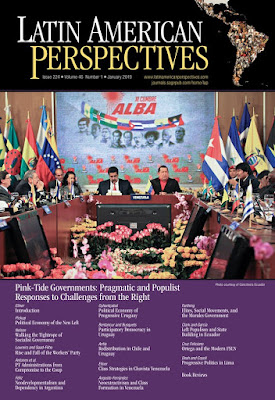
Abstract, Neodevelopmentalism and Dependency in Twenty-first-Century Argentina: Insights from the Work of Ruy Mauro Marini

:::::: Abstract ::::::


Neodevelopmentalism and Dependency in Twenty-first-Century Argentina: Insights from the Work of Ruy Mauro Marini
by Mariano Féliz


For Ruy Mauro Marini, writing in the mid-1990s, neodevelopmentalism in Latin America ended with the moratoria on debt repayment in Mexico and Brazil in the early 1980s, which ushered in an era of International Monetary Fund control. For him this demonstrated the inability of the Latin American bourgeoisie to achieve autonomy at the international level. Neodevelopmentalism returned in early-twenty-first-century Argentina in the local context of a new class politics and a wider context marked by the emergence of China in the world economy and the influence of Chavismo. It consisted of an economic policy that consolidated the new hegemonic groups led by transnational capital through the superexploitation of labor and nature and the revival of the myth of development expressed by the notion of “growth with social inclusion.” For a time the project was characterized by high rates of profit and high levels of (albeit precarious) employment, but, as the global crisis of 2008 revealed its limitations and the “fine-tuning” of economic policy produced a decline of real incomes and consumption, it led to fragmentation of the political spectrum and a realignment of its principal actors. Mauricio Macri’s election to the presidency in 2015 represented a counterrevolution that, as Marini predicted decades ago, would involve more violent superexploitation and stronger imperialist influence.


CONTINUE READING THE FULL ARTICLE HERE

SaveSave
SaveSave
SaveSave
SaveSave
SaveSave


SaveSave
SaveSave
SaveSave
SaveSave
SaveSave
SaveSave

January 31, 2018

Abstract, Solid Waste Management and Social Inclusion of Wastepickers: Opportunities and Challenges

:::::: Abstract ::::::


Solid Waste Management and Social Inclusion of Wastepickers: Opportunities and Challenges
by Marta Marello and Ann Helwege


As informal workers, wastepickers gather recyclable material without adequate social benefits and occupational protection. In response to wastepicker demands for legalization and access to the waste stream, cities have created inclusion programs to improve livelihoods and promote recycling. While inclusion yields benefits for many participants, it brings challenges at each step of development. In the poorest countries, workers lack the skills, capital, and managerial experience to operate profitably, while projects in wealthier cities employ few wastepickers and face stiff competition from the formal sector. The most sophisticated municipal systems mechanize waste processing and threaten wastepickers’ livelihoods because capital-intensive methods yield few jobs. To realize genuine inclusion, policies to support wastepickers must enable workers to compete throughout the broader economy.

December 25, 2017

Abstract, Solid Waste Management and Social Inclusion of Wastepickers: Opportunities and Challenges

:::::: Abstract ::::::


Solid Waste Management and Social Inclusion of Wastepickers: Opportunities and Challenges
by Marta Marello and Ann Helwege


As informal workers, wastepickers gather recyclable material without adequate social benefits and occupational protection. In response to wastepicker demands for legalization and access to the waste stream, cities have created inclusion programs to improve livelihoods and promote recycling. While inclusion yields benefits for many participants, it brings challenges at each step of development. In the poorest countries, workers lack the skills, capital, and managerial experience to operate profitably, while projects in wealthier cities employ few wastepickers and face stiff competition from the formal sector. The most sophisticated municipal systems mechanize waste processing and threaten wastepickers’ livelihoods because capital-intensive methods yield few jobs. To realize genuine inclusion, policies to support wastepickers must enable workers to compete throughout the broader economy.