Showing posts with label Haiti. Show all posts

December 19, 2019

Political Report # 1430 Demonstrators in Haiti are Fighting For an Uncertain Future


Political Report # 1430

Demonstrators in Haiti are Fighting For an Uncertain Future


Early in his term as President of Haiti, in a cartoon that was either meant to caution or mock him, Jovenel Moïse is shown dressed as a Haitian superhero. Eyes closed, he’s standing in the barely lit home of a Haitian family, where he announces that in twenty-three months they will have electricity twenty-four hours a day—even as the father reads a book by candle light and the mother presses clothes with a charcoal-fuelled iron. The couple more or less ignores him while only their baby cheers him on.

In the accompanying article by the journalist Roberson Alphonse, published in Haiti’s Le Nouvelliste newspaper, on August 10, 2017, Moïse is quoted as saying, “When I say the entire country will have electricity twenty-four hours a day in twenty-three months, I will do it.” He added that a President “shouldn’t have to promise that. It’s an obligation, a necessity. A country must have electricity, water, and roads.”

It’s been thirty-two months since Moïse was sworn into office after a contested, fraud-plagued, two-round election cycle in which only eighteen per cent of eligible voters participated. In a country of more than ten million people, about six hundred thousand voted for him. Even before taking his Presidential oath, Moïse was accused by Haiti’s Central Financial Intelligence Unit (ucref) of having laundered millions of dollars. A few months into his term, he fired the director of ucref—a move that probably led to Moïse being cleared of the laundering charges, which he has denied.

Unknown to most Haitians until he was handpicked by his predecessor, Michel Martelly—who also came to power through elections mired in fraud—Moïse was presented as a successful rural businessman from outside Haiti’s political class, a banana exporter nicknamed Nèg Bannann, or Banana Man. Less advertised was that he was also an auto-parts dealer and a supposed road-construction magnate. According to two reports published earlier this year by Haiti’s Superior Court of Auditors and Administrative Disputes, in 2014, before he’d officially become a Presidential candidate, Moïse received more than a million dollars from Martelly’s government, funds that were allocated for road construction and repair in the northern region of the country. The government auditors report that Moïse was paid twice for the same contract, once as the head of Agritrans and again as the leader of another firm, called Betexs. The two firms were listed as having the same staff and projects, as well as the same government patent and tax-identification number. The road for which the money was doubly paid shows no sign of having been constructed or repaired. Moïse also got more than a hundred thousand dollars for another one of his companies, Comphener S.A., to install solar panels on street lamps.

The funds allegedly pilfered in these schemes came from Venezuela’s Petrocaribe oil program, which Haiti joined in 2006. Through the Petrocaribe agreement, the Haitian government bought oil from Venezuela, paid sixty per cent of the purchase price within ninety days, then deferred the rest of the debt, at a one-per-cent interest rate, over twenty-five years. The Haitian government controlled the sale of the oil and was supposed to use those funds for development projects, including infrastructure, agriculture, education, sanitation, and health. This debt to Venezuela has grown to almost two billion dollars over the past decade.

On July 6, 2018, Moïse’s government announced that it was raising the price of gasoline, diesel, and kerosene between thirty-eight and fifty-one per cent, in order to qualify for low-interest loans from the International Monetary Fund. Huge nationwide demonstrations followed. I was in Haiti at the time, and it was clear that most Haitians were fed up with all the corruption, as well as Moïse’s ineptitude at addressing the country’s urgent problems. His silence and disappearance during difficult times has not worked in his favor, either.

In the summer of 2018, Haiti was already facing high rates of unemployment, rising inflation, a growing budget deficit, currency devaluation, and spikes in gang violence, all of which have grown considerably worse in the past year. Moïse’s government reversed its decision on the gas hike after twenty-four hours, but the protests continued. They were later amplified by the Petrochallengers, mostly young Haitians who started demanding accountability for the Petrocaribe funds, on the streets, and online.

On November 13, 2018, seventy-three men, women, and children were wounded, tortured, hacked with machetes, and set on fire in La Saline, an impoverished neighborhood of Port-au-Prince where residents had participated in Petrocaribe protests. Among them, fifty-nine were reportedly killed. Seven women were raped, and many houses were ransacked or burned, according to the Réseau National de Défense des Droits Humains. Witnesses accused two top government officials close to Moïse, Joseph Pierre Richard Duplan and Fednel Monchéry, of having been among those who helped to plan the La Saline massacre and providing area gang members with weapons and police uniforms. Both men, who have denied the allegations, remained in the government's employ—Monchéry as the executive director of the interior ministry, and Duplan as Moïse’s representative for La Saline and the surrounding area—until a few weeks ago, when they were fired by Moïse as the protests intensified. Moïse has not directly denounced the La Saline massacre, nor has his government sought to prosecute any of the perpetrators. The government has also not provided any medical, financial, or security support to the survivors. The killings in La Saline reminded Haitians—especially those living in destitute, gang-controlled areas—what can happen when people in power want their resistance smashed.

In February, 2019, the frequency and size of the protests grew, starting on the second anniversary of Moïse’s inauguration and the thirty-third anniversary of the end of the thirty-year Duvalier dictatorship. Schools and businesses were closed for ten days and public transportation was generally halted in what became known as peyi lòk, or Operation Lockdown. During peyi lòk, thirty-four people were reported to have died and a hundred and two injured. Venezuela, which is dealing with its own political and economic crisis, is no longer providing discounted fuel to Haiti, so the Haitian government now buys fuel from U.S.-based energy traders, to whom the government has been chronically in arrears. This led to recurring blackouts and gas shortages this past summer.

Peyi lòk returned in full force in September, in the midst of a widespread fuel shortage. Haiti has now been on lockdown for a month, with large demonstrations taking place almost every day. Schools have not been opened. The sick can’t get to hospitals, where resources are also dwindling. Those who are not at the demonstrations lock themselves up at home until there’s a reprieve, during which they go out and buy food, which has become exorbitantly expensive, and water, of which there is a shortage in some areas. Haitians from all walks of life have been calling for Moïse’s resignation, including Catholic and Protestant clergy, artists and intellectuals, university professors, business people, bar associations, and the various groups and parties that make up the political opposition.

Moïse has repeatedly said he will not resign. In his most recent pre-recorded address—released on September 25th, at 2 a.m.—he told Haitians that he’s heard their cries and is aware of their despair. He called for unity and dialogue. He promised not to respond to violence with violence. The streets, where some police officers have used live ammunition to disperse protesters, tell a different story. The senator from Moïse’s party who fired a pistol outside the parliament building last month, wounding a photojournalist and security guard, also tells another story. As does the massacre in La Saline.

Looking back at that 2017 cartoon of Moïse being derided as a would-be superhero, I am reminded that it is the Haitian people who have always exhibited superhuman traits and who have had to continue to do so over the past year. They have been dodging bullets and enduring tear gas and water cannons while, for the most part, not being able to eat regularly, or send their children to school, or go to a decent hospital when they are sick, or afford the medicine they need. I know from speaking with many young people in my own family and beyond that they know Moïse is just the latest manifestation of bigger and broader structural and institutional problems. They are also aware that, like generations of Haitians before them, they are fighting for a very uncertain future.

The young men and women demonstrators, when speaking to both local and foreign journalists, sometimes speak of their desire for a tabula rasa. They want a more egalitarian, inclusive, and just society, where the rights of every citizen will be respected. Not just the wealthy and well-connected but the urban and rural poor, too. They want the international community to stop meddling and pushing elections as a vehicle for change, only to rig them and saddle the country with leaders like Martelly and Moïse. They want Haitian-led solutions. They want institutions that work. They want an end to impunity. They want freedom from government and privately funded gangs, who routinely rape women and girls. They ultimately want accountability not just from Moïse but from everyone who has stolen or squandered the Petrocaribe money, which their children, grandchildren, and great-grandchildren will still have to repay.

They must see some parallels between themselves and those taking part in the equally massive, and increasingly violent, protests in Hong Kong, to which the world at least is paying attention. Twenty people were killed and about two hundred injured during the protests this past September. The numbers are likely to increase this month as demonstrations persist and ramp up in intensity. One thing that Moïse said in his dead-of-night speech on September 25th, which all Haitians should be able to agree on, is that “Ayiti pap peri. Ayiti pa dwe peri.” Haiti will not perish. Haiti should not perish. Not over him, or anyone else.


Original article can be found (here).
URL:      Click here for article

August 1, 2018

Political Report # 1357 Amid an Uprising, Can Haitian President Jovenel Moïse Deliver on His Promises?


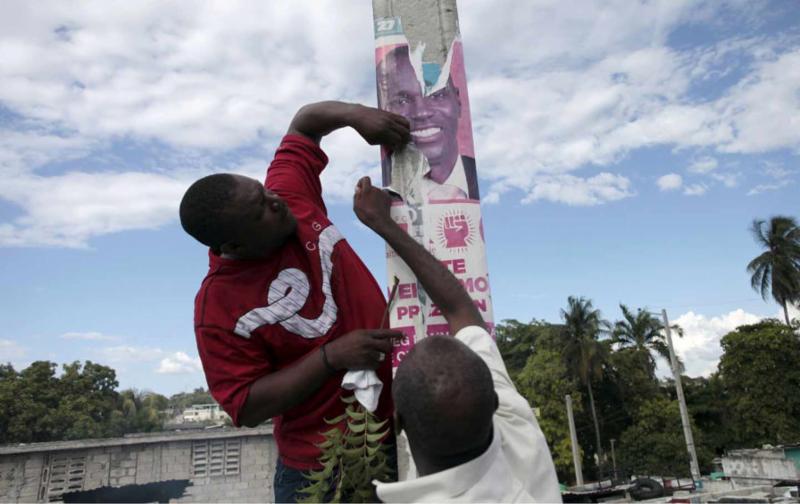
Protesters rip an electoral poster of president Jovenel Moïse during a demonstration against the electoral process in Port-au-Prince, Haiti, on November 6, 2015. (Reuters / Andres Martinez Casares)


Political Report # 1357
Haiti’s “Banana Man” compared himself to Trump-he was more right than we realized.

The announcement came on a Friday afternoon, late in the second half of the World Cup quarterfinal match between Belgium and Brazil, the national team adopted by most Haitian soccer fans. Minutes later, Brazil had lost the match. And soon after, thousands of Haitians were in the streets, though not because of the game’s disappointing result.
The government stated it would be eliminating fuel subsidies, sending the price of gasoline soaring by 38 percent overnight, to $4.50 a gallon. Kerosene, heavily relied upon by the country’s poorest citizens, would increase by 51 percent, to almost $4 a gallon. If the thought was that most Haitians would be distracted by soccer, the plan failed.
The government had agreed to end the subsidies months earlier as part of an agreement with the International Monetary Fund (IMF). “The people were waiting for that decision,” a law-enforcement source explained, “and everyone in each area was prepared to react.”
Though fuel subsidies predominantly benefit the wealthy, any increase in the cost of living can be catastrophic in a country where 60 percent of the population scrapes by on less than $2.40 a day. Protesters built roadblocks and burned tires throughout the capital, Port-au-Prince, and soon demonstrations had broken out across the country. By Saturday morning the situation had worsened. An uprising had begun.
Protesters appeared to target hotels catering to the international market and a supermarket owned by one of Haiti’s richest families. But just as the country’s economic malaise has hit the middle class, so too did the protests; overall some 80 businesses of all sizes were damaged. International airlines canceled flights to Haiti, while some of the wealthy boarded helicopters or private jets and fled the country. As many as 20 people were killed, and more than 50 arrested.
Less than 24 hours after the initial announcement, the government walked back the price increase. And a week later, on July 14, Prime Minister Jack Guy Lafontant was forced to resign rather than succumb to an embarrassing no-confidence vote in Parliament. But the aftershocks of that initial decision have continued to reverberate and have exposed fault lines that continue to threaten Haiti’s democracy.
President Jovenel Moïse, who took office in February 2017, now finds himself alone atop the government, but he faces the stiffest test of his presidency.
An agricultural entrepreneur from rural Haiti, Moïse was put forward as the candidate who could feed a hungry nation. And he came to office with lofty promises of food security, paved roads, electricity across the country, and a crackdown on corruption. After the election, Moïse likened his own victory to that of another businessman turned president: Donald Trump. “President Trump and I are entrepreneurs, and all an entrepreneur wants is results,” he said at the time.
But results have been elusive. Food scarcity remains high, and multiple years of double-digit inflation, coupled with the local currency’s losing half of its value, have eroded purchasing power in a country that is highly dependent on imports. Haiti remains one of the world’s most unequal societies, while government waste and inaction have fueled the perception that the country’s politicians are more interested in their own bottom line than that of their constituents.
The response to the elimination of subsidies appeared to come as a shock to Moïse and his administration, as if they could not see the reality surrounding them. But the fuel-price announcement was like tossing a lit match on a gasoline-soaked pile of kindling; it shouldn’t have been a surprise when it went up in flames.
Trou-du-Nord in Northeast Haiti is Moïse’s hometown and the site of the banana plantation that gave him his nickname, Neg Bannann, or Banana Man in Haitian Kreyol.
In a former colony subject to centuries of foreign interference and exploitation, the moniker would have been too clichéd for a Graham Greene novel. But it resonated across the country, and served as a selling point for the political neophyte.
In September 2015, just one day before the official launch of his presidential campaign, Moïse stood amid his fields of produce and proudly exclaimed, “Our bananas are now on their way to Europe.” It was his company’s first shipment, and, the company said, Haiti’s first export of bananas in more than 50 years.
Moïse, the ruling party’s pick to take the reins of government, officially received the most votes in the 2015 election, only to see those results tossed out because of “widespread” irregularities. His predecessor, Michel Martelly, left office at the end of his term and was replaced by an interim government, largely made up of political opponents. Then, in October 2016, Hurricane Matthew devastated Haiti’s southern peninsula, delaying the rerun elections even further.
Moïse was the best-funded among Haiti’s sprawling field of candidates, 54 in total, and with a slick international public-relations company at his back, he was able to keep up the campaign as others faded through the delays. With food stocks-including bananas and, far more common in Haiti, plantains-decimated by the hurricane, Moïse appeared to be the perfect antidote.
“Without [the plantation],” Jean-Max Bellerive, a former prime minister who also held a position with the interim government, explained to me, “there is no way he’s president.”
Still, less than 20 percent of registered voters turned out. While Moïse emerged with a parliamentary majority and the presidency, the popular mandate he claimed was never there-as has become clear with the recent unrest.
A banana tree can go from planting to harvest in nine months. In November 2017, a year after Moïse’s election and nine months since he had taken office, I traveled to the plantation that catapulted him to the presidency to see for myself if the Banana Man was beginning to bear fruit.
A fence, formed by green stalks of bamboo threaded together with barely visible strands of barbed wire, lined the road to Moïse’s 2,500-acre banana plantation, an area three times the size of New York’s Central Park. In 2013 the Haitian government declared this land part of its first-ever agricultural free-trade zone. The government granted tax-free access to the land and a $6 million loan to a new company, Agritrans, owned by Moïse, the president of the local chamber of commerce. Anonymous investors contributed at least another $10 million.
Back on the road, the bamboo fence gives way to Agritrans’s entrance. There is no real office here. Just a tall metal gate, a few empty shipping containers, a faded sign, and land-lots of land.
A handful of workers watched as a new Hyundai excavator fired up its engine and began slowly poking into the earth, now largely overgrown with grass. In the distance, a dozen or so workers appeared to be planting cuttings in a small newly tilled area. As I would come to discover, no bananas had been shipped since the Banana Man’s election.
“After the election, they cashed in,” a water technician on site explained, with a shrug. I could see an irrigation system snaking through the fields before disappearing into the distance. He pointed to a small building a few hundred yards away where I could find the man in charge.
Erlin Tijerino, a Costan Rican agronomist and banana specialist, was perched on a stalled conveyor belt in the processing area. Tijerino didn’t have an office, but this worked for him. The belt hadn’t moved in more than a year-since he was hired.
When Tijerino showed up for his first day of work, soon after Moïse won the election, all of the banana trees were already dead. “The soil was not right,” he explained, “it was difficult to grow bananas.”
It took a moment for the implication of what he said to sink in.
When I met him, Tijerino was overseeing a process to improve the soil and was just beginning to plant a new variety that he hoped would be better suited for the land. The first small harvest would come in early 2018, he expected. Less than a hundred acres had been replanted-about 5 percent of the land that lay behind the bamboo fence. It would take time to make it viable. The soil, he explained, had been better suited for small-scale production of foods such as peanuts, corn, and beans.
“We used to sell our goods at the market to buy local produce,” Nadia told me. But now, she continued, her expression hardening, “It is mostly imported rice we eat.”
We were standing next to a quarter-built cinder-block frame, wedged between Nadia’s mother’s house and the road that runs alongside it. Across that road is Agritrans’s fence, and behind that, open land. But that land is no longer open to Nadia or to the rest of the crowd that assembled beside her stunted home.
Nadia still remembered the day, more than four years earlier, when Moïse showed up with the tractors. Her family had lived and farmed this land for more than 30 years, she told me. Then, one day the fence went up-with her home inside it. Days later, the tractors came and demolished that home, and what remained of her previous life along with it.
Nadia and her husband moved across the street, to her mother’s house. Slowly, Nadia and her husband saved up and started building a house of their own on the same lot. But he passed away soon afterward. Since then she hasn’t been able to afford to keep building. And so the quarter-built house sits empty, a constant reminder of all that has been lost.
Agritrans promised that some 3,000 local farmers would find work on the plantation. But the farmers who had gathered at Nadia’s house claimed not to have worked a day on the Agritrans land. At the plantation, employees told me that only a few dozen worked there full-time. And for the few farmers lucky enough to get rotational shifts preparing fields, the daily pay is about $3.50.
Jennifer Vansteenkiste is a Canadian anthropologist who was doing field work around Trou-du-Nord when Agritrans took over the land. Her research provides a rare glimpse into the actual impact on those communities displaced by megaprojects such as Agritrans. Her before-and-after study, published in May 2017, showed a drastic change in diet, and a significant loss of income. On average, she found, each person lost about $1,400 a year. Some families received a small, one-time payment as compensation for losing their land and their livelihood. But no one I spoke with had received more than about $700.
But when I asked those gathered at Nadia’s for whom they voted, nearly every resident quickly proclaimed “Neg Bannann!” Moïse received more than 85 percent of the vote in Trou-du-Nord. He’s from here, they said. He made promises, they said.
Even after taking office, the Banana Man’s campaign never really ended. En route to the northeast, I stopped in the fertile rice fields of the Artibonite Valley. It was here where, upon taking office, Moïse launched the “Caravan for Change,” a catchall development program that he pledged would travel the country and restore agricultural production to its full potential.
I met Mesadieux Alexis, the leader of a Caravan-created farming cooperative, at a rice-milling station he operates in Ponte Sonde. As part of the program, the government has provided new tractors and processing mills on credit to such cooperatives. The smell of diesel used to run the mill was heavy in the dark building, filled close to the ceiling with bags of rice awaiting processing.
Alexis explained that the problem is not their ability to produce, but that there is no market for it. Alexis was happy with the Caravan’s support, but “we have to be prepared to confront the government,” he told me. “We cannot produce rice if they keep importing it.”
In the 1990s, under pressure from Washington and multilateral lenders including the IMF, Haiti dropped rice tariffs from 50 to 3 percent. Imported “Miami Rice” flooded the market. Haitian diets changed with the policy. Today, the average Haitian gets nearly a quarter of their daily caloric intake from rice, 80 percent of which is imported.
The collapse of peasant agriculture pushed hundreds of thousands of Haitians to leave the country, and millions more into the sprawling slums of the capital where they are ever more reliant on imports. But once there, Haitians face an extraordinarily high cost of living. The history of the IMF’s involvement, and the deleterious impact, cannot be delinked from the response to the fuel-price increase.
But despite the administration’s apparent focus on undoing this lingering harm by focusing on national production and rural livelihoods, many of the country’s peasant organizations are becoming increasingly frustrated. Some 20 organizations signed a declaration in October declaring that while “the president has talked much about farming,” he has left farmers out. “The most important attacks against agriculture among peasant families are coming from the Haitian state itself,” the statement concluded.
It hasn’t helped that, even if his plantation someday succeeds, the Banana Man’s harvest was always meant for a foreign audience. And the banana cuttings themselves are imported.
But the Caravan has also come under criticism for its lack of transparent financing. The Caravan itself is not mentioned in the official budget, and the government has paid for the program using funds from a variety of government ministries, making accountability more difficult.
Though I requested more detailed financial information from the government multiple times, none was provided. “There is no paper, no anything,” Tonny Joseph, an international consultant and good-governance campaigner, told me.
In February 2018, I reached out to the president’s staff for an interview. I wanted to know more about the Caravan and who Agritrans’s anonymous investors really were and how this plantation, which had exported next to nothing, could still be in business. After initially saying they’d quickly get me some answers, the staff abruptly stopped responding.
But two weeks later, with the heads of state of Caribbean nations in Haiti for a high-level summit, Moïse and a convoy of official vehicles arrived in Trou-du-Nord, at Agritrans. In well-produced video clips, one can see the conveyor belt that Tijerino, the agronomist, had used as his desk, now loaded up with green bananas.
The fact remains, however, that Agritrans has never made a profit. Since Moïse launched his presidential campaign with that first shipment, only one additional container has left port, and it was more than two years ago, in April 2016.
As a free-trade zone, Agritrans is legally required to export 70 percent of its production. In 2014 the company signed a long-term deal with a German company, Port International, which called for the shipment of up to 60 containers per week. Agritrans has claimed that the replanting effort was made in coordination with their international partner, but the company provided a contradictory view.
Mike Port, an official with the company, confirmed to me that there had been no recent communication with Agritrans. “We had just 2 shipments and it seems that due to unknown reasons Agritrans was not in a position to establish the relationship we wanted,” Port wrote to me via e-mail in February. “We lost contact during and after elections.”
It is unclear how the firm has any funds remaining from its initial, and anonymous, investment, or if it has paid anything back to the government on that $6 million start-up loan. Wilson Laleau, the minister of commerce at the time and a cousin of Moïse’s wife, signed the agreement granting Agritrans the state land and generous tax exemptions. Laleau is now Moïse’s chief of staff.
While the government has been under pressure to eliminate fuel subsidies, Agritrans itself has benefited from close to $600,000 in import tax exemptions alone. As Americans are also quickly learning, it can be a tricky thing having a businessman as president. Especially one with a history of allegations of financial impropriety.
In August 2016, the government’s anti-money laundering office released an investigation into the then-candidate Moïse, identifying a number of suspicious bank accounts (including in the name of Agritrans) and transactions that appeared to indicate involvement in money laundering.
Another investigation, this one from the government’s anti-corruption unit, found that Moïse had received two personal loans totaling hundreds of thousands of dollars in 2011 and 2013 from a state-run bank now on the verge of bankruptcy. The investigation alleged that the bank had not performed due diligence before making the loans to Moïse. After “delays and irregularities” on the payments, the second loan was restructured, the investigation found. The remaining balance of about $160,000 was due last month.
Both files were passed on to an investigating judge before Moïse’s inauguration, but local human-rights organizations say there has been no progress since. Moïse has categorically rejected the findings as politically motivated. Once in office, he fired the director of the anti-money laundering office.
Moïse campaigned as the candidate of rural Haitians, the man who could restore national production and feed a hungry nation. Moïse was elected president, but those displaced farmers in his hometown are left to look across the road, through Agritrans’s fence, at the largely fallow land that once sustained them. Today, Moïse is a president without a government.
The mishandling of the fuel-price adjustment has alienated allies, emboldened his enemies, and forced the president to the negotiating table. It wasn’t just the response to the elimination of subsidies that seemed to come as a shock, but also the president’s political fragility.
His first prime minister, Lafontant, had also never held political office, and the pick ensured Moïse would not be overshadowed. He is known as insular, resistant to criticism, and reliant on a small coterie of close advisers, but it has become clear that Moïse will have to adapt to lead Haiti out of its current crisis. “When will the one-man show end?” Haiti’s largest and oldest newspaper, Le Nouvelliste, asked following the demonstrations.
The former prime minister Bellerive has been involved in negotiations with the government to find a way out of the crisis. For him, it is Moïse’s business background that, more than anything else, reveals his shortcomings. “They sold him as an entrepreneur,” he told me earlier this year, “but the manipulation is bigger than Agritrans.... he has had no real success.”
His previous business résumé consists of running a rural auto-parts store and a water distribution company. Under his predecessor, Martelly, another of Moïse’s companies received a government contract to install solar lights. He has been accused in a Senate corruption investigation of failing to deliver on that project-a charge he has rejected.
Yet, Bellerive continued, “each setback has resulted in a step up, and so he can’t see the reality. He has convinced himself that against all odds he will succeed.” It reminded me of Trump, I said.
Now that reality is getting harder and harder to ignore.
Jake Johnston is an international research associate at the Center for Economic and Policy Research in Washington, DC, and the lead author of the Haiti: Relief and Reconstruction Watch blog. His work has been published by The Nation, The Intercept, Al Jazeera, and Boston Review, among other outlets.


Original article can be found here:
https://www.thenation.com/article/amid-uprising-can-haitian-president-jovenel-moise-deliver-promises/

March 28, 2018

Political Report # 1324 Movement Building at the Heart of Haitian Peasants’ Response to Climate Change


By Mina Remy And Salena Tramel  
Grassroots International 

Social movements in the Haitian countryside are dealing with the politicized challenge of climate change through methods that reach back to a rich agrarian tradition and weave in contemporary grassroots solutions. Deep in the Central Plateau, the Peasant Movement of Papaye (MPP) is leading the way towards a new Haiti centered on food sovereignty and climate justice. These twin proposals are not only a way out of hunger and the climate crisis, but are political tools meant to contribute to systemic change in Haiti and beyond.
Haitians are used to navigating the intersections that occur where nature meets politics, and the small Caribbean country’s landscape shows the scars of that process. Bare mountains that were once green loom over makeshift, seaside cities where the rural majority once farmed and fished. Every now and then, Haiti, paradoxically isolated from and dependent on the rest of the world, makes the news: a state coup, a massive earthquake, or yet another hurricane. And today, while receiving a lesser degree of international attention than these monumental moments, the increasing impacts of climate change are threatening to break Haiti’s already weakened agricultural backbone.
CLIMATE DISRUPTIONS
In October 2016, the country was hit by Hurricane Matthew, a category 4 storm which completely flooded large swaths of the country, and devastated Southern Haiti. Hurricane Matthew hit just weeks before harvest, and the country has not recovered since. As a matter of fact, farmers in Haiti are now dealing with periodic flooding. Without respite, they have gone from one extreme to another: in the 2014/15 season, the county’s agricultural production fell by more than 80% due to drought.

April 25, 2017

Book, Haiti: From Revolutionary Slaves to Powerless Citizens: Essays on the Politics and Economics of Underdevelopment, 1804-2013

:::::: Book ::::::


Haiti: From Revolutionary Slaves to Powerless Citizens: Essays on the Politics and Economics of Underdevelopment, 1804-2013
by Alex Dupuy


This title focuses on Haiti from an international perspective. Haiti has endured undue influence from successive French and US governments; its fragile 'democracy' has been founded on subordination to and dominance of foreign powers. This book examines Haiti's position within the global economic and political order, and how the more dominant members of the international community have, in varying ways, exploited the country over the last 200 years.

April 5, 2017

Political Report # 1239 Haiti's Eroding Democracy

 By Jake Johnston, Jacobin


After more than a year of delays, Haiti finally elected a new president this past November. Jovenel Moïse - nicknamed the Banana Man - scored a first-round victory in a sprawling field of twenty-seven candidates, taking over 55 percent of the vote. The banana exporter, who has never held public office, was inaugurated on February 7.
The previous president, Michel "Sweet Micky" Martelly, seemingly plucked Moïse out of nowhere last year, making him the new face of the Haitian Bald-Headed Party (PHTK). Moïse's win is an extraordinary achievement for a political neophyte, but it has one glaring problem: only 20 percent of Haiti's voters showed up on election day. Moïse because president with less than 10 percent of registered voters - only about 600,000 votes - supporting him.
Haiti stands as a stark reminder of the fragility of electoral democracy amid rising inequality and exclusion. After the fall of the Duvalier dictatorship in 1986, Haiti's poor majority turned out en masse for general elections, but that cycle appears to be broken. Today, Haiti ranks among the lowest worldwide in terms of voter participation.
Why have Haitians lost faith in electoral democracy? Certainly, the impact of foreign intervention, the crushing constraints of neoliberalism, and the prioritization of economic stability over democracy all played a part. The disappointments and betrayals of left-leaning political leaders, put into office by Haiti's once-powerful popular movements, only add to this sense of apathy.
Meanwhile, the ruling elite have allied with the last vestiges of Duvalierism to accomplish what they never before could: consolidation of power through elections. After two decades of failed runs and successful antidemocratic subversion, the dominant classes have finally retaken the political upper hand.
But how long can they hold on? The recent arrest and prompt extradition of senator-elect and former paramilitary coup leader Guy Philippe, indicted for drug trafficking and money laundering, has revealed the incoming administration's darker side. Moïse openly campaigned with Philippe, and his party's power stems from the electoral success of other unsavory characters.
Whether Moïse's election presages the dawning of a stable neo-Duvalierist order or simply marks another cycle in Haiti's political spiral remains to be seen. But Moïse's rule is inherently precarious.
Growing Apathy
A few days after the November election, residents of Port-au-Prince's Cité Soleil community took turns expressing their frustration with the country's politicians. A young man explained, "I don't care who wins, they are all the same." An English teacher named Fritz interjected, "People ask, what's the point? They see nobody has done anything to change our situation, so they lose faith in voting." While Cité Soleil has long supported Jean-Bertrand Aristide's Fanmi Lavalas party, only about 10 percent of the neighborhood voted in November. This time, many of them chose Moïse.
"There are obvious weaknesses and limitations within Fanmi Lavalas," Brian Concannon, the director of the Institute for Justice and Democracy in Haiti, told me after the election. "But much of that can be explained by the undermining and overthrowing of the Lavalas governments, which prevented them from demonstrating how democracy can work, and the killing, jailing, and exiling of important leaders."
When Fanmi Lavalas emerged, it promised to restore Haitian democracy following the years of dictatorship. Its leader liberation theology priest Aristide, had openly opposed Duvalier and easily won Haiti's first democratic elections in 1990. But just months into his term the old order ousted the popular president, who was forced into exile. Members of the military and the dictatorship created death squads to repress the population and stamp out the popular movement that threatened its rule, killing thousands. In 1995, Haiti disbanded its military, hoping to prevent further coups.
After returning under the protection of American troops in 1994, Aristide became president again in 2000. With no military structure, former soldiers instead allied with elites to lead a years-long destabilization effort.
Philippe - the now extradited senator-elect - played an important role in this campaign. His paramilitary force attacked government institutions and supporters throughout the country, contributing to Aristide's second ouster in 2004. In both cases, it was later revealed that at least certain segments of the American government had supported the coups.
Meanwhile, international development banks and foreign governments were imposing neoliberal economic policies on Haiti. They privatized state-run enterprises, cutting off the government's much-needed financing, and slashed tariffs, seriously harming Haiti's national agricultural production. In 2010, former president Bill Clinton apologized for the impact of some of these policies, though little has been done to reverse the damage.
Fault lies with some of Haiti's own leaders as well. René Préval, president under the Lavalas banner from 1995-2000, was reelected 2006. By then, however, he had built his own political movement and distanced himself from his former ally, who had become enmeshed in allegations of human rights abuses. Unwilling to cede power to a new generation of leaders, Aristide watched from exile in South Africa as the movement that had broken the shackles of Duvalierism splintered apart. In 2015, former Laval's members were running under the banner of just about every major party - even the PHTK.
Twenty years after Duvalier's fall, living standards had declined, and people began to doubt that elections would produce social transformation. Only two million participated in the 2006 elections, compared to the almost three million who voted six years prior. The decline has only continued. Since then, the number of eligible voters has grown by 2.5 million, but barely more than a million turned out last year.
Haitians' trust in politicians and their faith in democracy has evaporated as foreign donors have poured billions of dollars into "democracy promotion" programs and a UN military "stabilization" mission that arrived after the 2004 coup to enforce order. Donors fund elections; observers sanctify them; and Haitian elites reap the benefits.
Stability
Stability has been a buzzword in Haiti for years, justifying both international interventions and the Haitian elite's decisions. But prioritizing economic stability over democracy hasn't improved lives for the poor; rather, it's ensured that the status quo continues. "[The elites] want stability for themselves, not to improve people's lives," Pierre Espérance, the leader of one of Haiti's largest human rights organizations, told me.
Indeed, creating a stable environment for business doesn't have anything to do with creating stability nationwide. A former US Ambassador to Haiti explained that, for the private sector, "prosperity works, chaos works, and disaster, ooh! They never get richer than during a disaster."
Elections are held to create a veneer of democracy that masks the country's inequality. The former ambassador said, "There's no doubt in my mind that money runs Haiti" and now questions who really wants elections: the Haitian people or the international community. "Frankly, I'd say the international community does."
These contradictions came to a head with the 2010 earthquake and the elections held later that same year.
After the quake, the Haitian government was barely functioning, bogged down trying to assist the millions of victims. The billions of dollars in international aid that poured into the country did not go to the struggling government. Instead, it was channeled to foreign NGOs and development agencies - most of which rely on the country's elite to carry out their work. In a country often called the "republic of NGOs," the government's role in citizens' lives eroded even further.
President René Préval, who was harshly criticized for the government's ineffectiveness during the crisis, refused to cede greater control to international donors. When he rejected a Clinton-led reconstruction commission's request to seize and allocate land, he isolated himself even further. This, he believes, led donors - and the United States specifically - to turn on his chosen successor in the 2010 elections.
That November, more than a million people remained displaced from the earthquake. The elections were, predictably, a complete failure. Turnout was depressed, the Lavalas party was excluded, and violence disrupted the process throughout the country.
In the aftermath, a majority of candidates called for a new vote. Behind the scenes, the Préval government, whose chosen successor Jude Célestin had advanced to the runoff in second place, agreed to a do-over. But, from the international community's perspective, stability meant moving forward, no matter the resulting blow to democracy.
Préval asked, the Organization of American States (OAS), which had observed the elections, to analyze the results. Without any statistical analysis or recount, they determined that Célestin should be replaced by Martelly in the second round.
According to multiple sources, a small team from the American embassy had made the decision before the OAS experts ever set foot in the country. In the midst of historic upheaval in the Middle East and North Africa, Hillary Clinton, then serving as secretary of state, took time to personally go to Haiti to make sure everything moved forward smoothly.
E-mails from Clinton's private server, released thanks to Freedom of Information Act requests, show how the American government collaborated with the Haitian elite to place Martelly in the second round. Reginald Boulos, an influential businessman, wrote to Clinton's top aide, Cheryl Mills: "On behalf of the Haitian private sector, I want to thank you for the commitment you have shown to Haiti."
After the United States used the OAS to overturn the results of the 2010 elections, the perception that Haiti's leaders were chosen by foreign embassies and their local allies was confirmed, rendering voting virtually meaningless. Meanwhile, international donors, having put Martelly in office, stood by the charismatic new president, who announced that Haiti was "open for business."
The 2010 election would have another long-term consequence: the consolidation of a neo-Duvalierist political movement.
Lord Logic
A month before this year's election, a diplomatic source told me that "there are three kings in Haiti: Préval, Aristide, and the Duvalierists." If the vast majority of the political class originates from the first two, the latter has empowered the PHTK. Indeed, Martelly has long-standing ties to the Duvalier dictatorship.
As the "bad boy" of Haitian konpa music, he played late-night shows for military friends through the late 1980s and early 1990s. He's also admitted to belonging to Duvalier's dreaded Tonton Macoute militia in his youth.
Martelly campaigned around "ousting the political class," as former prime minister and the then-president's cousin Jean-Max Bellerive told me in 2015. He explained, however, that Haitian politics have always depended on personal connections: "Inside, everything is possible." Indeed, once Martelly became president, he repaid his sponsors, making Jean-Claude "Baby Doc" Duvalier's son his adviser. Other dictatorship-era officials spread throughout the administration. Martelly also put the restoration of the military at the heart of this new movement.
In January 2015, parliamentary terms lapsed, rendering the legislative branch dysfunctional and allowing Martelly to rule by decree. For four years, the Haitian government didn't hold a single election; the constitution required three. Martelly single-handedly appointed mayors and other local officials.
According to Damian Merlo, an American political consultant who worked for Martelly's campaign and stayed on after his victory, a "Duvalierist clique" tried to convince Martelly to continue to delay elections. But the plan to consolidate power unconstitutionally was prevented. The long-splintered opposition came together, taking to the streets and demanding elections. The old guard - which had helped overthrow democratically elected governments twice in two decades - would have to hold onto its power through the ballot box. 
They overreached. Across the country, armed men disrupted the vote during the legislative elections. Even the electoral council, widely perceived to be under Martelly's influence, acknowledged that the PHTK and its allies were largely responsible for this electoral intimidation.
These tactics paid off during the presidential elections a few months later as the vast majority of Haitians stayed home. With turnout depressed, those with the most money stood to benefit, as any advantage they had would be magnified.
At the time, Jovenel Moïse was relatively unknown. He had been a businessman in Haiti's Nord-Est department and served as president of the local chamber of commerce. In 2014, the Martelly government invested millions in his company, Agritrans S.A., to develop an agricultural "free trade" zone. Despite his lack of political experience, the PHTK's strategy launched him into the lead.
Pascale Roussy, a political analyst with the European Union election observation mission, explained that "whereas other parties are built from the bottom up, PHTK represents the oligarchy, the elite." By keeping turnout low, they intensified local power brokers' influence.
"It's lord logic," she continued. "They may not be part of PHTK, but the local leader wants to maintain control of his area for himself, not just for the party." Roudy Choute, a PHTK representative, put it more succinctly, noting that elections in Haiti are a "science": "We get local candidates, they bring their voters, and they'll also vote for president."
In 2015, this almost worked: Moïse officially received the most votes but failed to win outright. The next three candidates - all from the center-left - received 200,000 more votes combined then he did.
Tens of thousands took to the streets, alleging that Martelly had stacked the deck to ensure his party's hold on power. They called for an investigation into electoral violence and fraud. The administration and its international allies adamantly forged ahead to a runoff based on the contested results, but they underestimated the united opposition's power. As the movement grew, the second-round election was indefinitely postponed.
When Martelly's term officially ended in February 2016, he reluctantly transferred power to former minister-turned-senator Jocelerme Privert. The interim president immediately called for a commission to investigate the elections, which revealed "massive fraud" and recommended that the results be thrown out.
The report represented a serious blow to foreign embassies used to getting their way. But investigating the election was the only way faith in Haiti's democracy could be restored, Privert told me at the time. "[Elections] have one objective: to save the country, to spare the country from political catastrophe. . . . It is anarchy, or [a] future," he said about the new electoral process.
The United States responded by withholding funding, but the Haitian government found the resources to fund the elections itself - a first in recent history and a major step toward sovereignty.
There's a saying in Haiti that Haitians will come together to oust a president but not to elect one. Espérance, the human rights leader who led the 2015 antifraud movement, recognizes this as a main factor in the 2016 election outcome. "Political parties don't want to work together. . . . There are too many, and they are very weak."
The leading opposition candidates could not unite around a common platform, so they all stayed in the race, dividing the Left. Meanwhile, on the Right, key private-sector actors lined up behind Moïse. Thanks to a year-long election process, campaign funding soon dried up. In November, the still disenchanted majority stayed home again. In the end, the pro-democracy mobilizations had proved no more than a speed bump in the way of Haiti's new political machine.
Legal Bandits
The losing parties contested the results, once again raising allegations of fraud, but most international observers praised November's electoral process. Espérance, who led the largest domestic observer network, agreed that the elections were largely "acceptable." He quickly added, however, "We can't have free elections under the current electoral system." And that makes Espérance pessimistic: "We have a newly elected president, but you can't expect anything." Since the election, he has received multiple death threats.
Granted, Haitian ownership of the electoral process had increased, and technical improvements were made. But November's elections made it even more clear that a deeper threat had been simmering for some time: Haiti's elections no longer serve as a means of representative democracy, but have become a theatrical performance to ensure international legitimacy and a steady flow of profit and power to the country's corrupted elite and their local allies.
With Jovenel Moïse's election, which came with a working majority in parliament, these criminal elements have consolidated their power and ensured the continuance, however fragile, of Martelly's neo-Duvalierist legacy.
Martelly was a controversial provocateur notorious for bawdy stage performances, but Moïse has become, at least on the surface, a more polished figure. One diplomatic source said that when the candidate first came to his embassy in 2015, he was wearing a suit several sizes too big, awkwardly draped over his tall, lanky frame. By the 2016 election, Moïse regularly attended embassy parties, events, and even visited the US Congress, now sporting neatly tailored suits.
Moïse has pledged to revitalize the agricultural sector and to prioritize national production. These promises seem ironic, given that his firm must export at least 70 percent of its output to benefit from its special tax status. He has given his word that he'll better manage the millions of dollars in foreign assistance and work to strengthen the government. He has also pledged to reinstate the military, raising fears of a new wave of political repression.
Although Guy Philippe, perhaps the best known Haitian leader linked to political violence, made a dramatic exit from the political sphere, others remain. Youri Latortue, who backed the 1991 coup as a lieutenant and then allied with Philippe during the 2004 coup, now serves as president of the Senate. A decade ago, a former US ambassador referred to him as the "poster-boy for political corruption in Haiti." In 2015, the Miami Herald used a popular 2008 Martelly song, "Bandi Legal" or "Legal Bandits," to refer to the incoming parliament.
Moïse himself was embroiled in controversy before ever taking office. An investigation launched in 2013 by Haiti's anticorruption body revealed dozens of questionable bank transactions involving his businesses. A government prosecutor is currently reviewing the file to determine if money-laundering charges are warranted.
Will this strategy of elite alliances and local influence maintain right-wing rule in Haiti? Three decades of near-constant foreign intervention and the failures of Haiti's traditional political class have weakened and divided the country's once strong and united democracy movement. Elite control, at least in the short term, is now all but ensured.
But the foundation for this "stability" has been built with kindling. With so many excluded from their country's politics, the viability of Haiti's electoral democracy as a path toward constitutional order and stability has been diminished.  More than two hundred years since Haitian independence, the struggle for freedom will find other expressions.


Original article and sources can be found here:

December 8, 2016

Book, Haiti: From Revolutionary Slaves to Powerless Citizens: Essays on the Politics and Economics of Underdevelopment, 1804-2013

:::::: Book ::::::


Haiti: From Revolutionary Slaves to Powerless Citizens: Essays on the Politics and Economics of Underdevelopment, 1804-2013
by Alex Dupuy


This title focuses on Haiti from an international perspective. Haiti has endured undue influence from successive French and US governments; its fragile 'democracy' has been founded on subordination to and dominance of foreign powers. This book examines Haiti's position within the global economic and political order, and how the more dominant members of the international community have, in varying ways, exploited the country over the last 200 years.

November 25, 2016

Political Report # 1202 Haiti's never-ending nightmare grows longer


Residents return to their crumbling homes after Hurricane Matthew strikes Haiti


By By Edna Bonhomme, Socialist Worker


HAITI IS enduring another not-so-natural disaster in the aftermath of Hurricane Matthew.
With winds reaching 145 miles an hour, the storm wrecked homes, communities and lives, particularly along Haiti's southwestern coast. Estimates of the death toll have reached as high as 900, but most news sources acknowledge that this number is sure to rise.
The storm caused havoc along the Florida and Carolina coast in the U.S., making landfall this Saturday. But the death toll will be nowhere near as high as in Haiti, where the violence of the storm was intensified by man-made factors that are many decades old.
The world's most powerful governments, especially the U.S., have inflicted suffering on Haitians throughout several centuries and up to the present day--when the Obama administration announced, as the Matthew was battering the Caribbean, that it would increase the number of Haitian refugees deported from the U.S. during the rest of the year.

November 2, 2016

Political Report # 1194 Hurricane Matthew in Haiti: Looking Beyond the Disaster Narrative


Photo by James Loesch | CC BY 2.0


By Mark Schuller, CounterPounch


Well-meaning people have either emailed or texted me over the past couple of days, with some variant of "how are things going in Haiti?"
Short of people's prayers, and the question, "is everyone you know ok?" How indeed to respond?
Hurricane Matthew is a Category 4, meaning that winds are gusting at 145 miles per hour. This is the first category 4 since 1954, Hurricane Hazel, which introduced nongovernmental organizations (NGOs) to Haiti.
Aside from random notes trickling in here or there, the coverage has been minimal. This is in direct contrast to the earthquake that rocked the country on January 12, 2010.
Anthropologist Gina Athena Ulysse has inspired a generation of scholars, challenging us with a deceptively simple call: "Haiti needs new narratives." The coverage of this storm is an urgent case for why.
Disaster aid is faciliated by media coverage. An article in Disasters demonstrated a correlation in the amount of seconds allocated on prime time news to a particular disaster and the generosity of the response. However, the Haiti earthquake's high media profile - and the generosity it inspired - came at a price. With stories of devastation, appearing to many foreign observers as hell on earth with phrases like "state failure" often repeated, foreign media coverage also naturalized foreign control of the response.