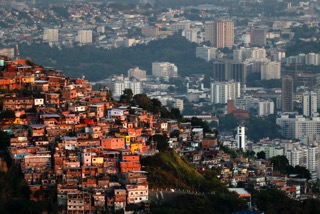
Wei Han Frank Lin / Flickr
By Brian Mier, NACLA
|
The 2016 Summer Olympics in Rio de Janeiro have put the city's controversial "arts-led" gentrification initiatives on full display.
With the 2016 Olympic Games in Rio de Janeiro, Brazil, entering their second week, the issue of how the city's urban landscape has changed since winning its bid to host the Olympics is more relevant than ever. Faced with a weak economy and ensnared in political scandal, the state and city governments of Rio de Janeiro have faced harsh criticism for their immense spending on the 2016 Rio Games. But government decisions have also changed the face of Rio itself. These have included transportation improvements that mainly benefit white, middle-class sections of the city's west side and the carrying out of the largest public-private partnership in Brazilian history: an "arts-led" gentrification project in Rio's port area.
Arts-led gentrification has in recent years become a popular tool for neoliberal mayors to strengthen real estate speculation in blighted neighborhoods around the world. Today the process is repeating in Rio de Janeiro's port region, where an artist's colony, supported by the Rio de Janeiro Mayor's office, coexists within the context of a mega project called Porto Maravilha (Marvelous Port)-part of a network of public works projects associated with the 2016 Summer Games. In a move patterned after similar processes in the Global North, the Rio de Janeiro city government has used the Olympics as an excuse to target the port region for gentrification while at the same time attempting to theme the area as a vibrant neighborhood for Brazil's "creative class."
|