Showing posts with label Paraguay. Show all posts

February 18, 2021

Political Report #1453


Afrodescendientes in Paraguay: the 209-Year Struggle for Recognition

by Valencia Wilson

Introduction


A glimpse of Afro-Paraguayan contributions occur through the annual Kambá Cuá festival on January 6th.  Kambá refers to the Afro-Paraguayan community, and this proud community with Kenyan roots participates in this festival using vivid colors and dances.  The problem is that this annual tradition consistently falls short of the recognition they deserve. In simple terms, Afro-Paraguayan activists are fighting an uphill legislative battle for Paraguay to acknowledge that they exist. Existence in the Afro-Paraguayan context means opportunities for formal, cultural education and a variety of employment opportunities; it is weaving their historical and current efforts into the national consciousness demonstrating their relevance today. 

The Proyecto de Ley de Reconocimiento de Afrodescendientes en Paraguay began as a blueprint.  A report submitted to the UN stated that Congressional support would ensure the acknowledgement of Afro-Paraguayan contributions to its citizens. This article explores more than the history of Afro-Paraguayan contributions in historically significant black towns like Kambá Cuá, San Agustín de Emboscada de los Pardos Libres, and Kamba Kokué.  It delves into an exhausting struggle for the bare minimum of being recognized for their contributions and how it has shaped Paraguay today. This also elevates Afro-Paraguayan voices and activists on-the-ground demanding that their diverse voices be celebrated every day in their own country.


El Supremo and his authoritative style of nation building

While Paraguay is often overlooked in Latin America, the historic policies of Dr. José Gaspar Rodríguez de Francia or “El Supremo” are not. Dr. Francia’s dictatorship (1814 – 1840) brings up mixed feelings of the vision he had for the country.  Paraguay became independent in 1811, but this path to independence rested on El Supremo’s distrust of Europeans and foreigners.  This became apparent when ‘foreigners’ began to witness increases in their taxes.  However, the most notable of Dr. Francia’s sanctions were strict mandates that “the [marriage] to Europeans were only [reserved] [for] Indian, “known mulattoes”, or blacks”;  this mandate was in effect for 26 years. Essentially, white ‘Europeans’ could not elect to marry anyone who looked like them; this was a ‘genetic revolution’.  

In addition to the marriage laws, Dr. Francia’s very liberal derecho de asilo (asylum laws) allowed many to seek refuge in 1822. To some El Supremo was a dictator, but to other enslaved peoples he provided a place for better opportunities relative to their experiences at that time.   Archives show Dr. Francia ordering his highest commandant at Concepción to not return any runaway slaves.  The asylum laws also included Jose Artigas and at least 200 of his black soldiers from the Banda Oriental.  These elite black soldiers were routinely called upon to defend Paraguay.  In return, the land Dr. Francia provided is what is now Kambá Cuá, San Agustín de Emboscada de los Pardos Libres, and Kamba Kokué.  Afro-Paraguayan contributions are fundamental to the perspectives of their descendants, and their massive efforts today.


Afrodescendencia y La Negritud in Paraguay

The Afro-Paraguayan community lacks political representation that effectively communicates cultural and socio-economic challenges they face. Cultural education, land rights and titling, and joblessness relative to their white and mestizo counterparts are key issues.  In 2006-2007, the Kambá Cuá Association, government’s census office (DGEEC), and the Inter – American Foundation launched a household survey to compile statistics on those who may self-identify as Afro-descendants.  The purpose was to gather more reliable data.  An initial survey suggested 2% of the entire population is of Kambá descent. However, public criticism increased due to poorly constructed questions and survey methodology. Nonetheless, the DGEEC revealed common knowledge; many Afro-Paraguayans live in the Central, Paraguarí, and Cordillera provinces. 

As such, those provinces are frequently relied upon to teach their own Kambá history and ranges from member meetings to charlas which provide safe spaces to talk about Afrodescendencia and La Negritud in Paraguay. Recurring themes also involve self-discovery, stigma, discrimination, and blatant racism with adults and children. As the 209-year wait continues, these spaces also serve as an opportunity for those white and mestizo Paraguayans to do their fair share of work. By educating themselves and challenging their friends and colleagues, they become true allies working to build a more inclusive society.


Educate & Uplift: Kambá Descendientes

Community organizations and projects are often just that: personal and group projects pushed by black activists. Despite no funding from the government for these cultural activities, the work falls on younger black activists and “artivists” like Alma Areco. Alma, a Kambá Descendiente and student at Universidad Nacional de Asunción, lives in the Central Department, on the outskirts of Asunción. When she was young, her father taught her the importance of their Kambá ancestry, oral storytelling, and traditions as his Afro-Paraguayan father did. Alma embraces oral traditions, and she and her sister wear trenzas despite societal stigma and the racism they face. In addition to the societal stigma and racism they face, it is the audacity of those who are not part of the Afro-Paraguayan community questioning who should wear trenzas. Those who are not part of the community end up placing societal controls based on their perception of ‘blackness’; to be clear, that is unacceptable. These sorts of interactions led Alma to create Kambá Descendiente bringing Afro-Paraguayan women together to discuss the situations they continually face.  In addition to Kambá Descendiente, Alma created Voces.Negras that unites both men and women to discuss perceptions and realities of being Afro-Paraguayan.  This is not just an educational tool, but it helps build strong ties and passes their cultural contributions to the next generation. 

Congressional approval of the Proyecto de Ley de Reconocimiento de Afrodescendientes not only helps fulfill their commitment to the UN, but recognizes that Paraguay must do more to educate its populace.  This admission is a starting point – and these improvements works towards amplifying contributions of Afro-Paraguayans in cultural education, social development, and increased employment opportunities.  Even more, by recognizing Afro-Paraguayans it could galvanize its citizens and politicians to approve Anti-Discrimination Laws that remain untouched in Congress. To date, Paraguay does not offer any protections for those who are being discriminated based on their race. These communities should not bear the burden alone, and after 209 years in the shadows, approving the Proyecto de Ley de Reconocimiento de Afrodescendientes acknowledges and safeguards Afro-Paraguayans endless contributions which are long overdue.


A special thanks to Alma Areco, an activist and Afro-Paraguayan feminist and Maximiliano Britez, a colleague and native of Asunción for their support throughout the development of this post.


Endnotes:

1 For more information, see Paraguayan Senate webpage at http://silpy.congreso.gov.py/expediente/119313 as“Proyecto de Ley “Que reconoce a la población afrodescendiente del Paraguay como una minoría étnica e incorpora el legado de las comunidades afrodescendientes en la historia, su participación, y aportes en la conformación de la nación, en sus diversas expresiones culturales (Arte, Filosofía, Saberes, costumbres, Tradiciones, y Valores)”
2 In Guaraní, Kamba Kokué means “black people’s farm”.
3 John Hoyt Williams. “Paraguayan Isolation Under Dr. Francia: A Re-Evaluation.” Hispanic American Historical Review 52, no. 1 (February 1972): 102–22. https://doi.org/10.1215/00182168-52.1.102.
4 Lawrence Edward Crockett, Jr. “Landlocked and Unwanted: The Afro-Paraguayan Dilemma” (PhD diss., University of Texas at Austin, 2017), 73, https://repositories.lib.utexas.edu/bitstream/handle/2152/62965/CROCKETT-DISSERTATION- 2017.pdf?sequence=1.
5 Williams, 119
6 While Artigas was accompanied by 200 black men, there were their women and children. Reports indicate a total of 400 people joining Artigas.
7 There are still land title issues for Afro-Paraguayans due to Dr. Francia’s land titling procedures.

October 1, 2019

Political Report # 1415 The Dam that (Almost) Brought Down Paraguay’s President

The past two weeks have brought Paraguayans a political earthquake and a crowd of new household names, all connected to a bilateral energy deal signed with Brazil in May and kept under wraps until late July. Since the public learned the terms of the agreement, four top Paraguayan officials have resigned and the senate nearly impeached President Mario Abdo Benítez and Vice President Hugo Velázquez.
Although Brazil agreed to scrap the deal and restart negotiations, Abdo Benítez and Velázquez are still fielding accusations of treason and the political fallout from the deal, rooted in 50 years of tension over the world’s second-largest dam. The dam straddles the border between Brazil and Paraguay and operates under the company Itaipu Binacional, a sort of state-within-a-state run by directors from both countries. This summer’s scandal unfolded on top of a long history of inequality between Brazil and Paraguay, turning a closet shift in energy payments into a symbol of national betrayal.
By requiring Paraguay’s National Energy Administration (ANDE) to buy more expensive electricity from the dam, the deal would have raised ANDE’s costs by at least $250 million between now and 2022, according to former ANDE head Pablo Ferreira. The negotiators also capped the amount of energy ANDE could contract and threw out a clause that would have allowed ANDE to sell Paraguay’s excess electricity directly to the Brazilian market at a higher price than what it receives now. Ferreira saw the final deal on July 4, about six weeks after both ambassadors had signed it and left his job on July 24. His resignation and refusal to comply with the terms of the new agreement raised the tenor of the debate over how to share the Itaipu dam.
For many Paraguayans, the agreement represented a step backward from terms reached in 2009 and a return to the systemic corruption that gave rise to the dam during the country’s dictatorship in the late 20th century. Nearly 50 years after it was built, the dam is still central to criticisms of the former dictator Alfredo Stroessner’s Colorado Party, which controls Paraguayan politics to this day.
“The citizenry is indignant over all of the theft that Itaipu represents on a historical level,” said environmental engineer Guillermo Acucharro. He is a spokesperson for a campaign called Ñane Mbae Itaipu, which means “Itaipu is ours” in the Indigenous language of Guaraní. “The Paraguayan people know, at least for this society, Itaipu was a scam and that the government of Mario Abdo wanted to carry out a negotiation behind closed doors.”
A Dictators’ Agreement
The Itaipu Dam was born out of a border conflict between Brazil and Paraguay nearly 100 years after the devastating Triple Alliance War ended, establishing the Paraná River as the national boundary. In the mid-1960s, the military dictatorships of both countries pressed toward the Saltos del Guaíra waterfalls (Sete Quedas for Brazilians), hoping to take advantage of the water resources that plunged 375 feet. Composer Phillip Glass created a tribute to the falls and the engineering marvel that replaced them when the two governments decided to build the dam together, signing the Itaipu Treaty in 1973 and founding Itaipu Binacional the following year. Brazil’s state utility Electrobras provided the largest loan to build the dam, which began production in 1984 but was not fully completed until 1991.
One significant trade-off of the two countries’ cooperation was that Stroessner allowed Brazilians to move into the agricultural lands of eastern Paraguay. This set the conditions for the predominance of land-holding Brazilians and their descendants, who now control Paraguay’s top export, soy. In other words, the act that preceded the dam paved the way for two primary examples of how Brazil has utilized Paraguay’s natural resources-land and electricity-in some cases impeding on national sovereignty.
The 1973 treaty established that each country would own half the energy produced by Itaipu, but Paraguay consumes less than 10 percent, passing the rest to Brazil. The larger nation has always paid less than market value for that ceded electricity. Since the dam began operation in 1984, Paraguay has helped to fuel industrial development in São Paulo and elsewhere for a set compensation rate. Between 1984 and 2018, Brazil underpaid its neighbor by about $75.4 billion, according to economist Miguel Carter. Under different rules, Paraguay could have earned nearly twice its current GDP from Itaipu alone.
Critics argue that on top of the lost investments their government could have made to education, health and infrastructure, Paraguayan users have been overpaying for electricity. Even though the country has only used a fraction of the energy churned out by the dam over the years, consumers are still paying back construction debt, which makes up more than half of their electricity bills. Critics like renowned Paraguayan engineer Ricardo Canese and Columbia University economist Jeffrey Sachs say Paraguay has likely already met its obligations.
The debt payments will end in 2022, in time for the two countries to finish renegotiating a section of the 1973 treaty that governs energy distribution and pricing. The 2023 negotiation is crucial for those who want to Paraguay to get more from its share of the energy. This year’s fumbled agreement appeared to point in the opposite direction, enraging critics of Itaipu’s legacy.
To critics like Acucharro of Itaipu Ñane Mbae, another key problem is that Itaipu Binacional operates outside the legal system of either country, which he says has made it difficult to control.
“The sector of elites within the Colorado Party always used hydroelectricity to pay political favors,” he said. “Itaipu contributed to strengthening the dominant class of the country from the moment they signed the treaty.”
The dam represented how Stroessner’s regime pursued development for the benefit of a few: the benefactors of construction deals, as well as the engineers and employees of the new binational company. Zona 1 of the Paraguayan border town Ciudad del Este bears this legacy with its parks and guarded houses, a far cry from poorer parts of the city.
Paraguayans have been concerned about how the dam might weaken the country’s sovereignty since the earliest stages of the project. In the 1970s, students, led by Ricardo Canese and other young engineers, organized around questions such as where to put the turbines and what frequency of electricity would be generated. This July, engineering students from the Universidad Nacional de Asunción were once again leading the demands for the nation’s “energy sovereignty.”
Canese had remained a critic of Itaipu and finished his schooling in Holland, after Stroessner’s police forced him into exile in 1977. In 2008, the engineer joined the government of leftist President Fernando Lugo to help him fulfill a campaign promise: improve the rules of Itaipu for Paraguay. The team managed to triple the compensation payments Electrobras made to Paraguay from $120 million to $360 million per year.
Lugo’s Brazilian counterpart and political ally, Luiz Inácio Lula da Silva, made other important concessions that year, allowing Paraguay to sell to outside countries after 2023 and agreeing to a debt audit by Paraguay’s comptroller general. One key change gave ANDE the right to sell to private companies in the Brazilian market “as soon as possible,” Canese says, instead of only ceding energy to state-run Electrobras at a lower rate, but the new policy was never implemented.
“We were about to get it when the coup came in 2012, and now the ousted president of ANDE proposed it and it cost him the position,” Canese said.
Lugo’s election had broken a 60-year streak of Colorado Party rule, but his presidency reached a sudden end. After a land conflict resulted in the death of 11 campesinos and six police officers, his political rivals launched impeachment proceedings supported by the country’s powerful agribusiness lobby. After a year under Liberal Vice President Frederico Franco, Paraguay returned to Colorado control in 2012. The current president, Mario Abdo Benítez, is the son of dictator Stroessner’s personal secretary. Before winning the 2018 election on a platform of social conservatism, he studied in the United States, walked with Stroessner’s coffin at his funeral, and founded a wing of the bulky Colorado Party with the dictator’s grandson.
Canese worries the right-wing governments of Abdo Benítez and Brazilian president Jair Bolsonaro are undoing Lugo and da Silva’s contributions, which he says “restored some equity in the relationship after the asymmetric era of dictatorships-the Brazilian sub-empire, we said in Paraguay.”
“That’s what Bolsonaro wants now, as stated publicly, to go back to that time when Paraguay was almost a Brazilian colony,” Canese wrote in an email.
Bolsonaro has praised both Brazil’s and Paraguay’s military dictatorships. The controversial leader drew criticism in February when he stood next to the dam and honored Stroessner’s “vision.” Itaipu has become center stage for Paraguayan frustrations over their leaders’ approach to Brazil, and the feeling that their country’s resources are being sold out from under them. Bolsonaro’s administration approached Paraguay earlier this year, pursuing higher prices for ANDE and lower costs for Electrobras. Especially for critics of the ruling Colorado Party, Abdo Benítez’s concession amounted to the latest “surrender” of Paraguayan sovereignty.
A Political Crisis
Former ANDE head Ferreira has accused Brazil of financial extortion for its tactics in bringing Paraguay to this years talks, and Canese agrees.
“There never should have been a negotiation,” Canese wrote. “[Brazil] stopped paying Itaipu in February of 2019, defunding it and obliging it to negotiate on its terms and against everything that was agreed upon before.”
The new agreement that sparked calls to impeach Abdo Benítez reached national attention on July 24, after Ferreira turned in his resignation. On Twitter, Abdo Benítez welcomed former finance minister Alcides Jiménez to Ferreira’s vacated position that same day, writing, “We wish him the best!” Within days, the deal Jiménez was ready to support had become radioactive, with citizens and politicians condemning its terms, as well as the secrecy under which it had been negotiated. The senate called an extra session. Protesters toilet-papered the home of José Alberto Alderete, the Paraguayan director of Itaipu Binacional. Abdo Benítez accepted Alderetes resignation along with those of Jiménez and two other top officials involved in the negotiations: the chancellor and the ambassador to Brazil.
Brazilian negotiators have argued that it is the other company that contracts with Itaipu-Electrobras-that had been getting the raw deal because power is cheaper on average in Paraguay. A change in the distribution of pricier versus less expensive, “surplus” energy is what Ferreira said would result in $250 million in extra costs for the utility, which already struggles with losses from poor infrastructure.
There appeared to be nothing in the original deal that could be construed as an advantage for Paraguay. In a speech on July 25, Abdo Benítez claimed this would make the country appear “serious” in future negotiations-“a country that does not need anyone’s crumbs”-and promised rates would not increase in the next two years. He has since said in a radio interview that he believes the deal was a mistake and “did not know the extent or scope of each point.”
Just a week after Ferreira’s resignation, opposition parties in Paraguay’s senate prepared to impeach Abdo Benítez and Velázquez, with the blessing of Honor Colorado, a faction of the leaders’ own party. The day after the impeachment threat, Abdo Benítez’s administration managed to win over the dissident Colorado members, avoiding an ouster just before the one-year anniversary of the president’s inauguration.
But WhatsApp messages published by Paraguayan newspaper ABC Color on Aug. 5 renewed calls for a political trial, suggesting that Ferreira had warned Abdo Benítez about the price changes desired by Brazilian negotiators. The president urged him not to show his misgivings publicly, warning that it would weaken Paraguay’s position. Since the leak, along with new evidence against his second-in-command, protesters and opposition lawmakers have continued to push for impeachment, a goal made more challenging by the Colorado Party’s decision to stand together.
Other messages between Ferreira and a lawyer claiming to represent Velázquez suggested that the vice president was trying to intercede in the negotiations on behalf of the private Brazilian company Leros Comercializadora. The lawyer, 27-year-old Jose Rodríguez Gonzalez, also suggested in the chats that Leros had ties to Bolsonaro. Rodríguez has since testified that he was not speaking on behalf of Velázquez, but only trying to get Ferreira’s attention.
The Public Ministry is hearing testimony from both leaders as well as requesting records and messages from phone companies, while Canese and other critics remain suspicious.
“Abdo gives in to Bolsonaro because that is how they do business together,” Canese wrote in a message, “above all, in the sale of energy for hundreds of millions of dollars with friendly companies.”
Future Negotiations
For his part, Bolsonaro has said since the scandal that his government is “willing to do justice on this issue of Itaipu” and “avoid problems” for Abdo Benítez. The two countries are working on a new agreement, which could be finished as early as next month, while they continue to prepare for renegotiations of the 1973 treaty. The Brazilian leader said he does not intend to “give in” to Paraguay, but instead to discuss “small deviations” during the 2023 talks.
As Duke anthropologist and Itaipu expert Christine Folch asserts in an explanatory video, Brazil’s primary goal is to secure cheap energy to finance its industrial sector. She claims the best option for Paraguay is to invest in its electric infrastructure now in order to diversify its economy.
“Today, the Paraguay half of Itaipu produces enough electricity to meet the needs of three Paraguays,” she added. But since Paraguay’s energy demand is increasing, the country will not always have extra to sell. “This surplus has a time limit that makes it very important to use the surplus today.”
Folch’s research team estimates that Paraguay has until 2035 at the latest before it catches up to Itaipu’s production.
Canese, the Paraguayan engineer, is also pushing for better investments of energy revenue. “Electrical income should be a tool for development, not ‘profiteering,’” he wrote in an email. “Quality employment, value-added quality, that should be the goal, as well as sustainability.”
In a book published earlier this year, Canese argues for getting a better deal on Paraguay’s share of electricity from Itaipu as well as Yacyreta, shared with Argentina, and using that money to improve the electric system and attract industries that will provide jobs. Right now, much of the $750 million annual tariff goes toward local and national government entities, filling in the gap left by Paraguay’s exceptionally low tax rate.
Acucharro and the campaign Itaipu Ñane Mbae want the two countries to annul the 1973 treaty altogether and replace it with better terms for Paraguay.
“We recognize that, on the one hand, it’s a radical position, but we want to solve the root problem and not receive crumbs like always,” he said.
Both the recent scandal and the coming negotiations are changing the way Itaipu is debated in Paraguay, from exchanges between party elites to the kind of controversy that can threaten a presidency.


Original article can be found (here).
URL:   https://nacla.org/news/2019/08/13/dam-almost-brought-down-paraguays-president

January 26, 2018

Abstract, Living on the Construction Site: Paraguayan Construction Workers in Buenos Aires

:::::: Abstract ::::::


Living on the Construction Site: Paraguayan Construction Workers in Buenos Aires
by Álvaro del Águila


Argentine enterprises subsume Paraguayan migrant workers into the construction industry in the Buenos Aires metropolitan area, subordinating them to the demands of production by temporarily housing them on the construction sites themselves. Ethnographic fieldwork carried out on various construction sites between 2006 and 2015 shows how this practice overlaps with wider processes of global transformation in labor relations. The lodging of workers on construction sites is an increasingly widespread strategy for capitalist entrepreneurs to exploit the migrant workforce even further.

December 20, 2017

Abstract, Living on the Construction Site: Paraguayan Construction Workers in Buenos Aires

:::::: Abstract ::::::


Living on the Construction Site: Paraguayan Construction Workers in Buenos Aires
by Álvaro del Águila


Argentine enterprises subsume Paraguayan migrant workers into the construction industry in the Buenos Aires metropolitan area, subordinating them to the demands of production by temporarily housing them on the construction sites themselves. Ethnographic fieldwork carried out on various construction sites between 2006 and 2015 shows how this practice overlaps with wider processes of global transformation in labor relations. The lodging of workers on construction sites is an increasingly widespread strategy for capitalist entrepreneurs to exploit the migrant workforce even further.

December 18, 2017

Abstract, Living on the Construction Site: Paraguayan Construction Workers in Buenos Aires

:::::: Abstract ::::::


Living on the Construction Site: Paraguayan Construction Workers in Buenos Aires
by Álvaro del Águila


Argentine enterprises subsume Paraguayan migrant workers into the construction industry in the Buenos Aires metropolitan area, subordinating them to the demands of production by temporarily housing them on the construction sites themselves. Ethnographic fieldwork carried out on various construction sites between 2006 and 2015 shows how this practice overlaps with wider processes of global transformation in labor relations. The lodging of workers on construction sites is an increasingly widespread strategy for capitalist entrepreneurs to exploit the migrant workforce even further.

December 11, 2015

Political Report #1098, Structural Problems Perpetuate Widespread Corruption in Paraguay By Miguel Salazar and Edwin Nieves, COHA


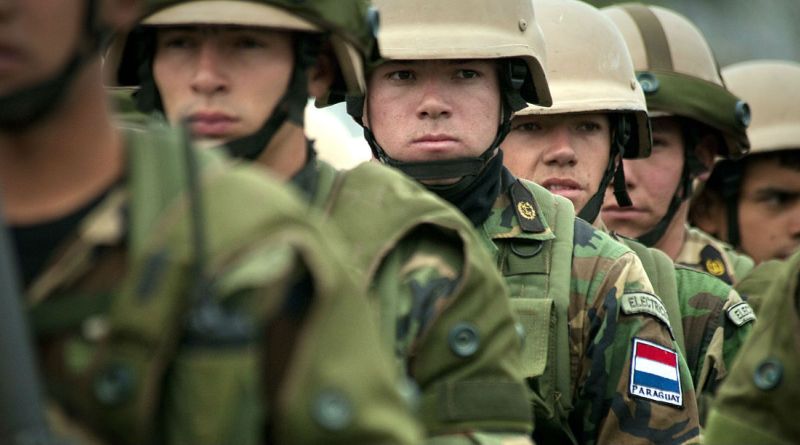
                             Featured Photo: “Paraguayan marines at Ancon Marine Base” (Brien Aho)
Since the end of the Stroessner dictatorship in 1989, Paraguay has struggled in its efforts to reform its weak institutional structures. Systemic corruption, growing poverty, and media censorship have all contributed to the perpetuation of the country’s stagnation over the years. Paraguay’s consistent failure to institute comprehensive land reform has even contributed to the rise of a local guerrilla movement that has not been neutralized by a corrupt military. While President Horacio Cartes has acknowledged the existence of corruption within the national police and military, many of Paraguay’s structural problems remain mercilessly neglected.